Andy Tang explains how startups raise money through loans, stock, and convertible notes. He walks through why founders and investors pick each instrument, how conversion mechanics work, and the cost differences between them.
Chapters
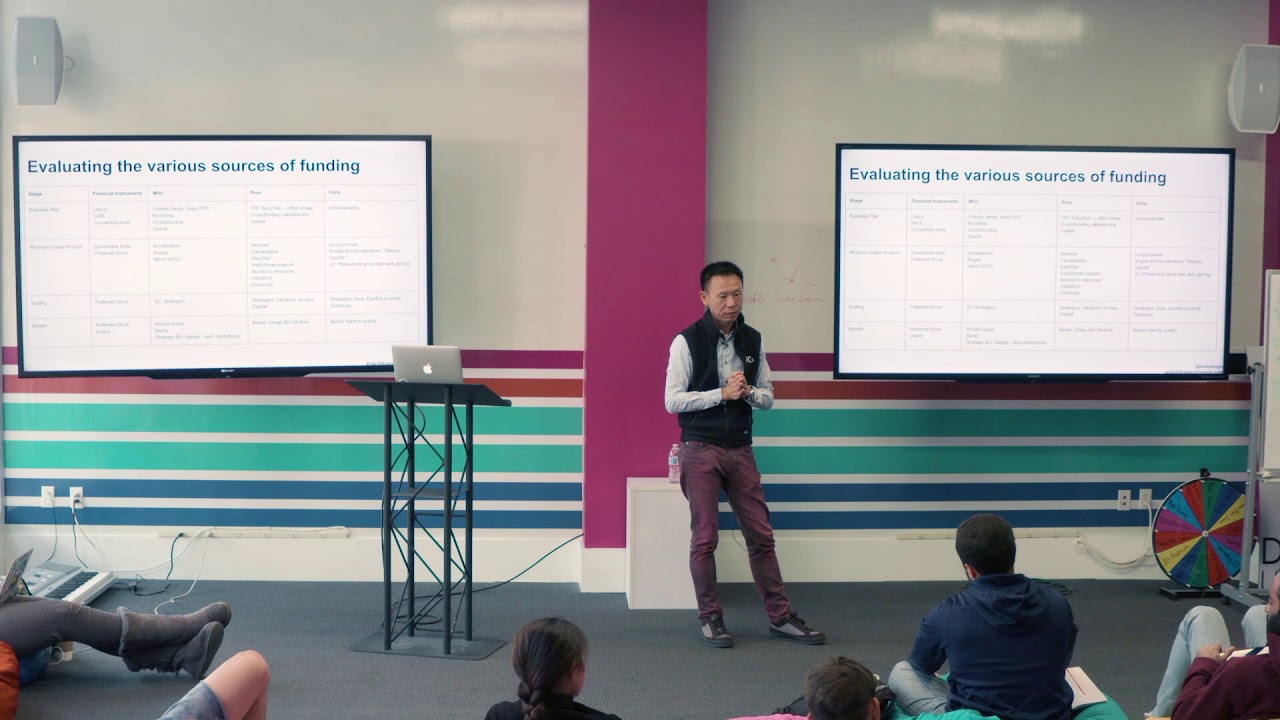
So just a quick review. 4 different stages, right? He may not have broken it down into these 4 stages, but this is an easy way to do it. Early stage, late stage, right? At the very earliest stage, you have 2 people, a piece of paper, and a dog, you know, and you get—
A dog.
friends, families, and fools to invest in you, a little bit of money, okay, and then you achieve— A more robust business plan. A more robust business plan and nothing else, okay. So it's very early. And then the next stage you actually have a minimal viable product, right, and that's when you actually have angels and accelerators that will admit you and maybe even some cases the micro VCs, some of the smaller VCs will come in to invest in you, right?
Yeah.
And then when you actually have a product working, maybe even selling, right, that's when you have the VCs and even some companies like corporates, strategics come and invest in you, okay? And then when you have revenue and you're growing, That's when you actually have some larger companies, even larger strategics, private equity firms, or even sometimes banks would offer you loans. So that's a very simplistic view of scaling the company and at different stages you have different financial instruments. Does that make sense? Very simple. And these things are supposed to overlap, right? Sometimes when you just have a business plan, you may have friends, family, fools, and angels, or these are just maybe foolish angels who invest in you. That would happen, yeah? And at each stage of the business, you have different instruments. Okay, so people give you loans, people give you convertible notes, right, and let me explain to you what they are. So loans are loans, people lend you money, right? Why do people loan you money? Because it's easy. You don't have to figure out how much the company is valued, you don't have to draft a big document, low legal fee. And convertible note is basically a cross between a loan and then a stock. Yeah? Did he cover that with you?
No.
Okay, so let's cover that. So a loan is something that you're the company, I'm the investor, right? I loan you $100, okay, and when the company becomes successful, you return me $100. That's it. Okay? A stock is your company, I give you $100 and I own 1% of the company, right? When the company gets sold for $100 million, I get $1 million, right? Does that make sense?
But in this note thing, You don't have equity in the company, right?
In a loan you don't have equity, but in a convertible note you might have equity. You might have equity.
Well, when you return that amount to the investor back after a certain time and your company is successful and you return back that, for example, the $100 amount back, so do you still Do you still own that part of the company or not?
So let me explain to you the difference. You're basically asking what a convertible note is. So again, loan— or I should do it like this— loan, stock, and then in the middle it's called a convertible stock or convertible note, same thing. Okay, does that make sense? So I give you $100, right? In the loan case I just return you $100. If the company goes up really high, I don't get to participate in the upside. In the stock case, I would essentially become a shareholder. If the company does well, I keep 1% of the company. In the convertible note case, basically you are a loan and then you are also an equity.
Okay.
You have a choice to convert. you as an investor could just stay a loan holder and be happy and get your $100 back, or you could say I could choose to convert. So when would you want to convert? Convert to equity at a valuation.
So do they convert at the valuation later or the valuation when they gave the loan?
So typically you would negotiate a conversion valuation. So in this case let's say we'll convert at— $1 million, right? So I invest $100— let's make it a round number. I invest $10,000 and I want to convert at $1 million. Or make it even simpler, $100,000 investment, I want to convert $1 million. That's 10%, right? So when a company is worth $100 million, I would just convert at $1 million and own 10% of the company. Does that make sense? But if a company is not doing well, then I say I'm just going to stay alone because I could just get my $100,000 back.
Yep.
Is the only way these benefits that come money by not having to pay the—
Lender?
The legal fees.
Legal fees for what?
Oh, so let me not confuse you. So forget the legal fees. The only way to benefit is to not pay the lender?
Yeah, like what do I get as a company from having them— the loan being converted into stock?
It doesn't help the company. It's just— The company— so the question is why wouldn't the company just issue stocks every time, right?
Or—
well, why wouldn't the company just issue loans every time? Ask the question again.
Like my question is if I have my company and I get that money, like why would I make it a convertible note? Why would I want that to be convertible?
Rephrase it, it's not clear. Can someone help him rephrase?
I think what he's asking is that why is a convertible note existing? Why wouldn't someone just directly sell stocks? And I think convertible notes are more advantageous, are easier for a VC to give you money, right? It's to get a VC to—
Is that what your question is?
Yeah, kind of. I just want to know like what's the benefit of having loans with the option that—
To convert into equity?
Yeah.
For the company or for the investor?
I know what the benefit is for the investor.
Yeah.
If the company is doing great.
Why would the company do it?
Yeah, why would the company do it?
That's the question. Because the company, when they issue the convertible note, it's actually cheaper compared to issuing stocks. The difference between this, the issuing cost, the legal fees is much higher for this stock. It's cheaper to just issue a convertible note. And—
One second.
And for loans, it would actually be the best for a company to always issue loans, right? Wouldn't they? If you're a company, I'm an investor, wouldn't you just want to To issue loans?
Yeah.
Yeah, but for investors I always want stocks, I don't want loans, right? So between these 2 there is a sort of a common ground, it's like a negotiation. I want stock, you want loan, you want to give me loan or you want to receive loans from me, right? But I don't want to give you loans. Because there's no upside in that example, like why would I want to do that? So this is something in the middle and it's pretty cheap to issue compared to that. Sorry, you had a question?
Can you give us an example of how cheap percentage-wise it is to run it with no end stop?
Issuing stocks in the U.S., if you do like a preferred stock, it may cost you $50,000 to So if you're raising $500,000, you spend $50,000 on the stock, you're using 10% of your proceeds on the transaction. That's not— that doesn't make sense. By the same token, a convertible note could be a few thousand dollars. And you'll see something called SAFE, Simple Agreement for Future Equity. We used to be investors in SAFE, but we stopped doing that now.
Why?
SAFE is very cheap. SAFE is very cheap. SAFE is maybe $1,000. Yeah?
Why did you guys stop?
Because anything that's cheap typically tells you the amount of work is not that much to create it, right? If you don't create a robust legal document, it basically means there are a lot of holes. If there are a lot of holes, it basically creates a lot of confusion later. So we tried it for a couple of years, probably did 50 investments using saves. When it works well, it works really well, but in some cases when it didn't work, you spend a lot of time negotiating and it's not a good use of our time or the entrepreneur's time. So we basically said we stopped doing that and for our early-stage companies we just do preferred stock.