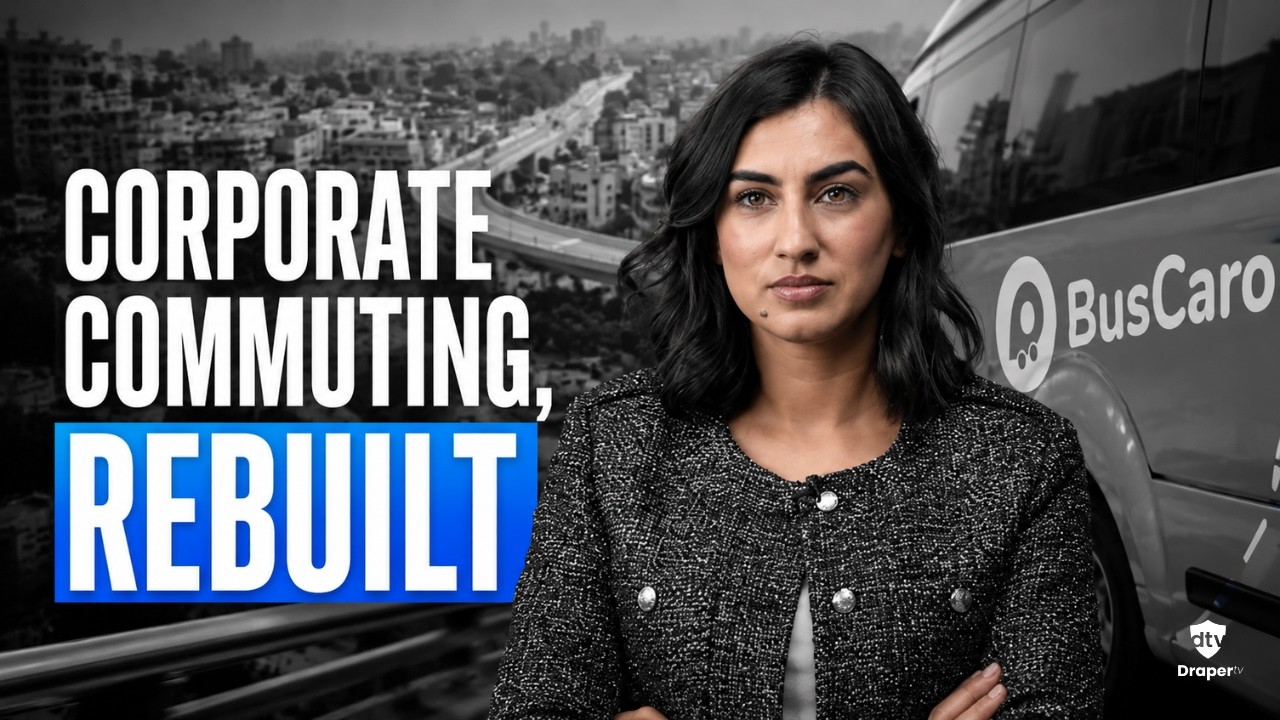
The video features two Pakistani social‑impact founders, Maha Shahzad (Buscaro) and Hashim Akbar (Reupcycle), discussing the problems they set out to solve, their business models, early traction, and why partnership or investment from Tim Draper would matter. Maha explains that commuting in Pakistan is unsafe, unreliable and prohibitively expensive, especially for women and children. She founded Buscaro – a mobility platform that provides vetted drivers, GPS tracking, panic buttons and school‑bus services. The company now employs about 65 people (with plans to double) and serves thousands of daily rides, a third of which are minors. She highlights trust‑building with parents, the hiring of female bus drivers, and the social impact of giving women affordable, safe transport. A million‑dollar investment would provide working capital to scale the fleet (from 1 bus to ~1,000) and reach a million more users. Hashim describes Pakistan’s plastic‑waste crisis (4 million tons annually, >70 % littering the environment) and the low global recycling rate (9 %). He founded Reupcycle, an app that turns household waste into cash by connecting users with collectors, sorting facilities and downstream manufacturers. The team of ~50 people processes plastic into clean flakes for industrial reuse, while also encouraging behavioral change (e.g., users stop using single‑use plastic). He outlines the operational flow: collection, sorting, delabeling, crushing, washing, and sale as raw material. Both founders stress personal motivation (Maha’s own commuting struggles; Hashim’s experience at Philip Morris and a wake‑up call after returning from Switzerland), the social‑impact mission, and the need for capital and mentorship to accelerate scaling.
Chapters
I think when you see a problem, you either solve it or you learn to live with it, and I didn't want to learn to live with it. And I'd spent time in Pakistan previously and had a really tough time commuting, and it would be unreliable, it would be unsafe, it would be extremely expensive, and just didn't seem like the way things should be. And so I saw a company that was trying to solve that, ultimately just you know, joined them and then joined another one that I thought was, was trying to solve that problem. And I think there came a day when nobody else was, was doing this, and I thought that that problem is so massive in Pakistan, if I don't take it up, nobody else will. And so I started my company. I think generally in markets, public transportation is what solves for commute overall, and that's not something that we have here, right? Our public transport can only serve a very small portion of the population here. There's a lot of then challenges around accessibility and safety, and particularly when you talk about women, they're in the biggest trouble there. And so that is just something that unless we can, through private companies, solve for here, it's just not going to happen. And I think trying to build a sustainable model around that, that can work. This is something that's safe for women. This is something that's safe for their children to use. I think that building that trust has been a lot of work.
Maha Shahzad's app offers vetted drivers, tracking, and panic buttons. Thousands ride daily with trust and ease.
I'm Maha Shahzad. I'm the founder of Buscaro. Buscaro is a mobility startup in Pakistan that helps people get to school and work on a daily basis at affordable prices in a way that's safe for them. So we're about 65 people right now as of today. I think the team size is going to double in the next few months. Our business is scaling very rapidly, and so there's a lot more growth that's coming in. And I think particularly when it comes to women, they are— they have no options, right? I think if you're a man in Pakistan, you can get on the back of a bike. You won't see a woman do that, which means all of a sudden her options are 5 times more expensive. Right. And generally what women earn is less than what men earn. And so they're in the worst position. And when you think about how to get girls to school, you run into that same issue. And then you think about employment opportunities for them and it's the same damn thing. So a third of our users today are minors and they're children. And I think when we started working with children and we started the school bus sort of model, we used to have parents that would follow us around in their cars because they'd be so worried. And I think, you know, they did that for a couple of days. They saw how things progressed. And I think when parents trust you with their children, I think that for us has been the thing that we've been most proud of. And then, of course, there's a lot of cases, right? We today have female bus drivers, which is something that's pretty much unthinkable in Pakistan. And now we have these women who are driving with us. And so I think there's a lot of change that's coming from this that we're just very proud of.
So what would working with Tim mean for your company?
I think working with Tim for me would mean a lot of things. I think, as you know, for those of us who are in this ecosystem, you grow up and you learn about VCs, and he's chapter one, right? And I think he's such a huge inspiration. Just to have the opportunity to work with him, I think on a personal level, that means a lot.
Maha Shazad built Buscaro, to serve communities. Partnering with schools and factories, Buscaro ensures safe routes. Every ride helps every individual move forward with positivity.
What would a million-dollar investment mean for your company?
So a million-dollar investment would help us, you know, further scale our company. We need working capital for all of the work that we do, and with every dollar that we get, there's multiple additional users who we can solve for on a daily basis. A million dollars for us means you know a million more people that we can we can help in Pakistan, and I think we've figured out how to solve what to us is the most important problem in this country. And I think we celebrate that on a daily basis, but also you know want to multiply the effect that we're having on people. जो डर गया वो मर गया, which literally translates the person who is afraid. that person is dead, right? Um, makes a lot more sense in Urdu than it does in English. But I think that's just how I've always been trained. And I remember, you know, when I was working for Swivel and that company shut down, um, I think I was crying and my dad had called me and it was the first time he heard me cry in my entire life. And he was in shock and he said, what the hell is wrong with you? And I was like, it's over. And I think he asked me at that time, why? If you could run these buses then, why can't you run them now? And if you want to help people, then why can't you just get up and do it instead of crying and making excuses? And I think that stuck. And we had one bus on the road that day. We have about 1,000 of them now.
So can we start with your name, your full name, your company name, and then sort of the elevator pitch, like a concise version of what's your— the core problem you're trying to solve?
Hashim Akbar saw value in waste and therefore founded his app in Islamabad called Reupcycle. It connects recyclers and creators, turning trash into treasure.
When I graduated from grad school, I joined Big Tobacco. So I was with this company called Philip Morris for about 7 years all across Pakistan, then spent some time in Switzerland and then came back. And then I think that's where I realized this is something that I need to do. Going from the most beautiful country in the world and then coming back to Pakistan, understanding how waste is ruining our world and causing climate change. I think that's where technically the idea came that there's something needs to now be done. I think the problem here is that we generate 4 million tons of waste plastic every year, and more than 70% goes back into the environment, which floods the waterways, the rivers, ends up in the sea. So it creates a lot of problems. There's a lot of greenhouse gas emissions, there's a lot of carbon emissions, which is obviously causing a lot of climate change. It's bad for the ecosystem. So if we look at it from a perspective of a human being, we're eating plastic, it's in our bodies, we're breathing it, it's everywhere because we never recycle. Since plastic has been manufactured globally, Only nine percent has gone back into recycling. So basically, I'm converting their trash into cash. So it becomes a cash for trash. We're starting with plastic, then we go into all recyclables. So you sitting at home, you've got paper, you've got a notebook that's finished, you've used it, and you don't want to throw it away. You want to keep it because you can sell it later for some money. Like it's not going to be zero waste. And when we pay people. They're like, okay, we're getting money for free for something we were never getting money for.
Reupcycle makes recycling easy. The platform links users to collectors and tracks waste. It's eco-action made simple.
I am Hashim Akbar. I am the founder at Reupcycle app. And the core problem that we're trying to solve is that we want to reduce plastic pollution in the environment and save the world. We're currently about 50 people. Out of that, 80% of them are people who support in the sorting of the plastic waste that we have, the collection, the sorting, and then processing into raw material. Our middle management, top management, we're about 7 people who are running the show with 40+ people who are supporting us in making sure That we put it to correct use. Day-to-day is we got plastic coming in, we dump it at a certain place, we sort it into different colors, delabel it, and put it into a machine where it gets crushed, cut, washed, and into small flakes. And then that gets sold to the industries who utilize it as a raw material. And I think I've also converted people. I was giving an interview to someone a few days ago They're like, after speaking to you, I've stopped using single-use plastic. Now I—