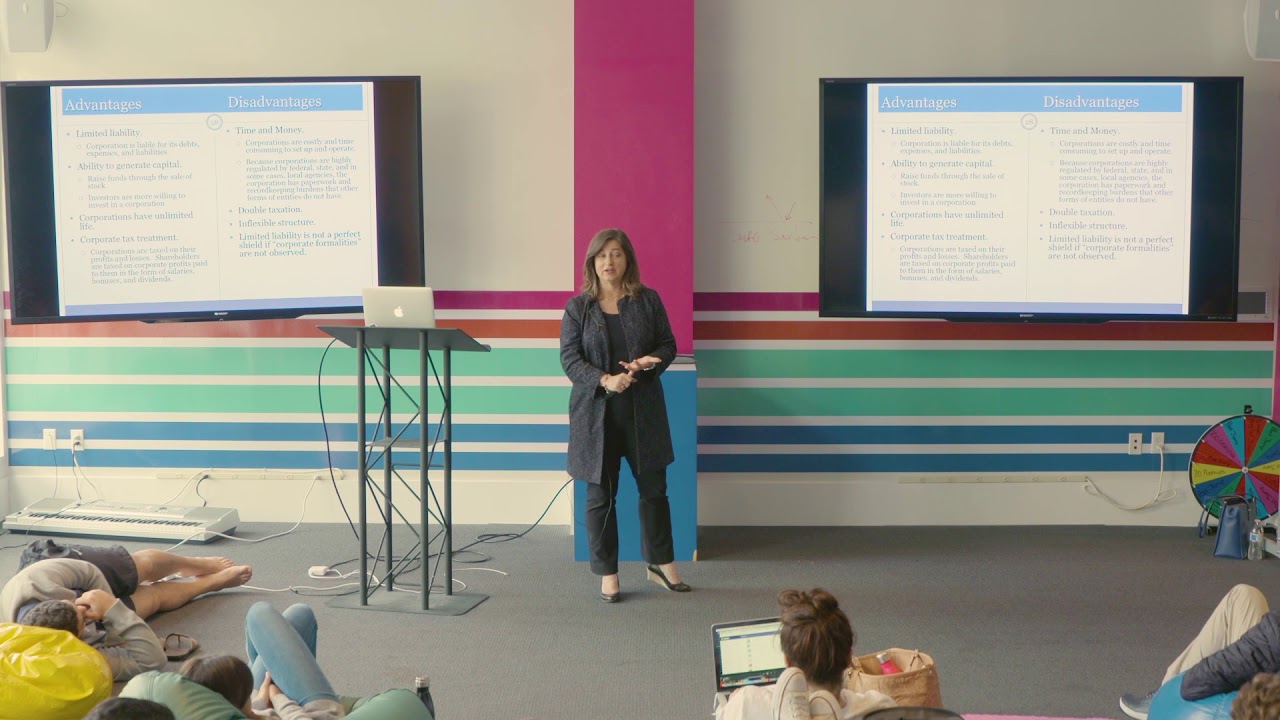
Kathryn McCall walks through how startups should structure themselves as corporations. She covers the tradeoffs: limited liability and easier fundraising against double taxation and paperwork. The practical stuff matters most: keep a separate bank account, document board meetings, and consider an S-corp election.
Chapters
So what are the advantages and— now we've learned about how to set up your company or your corporation. What are the advantages and disadvantages of it? Again, the whole thing about limited liability, that's key. But to get that limited liability, keep in mind you have to treat your corporation as a separate entity. It has its own bank account. It makes its own decisions. It signs its own agreements. Keep it a separate— no what we call commingling of funds. If a check comes in, the check needs— from a customer, check needs to be made out to the name of the corporation and deposited into the corporation's bank account. It doesn't go into your personal bank account. No commingling of funds. If you make decisions for the corporation, make sure that the board— Is aware. If it's appropriate for the board, is making those decisions. Make sure that you have board resolutions, board meeting minutes, things like that. And again, this is where somebody knowledgeable about corporations or an attorney will help you. I go to— all my clients, I go to all of their board meetings. I write up their meeting minutes. A lot of times they look at me like, do we need to have a formal resolution for that? How do we handle this? I'm there to answer those questions. And I'm there to make sure that those board meeting minutes get properly documented. I'm there to make sure that when they make decisions on the fly, that we get that properly documented. I call the minute book— I— when— every time my clients start complaining about the record keeping and I'm hassling them for signatures to board resolutions, stockholder consents, my God, do we really have to do all of this? I'm like, okay. Liability, limited liability. You want to protect yourself. You want to make— and you also want to build your minute book, which is your book that has all of your resolutions, board meeting minutes in it, stockholder consents. It's like the story of your company. It shows what you've been doing. And then when you go and raise money, that's something your investors want to see. They want to make sure that all the decisions the corporation has made have been properly documented? Have— if something requires stockholder consent, do we have that stockholder consent? If we need a waiver, is it in there? Have you been holding board meetings? Are the board meeting minutes in there? And a lot of times, like, my clients will laugh because they're like, Catherine, we spent 2 hours talking about our fabulous technology, our roadmap, where our sales pipeline is. And your board meeting minutes are like, Vice President of Sales discussed the sales pipeline. Questions were asked. Discussion ensued. Then we spent 30 seconds approving stock option grants. And the board resolutions are a page long because it's got all the stuff about what's the fair market value, how many shares, what is this, what is this. And it's just the difference between, number one, I don't want to put in any of my clients' board meeting minutes, anything about their technology. That's discoverable. So, I'm not going to put anything about who their competitors are, what their sales pipeline is, what their issues are, a new direction they're going, if they're pivoting, anything like that. I'm not putting that in there. But corporate actions, we're getting a lease. We're taking on— maybe we're going to take on a license that's a bet-the-company license. Maybe the terms aren't very favorable. What's going to happen if that license sinks the company and later on the investors start questioning it? Well, I might have a couple of pages in the board resolutions that approve that license saying that we recognize it's risky. However, if it works, the benefits to the company are huge, are enormous. We don't have any other alternatives right now. I mean, Of course, I put this in all my little fancy legal language, but that's kind of the gist, to really show that the board is exercising what we call their fiduciary obligations to the company. Are they thinking through these issues and doing what's best for the company so that if there's a problem later on, you can use that as a defense? Look, we looked at these issues. We discussed it. This was our only option. This is why we went this way. This is why we made this decision. And then that's going to protect you again, that whole thing about personal liability, that you're showing that the corporation is acting as a corporation. So quickly, we'll start moving through. It's easier to raise money with a corporation. You sell shares. Pretty easy. You raise money. Investors are generally more willing to invest in a corporation. Venture capitalists understand the corporate entity. They get it. They know what to do. They know how to protect themselves. You get corporate tax treatment. So, if you're getting— if your corporation is making a ton of money, that money isn't flowing through to your personal income tax return and shoving you into a different tax bracket. The disadvantages: time and money. I've talked to you a little bit about What goes on with board resolutions, board meeting minutes, all this documentation you need to do to make sure that you're treating your corporate entity the proper way so that nobody can pierce that corporate veil and hold the directors, officers, shareholders personally liable. That requires time, requires money. They're highly regulated. So, there's just a lot of paperwork and there's more record keeping. But again, These are things, functions that you can get somebody to help you do. It doesn't have to be on the shoulders of the CEO. The CEO should be out there building the company. This is something you can outsource. There's the whole double taxation issue we've talked a little bit about where the corporation gets taxed on its earnings. Then if you're drawing a salary, you're going to get taxed on your salary. So double tax. If you get a distribution from the corporation, you get taxed on that distribution. That's what the double taxation is. But keep in mind that in the beginning, most likely your startup is going to be losing money. So I wouldn't worry so much about the double taxation issue. The structure is relatively inflexible. Stockholders, board, officers. That's it. You don't have like with the LLC where you can define different roles. Stock. One share, one vote. That's it. If you have a million shares, you have a million votes. You're on the board. One board member, one vote. And then, again, I've talked about this. This is what the— the limited liability is not the perfect shield if you don't maintain the proper corporate formalities. You don't properly document things. I get agreements my clients sign and I'm like, hey, Freddie, you just signed this agreement as yourself, not the company. You've got to sign it as the company. There's a certain way to sign things for the company. You don't just sign your name on a line. You have the name of the company, then you have by, then you sign, then underneath that you print your name and your title. That means it's— or like, I'll look in the, you know, this is an agreement between ABC Corporation and Freddie. I'm like, that's great, but Freddie, your company is XYZ Corporation. XYZ is not a party to this agreement. So you got to make sure that you observe the proper formalities, you enter agreements the right way, you do the right actions. And then some people worry about this whole tax treatment and they're really concerned about double taxation, so they want to go with an LLC. You can do what we call an S corp election, which means your corporation will be taxed like a partnership. But there are certain limitations on that.