Crossing the chasm and thinking in 10x
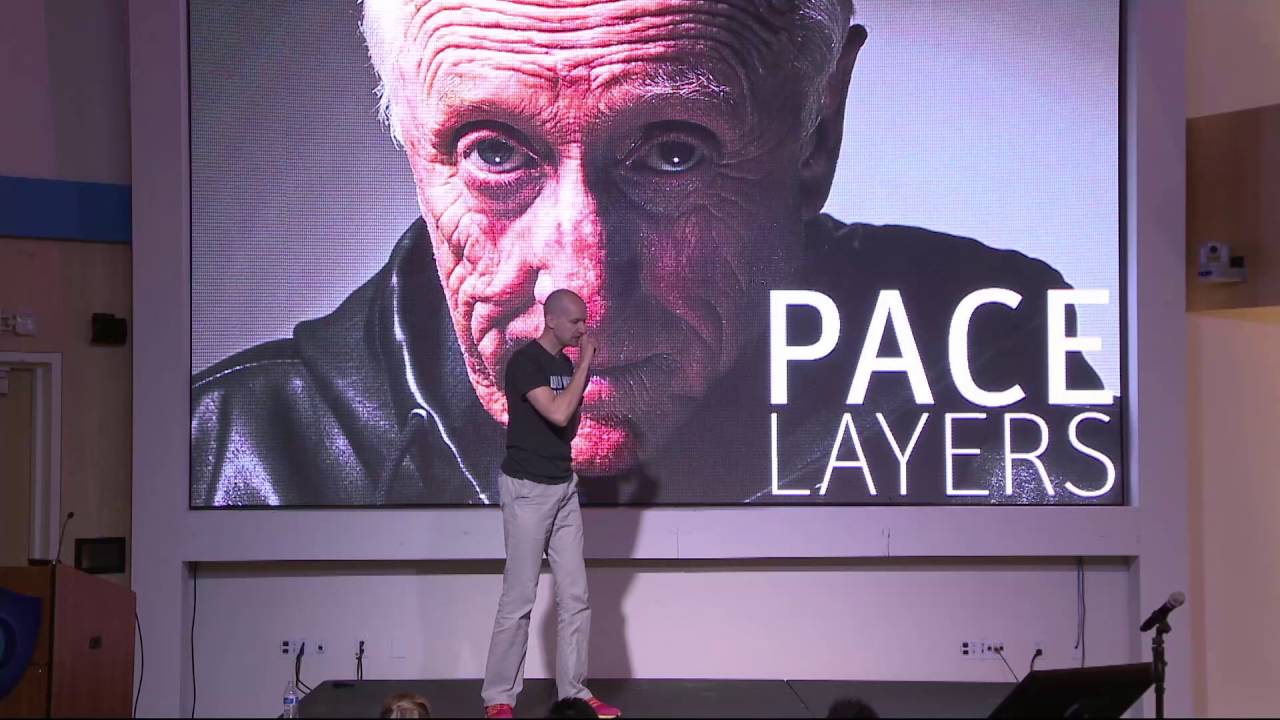
Tim Draper explains why startups fail between early adopters and mainstream customers, using self-driving cars and lab-grown meat as examples. He introduces pace-layering to show how different parts of society change at different speeds, then pivots to his favorite VC question: if you had 10 times the resources, what would you actually build?
Chapters
Geoffrey Moore, who's like a godfather here in Silicon Valley of strategy, has a, has a model called Crossing the Chasm, and I think it's really important. I find it interesting because a lot of younger entrepreneurs are not familiar with it, and it's super important. So if you think about the adoption curve of your product, this is the classic adoption curve. You start with the innovators, like the totally crazy people, and they don't care. Then you've got the early adopters. The early adopters are people like myself who go on Kickstarter and buy a Pebble watch. Then you come to the early majority. Early majority are the people who go into a Best Buy or on Amazon and buy a Pebble watch. Then you've got the late majority. This is like my mom now starts to buy a Pebble watch. And then you've got the laggards, like the people who are like, you know, my mom's mom now buys a Pebble watch. So this is a classic— the classic way products disseminate. The important piece is, is that there's a massive chasm between the early adopters and the early majority. People don't understand this, but it's really important to understand that you will hit a point in your growth where you go from early adopters who love technology, and you want to get to majority. You actually want to make people use the product in larger amounts, and it's really hard because the product needs to look very, very different. I give you an example: self-driving cars, autonomous cars. This is what happens if you put a normal person, a late majority or a laggard, into a self-driving car.
Coming!
Oh!
Oh, there's cars! Ahh! Bill, just put me back for me controlling it! Oh dear Jesus! I could never! Ahh! Ahh! Oh, where's it going? Goddamn, Bill! Oh my God! Oh, this is so scary! Oh Jesus, it's my first day out and I'm about to die. Oh, come on, relax. Oh my God, Bill. I couldn't do it. Oh, oh, there's a car coming! Just— oh my God, they're going to hit us! Oh, I— it's— ahh!
Hit the brakes, hit the brakes.
Oh my Jesus.
Now you're driving. So this is, first of all, it's funny, but here's the bigger point. It's actually— so I was at Google, we had Chauffeur, the self-driving car. I used to drive Chauffeur a bunch of times. It's actually really jarring if you're sitting in a car and the car moves the steering wheel. It's really jarring. It's like, it's scary. It's like, why is that happening? And I fundamentally believe that is the chasm we need to cross for self-driving cars. There's a lot of people who will not sit in a self-driving car with a steering wheel. So how do you solve this? Now, as a technologist, as a founder, it's your job to figure out, how do I cross that chasm? So one way could be to educate people. The other one could be to wait for it to happen, and like it becoming mainstream. The easier one is you figure out like, what is the actual problem? How do I need to design a product so that it appeals to a larger amount of people? And here's the solution. The new Google car, the little bubble car, which you can see in Mountain View driving around, Doesn't have a steering wheel anymore. You turn it into something different. It's not a car anymore. It's a pod. It doesn't have a steering wheel. It's not a car. And then what happens is you put people in there and it looks like this. We're like, can you just sit?
Yeah.
You said relax. You don't need to do nothing. It knows when it needs to stop. It knows when it needs to go. It actually This rides better than my own car.
Yes.
What she really liked was that it slowed down before it went around a curve and then accelerated in the curve. She's always trying to get me to do it that way.
That's the way I learned in high school driver's ed.
That's how you cross the chasm. Like, you just remove the thing which, like, a geek is fine with it. Like, I'm fine with, like, the steering wheel moving. These people aren't, right? Right, it's really important to understand. I give you another interesting idea where the chasm is currently hitting us. This is a project coming out of the Netherlands. This is artificial meat. This is meat grown in a lab by using a biopsy. So they basically use a biopsy, a tiny little amount of actual meat from a cow. They coax these cells into replicating themselves and they create a hamburger patty. The first time they did this, 3.5 years ago, that hamburger patty was $350,000. So not quite like McDonald's value meal. The next time they did this publicly— obviously they did it a ton of times in between— but the next time publicly, about 4 months ago in Nature, which is a big magazine, scientific magazine, they announced that the price of this patty came down to $11.29. Within three years, boom! Now here's the thing: I keep showing this to people, and they're all like, "Yeah, this is interesting. I wouldn't eat this because it's like it's gross. It's like you know lab-grown meat. I want meat from cows. I want you know they need to have a face and whatever." And I get it, right? There's another company doing this, and what they're doing is they're basically saying, "Well, instead of replicating meat and having the chasm to cross." We're taking effectively a meat product, but we're creating something completely new. We're creating a product which has never existed before. So they're currently producing meat chips, you know, like potato chips, but they're actual meat. They're super tasty, and they're full of protein. They're meat, but they're not— like, you don't have this chasm. You don't have this like, oh, but it should be like this. So think about this when you build your product. I want to give you a last example. This is Stewart Brand. Stewart Brand is a really, really important person in Silicon Valley. He invented in the '60s something called the Whole Earth Catalog. The Whole Earth Catalog was basically the World Wide Web on paper. And he developed a model called pace layers, and this is important to understand. So the idea is very simple. You've got these different layers of change, and they happen at different speeds. So at the top layer, you've got fashion. Fashion changes rapidly, like daily basis.
Basically.
At the bottom layer, you've got nature. So nature moves at a glacial speed. So take the San Andreas Fault, which we are like literally right on here. The San Andreas Fault moves by 2 inches a year. Tiny movement, okay? And everything in between moves at different speeds. And it's important to understand because the top layer, the one which moves fastest, gets all the attention. But the lower layers are the ones which actually shift behavior. So the challenge is we all focus a lot on— either we focus on the fashion layer, or we want to change, for example, culture. We want people to behave differently, but we expect that to change very quickly. I'll give you an example where this plays out, and it's important to think about when you think about your company. You take Uber. Uber, if you go back to this layer here, Uber needs to change something on the infrastructure level, right? They're changing car ownership. They also need to change something on the governance level, which is what they're currently— what's hitting them really, really hard. So a lot of the trouble they're having is they're trying to apply a speed which they want to use in the fashion layer on the top and the commerce layer and try to apply that to the lower and slower-moving layer of governance. And it slows them down currently, and it's really painful. And I think they're now better, but in the beginning they didn't understand that these layers move at different paces. So it's a really powerful concept to think about, particularly if you have breakthrough technologies. How do you actually sift them through to get to real change? So this is pace layering. Let me give you one last concept, and we're calling this abundance. Abundance is a really important concept because we're in a world which we perceive as scarce. Like everything around us, we perceive as scarce. A lot of our business models are built on scarcity. Now the challenge is digital technology is turning this on its head. It creates abundance. So if you think about the printing press, like when we built books, when we wrote books back in the day, books are really expensive, right? You need to fell a tree, you need to turn it into pulp, you turn that pulp into paper, you put ink on the paper, you need to put the the books in a truck, it needs to be shipped around. Books are a really precious resource. Obviously, that's not true anymore because now with digital technology, the cost of duplication and the cost of distribution are very close to zero. Information wants to be free. And you see this happening in industries. You take something like Napster. Napster turned around the whole music industry. Like in the old days, music was like you produced it, you put it on a record, That record needed to be like printed, shipped into store, etc. That is all gone now. Now you're on Spotify. It's an abundant world. On Spotify, I've got like what, 14 million songs or something? You take information, Wikipedia. When I grew up, like my parents bought the Encyclopedia Britannica, which is like this printed tome of stuff. Now information is like available to me for free. Anytime. What this means is, like, if you're looking at the world, ask yourself, the business model you're currently looking at, is that a scarcity business model? And if it's a scarcity model, if it's a model based on scarcity, how long can you preserve scarcity, whereas the world is moving to a world of abundance? All right. So here's the second point, and this is my favorite question of all times. So I— one of the things I did was I used to run a venture capital fund back in Europe, and every time I met an entrepreneur, we asked them this question. It's the hardest question you can ask someone because I love, love, love how this works. So you come to me and you say, hey, I'm pitching you this company. This company does X, Y, and Z, and we need $1 million. And you typically have a really good reason why you need $1 million, right? Like you want to hire a bunch of techies, you need to buy some infrastructure, you do some marketing, blah. I'm looking at you and I'm like, this is great, I really like this. I give you $10 million, what do you do? I swear to God, there's 99.9% of entrepreneurs can't give you a good answer because they've never thought about it. It's a really hard question to answer because typically what you say is, oh yeah, we hire a few more people, or we buy some more technology, or we go into a couple of countries. That is never the answer. If you think about like, what is it, like what does 10x of what you're doing look like? It's a very different thing. I love the question because it forces you out of your current model of thinking. Your current model of thinking is bound by the boundaries of where you are at the moment. Once you do 10x, you get into a whole different world. This is what Google calls moonshot thinking. This is the reason why Google is so successful because Google drills this into everyone's head.
More from Tim


He Sold His Car to Build This Startup, Then Pitched It for $1M 😳 #Startups #AI

This Startup Moves Your Crypto BEFORE Hackers Can Steal It 😳 #Crypto #Cybersecurity




15 Months Without Refrigeration?! This Startup Thinks It Can Go Global 🥥 #FoodTech #Startups



