Currency and Development of Blockchain Part 4 Q&A | Blockchain: Out of the Labs
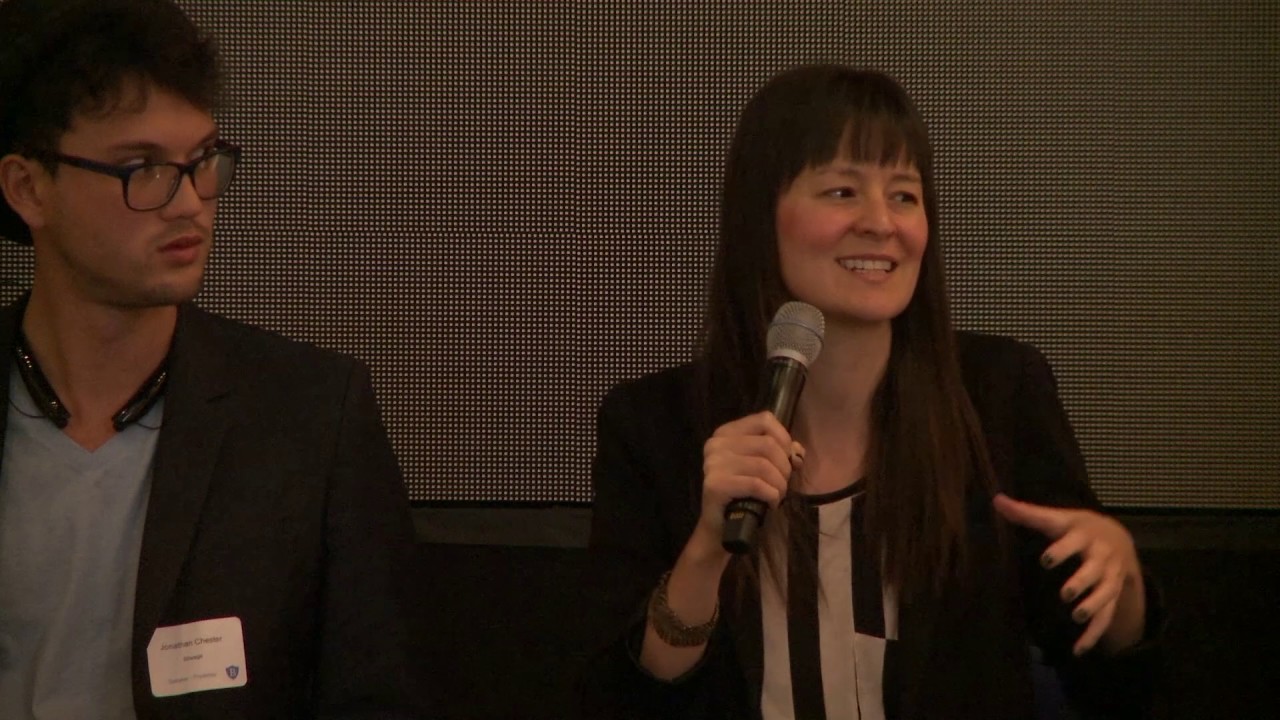
This content was created by Tim Draper. This content was uploaded by Tim Draper. This is a YouTube panel Q&A titled "Currency and Development of Blockchain Part 4 Q&A | Blockchain: Out of the Labs" (posted 2017-05-30). The excerpt is a multi-speaker discussion moderated for an audience featuring panelists (identified as Kat and several other labeled speakers) covering investor attitudes (East vs West Coast), blockchain adoption in healthcare (use of hashes/pointers vs storing records, HIPAA concerns), private vs public blockchains, Hyperledger, Bitcoin as a commodity in countries with failing monetary systems, ecosystem/standards risks, storage solutions (IPFS), and sales/education challenges. Several people are referenced by name in passing (e.g., Rick, Jack, Tim) but Tim Draper does not appear as a speaker in this transcript.
Chapters
Awesome. I'm going to toss out a softball to you guys before opening it up to questions. And Kat, we'll start with you. What is a common aversion you receive from either investors, institutions, or partners, and how do you rebuttal them?
Yeah, so I'll start with the investors first. So I'm actually based in Connecticut, so on the East Coast. And it's really funny, the conversations between investors from the East Coast versus the West Coast. East Coast hasn't— East Coast in healthcare. This is not New York City where they're in fintech. They've already—
they're on board.
The investors that I'm speaking to, my conversation always starts with, this blockchain thing, I don't really know, what is it? And so I actually was talking to one of my mentors and investors— you're shaking your head and I did the exact same thing— and I said, you know what, Rick, I find it very surprising there's a difference between East Coast and West Coast investors. And he said, really? Well, what do you think that is? And I said, well, you know, there is no question about blockchain out here on the West Coast. Everybody's in, we get it, we know that it's the next thing, and we're already way far ahead of you guys. And he had no idea how far ahead the West Coast was in terms of accepting this, understanding it, having done the research, and being able to have really smart, intelligent conversations with entrepreneurs about it. So I thought that was very interesting. So now we're really focusing on West Coast investors. In terms of healthcare and pushback, for the IT teams that I've talked to, they have completely embraced blockchain. They are so excited about it because there is so much inefficiency. You heard Tim allude to it. There is so much inefficiency, dissatisfaction, poor patient care that there's something needs to be changed. And the promise of blockchain is what has a lot of healthcare IT companies very interested. Based on what we're doing, we've already had 3 health insurance companies approach us to figure out how we can work with them in this whole new area of healthcare. So they're interested. The walls are down on certain parts of healthcare. In terms to get to the much further, more visionary side of it, we're probably 5 to 10 years out from healthcare. We tend to be further behind anyway. But I would say that it's been very— they're very receptive.
Raj?
So basically investment, like, I won't be able to speak much. I'll pass it to us. We are going to be there. We can answer all those things. But especially for San Francisco Stock Exchange, We are not basically just a blockchain-based company. We are a complete ecosystem where we talk about finance, we talk about like regulation, and we add blockchain. Or blockchain is just one of the components which is enabling. So blockchain is not like— again, we are not a blockchain core company, but blockchain is one of the enabler who is making us to take the business to the common people. So not that once centralization will come out, is not that we are going to give the public privacy to our user. No. So here we are combining today's business or our regular architecture to the blockchain new architecture, and that's what the world is looking for. You need to combine. We can't say that okay, one thing is only blockchain and one thing is a centralized service. Why not combine these two things together and create something unique which everyone can use? For example, here public-private okay, you forget your privacy, you lose all your money. Why not take the help of bank-grade security combined with the public-private so that a central system takes care of the public-private key and the end user, why should he worry about all those things? Why don't he care of— just take care of his own password and do the step? So yeah, again, like investment question, again I'll pass it to you, but that's how we do it.
Sure, so I'm gonna take this from the perspective of like a Bitcoin commodity payments side of things, and it and as it relates to the customer base.
Right.
And I think that really the biggest issue is an education issue, which was talked about over here from an investor standpoint. But also, if you think about Bitcoin as a commodity, right, an alternative to dollars in countries around the world that have bad monetary regimes. Venezuela is like a great example where the official exchange rate is 10 Venezuelan bolivars to the dollar. And the Black market rate is 3,000 Venezuelan bolivar to the dollar, and there's absolutely no way you can get close to that going through any traditional mechanism. And so by receiving bitcoins, you're actually able to get essentially the true value of your money, which you can't do through another mechanism. And that's all through hyperinflation. You have India as well, where they removed the 500,000 Ruby bills, and it caused around 80% of the cash in circulation in the country to no longer be valid. So you saw basically huge lines of people going to banks trying to exchange some money, and commerce stopped. And what you're seeing is when these events occur, more education around Bitcoin occurs. So at the time, you actually saw a premium on the price of Bitcoin. In India, between 20% and 40% versus the rest of the world. And people are now looking at Bitcoin as a commodity to essentially avoid the risks of failing monetary regimes. And I think that as more education around this occurs, you're going to see, if not Bitcoin, some other digital commodity out there. Begin to flourish in basically all the countries that aren't part of maybe the top 10 currencies in the world.
So one really interesting thing about being in the whole Bitcoin blockchain ecosystem, especially we're focused on Bitcoin, although we're going to release another currency implementation soon, is there's somewhat of a systemic risk. You know, what if Bitcoin fails or the whole cryptocurrency world just totally blows up, right? If you have an AI startup, There's not necessarily one or a small set of, you know, commodities, tokens, and a set of code that everyone has to agree upon. There are different frameworks for AI and people can choose to work on different things. Here we're kind of all in it together in this community. And for example, in the Bitcoin community, there is a change called Segregated Witness to the protocol that we built our technology with. And the whole community is kind of fighting right now as to whether you should adopt it or not. So interestingly, we have this dynamic unlike other industries where we have this one set of, you know, technologies or individual protocol technology, and we're all building on it, we're all dependent upon it, and that can be a risk in terms of— we've heard this from, you know, institutions and investors— as to what happens if it all blows up.
I definitely want to echo that. In most industries you have standards bodies and no standards. In Bitcoin you have standards and nobody is in charge of them. It's a constant argument all the time. But for us, you know, as a startup, we're out in the world trying to talk to businesses and developers and sell cloud storage services. We provide basically the same service Amazon S3 does, or Google, or Microsoft. And what we kind of found doing that for the last few years is that the moment you say blockchain or distributed Or cryptography, people's eyes just kind of turn off. They check out of the conversation, they write it off immediately. So we actually, when we're in sales meetings, when we're talking to customers and, you know, for people signing up for our services, we don't really talk about the backend at all. We don't say that we're using blockchain for payment rails on a distributed storage network. We just say we can provide cloud storage, it'll be faster, And there's a lot of educational problems that we have to solve if we ever want to actually talk about what we do to our customer base.
Are they on the East Coast or the West Coast?
Uh, everywhere in between. And all around the world.
Alright, so we'll open up to questions from the audience. Um, who's up? Right here in front.
So James, this is a comment on, or a question I should say, on one of your comments, and I think any one of you could answer it. It's around Hyperledger. I haven't heard you mention that in the conversation about open source. I realize that 1.0 isn't out yet, but where do you see that fitting into the overall framework?
Yeah, I think Hyperledger is a really interesting project, and I've had sit-down talks with You don't see a lot of excitement about Hyperledger outside of large corporations. So typically a lot of the consulting firms or things like that will be pushing Hyperledger, while all of the people who are actually hacking away on projects are working on one of the public blockchains, Bitcoin or Ethereum. I think it's an interesting project. I prefer free software to open source software, So it's a little bit of an ideological shift for me, but I think it's a good thing overall.
So for any number of these projects that are not traditionally payment-type systems, like healthcare, I think specifically the Maybills or the Stock Exchange and so on, how much do you deal with the need to extend data, capture extended data That doesn't fit in a standard ledger row? Like you have additional documents you've got to capture or other extended data that's too big to fit in a row in a blockchain, and where would you keep that?
Yes, so what we're storing is a hash of the information. So we're not storing— it's a small line of numbers and letters. So we don't have the issue there. And I think what's happened in healthcare is people are thinking that electronic Electronic records are going to be on the blockchain. There's going to be a ton of information on the blockchain. But really what we're looking to do more is the connection, the pointers and hash addresses. So we don't have an issue there in terms of size and storage.
I just want to jump in on this really quickly. So for different use cases, you can kind of describe the technology a little differently. In healthcare, it's not described as a distributed ledger, it's more of a network of databases. So this information lives locally at that hospital or at that institution that you're working with. They place a pointer to the network. And so if I walk into an ER for the first time where I've never been, I can pull my records from every database I've ever been at just using these pointers. So it's not cloud storage, but it's a pointer for the network of databases to operate.
And in terms of how that would, you know, to give more detail on what it means to store that hash on blockchain, what it basically means is that you can prove that a particular piece of data existed at a particular time. And that's why— that's what you're doing, is you're saying this piece of— this document, this book, this sign-off on a medical record existed as this way at this time. And that's the value that's being created with blockchain.
Yes, and that's why HIPAA is such a big deal, because the HIPAA protocol, what it requires is is you, if you are a platform, have to demonstrate who accessed what at what time, what they accessed, how they accessed it. So that's what we're hashing, is the interaction of the information. The end goal is the access of the data.
I'm gonna jump to the next question just so we can get one more, and I apologize, Niraj. Yes, over there, you had your hand up.
Thanks. This question So you mentioned that you're modifying the Ethereum, the code. Is that something where you're running a blockchain solely inside your organization, or are you still using external computing? I was just wondering how that works where you're doing like an organizational modification of the code.
So remember, as Jack mentioned at the very start, there are 3 types of blockchain. So what we are doing is a private blockchain. Yes, it's totally possible you can run it external, but if you do whatever we have done, if you do and if you're running it on as a public blockchain, it is compromising the security. Because increasing the— reducing the mining time and doing mining only when transaction done, it reduces the security, but it's more— it's completely okay for our particular use case. So what we have done, this particular good for my use case might be whatever use anyone else's work in, it's probably not useful. So to answer your question specifically, yes, we have done it for private blockchain. And just to answer one more thing, if you want to store data, there are other file systems like IPFS which you can use in order to store your data.
All right, thank you guys very much for your, for your time and your insights.
More from Tim


He Sold His Car to Build This Startup, Then Pitched It for $1M 😳 #Startups #AI

This Startup Moves Your Crypto BEFORE Hackers Can Steal It 😳 #Crypto #Cybersecurity




15 Months Without Refrigeration?! This Startup Thinks It Can Go Global 🥥 #FoodTech #Startups



