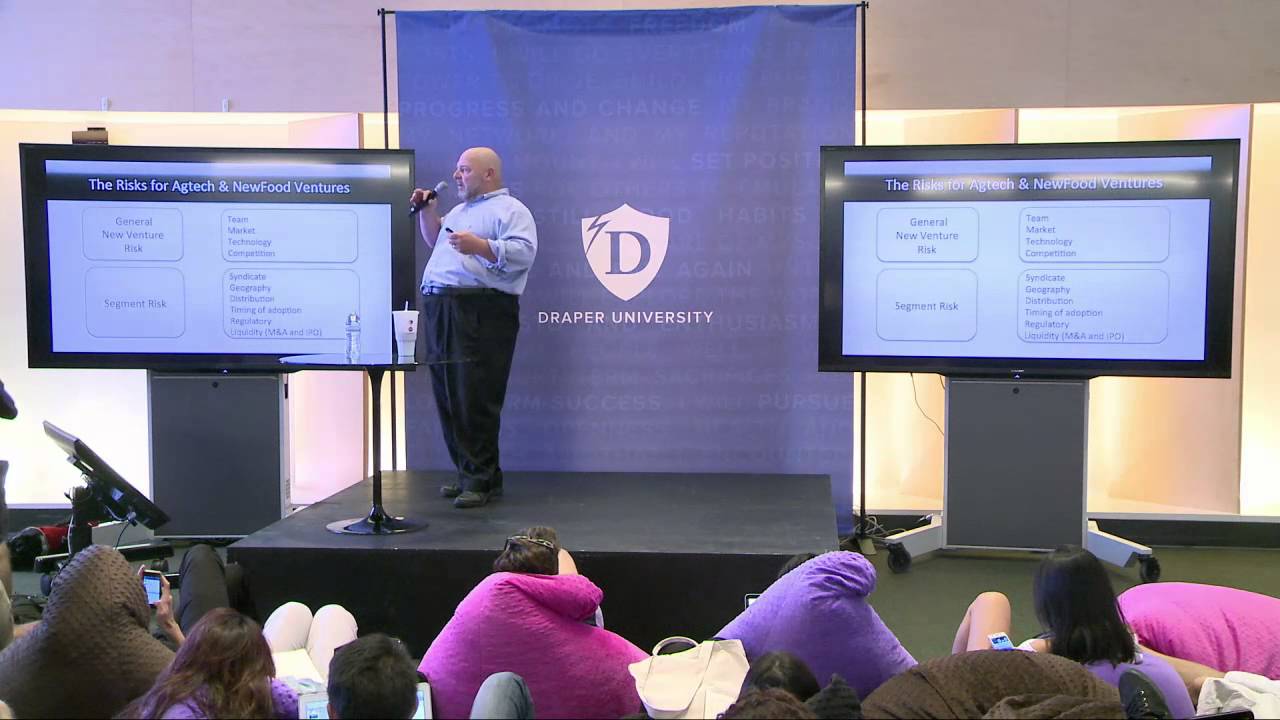
In this talk Paul Matteucci surveys the rapid growth of farmed seafood— from a few percent in the 1970s to over 50% today— and warns that traditional fish‑meal feed (ground sardines and anchovies) is unsustainable. He outlines four venture‑friendly domains with high potential: (1) alternative protein feed and aquaculture, (2) bio‑fertilizers and biobased pesticides that break down into harmless amino acids, (3) waste‑to‑calorie conversion, and (4) emerging research areas such as water conservation, soil improvement, and ag‑IT. Matteucci then details the layered risk profile for ag‑tech startups, adding segment‑specific challenges (thin VC syndicates, geographic dispersion, conservative adoption, regulatory hurdles, and limited M&A exits). His strategic takeaways stress screening ideas first for economic viability, fostering rapid experimentation, and creating an existential consumer‑driven pressure on “big ag” to spur acquisitions. He argues that Silicon Valley’s tolerance for failure and the presence of an existential threat (e.g., tech giants fearing obsolescence) enable the high‑risk, high‑reward model, a dynamic missing in agriculture. Finally, he describes his outreach through Feeding 10 Billion, MIT, Notre Dame, and the University of Minnesota to shift food scientists toward entrepreneurship, arguing that changing consumer preferences (e.g., millennials avoiding fast‑food chains) is the lever to drive systemic change.
Chapters
In 1970, when I was, I don't know, a teenager or young, not even a teenager yet, we sourced about 3%, 4% of our seafood from farm sources, and it was mostly rainbow trout in Idaho. Now it's over 50%, over 50%, and it's continuing to go up. We can't keep feeding it. ground up sardines and anchovies from the ocean. We're going to deplete that resource as well. Input substitutes. How do you get— how can we get biofertilizers, biobased pesticides to substitute for petroleum-based ones? Why this is good is because bio stuff tends to remove itself from the environment in a couple of weeks. It tends to break down into its composite amino acids and become just— Soil. Just amino acids in the soil as opposed to virulent stuff that kills pests. And then we talked about reducing and reusing waste. Giant source of potential calories here. Areas that I think are interesting but have fundamental issues. And I'll talk about these if anybody wants to talk about them, but these are the 4 areas that I think have some potential, but from a venture standpoint or from an— and again, I'm looking at all of this from the point of view of an entrepreneur. These have some big issues which I've listed here on the right. And then there's areas I'm still studying: water conservation, soil improvement, and ag IT. The problem with water conservation, people ask me, well, is the drought going to help get more money to water? And my answer to that is, yeah, until it rains. And that's the problem with these things, with these technologies that get investors excited one year and then get them running for the hills the next year. So I think that water solutions are going to continue to come from places like Israel, like the Middle East, where it never rains. Israel's got a problem forever. There's no fresh water, certainly not enough. And that's where the technology's coming from. Thank you. Soil improvement, I think, is an important area, and there are people that are figuring out how do we put back the micronutrients into the soil that we're depleting by the way we farm. The big problem really though is that we're losing soil. I mean, we have inches of soil in places where we used to have feet in Iowa, Nebraska, etc. And once you— it takes a long time to build more soil. These are database systems, systems for helping the farmer make better decisions and more efficient decisions. There's a lot of people working on this, and I think it's an interesting area. Risk. The risk for agtech and new food ventures certainly includes the risk that you get in any venture. Is the team good? Is the market big enough? Is the idea, the technology, will it work? And what's the competition? But you also have segment risk. How do you build an investing syndicate when there aren't 2,000 venture capitalists investing in this segment. How do we get the next round done? Geography. Unlike Silicon Valley and a couple of other places, Lower Manhattan, et cetera, where all the entrepreneurs are concentrated, these entrepreneurs are spread all over the planet. I think we have tremendous advantages by having places where there's a high concentration of entrepreneurs to test each other's ideas. Distribution, timing of adoption. People are very conservative in agriculture. Regulatory environments, you poison somebody, they tend to get pissed. And then liquidity, there's not a big M&A market like there is for things that we do like technology in Silicon Valley. Takeaways, expect and exploit radical change. Screen first for economic viability. Now why I say this is because when I get a new idea that comes to me that both has a social purpose and an economic model, I find that if people— if you screen for the social purpose first, you'll tend to stretch in your mind the economic model to make it work because you're so committed to the social purpose. If I screen for the economic model first, I just weed everything out that I think is not going to work economically, and then I look at the social purpose and determine if it's going to be a big impact or not. Top-down planning is for incentive regimes, not for solutions. I think what we need here is what you guys are doing. I think we need lots of experiments. Big ag remains a big obstacle to success here. They don't acquire very much, and that's a big problem. That's the biggest issue. Big ag companies don't fail. People ask me, what's the secret of Silicon Valley? Is it Stanford? Is it Berkeley? Is it that we attract entrepreneurs? I said, no. The secret of Silicon Valley, the thing that we do that nobody else does, is we let things fail. We let things fail. When I look at— in my early years in technology investing, I look at the companies that were rocketing to the moon. That's what's left. That's what's left. Would that happen in the auto industry? No chance. Did it happen in the banking industry in 2008? No chance. Everybody went in and rescued all these bad decision makers. But here it happens. Everybody knows it. So there's 2 kinds of motivations in Silicon Valley that doesn't exist. The one that exists everywhere is greed. How can we make a lot of money? How can we do something and make a lot of money? The one that doesn't is the existential question. Microsoft knows that it might not exist in 10 years. It saw what it did. Yahoo is struggling. Yeah. Google's worried about Facebook. There's an existential threat that makes these companies acquire other companies, take more risks. When they can't take them themselves, then they will go and buy companies that have already taken the risks. I think that is the biggest obstacle currently to making this all work, is creating a situation where there is this exist— I'm missing some slide. I can't go back? I'm pretty sure that wasn't the last slide. Okay, so the fact that there is no existential question is something that's really retarding it. And people will say, oh, you know what? Monsanto bought Climate Corp. I say, yeah, and Twitter's buying 3 companies a month, and Monsanto hasn't bought anything since Climate Corp 3 years ago. So it's a question of not do they ever acquire companies? Yeah, they do, but what makes the venture model work is that I'd make 10 investments. I know only one of them is going to skyrocket to the moon. I wish I knew which one, otherwise I wouldn't make 10. But I know that 5 of those other companies are going to do okay, and there's somebody I can sell them to. And that makes the whole model work. When I have to rely only on that 1 in 10 that gets to an IPO, et cetera, the model breaks down. It's too much risk for the amount of reward that my limited partners get. So we need to create a situation where, I think, where there's some existential risk for these big ag companies. The way to do that is by changing consumer demand, making consumers require different kinds of foods, different kinds of diets, etc. That is beginning to happen. I'm really excited to see companies reluctantly do some of the things that the fast food companies are doing and taking certain kinds of unsustainable ingredients out of their products and making their products hopefully more sustainable. Now, they're doing it because they're responding to consumer demand. There's no law telling them they have to do that. McDonald's is in a financial crisis right now. They're trying to figure out anyway. What they've done is they've missed you guys. You guys don't wanna go to McDonald's anymore. And it's not just you guys who are entrepreneurs and experienced and get it and study food, et cetera. It's millennials, period. They don't wanna go to McDonald's anymore. They wanna go to Chipotle, which by the way McDonald's owned for a short period of time before they sold it back. Big mistake in my view. So I'm excited to be here. I'm excited to be at MIT, at Notre Dame, at all the places where I'm talking to try to get entrepreneurs to think about the food system. What I do in those other places, it's less about getting entrepreneurs to think about the food system, it's getting people in the food field to think about being entrepreneurs. When I go for the University of Minnesota, I see these guys doing their PhD in food science or whatever and they're looking at, gee, do I become a— professor? Do I go to work for the Department of Agriculture? Do I go to work for Monsanto or DuPont? And I go to them and I say, start a company. That's how robots got started. That's how robots— these guys said, we don't have to follow the same path. Now out here, you guys have already self-selected into getting that. But most of the world has not self-selected into getting that. And so that's what I do with Feeding— that's one of the things we do with Feeding 10 Billion. Thank you.