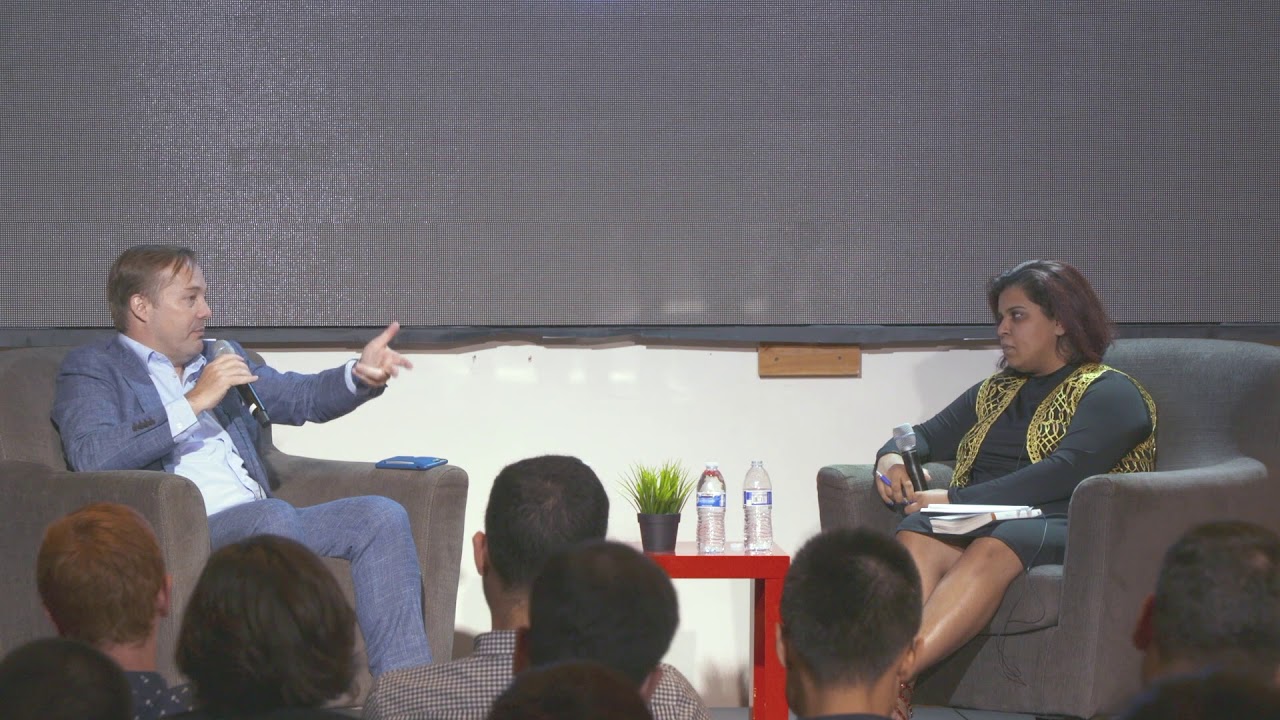
This content was created by Tim Draper. This content was uploaded by Tim Draper. This is a YouTube video titled "Entrepreneurs and Investors | Jason Calacanis" (posted 2017-08-22) containing an interview/conversation between Jason Calacanis and an interviewer (labeled SPEAKER A). Calacanis discusses industry responses to misconduct (referencing Uber and Eric Holder), efforts to increase female founder representation at LAUNCH events, programs like Founder University and Angel University, his "Goldilocks zone" investment thesis, and practical advice for founders on when and how to approach investors, team-building, and capital efficiency.
Chapters
Right.
So in the example of Uber, obviously I'm not pleased as an investor with some of the things that happened, but I was very pleased that they hired Eric Holder. I was very pleased that they really took a lot of serious action to try to change the situation. I mean, this is the most severe situation I've ever seen occur in 25 years in technology where people took incredible action to try to solve problems. Does it forgive the problems? I guess not. And should people be upset about it? I think rightfully so. But I, as an investor and as somebody who's seen this before many times, if Eric Holder went into Google or Facebook and did the kind of diligence, instead of 20 instances, it would be 200.
Yeah.
Anytime you have a large group of people, whether it's Coachella or a company or anywhere, there are gonna be instances that happen. It's how you respond to them.
Right.
And the culture you set. And I think that's some things that could have been definitely done better. And I feel like our industry is now— I think we're becoming leaders in how to operate in a just and fair way.
Right.
And it's painful. And there's going to be some trials and tribulations as we get there. But when you compare how open our industry is, say, compared to Hollywood or the financial industry, I think we're lightspeed ahead. So as critical as we are of each other in this industry, as hard as it may seem to read some of the headlines, I feel like we're outpacing almost every other industry.
Right.
In terms of being a just, fair environment for everybody. And I think we all have a part to play in it, and we're working really hard at my company at it, and many other companies. So I feel ultimately very positive about what's happening in our industry, and in fact, the world.
Thank you. So on that note, I've actually never had to pay as a female founder or anything for any LAUNCH events. I always apply, and I've always gotten a free ticket, whereas it hasn't happened for a lot of other people. So—
Well, the interesting thing about—
And this is even before the conversation started. So this is like from 2 or 3 years ago.
Yeah, starting about 5 or 6 years ago, we said, how much— how open can we make our events? And we made the LAUNCH Festival free for founders. Has anybody been to a LAUNCH event? Raise your hand if you have. And keep your hand up if you got your ticket for free. So everybody had their ticket for free, great. So, and it was about 20% of the audience, I think. We decided if our event, Launch Festival, the tickets were free, and if we didn't charge people to be on stage, and we gave them a free demo table, and we give 250 startups a table, we let 250 startups present on 2 different stages, we would get a great representation. It turned out, actually, we didn't.
Right.
We had about 10%, female in the audience. So we were struggling, how do we get the ratio in the audience up? And it's free tickets, so we kind of felt like on one hand there were people inside of our company like, well, we gave free tickets away, if that's the ratio, that's the ratio.
Right.
But we said, well, what can we do to change the ratio? And Jackie, who is the executive producer of This Week in Startups and has 4 Emmy Awards, Emmy Award-winning producer Jackie, she said, why don't we email the 10% who are female and ask them if they know any female founders who want to come? We went from 10% to 15% to 20% to 25% to 30%. And every time another 100 women would sign up, we'd email them. Do you know any female founders? It turns out the female founders know the other female founders, and we just started increasing the ratio. So there are very practical things we can do in our industry to really change the ratio and make it even more open and fair and just.
Amazing. So on that note, what are some of the things that you think— so as an investor, what are some of the things that you're working on to balance that diversity yet merit of a democracy, for example?
So we have a very specific zone in which we like to invest. We call it the Goldilocks zone. Not too hot, not too cold, just right. Right, we want the porridge just right. And it turns out if we just go with that group of people, we may not see the numbers and representation we want. And what we're looking for is You haven't gotten your Series A yet, and you have a product in market with a little bit of traction.
Right.
How many people have a Series A investment? Raise your hand if you do, nice and high. Nobody in the room. How many people have a product in the market? How many people have actual product in the market? It's about half. How many people are pre-having customers or a product in the market? Raise your hand. And that's the other half, right? So we're interested in the people who have a product in the market, And who have a little bit of traction, right?
Right.
Because we think we can help them get to that Series A. But now for the other half, there are other incubators that they should work with who work with people who are pre-having their product in the market. We specialize in growth techniques. In order to deploy the growth techniques, you have to have a product we can put the growth techniques against. So what we said was, well, let's create other products and services for those people. The LAUNCH Festival is open to everybody, and anybody can come. That's our product or service, and This Week in Startups, and the LAUNCH ticker. These are products and services to draw in people who are not in our investment thesis yet.
Mm-hmm.
And then we said, well, we want to get even closer to them, so let's do Founder University, and let's do Angel University, and create a specific event so we can meet more angel investors, and even train them to to be better angel investors, and let's have this Founder University where we can spend 2 days with people who are right before the Goldilocks zone.
Right.
So they're kind of like just about to have their product launched in some cases, or maybe they just had their product out for 30 days, and we can tell them, hey, here's when we invest. So one of the important things to know as a founder is when to approach investors. The worst thing you can do is make— get a list of 200 investors and then do a mail merge. This is— we know it when we get the email. It's a terrible approach. What you need to do is research the investor for an hour or 2, watch their interview on This Week in Startups or some other podcast, read their blog, read their social media, start to understand who they are, what they've invested in, and what appeals to them.
Mm-hmm.
And then contact them when you're in the right zone. There are people who love design, and so emailing Kevin Rowe a beautifully designed mockup, even if it's not a functional prototype, is a great idea. There are other people who maybe are very much into engagement and who care about metrics. Maybe the folks at Social Capital are very engagement-oriented, so you wouldn't send them a mockup. You would send them, here are the first 1,000 people who used our products, and here are the cohorts, and in this cohort we see an engagement level, and 7 times a day people are using it.
Right.
You have to know your audience. And what I find with a lot of entrepreneurs is they're emailing and saying, hey, Social Capital, Sequoia, Bill Gurley at Benchmark, can we have coffee? I want to talk to you about my idea. Hello? That's not what they do. You want to— if you want to get coffee and you want to just talk about your ideas, do that with a founder.
Mm-hmm.
Do that with another founder. But really what we're all trying to do as investors— and listen, I spent most of my time as an entrepreneur and 5 years as an investor— we're trying to sort out people into buckets.
Right.
And one of the big buckets is people who talk about doing a startup, and some of them are tourists, and some of them are actually entrepreneurs who are going to build great products. But in my estimation, 90 to 95% of the people are talkers, and they'll never get their product to market. So then as investors, we just look for people who are part of that 10% group that actually can get a product to market, because now we've eliminated 9 out of 10 founders. founders, or 9 out of 10 tourists, and we separated the one founder who can get a product to market and can build a prototype. And those are the folks that you really want to engage with. So as entrepreneurs, if you have ideas, if you have a business plan, unless it's explicitly a business plan competition, do not start contacting entrepreneurs. Find 2 or 3 people, one person who's a designer, one person who's a developer, one person who's got a really good business brain for business models or can build a deck or is a sales executive. And once you have that team of 3 or 4 Avengers, right, and you got your super team, you know, the Defenders, the Avengers, the Justice League, pick your metaphor, pick your team. You want to then build something that when you show it to people, they go, ah, this is a group who will build something and they can make progress on their product without money. The people you really want to invest in, in my opinion, are people who are able to build product and move the product forward without writing checks, or who can take a nickel and turn it into a dollar, or a dime and turn it into a $5 bill.