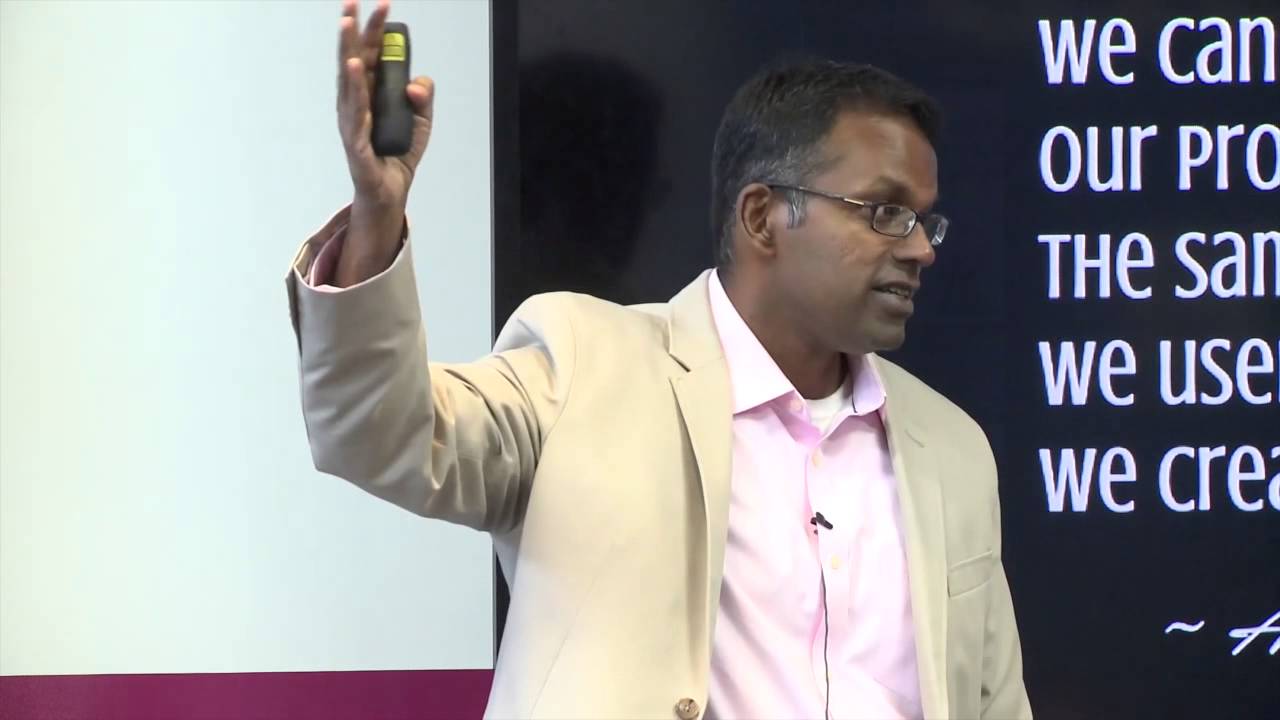
Sodan Selvaretnam argues that technology is democratizing business and making traditional education and office hierarchies obsolete. He maps how society has shifted from hunter-gatherer to agricultural to industrial to technological eras, then offers a framework for startups to reimagine their value chains: create, distribute, consume.
Chapters
Crazy-looking dude, but brilliant. We cannot solve our problems with the same thinking we used to create them. This is why the status quo falls. This is why empires fall. This is why leaders fall. This is why if Silicon Valley gets arrogant, It becomes second tier. We cannot solve our problems with the same thinking we used when we created them, right?
I was wondering if I could ask something, but when you said the same thinking, how do you understand? Do you mean like the same pattern of thought, the same way of approaching things?
Yeah, so let's talk about that, right? Let's look at history for a bit, okay? We were hunters and gatherers. We went out, we picked berries, we did what we needed to survive. And then somebody figured out some crop and we became an agriculture and farming society. The thinking that you used to create societies as a hunter and gatherer, was it the same as what we did when we became a farming society?
No.
It's quite different, right? The structures were different. What you needed to do to survive was different. There started to be more structure around who does what and those type of things, right? There may have been before, but there was a different lens with which people started to view things. The imagination it took to take that wheat and plant it and then start realizing that you can create societies around it, that's pretty amazing. That's vision, right? This has been happening throughout our history. So we moved into agriculture and farming societies. And then we went into the Industrial Revolution. And what happens in the Industrial Revolution? Great companies are created, these business titans come up, everybody gets sent to school, there's a teacher in front of the class telling you what to do, teaching you all the right things so you can start to work. Okay? Now we're in the midst of a technology and democratic tsunami. Does the thinking that we applied in the Industrial Revolution still apply to the way that we should be doing things today?
No.
If hunters and gatherers had to change to effectively run agricultural and farming societies, agricultural and farming societies needed to change their mindsets to create an industrial revolution. Does our education system and the way we do business, if we hone in on those lens, right, stay the same as we move into a technology and democratic tsunami?
No.
What are some of the things that change? Well, I heard it earlier, right? It's as simple as wearing casual clothes versus wearing a suit. It's as simple as having a flat structure versus a boss. A boss sounds like a caveman term today, doesn't it? It's my partner, it's not my boss. Like, what planet are you from calling yourself a boss, right? Boss man. It's funny. An office sounds weird to me. Office is crazy, right?
I like workshops.
I mean, I can— why do I need to be here? I could have been here, right? I could have done work without an office, right? I could have done— I can get things done with you and measure how you do even if you're sitting in Bali. In fact, my brother-in-law lives in Bali. I have technology friends who live in Bali. they get stuff done, right? All these buildings in a way don't matter. How many of you have done an MBA? Okay. Did you pay a lot of money? Okay. Was it a good business decision?
I think so.
Okay. We'll go over the math sometime and see if it makes sense. Okay. I did a graduate degree.
In economics.
Okay.
I've got a good ROE now.
Okay, very good, very good. But, you know, it's— what I'm encouraging here is not pointing to an MBA or anything else. It's about— look, Tim Draper created this university. He creates a program within weeks to get you up to speed on what's happening with entrepreneurs. You can go to an MBA and they have entrepreneurship programs, where you pay $150,000, whatever it is, right? And you gotta really think clearly as to what's giving you impact, right? You can go to a school today where a teacher stands in front of a class, and when you have kids, you can say, I want my kid to learn like it was the Industrial Revolution, right? And when they learn and they come out and the workplace requires creativity and they can't think through it, what happens?
They'd die.
They'd die like the dinosaur. They'd die like the newspaper companies, right? And so the creativity and the working in teams that the progressive education folks are talking about, right, is far more applicable to a whole society that's becoming entrepreneurial. It's not just the people in this room. Right? Potential is being unleashed. Right? Technology is becoming an equalizer. It doesn't take me even $100,000 to create the greatest company in the world. Right? And so do that math and think differently and listen to Albert Einstein. Right? He's a smart dude. We cannot solve our problems with the same thinking we used when we created them. And think about history, right? And how history changed, because we're at that time. And you're the greatest generation, right? You don't want to be thinking like the status quo. But I congratulate you on your MBA.
Thank you.
OK.
I got a PhD.
Did you? OK, very good. I mean, yeah, listen.
Public high school diploma. Yeah.
OK. And I'm not— listen, education is very important. I love learning, and I continue to learn, and I think it's fantastic. I'm being provocative to make a point. I have very good friends who've done their MBA. I think it's fantastic. OK? The key question here, again, comes down to how do you want the world to be different? You're shaping the world today, right? Because believe it or not, every single one of you is impacting how the world is being shaped. We can use it to create our own realities. It's more democratic than ever. Like, you're really at that point in time where you're creating the new world. Like, it's really happening, right? It's beyond Silicon Valley. I mean, you're learning some concepts in Silicon Valley, but you're going to go back to your homes, right, and take those concepts and make it really relevant to solve big problems. Right, so how do you want your world to be different? That vision, I think, is very important. So let's look at a framework that could— I like to simplify things, right, because complexity makes it just this rat race intellectual exercise that can lead to nowhere. Right, so simplification can lead you potentially to insights.
Right?
And if I simplify it, I look at it and I say, okay, how is the world as it is today? So what does the world you are creating inside look like today? And what can the world look like when you're done creating it? Can you imagine it? Can you imagine it with no bounds? I mean, think about the hunter and gatherer thinking about what an agricultural farming society looks like. Think about the agricultural farming pioneer who thought about what the industrial society looks like. You are now in the cusp change of an industrial society moving to a technological democratic society. You are the pioneers, right? So this framework is really as is and to be, right? And then I hate these terms like value chain and this thing. It's just like, it's just the way businesses run, but let's put a fancy term on it. And all it is is like, look, you create, you distribute and market, and you consume in business. I could call that a value chain, right? And if you have the tool of the as-is, to-be, and you understand that create, distribute, market, and consume, and you open your mind to recreate the create, distribute, market, consume in every possible permutation that you can think of, Your imagination starts to fly.