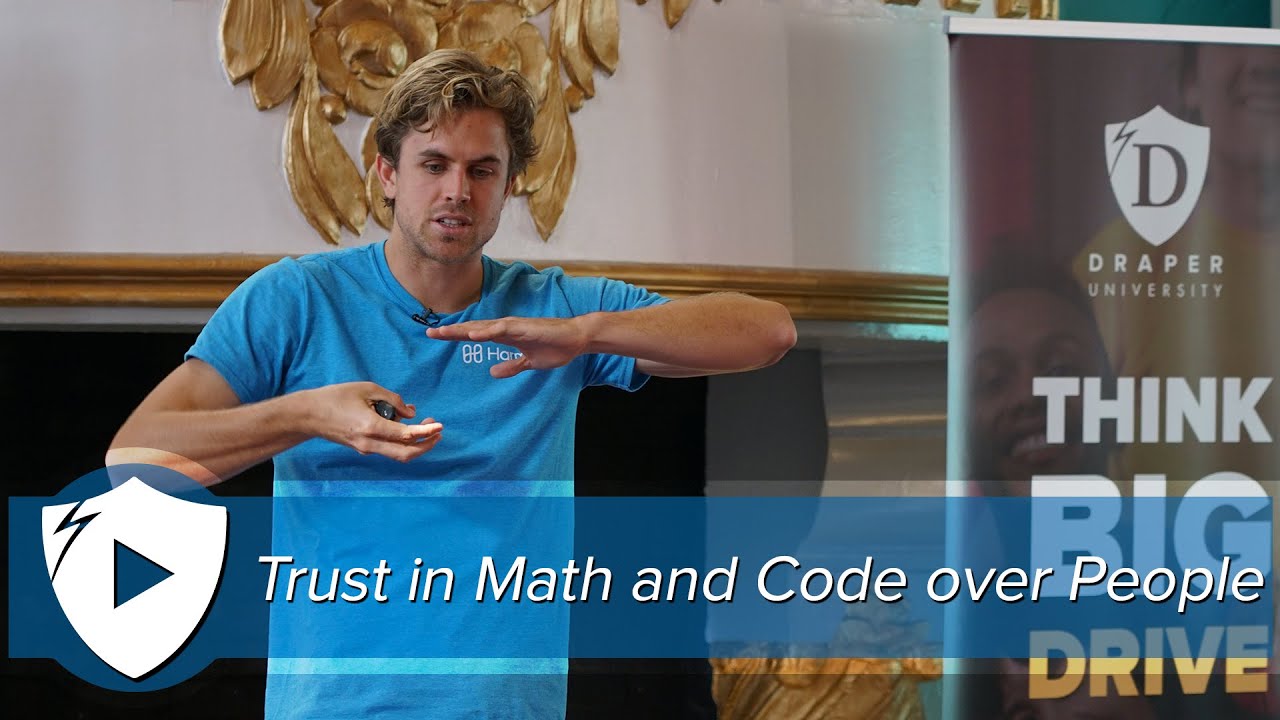
Harmony founder Nick White explains how Ethereum's smart contracts work like programmable vending machines, enabling decentralized lending through projects like MakerDAO. He contrasts Ethereum's potential to replace institutions with its current limits: 15-minute transaction times, low throughput, and high fees. The shift from trusting people to trusting code comes with real risks, as past hacks have caused massive losses.
Chapters
What if I didn't have to trust Trump, I just had to trust, like, math, right? I'd rather code and math. I actually— obviously, I don't want to overstate that, like, everything can be achieved by code and math alone. Not at all. At the end of the day, it's always a human thing. But I'd much rather put as much of my trust in that than in actual people, because I feel like people oftentimes cheat and are flawed. So, Wow, Bitcoin is pretty incredible, but aren't there a bunch of other cryptocurrencies? Like, I'm sure you guys have heard of Ethereum. Maybe you've heard of, like, Litecoin, or Zcash, or Monero, or whatever. There's actually, like, thousands and thousands of cryptocurrencies. Harmony is actually one of them, although we're newer on the scene. So, I want to talk to you guys about Ethereum, because I think Ethereum is really another very fundamental step in the progression of blockchain technology that it's important for you guys to grasp in order to know the potential. So, we'll go through this really quickly. So, Ethereum has a lot of similarities to Bitcoin. It has the same basic blockchain structure that we were talking about with the, you know, hashes and the chain and public-private key pairs, and it also uses the Merkle root that I was talking about. And it uses the same proof-of-work mining. So people are basically doing hashing to verify and secure the chain. But it's, it's same same but different. And it, the new, the new thing that it has is something called smart contracts, which is also another like huge buzzword, which you guys have probably heard of, if you follow the Bitcoin space, blockchain space. And you can think of smart contracts like a digital vending machine. Where basically, like, I can create this, this, this vending machine that it basically has, like, you know, when you go to a vending machine, it's like, hey, put, put your money in here. And then like, press these buttons. And then like, automatically, something's going to be output, like my Coca-Cola is going to come out the bottom. That's basically what a smart contract is. And that sounds super lame and boring. But it's actually really, really extremely powerful. Because it allows you, you know, it allows you to create your own rules with code, right? Which is what we were talking about. Like, I can basically create a smart contract that says, like, hey, if you lock money in here, then I'm going to lend— I'm going to create this new asset and send it to you, and this represents something that is basically pegged to the US dollar, and then you can go and spend that money. Or use it however you want. And when you want to unlock, take this money back, you have to basically return it to me. And what I'm describing there is actually a very popular smart contract on Ethereum called MakerDAO, which allows you to basically lock your Ethereum into this contract, and then get paid out in something called DAI, which is another token that is pegged to the US— the rate of the US dollar. So all of a sudden, I could take my Ethereum, and get a loan in US dollars that I can then spend and do whatever I want with. So, that's just one example of one way that you can use the, like, smart contracts, like code, to create a sort of interesting digital vending machine that actually has a lot of, like, very powerful properties. And this is just the very beginning. Like, we're only, like, a few years into this whole revolution. And I think there's just so much innovation that can happen on top of this. Um, it basically generalizes the concept of, you know, blockchain provides this sort of, like, layer of trust where you can, you know— maybe I should actually go to the next slide. Yeah, so you trust the blockchain to uphold those rules. You write them in the contract, you put it on the Ethereum blockchain, and then you trust— you can trust in the math, basically, that all those rules are going to be upheld so that no one can like go to your vending machine and like break it. Like, you know, like, or like an ATM, you know, like people, people are famous for breaking the ATMs and taking their money. But this is like, rather than a physical vending machine where people can like take an axe and like chop it open, it's, it's a mathematical vending machine where you can't, it's so difficult to break it. that you basically can't. Although, one caveat is that anyone who's a programmer here knows that code has a lot of bugs. It's like very common actually for like bugs to be in your program. And if there is a bug, then that's a vulnerability. So, it's not like perfect. I don't want to give you like the impression that, oh, a smart contract is like perfect, you know, you just put it there and then it's good to go. In fact, there's been lots of very devastating hacks in the past where millions and millions of dollars have been stolen. So, it has its own drawbacks. And this is partly why Bitcoin doesn't do smart contracts, is that they prefer to just be super secure and very, like, plain. And that way, you know, the likelihood of having bugs is much lower. So, you know your money is safe. So, this allows you to do things like programmable money and beyond. And actually the guy over here, his name is Nick Szabo. He is another kind of a father figure in blockchain and Bitcoin. He created things like e-gold and all these precursors to Bitcoin that didn't work. But he also wrote the very first white paper about smart contracts. So he invented, long before there was even blockchain, he invented this concept of a smart contract. So he's like a very visionary guy, I encourage you to look up, look him up. So smart contracts allow you to create a shared imagined reality where The rules can be written in code, and you only have to trust math to uphold them. So this is kind of, you know, going back to that original, like, mind-blowing thing that we talked about in the beginning about shared imagined realities and the power of them. And smart contracts kind of allow you to actually do this using the blockchain. And anyone can do it now, like anyone, you just need an internet connection, you need to know how to code. And then you can put something out there. So that's the power of an open permissionless network. So I mean, using this, we can recreate institutions like, you know, banks or even like countries, we can create like new institutions that can scale and be more trusted trustable than what we currently have, which, I mean, I think in a lot of, like, ways in the world, the trust is breaking down, right? Like, I don't know, honestly, I don't think I trust Trump, for example. Like, what if I didn't have to trust Trump, I just had to trust, like, math, right? I'd rather code and math. I actually, obviously, I don't want to overstate that, like, everything can be achieved by code and math alone, not at all. At the end of the day, it's always a human thing. But I'd much rather trust code and math, or put as much of my trust in that, than in actual people, because I feel like people oftentimes cheat and are flawed. But there's a catch. Ethereum is slow and expensive. So, basically every, in order for an Ethereum transaction to be verified, it takes 15 minutes. So, you'll, if you're trying to like do something, On the blockchain. You know, we're so used to in the internet age for everything to be instantaneous. Like, I send my text and it gets delivered around the world, like, you know, in a matter of seconds. Blockchain is still really slow in terms of like the latency. Like, it takes, for example, for Bitcoin, it takes 10 minutes for every block. So it's even worse. Or so anyway, the point is that it's really slow to update. It's also slow in terms of very limited bandwidth. It's sort of like trying to stream YouTube video, or like imagine the problem of like trying to stream YouTube video over old phone wire, basically. Like the throughput of the phone wire is so low that you'll never be able to have like high-fidelity video streaming on the internet. And so, this is kind of the stage that we're at with blockchain, is we have very low bandwidth. And that means that everyone's fighting over this very limited resource. It's sort of like if everyone in the world, let's say they were like, the entire data plan of the world was only like 1 gigabyte per day, and then everyone in the world would be like fighting over that 1 gigabyte. It's the same thing with blockchain right now, at least in Ethereum's case. So,