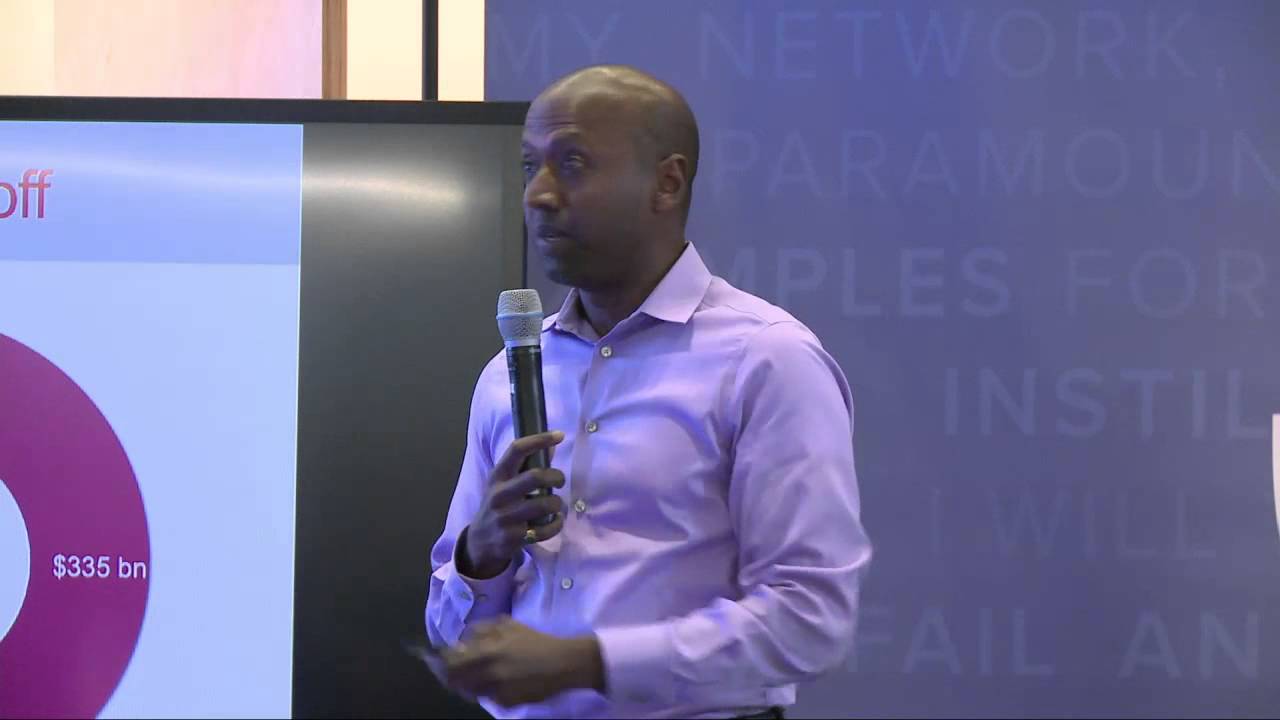
This content was created by Tim Draper. This content was uploaded by Tim Draper. This is a YouTube talk titled "Examples of Frugal Innovation | Frugal Innovation Author Navi Radjou" (posted July 17, 2015) in which Navi Radjou delivers a single-speaker presentation about the emerging "frugal economy." He discusses growing inequality and the unbanked population, consumer values and environmental concerns (e.g., California water shortages), the rise of the sharing economy (Airbnb, BlaBlaCar) with PwC market projections, and the maker movement enabled by technologies and platforms (Raspberry Pi, Arduino, TechShop/Fab Labs). He gives examples of hardware prototyping and frugal innovation outcomes (Square, the Embrace infant warmer), notes rapid scaling dynamics and policy interest (White House Maker Faire, Obama), and frames these trends as opportunities for new business models and market creation.
Chapters
And citizens also begin to worry about the fact that there is growing social inequality. Today, the 1% richest Americans, as you know, account for 60% of the wealth in this nation and more than 60% of the consumer spending, which is, you know, mind-boggling when you think about it. And that, of course, leaves a lot of people left out of the system. For example, many of you may or may not know that there are, you know, 68 million, that's about 70 million people, that's one-fifth of the U.S. population, which is unbanked or underbanked. They don't have access to a debit card, credit card, or a saving account that we may take for granted, right? So that's a big, you know, think about that as a market potentially, right? That's the size of the French population. Huge market to be tapped right here in our back door. And you look at Europe, same thing, 50 million people who live with very low income. So that's a situation that is getting worse as well in Europe. So this is also creating a need now for citizens to try to consume products and services that actually, you know, meet the tight budget. And also think boldly, how do we look at these people not as poor people but potentially as a market that could be served with the right business model? And we'll talk about that in a few slides. So citizens also worry about, you know, the environment. And especially in California, as you know, water shortage is gonna become a huge problem. You know, when I came here 7 years ago, We were hinting at it, but suddenly I think it's becoming increasingly clear that, you know, we have to learn to do more with less, especially because California, as you know, is the 5th largest food producer in the world. So we have to learn to produce more with less water. So all this is leading to an interesting, you know, attitude among consumers who are saying that 55% say, I'm willing to even pay some extra money for those brands that are socially and environmentally responsible. And 2/3 of them, many of them Generation Y and Z, want to work for companies that are also socially and environmentally responsible. So it means that the consumers are also becoming what I call values-conscious, and they want the products they buy actually embody those values as well. So as a result, what we begin to see emerge is what I call a frugal economy. This is an economy where, interestingly, the citizens are becoming more empowered, with new technologies, new social media platforms, and they're becoming what we call prosumers. Instead of being passive users of your products and services, they start producing themselves the products and services they need, either alone or as part of a community. And they're using 2 pillars to build this frugal economy. The first pillar is around sharing, and the other one is around the making. I'm sure that you're familiar with both, but I just want to kind of touch upon quickly the peer-to-peer sharing, as you know, with things like Airbnb and whether it's crowdfunding or whether it's, you know, apartment sharing or car sharing, is really going to explode only in the next 10 years. PwC, you know, sizes the market to grow from about $15 billion today to $335 billion within 10 years. And this is, by the way, the tip of the iceberg. This is the B2C sharing where us citizens share our apartment and cars. Imagine what happens when companies begin to share assets? And what happens if you create the next platform, the next Airbnb for companies, right? The next Uber for companies? And we'll talk about that as well. That's gonna be trillions of dollars, okay? So there's a big, you know, B2B sharing economy emerging as well. We'll talk about that. But this is the tip of the iceberg, the B2C side. And what is amazing is, of course, it's growing by leaps and bounds simply because the folks who are building the platforms have an unfair advantage. Today Airbnb is the 5th largest hotel chain in the world without without having a single hotel in the balance sheet. And they're growing, as you see, very quickly. As Brian Chesky says, Marriott wants to add 30,000 rooms, we will do that in 2 weeks. Marriott wants to have 1 million hotel rooms, I think, by 2020. Airbnb will have it by end of 2015. So that's the speed at which, you know, they can scale up very quickly. And this is growing more in Europe. I know that in U.S., You're very familiar with it. But I think Europe is way ahead in terms of adopting the sharing economy, especially in car sharing, which is with platforms like BlaBlaCar, which is Europe's largest car sharing platform. So this is really happening. This is essentially citizens saying, instead of buying a car, I want to actually share a car, right? Especially among young people, this trend is more pronounced. But the real phenomenon is gonna be the maker movement, as you know very well. This is something that began here in San Mateo, interestingly, so right place to be, as a Maker Faire in 2006. And today it has grown in sophistication, especially with new technologies like, you know, 3D printing that is becoming more and more sophisticated. And what is really driving this maker movement, in my opinion, are the building blocks that are going to be almost like the digital railways of the knowledge economy, if you if you like. These are some of them. You may be familiar with them. The left-hand, it's a Raspberry Pi, which I brought here. This is a personal computer the size of a credit card that costs about $30, and 5 million people have downloaded it now to create their own devices, you know. So this is like a building block for creating any kind of electronic device you want, which before used to cost a lot of money, but today is being democratized. On the right-hand side is Arduino chip. Which again cost, I believe, about $30, $35, which is a microcontroller, and that is being used by over 1 million developers today. So this is gonna be the building blocks, if you like, for, you know, creating the kind of frugal devices that used to cost a fortune, you know, a couple of years ago. And then you have, of course, these platforms like TechShop and Fab Labs, we call it in Europe, which are also becoming the venue where you can start creating some really cool applications such as Square, which came out from TechShop actually. Today, of course, it's famous, but at the beginning, Jim McKelvey, who actually launched it with Jack Dorsey, actually went to TechShop to prototype it. And when they went to the VCs to present their business model, they were all rejected in Sand Hill. But then when they went back and they showed the prototype of what they're developing, They ended up raising $10 million. And the message is essentially for you entrepreneurs, I call TechShop the place where you can help reduce your time to credibility. We talk about time to market. Time to credibility is when you go to VC, how can you quickly make your solution credible, right? And the more you can compress it by creating actual prototypes, the faster you can raise the money. Because before we couldn't do it, right? Because humans are visuals. So the more they can see, it's more likely the VC will ask you technical questions on how to improve your prototype, but he will be hard-pressed to shoot down your business model because you show that you can create a product, a real one, right, as a prototype. So that's really what's happening. A lot of hardware startups are being launched with a PO box in a tech shop now. And so this is one of them, which is Square. And the next one is this product. Some of you may have heard about it. It's called Embrace. This is actually launched by 4 students from Stanford University who actually developed this in a tech shop. Essentially, this looks like a mini sleeping bag. Actually, this is for premature babies. And when they are born, you have to keep them at constant temperature. So in the West, we put them in what we call an incubator. Incubator costs about $20,000. And requires electricity. So not really a viable option in developing countries, like in villages in India or Africa. So this solution essentially simply uses this material inside. It's called a phase change material. It looks like wax. And essentially you can melt it by putting it on a heating pad or in boiling water, and then you reinsert it inside, and then it can actually keep the baby warm. So it's a phase change material. Baby warm at constant temperature for 6 hours straight. And the solution cost $200, which is 1% of the cost of incubators sold in the West. And amazingly, they have already saved the lives of 160,000 babies around the world with this very simple solution. And again, this is frugal because they didn't require a big lab to prototype and develop the first version of it. They did it in a tech shop, and then they went to India to actually launch a real company that today, you know, serves, you know, multiple markets around the world. And Jane Chen, the co-founder of this solution, was invited to the White House to show her solution to President Obama, who actually hosted the first Maker Faire in the White House in June last year. And he said famously that today's DIY is tomorrow's Made in America. He has actually in his cabinet a senior advisor who is helping him think about how to turn this maker movement from something for hobbyists and amateurs into a real economic force as well. So you can begin to see that this is not some kind of amateurish thing happening here and there. There's a real movement building up behind it.