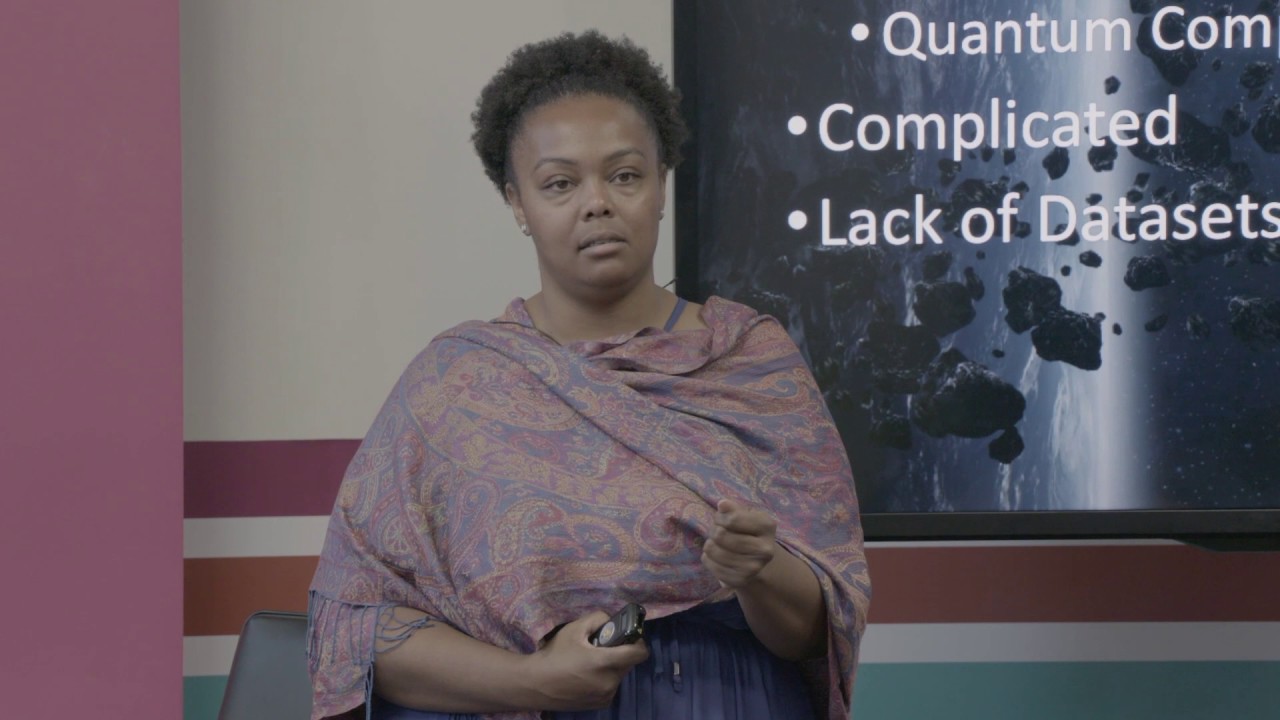
Christianna Taylor explains machine learning and AI, covering why training is slow without GPUs and why algorithms struggle with small datasets. She argues AI can't replicate empathy or human intuition, then walks through applications in space observation and environmental monitoring.
Chapters
And it has every right to be because technology moves so fast. And that's the cool thing about it because it transforms from one industry to the next. Now, challenges. I said we're going to talk about it. One, it's slow. I don't know if you've ever had to actually program a machine learning or AI algorithm. Programming is not that bad. It's not. If you like programming, if you like math. If you don't, it may be a little painful. But then we actually have to sit down and have it churn out your decision, and then it makes the wrong decision. You're like, no! It is so slow. Now, GPUs. That's where the NVIDIA comes in, comes through. GPUs come through in changing the game. We can do so much more data crunching, number crunching because of GPUs. Where we're looking at quantum computers, again, changing the game for how we're going to do AI. Heck, my computer— well, my computer has GPUs. This probably does too. But my computer has GPUs. You couldn't buy a GPU in 1960. You had like note cards. You know, you dropped them. You're kind of like, okay, I guess my dissertation is not happening for 2 years. It's going so fast. But even now, we still We still have a problem. It's very, very slow. And not only is it slow, it's complicated. How do you know you're using the right algorithm for the right decision? You still need a human in the loop at this point to make sure that you are verifying what you're trying to do. And that's where I think reinforcement learning is going to be really cool, because when it gets a better— excuse me, when it gets a— Better. More fulfilled dataset so that you know how to create these new algorithms. I think that's where it's going to really take off. But it's still really complicated. Finally, lack datasets. Now, I said, all right, you have some experiences, you make a decision, you have some outcomes, you're good, right? A computer needs data. And when I say data, I'm not saying, oh, here's one face. All right, you're good. A computer needs millions of faces. Not like, oh, maybe 1,000, maybe 10,000. No, you want a huge dataset. And what do you have to do as a computer scientist, as an AI person? You make up your data. Now, that's— I think that's kind of the only time it's actually okay to make up data. I could be wrong. But the reason you have to have multiple datasets is because If my face is straight on, if my face is smiling, if there's more light, less light, there's all these variations that we take in with our senses automatically. And that's part of our experiences. A computer can't do that automatically because there's so many more decisions that are being made at one time versus what you can take in as a human being. So datasets are huge. Therefore, whenever you hear about someone doing something really cool, like Planet Labs right now, they're trying to do— they're trying to look at the Earth once daily versus right now I think they're only at weekly, which before we were only at monthly, I want to say, before that 3 months. Those are huge data sets. Computer scientists are dying to get their hands on that. Please give me that data, please, because you can tell so much more information that you never had access to. Data is a huge Huge bottleneck for artificial intelligence. Drawbacks. You can't quantify everything. I don't care what you say. You cannot quantify absolutely everything. I don't want a computer telling me, hey, you know what? Your leg's broken. Hey, you know what? You need to— your parent's sick. I don't want that. Computer is never going to take away your bedside manner. And that's where I think our jobs, that's where I think people are going. That's how work's going to do. We have to do things that computers can't. A computer can't be empathetic. They can't be sympathetic. But more importantly, a computer can't design. I don't care what they say. A computer cannot design something for you. Now, I personally, I don't know if any car aficionados around here, but I personally love those 1920s Rolls-Royce, old-school black taxi car body shape. That is beautiful to me. I also like a nice Ferrari because it's sleek and it goes fast. That's great. A computer can't give me a Rolls-Royce that's fast. It can't because it's physically impossible. But humans can go and say, you know what, I see these shapes, I see these lines, I see this, I see that. I personally don't think a computer is ever going to be able to get there. Now, I could be wrong. Feel free to prove me wrong, please. I'm not going to. Let me know. But the things that a computer can't do, the way you feel, that gut feeling that something ain't right here, let me fix that, a computer is never going to be able to do that. But it can supplement. It most certainly can supplement and quantify your decisions for you. And that's what I think artificial intelligence is used for and most useful for. Now, I said I was going to give you guys a few resources. This article, Non-Technical Guide to Machine Learning and AI by Sandeep Brew, And there's a link there, but literally just Google that. One of the best, most comprehensive guides I've seen out there that literally has events, people, places, really great guide to different types of machine learning. And even if you're a technical person, I think this is a really, really great resource because it'll tell you who to follow. I personally use Iris AI. Iris is literally an— I guess they're 3 years old. They're about 3 years old. They're an AI company that literally will allow you to read your scientific journals and actually then give you other information and recommendations for new science journals. If you've ever done research, if you've ever done graduate work, you know how important that is. It'll summarize it for you very quickly and help you with things. Udacity has some really great, great content. Machine learning. The machine learning class is really good. The reinforcement learning class is good. The Google TensorFlow deep learning classes is absolutely excellent. I use NVIDIA hardware myself. And then MATLAB has some really great interfaces out there. So if you're looking for a quick starter guide as to how you can get into this AI world, this is my personal recommendations and things that has really helped me. Again, I did this in grad school. From what I did in 2011 to what it is now, it's a completely different world. So that's just me personally. But space, the coolest thing ever. This is what I love. How do I use all that AI stuff for space? Let's take it back a minute. What do you use space for? I had a really hard time explaining to people that aren't excited about space how you utilize space every single day. You utilize space in your food, in your logistics, in your banking. Imagine a minute difference between the US and European markets or the Asian markets. We utilize space so much every day, we don't even realize it. Even people who are— even indigenous people who have no contact whatsoever with technology, They are indirectly benefiting from us being able to see, this is what your environment looks like. This is how we can protect your environment. All the logging that goes on, all the logging that goes on, all the rainforest deforestation, all this stuff is benefit from space. Interplanet Labs, all the hyperspectral imagery that's coming our way. There's so many great things that we utilize space for. Now—