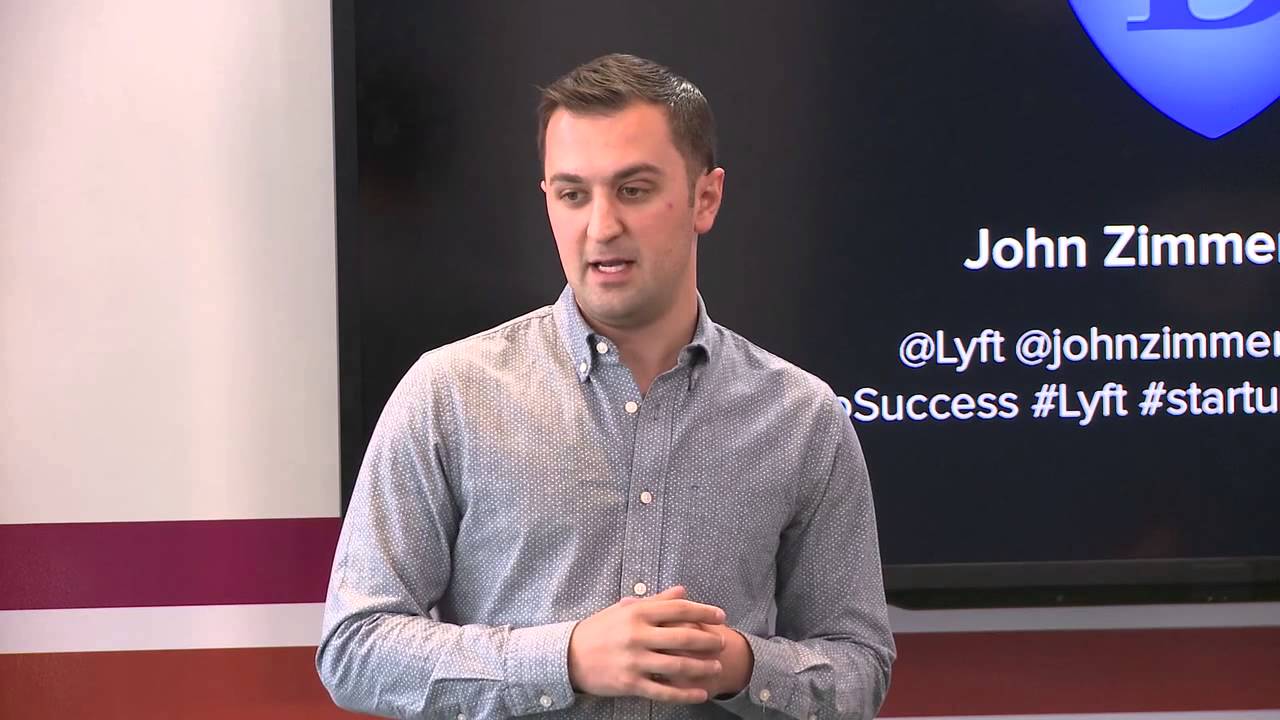
This content was created by Tim Draper. This content was uploaded by Tim Draper. This YouTube talk (title: "From Colleges to Ceast and Desist Letters, the Origin of Lyft | Lyft President, John Zimmer", posted 2015-07-17) is a first-person recounting by John Zimmer about the founding and evolution of Zimride into Lyft. Zimmer describes the idea origins in a 2006 college course, the challenges of trust, financial incentives, and critical mass for carpooling, his stint at Lehman Brothers, discovering co-founder Logan Green via Facebook, the early years operating Zimride (2007–2012) selling private networks to universities and companies, living modestly while building the company, and the 2012 pivot to an everyday ridesharing service (Lyft) aimed at replacing car ownership. He also discusses regulatory pushback (cease-and-desist from California), legal and community strategies they used, and broader lessons about reinventing products and sticking to a vision. The excerpt includes occasional brief interjections from another speaker (labeled SPEAKER B) but is primarily Zimmer's narrative.
Chapters
Taking it back to Zimride. So in 2006, I'm a senior in college. I'm taking a course called Green Cities in the School of City Planning. And my professor gave this lecture about the history of transportation, and that's when that sparked that idea that, wow, the current system is incredibly inefficient. I started thinking about occupancy. And I started writing a business plan and a marketing plan for an idea to make carpooling work. And at the time I thought carpooling sucks. I was like, it's the solution, but it sucks. And it sucks for 3 main reasons. One, how do you establish trust if you're going to get in the car with someone else? Your parents told you not to do 2 things, ride with strangers and take candy from strangers, and with Lyft we do both. So we had to think a little differently. How do you get people to trust each other? How do you create a financial incentive? It wasn't enough to say, oh, carpooling is good for the environment or it's fun socially. You have to have a financial incentive. And the third was critical mass. And the two other things led to that critical mass. You need to just solve safety, financial incentive, and then you could maybe start getting to the critical mass. And the critical mass question is the hardest. It's this chicken or egg. A lot of marketplaces have things like this, but I'd say this is particularly strong. If you didn't have enough people doing carpooling, then why would I start doing it because I couldn't find a ride or I couldn't find a passenger. So I started writing this business plan, marketing plan, and I still had that Greenwich bug of you need to get into finance. And so I went and worked at Lehman Brothers. And so this is 2006, and for those of you who know what happened to Lehman Brothers, it was still around in 2006. In fact, it had one of its best years ever. And I signed up to do a 2-year analyst program. And I told my best friend, I said, if I don't leave here after 2 years, punch me in the face, because I didn't want to stay there. But I was worried because I had seen people that got sucked into that world and I just didn't know what was going to happen. I didn't know why people got so intoxicated with that world. And so about a year into it, I realized I didn't like it. It wasn't motivating me. It wasn't super exciting. I'm glad I did it. I learned a lot. But I was on Facebook one night in 2007 and my co-founder, who I didn't know at the time, Logan Green, posted on a mutual friend's Facebook wall, hey, check out this website I'm building, Zimride. And my last name is Zimmer, so this is really weird. Logan had been to Zimbabwe where he had seen people sharing rides out of necessity, and he grew up in LA where people sit in traffic out of necessity. And he thought this is really stupid and let me design a solution. He had an engineering product background and he started building a website, zimride.com, to get people to share rides on long-distance carpools. Again, I'm online like not loving my job and on Facebook and see a mutual friend starts a website that has part of my last name in it related to the topic that I've been obsessed about for the last few years. And I say, what the hell is going on here?
That's good.
And so I called the mutual friend. He connects Logan and I and we— he said he was looking for a business partner. He flew out to New York, we start working together. I work for another year at Lehman Brothers and then I say I'm going to leave. I've done my 2-year analyst program, I had seen half of my group let go because Lehman was going like this and then it— my second year it started going like this. And a woman in my building who happened to be my best friend's mom said to me, How could you leave a sure thing like Lehman Brothers to do a crazy-ass carpool startup? And when I saw that, I think this is the thing about entrepreneurship is when you see these, you have to be— you have to think differently. You have to think when you're told that you're being— your idea is never going to work, sometimes that's either going to be true or you're going to have the best idea ever because no one else thought of it. And so it's part of being an entrepreneur is that you have to get comfortable and you have to almost like get fired up by that. I got fired up. She said, how could you leave a sure thing like Lehman Brothers to do a crazy carpool startup? And I said like, fuck it, like this is exactly why I don't want to be here. And I left pretty soon thereafter. 3 months later Lehman was bankrupt. So I sent her a note and said— yeah, yeah.
Did she respond to that note?
What's that?
Did she respond to that note?
Yeah, she gets mad at me every time I bring it up. She says, you like, it's many years later, stop bringing it up. So yeah, she she she.
I love that when such a situation happens. I'm like those people that say you shouldn't do anything and you do it and you prove them wrong. They should hear the rest of their lives. Like every time you meet them.
They what? They're scared.
Yeah. No, they should hear that story.
Oh oh they should.
The rest of their life.
Yeah. Yeah. Yeah. I think it was it was good for them to see. I mean they they're like this. A lot of people, I think a lot of New Yorkers included like that are just stuck in the same ways. Now New York is innovating. Bloomberg came in and said let's get— let's set up this city for tech. And so I think what often happens maybe out here in Silicon Valley ends up spreading across the country. So anyway, I did leave, I Zimrode across the country, so I carpooled out from the East Coast to the West Coast, ABC followed us because it was a summer of high gas prices. And we got to— we had a crazy journey with a few friends, we got to Palo Alto and I started living at my friend's parents' house. And so after working in Lehman Brothers, having a high salary with big bonus, around all my friends who like spent their bonuses, I always saved it. I went and lived at my friend's parents' house. And I did this for a few years, we took no salary, Logan and I, when we started Zimride. Zimride, for those of you who don't know, is again that long-distance carpool as I'm leaving from college campus going home. And I didn't realize how weird it was that I was living at my parents' friend's house until I would have friends visit me and eventually my girlfriend, who is now my wife, and everyone was like, what the hell are you doing? Like you're living with Quinn's mom, like this is really weird, man. Like you go downstairs and like, I would like go down, like cook in the kitchen, like use their pots and pans, and like I just got so used to it. And then I would have friends that would give me the perspective like, you're losing your mind.
I think it is the beginning of the success story for Lyft, because that is probably your first experience with shared economy.
I was like an Airbnb.
Yeah.
Yeah, and they charged me. My friend's mom charged me, and she charged her son actually.
She's a good entrepreneur, and if she charges—
She is a good entrepreneur, yeah. So anyway, so I was living there for a few years, I think it was probably 3 years, 6 months of the 3 years I lived in the office, we called it the apartfice, it was half apartment, half office. Logan got the bedroom and I had the second bedroom which was turned into an office, and so I slept on the couch and then rolled over and went onto the couch. Computer. But this was the first few years of starting a company. And so again, this was 2007, and we operated Zimride from 2007 to 2012. And the way that our business worked, we sold networks to universities and companies. They would pay us an annual fee and they would get a private network. So I went to Cornell, there would be a Cornell University Zimride network if you went to Cornell, had a Cornell email address, kind of the way Facebook started. And the business, it worked. We got to— I remember saying at the beginning when I was living at my friend's parents' house, it's going to be really cool when we have 20 people working with us. And we got there. We had 25 people working on the project. The business became profitable. We had 150 universities and companies paying and raised a couple million dollars. And Logan and I look at each other, in the middle of 2012 and we went back to our vision again. And we said, we want to reconnect people and communities through better transportation. And we had also said we want to change the fact that 80% of seats are empty at all times. And so we looked at ourselves and said, how are we doing towards that vision? And we said, we're not doing enough. We're getting college kids to use this for trips maybe twice a year, but that's not going to— that's not going to have a big enough impact. And so this is I think another important lesson, which is sometimes you have to reinvent yourself through the process or reinvent your product through the process and kind of ask the hard question of forget all the— we had 25 people working on this, we had built up all this technology, we had 150 clients, money was coming in, we had told investors this is what we were doing, but we had to say like wait, stop, if we were starting over, forget all that baggage, what would this look like? So now you have iOS and Android, which didn't exist when we started. You've seen other companies come about that are doing interesting things in transportation. And we said, well, what would we do today? We would make this work for everyday trips. So instead of trips that you would take twice a year from college, we want these to be trips you would take twice a day. We want to replace— we want to create an alternative to car ownership. And at the time, Uber existed doing black cars, and to us that was like everyone's private driver, that's great, some people will want that, but to be the alternative to car ownership that makes it such that you don't need a car ever, we're going to have to come to create an affordable product, but also a brand and experience that I would argue is more human, where people— where drivers treat passengers well and passengers treat drivers well, and this is, I think, from my background in hospitality, I wanted to create the right experience that would scale become mainstream that would allow anyone to be a driver. All of us should be Lyft drivers is the idea into the future. And so this is the middle of 2012, and the idea is to use personal vehicles to get people to provide rides to others for a fee. This is like— it's never been done with personal vehicles, and there are major legal questions. Many would argue it was 100% illegal. And so this is another turning point for us as entrepreneurs and for the business, and we had a business that was working and we said let's do this thing that we think will help us get farther along with our vision, but is completely different and fraught with regulatory risk. And we said fuck it, let's go for it. And actually like to the— credit of our general counsel, usually lawyers are not lenient, but we were in a board meeting and our now general counsel said oftentimes some of the biggest businesses are started when there is this type of challenge, because people haven't done it before. And so we did it, 2 months later we got a cease and desist from the State of California telling us to stop. I called Arnold Schwarzenegger's chief of staff, his former chief of staff, he was no longer governor, And she was phenomenally helpful in advising on government relations. We had already created a more safe system for sharing rides than any taxi or limo that we had seen before, so we had criminal background checks, driving record checks, we had created that experience of hopping in the front seat, getting to know your driver, we had onboarded hundreds of drivers, and so we fought back and we fought back with the community. And we fought back with the vision. It wasn't just the vision that we had, but it was the vision that our drivers had and our passengers had for a better way of getting around cities. And we were eventually able to push back against all the legal and regulatory hurdles we had. We created new rules in California that have now been spread across about 30 states now. And so that's just one of the hardest times and trying times. They told us they were going to come to our office. threatening to arrest drivers, impound vehicles, go after us, and we just went back to our vision and said, you know, the net of what we're doing is very positive, is worth fighting for, and we're gonna keep driving through it.