From enabler to advisor | Alyssa Simpson
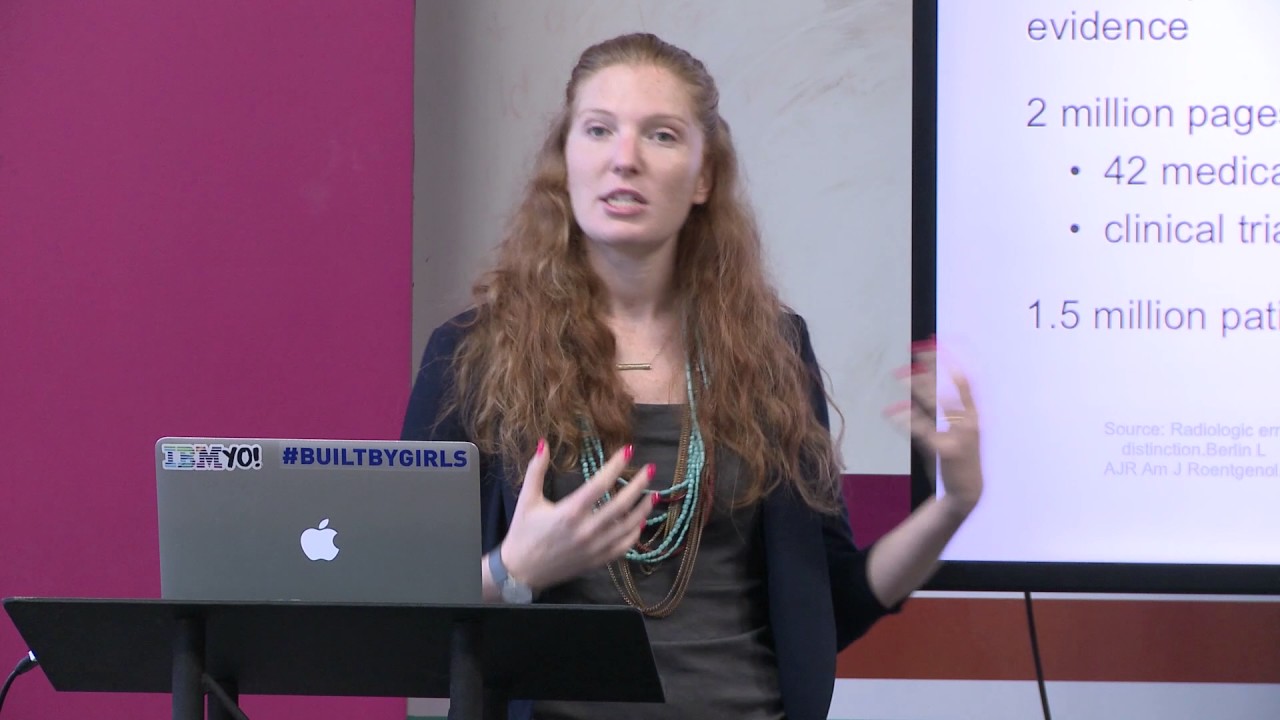
IBM Watson product manager Alyssa Simpson explains how AI shifts from tool to advisor. Watson beat Jeopardy, helps radiologists read scans, and works with Mayo Clinic on cancer diagnosis. Simpson shows how companies can use it to analyze customer feedback and integrate data across industries.
Chapters
Yeah, sure. Do you want to— Go ahead.
They already know you. All right.
I'm Alyssa.
It's all yours.
Cool. So let's see if this video works. My name's Alyssa. I'm here with Laura. We're from IBM Watson. So thank you so much for having us. Who's heard of Watson? Everyone. Not everyone. All right. So high level, who's heard of Watson beating Ken Jennings on Jeopardy? All right, cool. So I'll just sort of start there. Watson is a very fancy business area of IBM, cognitive computing. We're really excited about it. I'm in a product management or offering management role, and I oversee all the signal services. So vision, speech, tone, PI, and a bunch of other ones. I'm gonna start off with a little bit of a funny video just to kind of get you guys in the mood, and we're gonna go through kind of what Watson's all about and how IBM thinks about AI and cognitive computing. computing and what that means. Sound good?
Yeah.
All right. Stop me at any point with questions. Otherwise, it'll just be me talking, and that's no fun. So hopefully this is interactive. Let's see if this works. And there's no sound.
One day I wake up and it's like, it's like the world doesn't need us anymore. Exactly. I can hear you. What's he doing here? Hello, my name is Watson. I brought Watson here today to confront the source of our hazard. I am a cognitive system. I can understand, reason, and learn with humans.
With humans.
Yeah, that's not what I'm passionate about. I understand 7 languages, so I can help people collaborate. Collaborate and dominate.
Naive plans. Run it.
Forward, boss. Why don't we take a break? All right, we'll just have some coffee and some donuts. I'm eating my feelings.
All right, so it's an ad, but I think it's funny, so I like it. All right, cool. So it's going to play.
All right.
If you want to learn more about Jeopardy and how we beat Jeopardy, by all means, YouTube's great. Cool.
Ta-da!
All right, cool. So important IBM disclaimer, anything I say about future roadmap, I'm not responsible for, basically. All right, cool. So we at IBM talk a lot about artificial intelligence and cognitive computing, but kind of what does that really mean a little bit? So this is kind of a little bit talking about cognitive computing is kind of this partnership between humans and computers, right? And shifting the role of a, of a computer, right? Because everything you guys have, your iPhones, all the laptops that you guys are working on, are all programmable machines, right? So you give it a series of logic and information, and it'll do something, right? Send an email, send a text, it'll do something. The shift that we're talking about with cognitive computing is this partnership where we as humans give computers or computing systems information and data, and then we ask it a question, And the system comes back with, in an advisory role, advice. So in the same way, you guys may be familiar with interacting with Siri or Alexa or Cortana, some of our competitor type of roles. These systems can provide advice. They're sort of like a consultant. And so Watson is a platform that can be, that we open up for anyone to build businesses on top of, and so there's tons of cool examples that I'll take you through. Some of the ones we're more proud of are in healthcare, where we are advising doctors around how to treat cancers, or what treatment for this particular patient is the best, or how to deal with drought here in California, or all sorts of different areas of industry where it's not possible for individual humans or even a team of people to process the sheer volume of information that exists, 'cause there's so, so, so, so much data, and we need advice around what to do next, and make those decisions in split seconds. So that's kind of the model of partnership when we talk about it. So what's cool is that this is just beginning to take off, but the technology's not actually particularly new. AI has been kind of buzzy around for the last 50 years or so, but it's just now that the technology advances and the platform stability has come to fruition, and where there's sort of the amount of data where early adopters are really being able to take advantage of this and disrupt industries and disrupt businesses, and so that's what we're really excited about. So just some stats about the industry. But this term cognitive computing is still weird. Everyone's like, what the fuck is that? And so I just wanna reiterate, this is what we talk about, this role of enabler to advisor. Right, so anyone had an X-ray recently? I busted my ankle, I got an MRI, an X-ray, right? We've all had this done, but this is an example of technology as an enabler, right? It allows you to do something and see inside the body. However, anyone been to a radiologist? So you know that almost a third of them make a mistake. They will under-dye, they'll look at your scan, right, and— They'll miss something. they will not see something, right? Happened to my sister. She had a huge cyst inside of her. Doctors missed it. They did an ultrasound, right, for her appendix. There's a massive grapefruit-sized thing in her on the scan, and they just, like, didn't see it 'cause they're looking for something else, right? They're worried about her appendix, and they're not looking for this cyst that showed up. So error rates, a huge problem. And so, this is about 5 years ago. We set out to train the system, working with the Mayo Clinic, right? 600,000 pieces of medical evidence, 2 million pages of text, medical journals, right? There's 1.5 million patient records, so there's tons and tons and tons and tons of information, and as a radiologist, you can't be expected to, like, read all of that, right? It's just not possible. And then, so, the doctors and nurses who worked with this system, they say, hey, Watson, I have a patient in front of me. What do you think should be the treatment plan, right, or what is the diagnosis here? 90% of the time, the doctors and the nurses take the advice of the cognitive system, right? So pretty cool stuff that we're really excited about. So what's cool is that there's gonna be— yeah?
And what's the error rate?
So great question. Let's talk a little bit about what error rate and accuracy means. So let's take an example of, let's see, a picture here. So what is this a picture of? I can't hear.
Mammogram.
A mammogram, possibly. All right, what else?
Radiography.
Sorry, what?
Radiography.
Yep, radiology. All right, another correct way to say what this is a picture of is a white woman with her hair done pretty and a man looking at a white screen, right? Or it could be that, you know, this is in a doctor's office. Would you say that all of those are correct ways to describe this?
Yeah.
Okay, so accuracy is really a contextual piece of information, right? Accuracy depends on what answer you're looking for in what context. Does that make sense? So in simple cases, for example, if you're looking at her scan here, right, and let's assume for all intents and purposes, I don't actually know, but let's assume it's a mammogram, and we want to diagnose is it positive or negative, there is a correct answer probably there. It's black or it's white. But accurately coming up with a descriptor for this image, there's not one correct answer. So accuracy is really blurry. It really depends. And depending on what data you train the system with and what question you're asking, you can have different types of accuracy for different types of problems. And so accuracy depends on the system, who's training it, and for what purpose, and what is your ground truth, right? What is your— this is the correct set of answers that we're benchmarking against, and that changes over time. Does that answer your question?
Not really. Because you say, like, even with the 26%, did you then compare with what's on today's Okay, they were 26%, then using machine learning we had only 3%. Do you have an idea?
Yeah, yes, we do. So with, they did a, so this was, I think, a study that was done which compared clinical diagnosis, postmortem diagnosis, 20% of cases a major diagnosis was missed. I don't know what the error rates were off the top of my head for this particular comparison, but in another radiology example for melanoma, like skin disease, Humans have a rate that's, I think, around 15 to 20%, and Watson has a rate currently of about 4, 4.5%. But again, accuracy is a mixture of precision and recall, right? So precision is, did you accurately get it, kind of yes or no, and recall is, did you find it within that area, in computer vision, at least. So these are really complex questions that, When you start to break them down, there's not yes/no answers, or 4%, or 2%, or whatever. It depends. So every benchmark is different. All right, cool. So you guys are all building startups and building businesses. What's cool about this is that there's a huge market opportunity here, particularly for folks who are in kind of the C-suite. There's a lot of people who are really excited about cognitive technology and innovation and bringing that into their business, but they really just don't know how, and they're frustrated because they're concerned that they're not really going to be able to innovate at the speed at which they want to, or not be able to draw on customer feedback. Think about if I'm— anyone ever try to order flowers for their mother, 1-800-Flowers or something?
Yeah.
There's a lot of back and forth around ordering something, or maybe you got it wrong, and you're emailing them, or you're chatting online, or you call in. There's so much information that's captured there, customer feedback, that they don't have the toolset right now to draw upon and understand what's going well or what's going wrong or how do they make changes to their business. What's cool is that there's data that companies possess, like customer records, transactional records, what happened when, predictive models, and then data outside that a company owns, right, so Facebook, news, like Twitter, right, all sorts of things like that, the weather, what's going on there, and then sort of data that they don't yet have access to, right, that they could have access to. So for example, call logs. Right now that's auditory information, right, you and me speaking. It's not necessarily written down. It can't easily be mined, and so using AI, right, you can translate speech speech into text and start mining that data in a way that they might not have access to today. So, pretty cool. Anyways, in sort of different industries, this is a little bit how it breaks down. There's huge gaps in retail and healthcare and insurance, every kind of major industry. Thank you.
More from Tim


He Sold His Car to Build This Startup, Then Pitched It for $1M 😳 #Startups #AI

This Startup Moves Your Crypto BEFORE Hackers Can Steal It 😳 #Crypto #Cybersecurity




15 Months Without Refrigeration?! This Startup Thinks It Can Go Global 🥥 #FoodTech #Startups



