From Google Engineer to Life-Saving Biotech Founder | Meet The Drapers Global: Miami
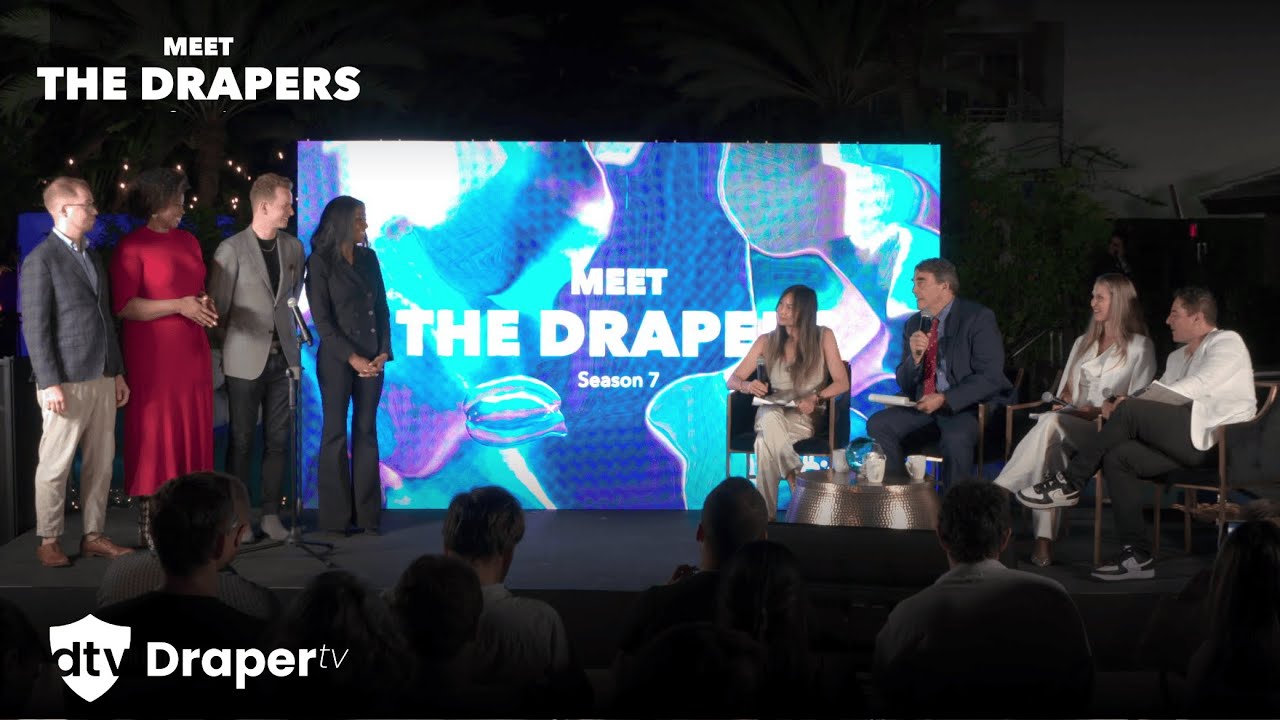
Tim Draper hosts four entrepreneurs pitching startups in Miami: Tamika Van Tifflin on sexual assault prevention, Kyle Sonlund on AI for rare diseases, Aurelia Edwards on nail health, and Johan Wikström on cystic fibrosis treatment. Judges grill them on market size, regulatory risk, and competition before voting on who advances.
Chapters
Entrepreneurs and help them secure a spot in the finale. Who will rise to the challenge and secure the funding to, to turn their dreams into reality? Let's find out together on season 7 of Meet the Lakers! We are here in Miami. Welcome to Miami! And we are here to see some of the greatest entrepreneurs, some of the greatest Bitcoin, some of the great startups of the entire world. These entrepreneurs, we've chosen the best of them to be on Meet the Drapers with me. So the great thing about Miami is freedom brings on some of the greatest entrepreneurs in the world because people with freedom, they're allowed to innovate, they're allowed to think big, they're allowed to explore their imaginations.
Getting $1 million would mean everything. It, one, helps us, one, get the app out there, but also, you know, building that technical team.
A million-dollar investment would allow us to treat more than just one or two patients.
It would mean growth and expansion. We have a pipeline of customers that we're working with, and we also have some really cool innovations that we want to start building out.
To show the world the software and the vision that I have while being able to apply some of the core values of neuroscience.
Welcome everybody to Meet the Drapers!
Woo!
This is the show where we bring in 4 awesome entrepreneurs out of thousands that try to get onto our show. We get the 4 that are selected to eventually compete for a million-dollar investment. We're here during Art Basel where all the art is going around, and this is really, really an exciting, unique day because we have 3 awesome entrepreneurs with us today as judges. And we select these judges particularly for how incredibly awesome they are But we also select these judges based on who we want to adopt into the Draper family. So all of you now, your last name is Draper.
Love it.
And you're a part of the family. So welcome to the family. I have Lucy Gao.
Is that right?
Lucy Guo. Close enough.
Lucy Guo Draper. And Lucy is an entrepreneur and inventor, founder of Passes and scale AI with 7.3 billion what dollars dollars in value, right?
Yeah.
To my immediate left, we have Crypto Megan, otherwise known as Megan Nielsen Draper. She has a great Web3 portfolio, strategy consultant for companies, investors, and celebrities. Megan, welcome to the show. Welcome to the Draper family.
Oh, that was amazing, Tim. Thank you so much for that intro. And from a Bitcoin OG himself, I absolutely love this program.
That's old guy.
All right. And to my far left, we have Adrian Joffre. I'm always a Draper.
Draper.
And Adrian is deeply involved in the entrepreneurial ecosystem and the Founders Institute director in Chile. And a representative of Draper University in Chile, Adrian.
Woo-hoo!
Welcome to the family.
I'm very happy to be here. Thank you for having me.
This show's really about the entrepreneurs, so let's bring on the entrepreneurs. But before we do, and this is something you're gonna have to learn now that you're a Draper, let's see what's going on behind the scenes. You gotta do this eyebrow.
I'm Tamika Van Tifflin, and I'm the founder and CEO of Aegis. Aegis is a personal safety mobile application that modernizes the way we interact with 911. Aegis was born out of tragedy. I have a twin sister who has suffered from seizures most of her life. On a walk home, she had a seizure, and she woke up to the horrors of a sexual assault. And due to her inability to speak, she wasn't able to get the help she truly deserved. And on the other side of that, because she wasn't able to articulate what had happened, she wasn't able to explain who I was to them. So being that it's my sister and I'm her, you know, emergency contact, she wasn't able to let them know. And it was over 24 hours before I found out what happened. And I kind of went into a downward spiral of How can I— is there a solution out there to prevent this from happening again? I have 20 brothers and sisters, and everyone knows to come to me to, like, protect them and save them. And being that this was my sister and I couldn't save her, it really messed with me. I knew I've always wanted to help people, and I never wanted people to feel, you know, sad or bad about themselves, because everyone's unique in their own way. This journey, it definitely is a roller coaster and has its ups and downs. I'm not a developer. I wish I was. But how I got to it, my CTO, Raul, we actually worked previously together at a company, and he actually had a personal story that resonated. So he was just like, this app needs to be out here. How can we help that? Having someone like Tim, you know, validate what I'm working on and really like highlighting that personal safety and public safety is, you know, something that's relevant and needs to be modernized and changed. I really want people to see me, resonate with me, and be like, okay, I can get into entrepreneurship, you know, I can start my own company. It doesn't matter my background, where I come from, you know, what I look like. I just kind of want to add to the face of tech because there's not a lot of us, you know, at least up on the higher level when it becomes like a CEO or like running a company. And once I get to that, you know, area and I'm recognized as, you know, a founder, not just As a first-time, you know, founder, I really hope I can change the game with that.
Coming up on Meet the Drapers.
So with the app, with stalking, I suppose like why would 911 be harder to call? Because generally they listen in the background as well, right?
You know, coming to Miami, it is absolutely a beautiful city, a great place It's a great place to be if you're an entrepreneur. It's up and coming, it's lively from the cuisines, and my favorite part is just meeting other like-minded founders and just really experiencing the environment.
Our first grilling goes to Aegis App, and this is Tamika.
Tamika, but close. I get that a lot.
Okay, I get— yeah, I get team a lot.
Tamika.
Is that right?
Tamika.
Tim butchering my name, but I thought that was fun.
My personality got to come out with just that.
Hi everyone, I'm Tamika Van Tifflin, the founder and CEO of Aegis. I have a sister who has suffered from seizures most of her life. A few years ago, on a walk home, she had a seizure and woke up to the horrors of a sexual assault. Due to her inability to speak, She was unable to get the help she truly deserved. Unfortunately, my sister's story is not unique. Countless individuals face communication challenges during crisis or emergency situations. This is where Aegis comes in. Aegis is a personal safety mobile application that modernizes the way we interact with 911. Think Uber for 911. Just as you can now order a ride through an app instead of hailing down a taxi, Aegis allows you to contact emergency authorities with just a tap of a button. No verbal communication required. Aegis functions like a personal home security system. First, you send an alert through our mobile application, triggering an immediate connection to our partnered monitoring company. From there, within seconds, our monitoring company receives your alert, your profile, medical background, real-time GPS location, and audio and video recording of your immediate surroundings. Finally, first responders arrive on scene informed and ready to help. Today, we are in active conversations with universities and corporations across the U.S. My drive stems solely from creating a solution from a longstanding problem that can ultimately save lives. So Drapers, join me in creating a world where personal safety is accessible with just a tap of a button.
Tamika, tell me this. First of all, if your sister's having a seizure, can she even push that button?
So yes, to answer it. So my sister— so usually if you're not familiar with seizures, a lot of people have like that window that they have before they have— before they go down in having a seizure. So the 2 ways would be my sister would be able to pull out her phone, or we'll be launching in wearables to tap the button and send that alert out. Or we're going to utilize Google Analytics and that crash detection.
So with the app, with stalking, I suppose, like, why would 911 be harder to call? Because generally they listen in the background as well, right?
If you've ever contacted 911, you would know that it could take— a hold time could take 3 to 10 minutes to even get to a dispatcher first. And then second, you have to go through 7 to 10 questions so they understand what your emergency is.
When you typically call 911, it's all triangulated, so they don't have your exact location.
So when you're speaking to them, you could be in a new area and may not, you know, know where you are, and you don't know how to describe it, don't know the address.
And then on the B2B side, who are your biggest customers and how much are they willing to pay each?
Yeah, so we're tackling one by one, but the industry that we're focused on right now is aviation and airports. We actually had one of the airlines reach out to us, heard about what we were doing, and then wanted to do a partnership.
I guess I'm wondering, Is it like a 5-figure, 6-figure, 7-figure per year contract?
Uh, 6-figure.
How do you— you said, um, and you turn on the videos all around the area. That would be easy in an airport or something, but out in the middle of a university campus, are there, you know, do you alert all these cameras?
Yeah, so we leverage the video on your phone.
Oh, of your own phone? I was— the way you described it, I thought you were gonna get That camera and that camera.
You know what, maybe I'm gonna write that down.
Write it down, go for it. Yeah, absolutely. Start marketing that now. Tamika, thank you for being on Meet the Drapers. It's great having you. Terrific.
Whoa, what do you think of Tamika?
It was all a little bit of a blur, I think, with the adrenaline just going on, getting on stage.
Let's hear what the judges thought of Tamika.
I think that the idea is great. We were talking about yesterday, we're talking about the crime.
Yeah, I absolutely love it. I think it's great that she has that passion because of her personal experience. And if you guys watch like true crime or all those crime shows and you hear these 911 calls and you're freaking out at the moment and the operator's like, can you repeat that? It's like, it's so hard to do in the moment. So I think it's a necessary service.
I liked how she was so knowledgeable about the 92— 911 system. And then on top of that, I think going the B2B route is very smart because the crimes that she listed generally don't happen— like, you don't expect it to happen, so you're not going to download an app in advance to protect yourself. However, going to B2B side, they can force all employees to download it, so when something does happen, they're prepared. So I thought that was really interesting.
Oh, so interesting. So there's a little bit of a viral effect that happens when you do it Throughout an entire business.
Yeah.
I thought she was great. Wow, what a winner. And, uh, and the business, I, I don't know how big it gets, but I think it really does have, um, some potential. It's definitely a need out there. Okay, we're gonna move on to our next entrepreneur, but before we do, I want everybody out there to do the eyebrows. Let's see what's going on behind the scenes.
My name is Kyle Sonlund, and I'm the founder of Wisdom AI. And the goal behind Wisdom AI is to capture the essence of humanity and build digital legacies that outlive any of us individually. So I'm from Philadelphia, Pennsylvania, or outside in Doylestown, and my whole career I had been focused on new and inventive technologies. I saw how the future of finance was going to be impacted by blockchain technology, and that's where I, I really started my tech career, but very quickly realized how powerful automation and artificial intelligence was going to be in amplifying the human condition and our experience here in every facet. I think we've all dealt with the loss of somebody that we love. or the risk of that. And it became incredibly apparent as I've watched my mother struggle through multiple rounds of chemotherapy and the anxiety that comes with cancer. I became focused on figuring out how can we preserve our legacies for those that we care about for the future. And I think that a lot of my goals with this technology has been built around Trying to preserve the intellectual wisdom that's created. Not only did Tim understand what this future looks like, but he also realized that it's incredibly expensive. And Tim has consistently doubled and tripled down on the visions that he sees are monumentally impactful. I see this technology similar to like having children. When you have a family, you want your child to be better than you. You want to leave a lasting legacy and impact on the world even after you We can use technology not only to do that for our biological children, but to help drive the technology itself in a way that we would like to see the world go, just as a family member would teach their child.
Coming up on Meet the Drapers.
At the moment, I think that people are generally lazy and they don't want to spend time training models of themselves. So I guess, like, who is your target customer?
The great thing about Brickell is that many people think that Miami is all beachfront and laissez-faire style of attitudes, but Brickell is the financial center. This is where a lot of investors congregate, a lot of the most impactful startup founders are located, and where some of the best developers that I've been able to meet and connect with are. Often found. And so I've lived here in Brickell for 6 or 7 years, and I couldn't be happier. It's young, high-energy, exciting, and friendly and happy. And it's allowed me to be creative and different and to be a little out there.
This is Kyle Sonlan from Wisdon— Wisdom. Wisdom.ai.
Close enough.
What? There's an E in there. Wisdom is only spelled with an W-I-S-D-E-Y.
I think beauty's in the eye of the beholder on that one, but you know.
Okay, hey, spell it any way you want. Okay, Kyle, give us your pitch.
So how many of you have a loved one that you've lost, or someone that you've cared about that's no longer here? A lot of us face that experience, something that's certainly no stranger to me. Unfortunately, my mother has had very aggressive lymphoma. And she's recovering now, and she's on her road to recovering from that. But as I was going through that process of collecting texts and videos and all of the representations of her and I that we've shared, I realized that that digital footprint just didn't capture the joy and inspiration that she provided to me, to my family, and to everyone that she impacts each and every day. And due to my understanding of software and technology, I've realized that We can make sure that that never happens again. So thanks to large language models, we can feed a lot of the information that makes you, you, not only in terms of the information that is external, which is the text and the emails and the work product you've created, but also have design perspectives where you take your intimate conversations and you can train this model to understand how you think, what makes you tick exactly. It's actually something incredible for your future legacy. Imagine, Tim, the impact that your wisdom can provide to future generations by capturing—
This is scary.
It would be pretty impressive. Not only would it change your world today by actually having you do all the work that you want to do exactly how you want it, but moving forward, we can capture the wisdom of humanity and provide that into the future in a more productive fashion.
So there are a bunch of companies out there doing something very similar. StoryFile is one. How are you gonna How is yours, your angle, better?
So actually taking the approach not only of preserving legacy, which I think is a compelling vision, but having a personalized productivity tool that actually knows exactly how you prefer deliverables and output is really the key here.
Certainly was a little bit caught off guard when they brought up a few specific companies also working on the solution and then asked me, What my exact differentiator is.
At the moment, I think that people are generally lazy and they don't want to spend time training models of themselves. So I guess, like, who is your target customer? Like, I think most CEOs, even for like the example you listed, wouldn't trust a bot to train their team.
I think we already are training these models. I think the big differentiator is that most CEOs are smart enough to know that that data being leaked would be a travesty. So focusing on securing and owning your own perspective and then building the tools on top of that, I think, is the more important role to play.
I'm wondering how you plan on convincing consumers to give all their data, because like I said, people are lazy, right? So I think with like entrepreneurs, the best way to do it is like scrape their Twitter, scrape every podcast they've done, scrape every book they've written.
You make a good point that connecting with the more manual processes is going to be difficult.
I had a great time going back and forth with many of Lucy's deeper questions on what the go-to-market strategy might look like.
You're talking about feelings, you're talking about emotions.
Sure.
How your LLM, you're looking to capture these emotions, these feelings?
This is so important to actually work and strive towards capturing these things. So more so telling your stories, Telling the struggles and all of your experiences and letting this software understand those things and solve those problems for you, understanding how things trend over time is, I think, the best process to do that moving forward.
What I see in Web3 and the crypto world is people don't care about the tech under the hood. They just want to use it and they want it to work and be easy. Like, what are you going to do to compel people to want to purchase this product?
I think you make a great point. It's all about user experience. It's all about the functionality, but it's about hyper-specific needs that get solved. And then making it usable is the most important part, not scary like technology, more about making a lasting impact on your friends and family.
Terrific. Kyle, thanks for coming on Meet the Drapers.
I really enjoy being in those types of environments, having your heart rate get up a little bit and, and having to kind of focus and lock in and, and, you know, do what you do and convey that energy to the crowd. So I had a lot of fun with it.
Judges, what did you think of Kyle? Lucy, you had a lot of questions for him. Go ahead, fire away.
I really liked the idea. I think that the key for him to being successful is finding that, like, a specific niche or, like, need to make it mainstream. So, for example, like, an AI assistant, I think, is probably the first thing that he should probably come out with.
That could be interesting, actually. I really liked him. I thought he was, he was really driven, had a lot of passion. And I think you're making a good point here. If you come up with something very practical that solves a very immediate need, that people understand, then you can go on because legacy, okay, that's cool, but is it going to drive people to buy it right now and try it right now?
And I also noticed he's a bestselling author and influential speaker and did something for tokenized securities. So I kind of, I wonder about how this might just be a stepping stone rather than a life for him.
The feedback that they gave me around the fact that I'm working on a lot of different projects over my career, I think that that's something I'm no stranger to as someone who's hustling and grinding on projects, especially in deep technologies that are very expensive.
Okay, let's hear from our next entrepreneur. But before we do, let's see what's going on behind the scenes.
Aurelia Edwards. I'm the founder and CEO of Standard Measure Technologies, and we are a virtual sizing technology company. That helps brands and retailers allow their customers to size efficiently online.
How is the journey to, like, a larger entrepreneurship where you're leading a team? Like, how's that been for you personally?
It's a roller coaster.
You have hills and you have valleys.
I find it interesting because I feel like as an entrepreneur, the, the low days or the days where you don't have as many wins seem to outweigh the wins. So I've made it a Like just something intentional to make sure that I celebrate my wins and really sit in that a lot longer and not let the days that are hard kind of take over and have a gray cloud over the entire journey. I think in the beginning what I found is that having a network is really important. Having mentors and people that you can ask for help. It's not something that I think we learn in traditional school, like how to ask for help. And mentors have taught me, number one, how to pitch, like pitch practice. So that's been a really big thing is how to talk about the company, Just authentically being who you are, not knowing that you don't always have to get the answers right. You don't always have to know the answer, but as long as you're willing to find out what that is to make sure that you can be the best person that you can be.
How has your family been supporting you through this process?
They've been supportive from day one. I mean, I think I was pre-med in undergrad, so when I said I wasn't going to medical school, that might have been kind of like a jab, but they've been really supportive to see The success that we've had so far, and I think every day I continue to surprise them with different things that I'm building. I think Miami is a great place to build. They really empower minority founders, female founders. It's a melting pot, and I think on a global scale, it's a really good jumping-off point being here in South Florida.
So at this stage, what would it mean for you to get to work with somebody like Tim Draper?
It would mean, number one, I could sleep at night.
I think it will help just validate what we're building, and I think having that backing would get us into the arena where we could bring on some of the major customers that we're working with currently and kind of close those deals.
Can't wait to meet you, Tim.
Coming up on Meet the Drapers.
My red flag goes up when somebody says they're a serial entrepreneur.
We're on Las Olas.
It's downtown Fort Lauderdale.
We're on the New River, um, that's right behind me, and you can see there's boats passing. It's one of my favorite places to come to walk and just clear my mind.
Just the diverse culture.
It's a true melting pot. There's so much diversity, so many interesting people. People are always moving here, not just from within the States, but also globally. It allowed me to work with a We have a very diverse team of people in technology, marketing, business development, so it's a great recruiting effort to have people move down to South Florida. And it's just a great place to get in on the ground level, make those connections, and see your company grow.
Woo!
Hey, Miami!
All right, we got Aurelia from Nail Street.
Whoa! I never get it right.
You got it right this time.
Oh, awesome.
I'm always nervous before I pitch. No matter how prepared I am, I still get the butterflies. Hi everybody, my name is Aurelia Edwards and I'm the founder and CEO of Nailstree, and we are enabling personalization to beauty brands and e-commerce platforms with our precision sizing technology. Personalization is a missed $200 billion Opportunity. And we're choosing to start in the press-on nail space for a few reasons. First of all, it was my personal pain point when I almost missed my cousin's wedding because I didn't have all the sizes I needed. I used some leftover boxes I had in the closet and realized I was missing 2 nails. On the way down, I was driving from Jersey to DC. I stopped at the drugstore to buy a box of 30 nails when I only needed 2, adding to the extra sets that I had that were going to be wasted. And at that moment, I wanted to know, why can't I just buy the 10 nails that fit? The press-on nail industry is on trend to be a $12 billion industry, and for the first time ever in history, press-on nail sales have surpassed nail polish, and that's a really big deal. And like Allure magazine said, press-on nail sizing is a huge problem, and we're here to fix it. So our patent-pending API seamlessly integrates with e-commerce platforms and brand websites, ushering the user through our measurement flow where we use photogrammetry, computer vision, and machine learning algorithms to detect their measurements in real time. Our approach has been validated by our brand partners such as Target, Unilever, and Shea Moisture. We started our B2B offerings in June, where since then we've generated over $190,000 in revenue. I'm a serial entrepreneur, a cosmetic chemist with over 20 years in the beauty spa and wellness industries, and we see a bright future ahead for Nail Street as we dig deeper into to personalization within beauty, also exploring other verticals like jewelry, immersive e-commerce like Web3 retail, and prosthetic fitting. The Drapers. Personalization is the future, and we're starting with nailistry.
My, my red flag goes up when somebody says they're a serial entrepreneur.
Okay.
How much do people pay to get size— their nails sized?
We have a few different business models. On our marketplace, it's commission-based. We take 15% on every transaction. But our real business model is working with brands and e-commerce platforms.
Okay, I think I'll jump in here because I know— I don't know about the gentlemen on this panel, but I know a lot about this nails and eyelashes thing.
Is it a problem for you?
Yeah, no, that's why I don't have nails today. Usually I got my bullish green nails, you know, I'm bullish green for Bitcoin, and it's a huge pain point. And also what I'm thinking about is People are concerned that the salons, the UV rays, are bad for your health.
So it's a huge opportunity. When you look at the beauty space, nails aren't even there anymore. Like, you look at Sephora, there's no nail section.
I guess I'm wondering why you're even custom sizing, because in my head there's not that many nail sizes. Like, 30 should cover it. My friend actually, I don't know if you've heard of Glamnetic.
Of course.
But yeah, she, um, we should connect. She owns it. But she Suns, like, I think 10 different sizes and it fits nearly every single person. So it feels like when you get enough data, you could just have more supply of certain nail sizes and ship them out without having to like custom print.
Well, there's a, there's a couple ways to address that. Number one, sustainability. Why do I want 40 nails that I'm throwing out? That's wasteful.
No, no, no. So I'm saying like in your back and split.
Yeah, from the sizing. Now people who skew traditionally really small nails or larger use 2 packs. And they're not solving for that. What we're seeing is that, let's say right now standard sizing, there's 15 sizes. They give you 2 of those. When you really get up close, a lot of people's nails don't fit well and then they fall off. And that's the reason people complain that they don't fit and they don't stay on.
Aurelia, thank you so much for being on Meet the Drapers.
It never feels like enough time, and I think that's the art of pitching— figuring out how to be as concise as possible, sharing with others your vision.
and making sure they can connect with you in a very human and very intentional, authentic way.
The men out there, did you learn something from our show today? I learned a lot. I learned there should be more female venture capitalists on the planet. What'd you think, Adrian?
No, I think it's great. The market is huge, and I will tell to Aurelia, to use 3D printing. I think that it would be a good add to her business.
Oh, nice touch.
I thought she was very well-spoken. It's definitely a huge industry, and being the API layer is very smart.
Usually the females get it really quickly, and about, I would say, 50% of men get it because they have wives and daughters.
I thought you did a fantastic pitch, and just her whole personality is great, and I love the customization. People will pay for that.
I didn't know this was a market, and I don't know what's going on right now, but it seems like the women on the panel are very excited about this product.
Realizing that Tim didn't get it, I would say, was a low moment. I told him that we'll get him some press-on nails soon.
Okay, so we're gonna move on to our final contestant here on Meet the Drapers, but before we do, Let's see what's going on behind the scenes. What is going on behind the scenes?
So my name is Johan Wikström. I run Tolka AI Therapeutics, and we make precision medicine against antibiotic-resistant bacterial infections. I grew up in Sweden. I went to school as a software engineer at the Royal Institute I have spent many years in software startups and also working at Google on commercializing various technologies, but I also have this underlying health condition called cystic fibrosis, which means that I am more prone to getting bacterial infections than the average person. So I've always wanted to do something to help people with cystic fibrosis and others suffering The antibiotics that I am taking from day to day, they cost tens of thousands of dollars per month, and they are not terribly efficient.
So I am a software engineer by training.
I specialize in machine learning and building products from scientific breakthroughs, essentially. But my wife has been incredibly supportive through this whole process. We could not have started this lab without her. Originally, it was just me and her, and she had the medical background, and in her undergrad, she actually isolated bacteriophages as a research project. So she had that basic knowledge to get started. There are many challenges to running a small biotech startup. Manufacturing of the bacteriophages can be complicated, especially when you need to live up to regulatory requirements. I've always been more towards the entrepreneurial side, even though I worked for one of the biggest tech companies in the world. I always gravitated towards the more entrepreneurial teams at Google. To work with Tim Draper would be a great opportunity for us. Tim Draper is obviously very well known in this field, so it would be amazing to have him on our cap table.
Coming up on Meet the Drapers.
So if you're patient zero or number one, doesn't that put a risk on the business?
We are in Wynwood, Miami, known for its murals. It's got some, uh, pretty good restaurants in too. And there's all just different sorts of people and cultures and ideas kind of flowing into this area too. All the different neighborhoods are Pretty unique too. I think, I mean, I've only been here six months. You've had a little bit more time, but so far I've really gotten a taste of like Wynwood, Edgewater, and Miami Beach.
Miami is a melting pot of cultures. You you really get every single country represented over here.
Our next entrepreneur is Johan from Tolka.ai.
Tolka AI Therapeutics. But you got my first.
Tolka AI Therapeutics. That's a mouthful.
Yeah, it got a little long.
Are you kind of a branding guy?
Definitely not. We added therapeutics so people knew what we were doing.
This was my first time pitching in front of a live crowd. It was also my first time doing public speaking in front of a live crowd in quite a while.
So Tolka AI Therapeutics, we make precision medicine against superbug infections powered by AI. Superbugs, or bacteria that are resistant to all known antibiotics, are a large and growing threat. The WHO estimates that by the year 2050, they will kill more people than cancer and cost $330 billion per year in direct treatment costs. Some people are already living this reality. today, notably people like myself who are affected by Mycobacterium abscessus, a particularly resistant pathogen. So if antibiotics do not work anymore, what are we going to do? We believe that the solution is phage therapy. So a bacteriophage is a naturally occurring virus that hunts and kills bacteria. The great thing about phages is they are incredibly specific. They only kill the bacteria you want to kill and leave the microbiome and human cells completely intact. The bad thing about bacteriophages is they are incredibly specific, which means you have to make a personalized drug for each and every person. And that's where a team of software engineers, ex-Googlers like myself and my co-founder, and our Thiel Fellow microbiologists make the perfect team. So we're combining the newly available cheap genetic sequencing with lab automation, which replaces the human labor of that used to be a big part of personalized phage therapy. And we combine it with machine learning to replace the human decisions that are also a big part of phage therapy. And we have already made our first phage therapy. We have made medical-grade phages, got an FDA approval to use them in our first patient, and we are ready to go.
So if you're patient zero or number one, Doesn't that put a risk on the business?
When you're investing in a biotech, the real risk you're taking is that people will, you know, they will tell you that it's working when it's not.
I've heard that question about patient zero before. I do appreciate his honesty because a lot of investors, I believe, think about that.
So Big Pharma wants it to be one drug fits all, and they are very big and very powerful. How are you going to compete with them when they come gunning for you because you've figured out something that's bespoke?
So first of all, we would be okay with collaborating with Big Pharma down the line. You know, we don't necessarily see them as competitors per se.
Yeah, the worry about Big Pharma, I think, It is a valid concern.
What I'm reading here is it takes 30 days approximately, let's say, to actually develop one of these phages.
If I had a bacterial infection, is that enough? Like, is that too late?
So for M. abscessus, it's perfectly fine. The treatment for M. abscessus takes over a year, right? And it's not the kind of thing a physician would take lightly. You know, they would ponder for a couple of months at least. least, because the current antibiotics, they are incredibly expensive. You know, they cost over $10,000 per month, use 3 or 4 at the same time, they come with side effects. So they, they will avoid it if they at all can, and that's why there's a huge need for this.
I feel like this is not my area of expertise, but whatever you just said, abscessus, what is that and how many people have it?
So Mycobacterium abscessus is a relative of Tuberculosis. It is especially common here in South Florida.
So depending on who I'm pitching to, I definitely have to change the level of scientific details.
What you're trying to do is go for like these niche things that are typically very resistant with their normal antibiotics, like staph infection, for example?
Yeah, staph doesn't really make you any money. Unfortunately, there are government regulations that add an artificial cap to the price you can charge, which is really It's really bad because if you end up in the hospital, they will spend like $100 on trying to save you, which is not enough.
When I think in developing a drug, I think in certificates, FDA, how much money you need to get the final product and the product you want to develop.
For phage therapy, we have several advantages. So the preclinical is a lot easier because we can go straight from the lab bench into a human. We don't have to do all this animal testing. And then phase 1 and 2 we can bake together into one trial.
You came from Google. Does Google have a whole microbiology department that you were a part of?
So the last few years at Google I spent in their internal startup incubator where I commercialized the technologies that Google's scientists came up with. In this particular space, the bioinformatics is such a vital component of phage therapy, that it's almost easier for us to pick up the bio than it is for bio people to pick up advanced algorithms and infrastructure and machine learning and that kind of thing.
Terrific. Well, Johan, thank you so much for coming and being on Meet the Drapers.
I felt the questioning went really well, honestly. I felt like it was a dialogue between me and the judges.
What did each of you think? What did you think, Lucy?
Very, very intelligent. I'm biased towards biotech companies because I think that even though there's a very off chance they succeed, venture is a power law effect and they tend to be the largest companies as well.
The girls here, they, they like to have personalized nails. I definitely like to have personalized drugs. I think it's a great idea.
Yeah, I think if you ever had a resistant— an infection that's been resistant to antibiotics, it kind of makes sense and it's a cool solution to that problem for sure. It's just I'm wondering how are you going to get Big Pharma on board so they don't attack you like Tim says, because that, you know, is a problem.
This is the tough time of the show. Hmm, we have to decide which of these 4 awesome entrepreneurs Are gonna move to the semifinals. But the good news is we don't really decide. We give advice to the crystal ball. And the crystal ball here in Miami is quite unique. Send your vibe to the crystal, crystal ball, and that vibe I will read. I'm actually quite good at reading a vibe of a crystal ball, and I don't know if I've ever had a closer competition. Let's start with Tamika at Aegis. Your business was, was really interesting, and there are a lot of competitors. Wisdom.ai, it also has competition, and my concern with you was Is this sort of a passing thing, or is this something you're going to dedicate your life to? Aurelia with Nailstreak, I was completely lost. I do get that my nails each individually are different sizes. These 2 think this is a really big market. That was a nice little dark horse that came through there at the end. And don't fool yourself. You're going to go head to head with Pharma. I will go to the crystal ball.
Oh my! Who moves on to the semifinal of Meet the Draper? I get it. Okay, I, Pharma.
I mean, obviously it's a huge vote of confidence that we won this competition against so many other startups that initially joined it. So we're happy that the concept resonates.
I think these 3 should get voted in to the finale. We'd love to see them again.
Vote me back in, not just for me, but just ultimately saving lives and how crucial this is. You know, safeguarding yourself and your loved ones isn't just a responsibility, it's an act of love and protection.
I think the audience should vote Wisdom AI back into the finals because we've all dealt with loss and we all understand the impact that can be provided in the world if we can find ways to build on our own, our families, and the most revered members of our societies, their legacies. We need to keep those things alive.
The reason you should vote for me is I am just an everyday person like yourself who had a big vision and a big dream. Start off with a personal problem that I thought I uniquely had. It's a huge market. We're solving a major problem. Personalization is the future.
See you next time on Meet the Drapers!
More from Tim


He Sold His Car to Build This Startup, Then Pitched It for $1M 😳 #Startups #AI

This Startup Moves Your Crypto BEFORE Hackers Can Steal It 😳 #Crypto #Cybersecurity




15 Months Without Refrigeration?! This Startup Thinks It Can Go Global 🥥 #FoodTech #Startups



