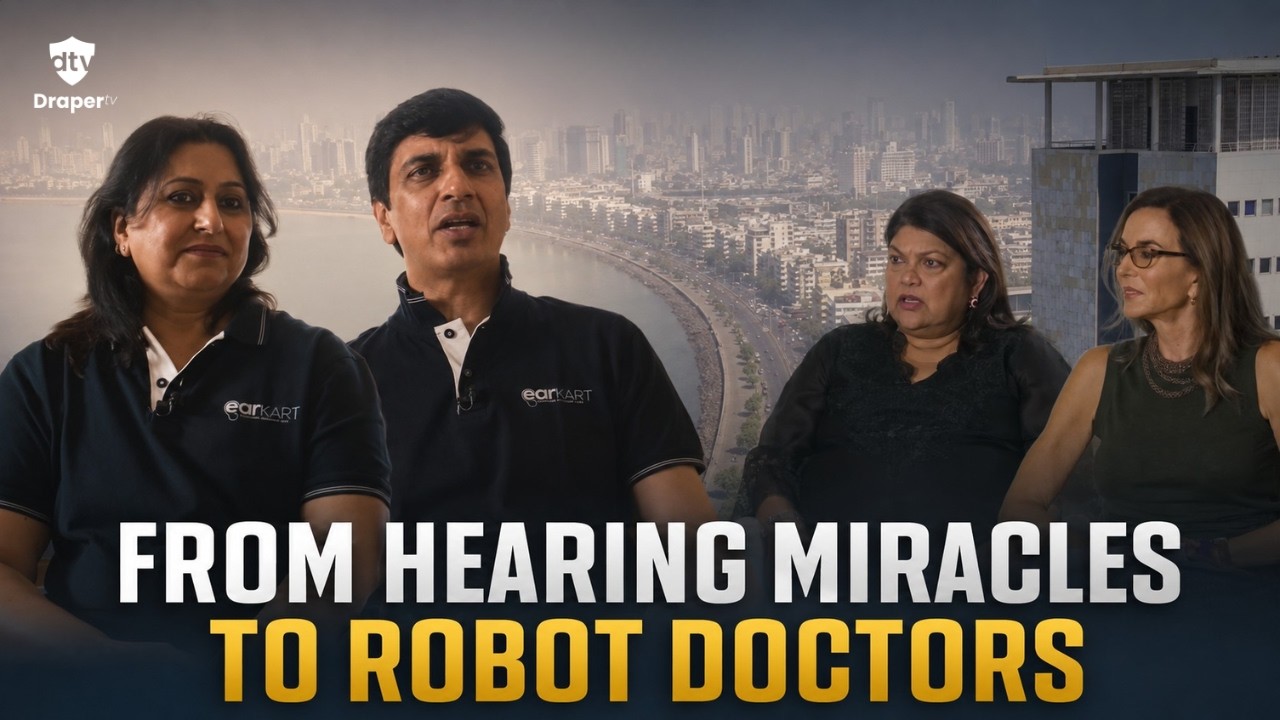
Rohit and Monica built a plug-and-play hearing aid that costs $20 to $300, versus thousands for traditional ones. They've sold 300,000 units and generated $90 million in revenue. An audiologist anywhere can diagnose and program the device remotely via smartphone, solving a crisis where 90% of the world can't afford hearing aids.
Chapters
90% of the globe cannot afford a good hearing aid. Out of 100 people who need a hearing aid, only 5 wear it. And the reason being the shortage of audiologists. Imagine for a country like India, 1.5 billion people, we have just about 7,500 audiologists practicing. For America, there's just about 14,000, where the need in India is about 180,000. And for US, it's about 86,000. So this gap unbelievably has not been filled for the last 4 decades. I want to show the most important part of Bombay. We are sitting right opposite to the Bombay Stock Exchange. Now, as a startup, my dreams are to be seen as a public limited company one day in the Bombay Stock Exchange, and that's where my dreams are living. Way back in 2007, when I joined this industry, 60% of the global population doesn't have access to an audiologist. 90% of the globe cannot afford a good hearing aid. Out of 100 people who need a hearing aid, only 5 wear it. And the reason being the shortage of audiologists. Imagine for a country like India, 1.5 billion people, we have just about 7,500 audiologists practicing. For America, it's just about 14,000, where the need in India is about 180,000. And for US, it's about 86,000. So this gap unbelievably has not been filled for the last 4 decades.
We have developed a device which is a plug-and-play model. It can be installed anywhere.
In any part of the world. It can be an Africa person sitting in Bombay can do the diagnosis part. Now I can also program the hearing aid at Africa sitting here.
Anywhere the customer who needs to be diagnosed for the hearing loss, and then the remotely fitting of the hearing aids can be done by an audiologist.
These hearing aids largely are costing about $1,000 to a pair. In U.S. and in India also, we're trying to make it down to $320, and that too on deferred payment.
But are you also making the hair?
Yes, which can be remotely programmed, which can also be programmed by a person's iPhone.
And you're saying you've already sold 300,000 of them?
That's right, yes.
Here's such a big market. Why are you suddenly so excited about the United States, other than the fact that you're pitching with the—
Wait, and you've sold 300,000 of them at $300 each? You're a $90 million business.
They're at a different price point. It starts from $20.
You're the biggest startup we've ever had on the show.
I think they didn't understand fully about the price point. The price point starts from $20, goes not up to $300, it's beyond that. It's only when you keep adding the features to the hearing aid, the prices go up.
Do I have the numbers right?
So it starts from $20 also, goes all the way up to $300. The initial minute or so was very jittery. I was fidgety. I was not sure. But then it became easy to get into an interactive question and answer mode.
How have you managed to make them so much cheaper?
Hearing aid is just about, say, about $70, $80 for every manufacturer. The only thing that we have done differently is to make this diagnosis thing, which is globally sourced, made it democratized. I can do the diagnosis at every single place. When a person is diagnosed, the adoption rate goes up Is the diagnosis online or do I have to go anywhere? You don't have to go anywhere. You can be sitting at home or an ENT clinic or a church or a temple. The audiologist can be sitting on the other side in India and the machine can be at your place.
Do you also do regular monitoring of the patients with your remote technology to facilitate and give proactive advice to them on—
Yes, so every time there's a patient who has taken our service, is also given free consultations to come and talk to our audiologist. And we do track that, the quality of the calls, the kind of complaints they are coming up with, the solutions, and if we are able to make some improvements to the entire journey of the patient.
We have a strong customer support team who gives regular calls and sends messages on WhatsApp also. We give— we offer them free online consultations.
And who are your competitors in India?
Luckily, there is none. Not in India and not in the world.
You're solving the affordability problem and access—
And accessibility.
What are you really out there to solve?
Because that's very important. Accessibility problem with affordability also.
Well, Rohit and Monica, thank you so much for coming and being on Meet the Drapers.
Thank you very much. Sometimes we don't get so many questions in one go, but they were very insightful and they were very deep questions. It actually reflects deep understanding of the business from all the judges.
I think they understood the relationship between the diagnostic and the solution well.
It's a massive, massive, massive market, and it hasn't really been catered to, not just in India, but in many other developing countries. The second is, I know for a fact that the margins are very good. Because actually the ability to manufacture and the price at which people will pay to be able to have that 30% up in your hearing is huge.
There is a need for this service in a much bigger way, and it needs to reach out in a much bigger way, the way blood testing now, or even, you know, the eye care services are now so much widely available, so that it stops being a problem for people who have the problem.
I love the fact that In India, a lot of people who thought they couldn't afford to get hearing aids can now get them.