Vincent Yang opens with a personal story about how his dedication to StarCraft honed his keyboard speed, enabling him to build a $10 billion leveraged‑buyout model in under 30 minutes at JPMorgan. He then critiques today’s leading SaaS workflow tools (Salesforce, Workday, Slack, Zenefits) for merely collecting internal data while leaving decision‑making to human intuition. Yang presents Everstream’s vision: embed AI into enterprises so machines can make business decisions. Everstream’s core offering is an evergreen predictive platform that links a client’s CRM and marketing systems with massive web‑crawled company and person intelligence, using machine‑learning models to identify which prospects are most likely to convert. The platform claims a 380 % lift in conversion rates for its customers (e.g., Microsoft, VMware, Comcast). He describes a five‑layer infrastructure – cloud storage, parallel compute, data aggregation (first‑party + web data), ML models, and applications – powered by four core technologies: web crawling, natural‑language processing, real‑time machine learning, and a company semantic graph. Finally, Yang outlines the market’s evolution from data storage to workflow tools, to business intelligence, to predictive analytics, and now toward prescriptive and autonomous AI, positioning Everstream as currently in the predictive phase but moving toward automated action recommendation.
Chapters
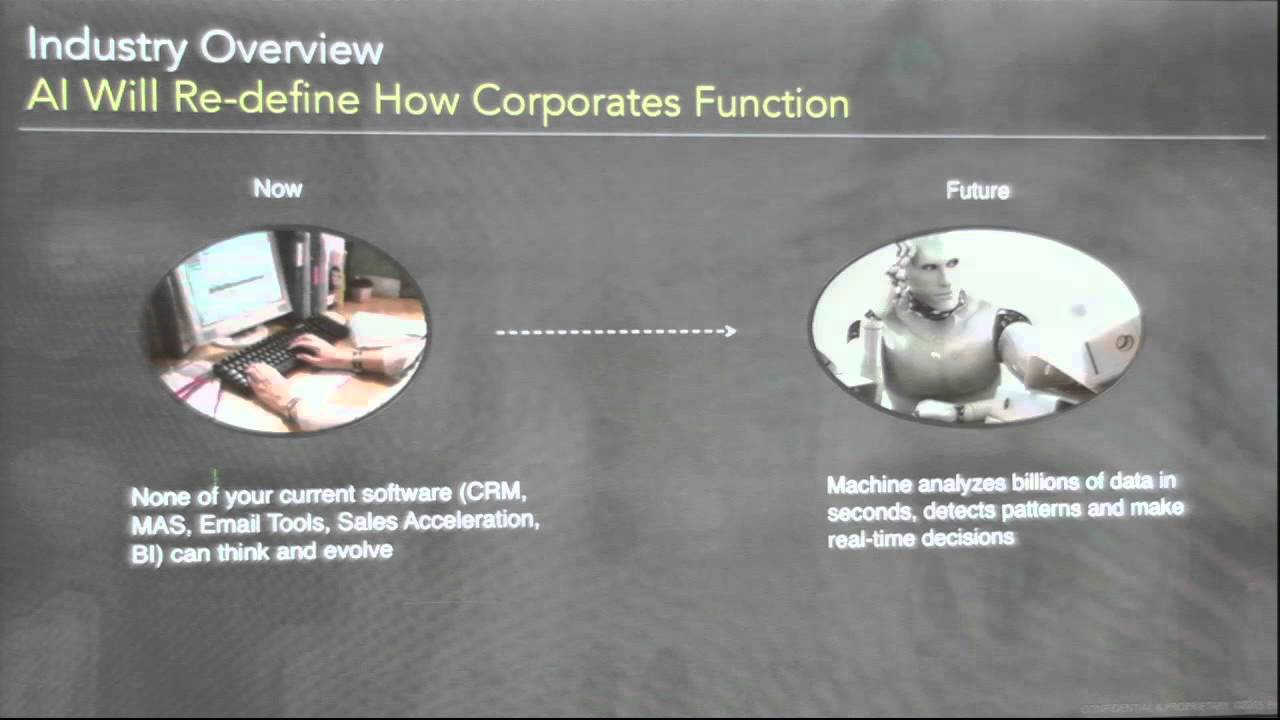
Hey guys, very good to meet with all of you. I just heard you were coming for the 4-week session, right? And most of you guys 22? Older? Lower? Yeah. Who's older than 30s? Oh, we got some guys like myself. So I was pretty impressed that at the age of this time that you are listening to how to start up another company. I remember when I was 22, my dream is to be a professional StarCraft player. players. And I was spending all my summers— well, my colleagues, my classmates are doing summer interns everywhere and I was practicing my mouse clicks for StarCraft. That was what I spent most of the time. And unfortunately, when I went to JPMorgan afterwards, the side effects of playing StarCraft a lot of time is I'm actually very good in using keyboard. And then I joined a team in JPMorgan doing leveraged buyouts. And most of the task was, as an investment banker, was building models, building LBO models. So one of my skill sets was building a very sophisticated $10 billion leveraged buyout model within less than 30 minutes using all keyboard without mouse. That's because of the StarCraft. So I think, but compared to you guys, you're doing way better. Anyway, coming to what we're doing. So what I want to spend a little bit, 5 minutes, to introduce what Everstream is and then spend 15 minutes talking about how I found Everstrain and leaving the most of the time for you to ask questions. Here's some of the problems we see. Most of the SaaS softwares do not think. Salesforce, Workday, Slack, Zenefits are the 4 top and fastest growing SaaS softwares in this space, but they're just workflow tools. Not only because they're workflow tools, the second thing is while you are using the software, you accumulate a lot of the internal data. When you're using Salesforce, every single sales transaction was actually accumulated, but not too many people are making use of that. When you're using Zenefits, you're actually accumulating a lot of the HR data, but no one is using that. The third thing is, right now, most of the business decisions are still made by humans via intuitions. So that's why they use software, but none of the decisions are made by machines. And our goal, the vision of of Everstream is to bring AIs into the corporates to hopefully one day help corporates to make decisions done by machines. And in the past, people make decisions whether CRM or email tools or sales acceleration tools and none of that, and they can't think. And one thing that inspires us is IBM, that before that they have Deep Blue, and then they launched something called Jeopardy. What they did is they trained a machine to read all the Wikipedia, and then they used that knowledge to compete with humans on the who has better knowledge about some business objects, et cetera. So one of the ideas we have is, what if we have the machine to analyze every single company's, every single website out there, and then use that knowledge to help sales and marketing to predict who's their next customers? So this is our first application. We— it's an evergreen predictive platform, so we do one thing, which is predict who's your next customer. The way how we do it is, on one side we link to our client's CRM and marketing automations and email tool, etc. On the other side, because we're only analyzing their CRM, there's nothing we can learn about that. So to make it simple, we try to learn— so for example, Microsoft is one of our customers. So when we are working with, let's say, Office 365, they want us to figure out who is more likely to purchase Office 365. So what we did is analyze historically who are the customers, and at the same time, we analyze historically Who are not the customers, who you engage with but never convert. So once we have that knowledge, but we still cannot make any prediction because that's just your information, it's a bunch of emails and company names. So how do we make predictions? So on the other side, we have the machine to actually crawl all the information about those companies and people to find who they actually are. When we analyze those companies, we figure out what does the company do, what are their product offerings, who are they hiring, What's the management team look like? And then to answer one question, for all the customers that have originally purchased your product, there must be something in common. We're trying to figure out what exactly is that. And for all the people in the leads that never convert, there also must be something in common, and we're trying to figure out what exactly are those ones. And then by combining our clients' data with the internet's data all together, and in between we use heavily on machine learning. And we're able to, as of today, every single company that uses our predictive platform saw about 380% lift. Meaning, before they use AverStream, let's say their average conversion rate from the raw lead all the way to convert is 2%. We're able to triple that. So what does that mean if we can triple your conversion rate? That means we can triple your net new revenue generations. And then we start with predicting who. We're predicting who is the next audience. And down the line, we're also helping clients to predict when. When are they gonna be converting to a customer? What's the best message to engage with them? And finally is how. How do you engage with this lead? So this is the infrastructure if you're interested, and it's 5 stacks. The bottom layer is our cloud storage infrastructure, and on top of that we build our internal parallel computing infrastructure. And then we aggregate all the data, whether it's first-party from the clients. So for example, right now, Evergreen's platform, we are stuck into VMware, Microsoft, Comcast, etc. So, in every single sales transaction they see, all of the data syncs in real time to Averistream Cloud. So, we are able to see that as well. And at the same time, we link it to all the world's data. We're doing the prediction for them in real time. While we're talking, there are 40 machines running at the same time making predictions. And then on top of that, we have different models. And then on top of the models, we have different applications. So that's kind of in ballpark what we are doing. The core 4 technologies are web crawling and then NLP. I think if you're interested in doing a big data startup, NLP is very, very important. Machine learning obviously is very important, but how do you build a software that can utilize the real-time machine learning is fairly complicated. And then finally is the company semantic graph. This is how we view the space is going to evolve. 30 years ago, it was more about data storage, data warehouse. And then you see a lot of workflow software coming up, like Salesforce, Siebel, and Marketo, et cetera. And then you move on to another space where we call business intelligence. But what they're actually doing is just visualizations, where Tableaus, Qlik, Domo, these kind of companies come into being. And then in the last 2 years, the hottest thing right now in the Valley about B2B space, especially in SaaS software, is about predictive. How can we really use machine learning to help clients to make predictions? And then, where my personal view of how the market is evolving is from predictive to prescriptive. Not only predict who's your next audience, but also recommend the next best action. How do you deal with that? And finally, it's really moving to the AI. It's not only we recommend action to you, but also take the action for you. So, that's kind of ballpark on where we are right now. I think we are in the— still in the predictive space right now. And that's kind of pretty much what we are doing.