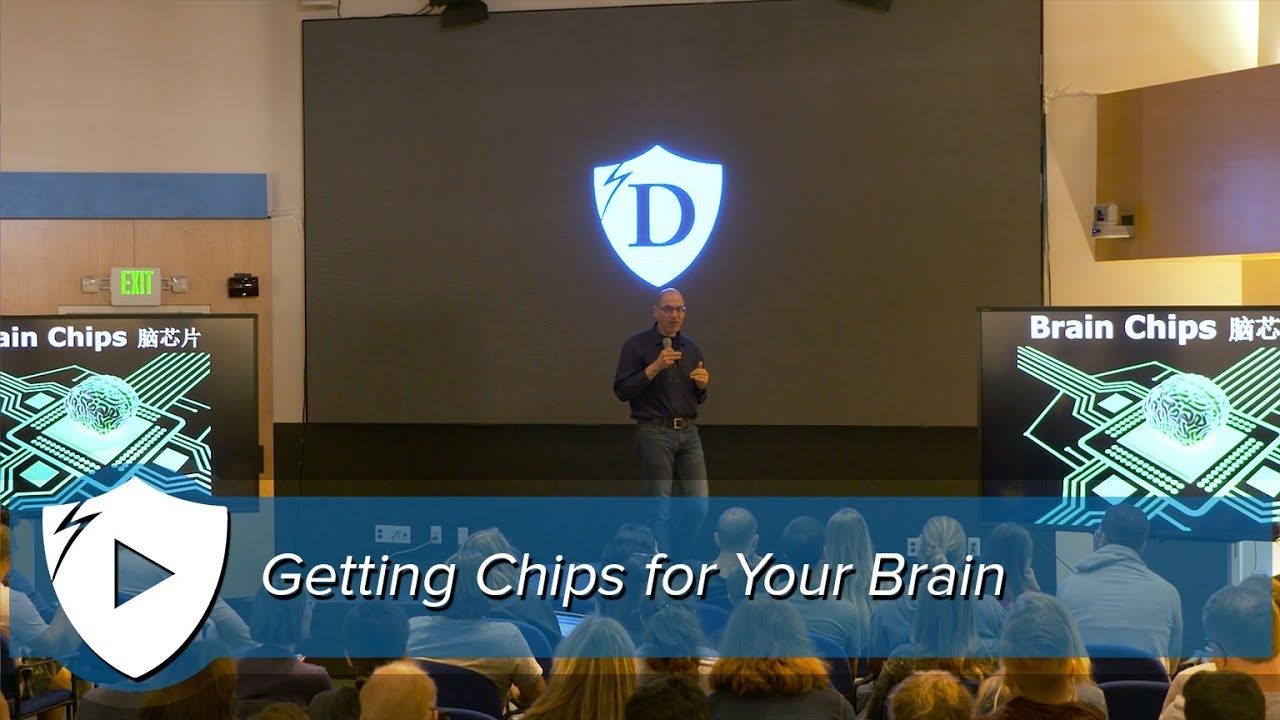
Steven Hoffman explores brain chips already restoring communication for paralyzed people and describes lab breakthroughs: a monkey walking again after implant, rats instantly sharing learned skills via wireless transfer. The U.S. military is developing smart helmets to upload data directly to soldiers' brains.
Chapters
The next thing scientists are working on right now are brain chips. Now, it seems, again, like who would— who of you would get a chip in your brain? Okay, there's some daring people. You would allow them to cut a little hole, put a little chip in there? Okay, that's good. Even today. Well, I'll tell you, a lot of people will get chips in their brain, even today, if they have medical problems. So, people now— imagine if you're like Stephen Hawking, who recently passed away, and you don't have control over your body, but having a chip in your brain allows you to actually communicate with people better, turn off and on lights, control things, then it becomes very valuable. And this is— they're working on this right now. So there are a number of startups working on this. Let me tell you a little about some of the experiments being done in laboratories. So right now, they have done an experiment with monkeys. Now, a monkey actually broke its back, so the monkey was paralyzed and couldn't walk. And what they did was put a chip in its brain, and then they put another chip after the break. So just by thinking, once they connected that wirelessly, the monkey within a few hours could walk just like normal. That's amazing. So if you are paralyzed, and I would— if I was paralyzed and they could get me walking again, I would do it. I would get a chip in my brain like overnight, right? There would be no question. Like if that could get me walking. This type of technology is in the experimental phase, but it will be rolling out in the next few years. Monkey controls a robotic arm. So they, again, they put it, and these are real pictures of the experiment, they put a chip in the monkey's brain. And just by thinking, the monkey could learn. You know, we learn, we try something, and we see, oh, the arm is moving. And the monkey could learn how to feed itself from the robotic arm. That's— it's very interesting. They did another experiment where they put the monkey in a little electric chair. And again, just by thinking, the monkey could Could learn how to drive itself around. So it could drive itself all over the place just by thinking. If a monkey can do this today, I think I could do it. Maybe the monkey's smarter than me, I don't know. But, you know, we could do this today. So the technology is actually coming right now where we can have chips in our brain and actually start to interface with the outside world. They are using— there's a company in the Bay Area called Kernel, which is now doing experiments on people, people with disabilities who want to be able to do more and are willing to try the chip in their brain. So this will become more and more prevalent as time goes on, and many more applications will emerge. And I'm always interested in startups. They did an even more interesting experiment. So at Duke University, they took this poor rat and they put a wireless chip connected directly to its brain. And what they did was they taught this rat how to get food. So how— they made it do certain things. So how do you teach a rat how to get food? And it took several weeks for the rat to learn how to extract special food that it really liked. Then they wirelessly connected this through the internet to another rat who had never been taught these things. That rat could get food right away. What does that mean? That means Right now, we have figured out how to successfully transfer knowledge from one living brain to another living brain. That is amazing, right? Imagine transferring knowledge from one brain to another. It's very primitive knowledge, right? Just how to do things to get food, but it's the beginning of what we're going to see. So the U.S. military. They are actually working on smart helmets right now. These, as you know, when you're in a battle, having a screen, they're doing overlays, different AR stuff, but there's— voice is one thing, but voice takes time. Every split second counts if you're in a firefight. When you're in a battle, you want to download and upload information quickly. They are trying to solve that problem. Again, it's so funny because the military contacted me and asked if I would help them, and I'm reluctant to do that because I like talking about everything. And it would be top secret, whatever they told me. So it's like, I don't know. I have a lot of ideas, but I don't want to know what you're doing because I only want to know what's public. So this is public, but how they're doing it is not public, and the different applications for it on the battlefield are not public. But I will tell you, the military, they pioneered the internet, DARPA, and now they are pioneering our interface to our brain. And if you think the internet is big, if you think blockchain is big, this is going to blow it all away, because there's nothing bigger than connecting our minds to the internet.