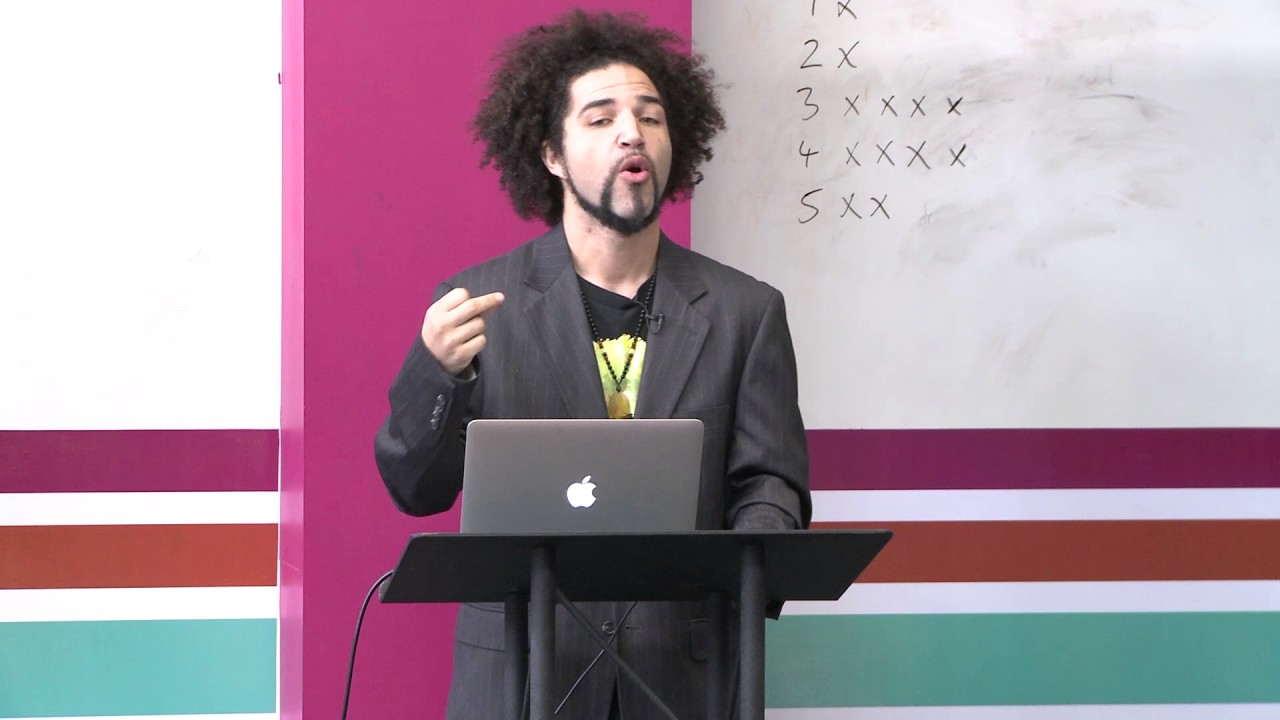
Rahman Jamaal teaches freestylers how rhythm and beat subdivision work. He breaks down note values from whole notes to sixteenths, uses counting exercises and group chanting to build timing, and explains that sixteenth notes match typical rap flow speed. The core idea: treat words as rhythmic units, separate from what you're saying.
Chapters
You can have a bunch of notes, right, but if there's no timing, we're not going to hear the differentiation. If you played all the notes at the same time, it wouldn't sound like— it would sound like trash, right? It's the spacing of the notes. It's the space in between the notes that makes it sound like music. And when we start to focus on just the rhythm alone, okay, we don't even— the secret that I learned to freestyling is don't worry about the rhyme. focus only on the rhythm at the very beginning, which is what we're gonna do. So who can read that for me? Rhythm is another level for anyone listening, all the students. Very good. So the key is rhythm is another level. If you're listening, we're going to be focusing not on whole words but on syllables, okay? We're gonna break down our language into singular parts. To work with the timing. So there's 6— there's really 8 stages of notes in music that you can break down into faster and faster rhythms. The whole note is equivalent to a bar in music, so if you ever hear a rapper and they're saying like, oh, I spit bars, or, oh, he drops bars, it's not bars like behind a prison, it's bars in music. That's where it comes from. Okay, you can take those bars and then you can divide them into smaller and smaller pieces. So the whole note is really like really, really slow. So we're not going to do that. We're going to start kind of partway through this. But just so you get an idea of how long a whole note is, if I were to play a beat for you—
whole note. Whole note.
It's about that far apart, every note.
Boom. Okay?
If we cut that in half, it's boom.
Boom. Boom, boom, boom. Okay?
We're going to start at the quarter note, which is basically this, and we're going to do it by counting numbers 1, 2, 3, 4. So repeat after me. It's going to go 1, 2, 3, 4.
1, 2, 3, 4.
1, 2, 3, 4.
1, 2, 3, 4.
Everybody with me so far? We got that, right? Okay, so you did just prove to yourself that you can freestyle just by doing that. Now let's take it up a notch a little bit. We take a quarter note, let's cut that in half. We get an eighth note. And it sounds like 1 and 2 and 3 and 4 and. 1 and 2 and 3 and 4 and.
1 and 2 and 3 and 4 and. Good. All right.
So those are the first 2 levels that we're going to play around with. Let's go back, keeping those rhythms in mind. And we're gonna go back to this sentence right here, except we're not gonna read the sentence normally. We're gonna read each syllable in time, starting with the quarter note. It's gonna be really slow, like the sloth in Zootopia, but it'll sound like this. I'll do one, and then you hear it, repeat after me. So it's gonna sound like rhythm is a-nu-ther-le-vol. 4 and knee, 1 listening, follow the syllables. Everyone got the hang of that? All right, so we're going to come to that. 1 and 2 and here we go.
Go! Rhythm is another life form. 4 and 3, 4, 6, 7, 8, 5, low, up, 6, low, 4.
Very good, very good. Now I know it doesn't sound like rap yet, but the fact that you are saying syllables on beat is teaching your brain what that sounds like and how you gotta kind of separate yourself from the language of wanting to say things fast to saying things on beat. We are going to speed it up though, so let's try it with the 8th note. I'm going to run this back real quick.
All right.
So the 8th note pace recall was 1 and 2 and 3 and 4 and. I'll read this sentence once and then you guys repeat. 1 and 2 and 3 and 4, it goes, rhythm is another level for anyone listening, follow the syllables. Rhythm is another level for anyone listening, follow the syllables.
Ready?
1 and 2 and 3 and go.
Rhythm is another level for anyone listening. Follow the syllables.
Very nice, very nice. Good. See, it's not so hard. All right, so, um, let's go to the next note. So you guys just mastered the whole left side of this. We got through our— we didn't do whole note, half note, I spared you that, but we got through the 8th note. Now The ones on the right are more in alignment with the styles or the flow patterns that you hear rappers use. In fact, the 16th note is average rapping speed. We're going to do the triplet first, which is a little tricky. It's the quarter note divided into 3 equal notes. And the easiest way to remember what a triplet sounds like is to say the word triplet like this. Triple it, triple it, triple it, triple it, triple it, triple it, triple it, triple it. Try that with me. Say triple it, triple it, triple it. Now say one is a two is a three is a four is a one is a two is a three is a four is a one is a two is a three is a four is a one is a two is a three.
All right.
Now I'm hearing something that a lot of people do, okay? I'm hearing a lot of us are going— listen to the difference. 1 is a 2 is a 3 is a 4, or 1 is a 2 is a 3 is a 4 is a— you guys hear the difference?
Yeah. Right?
So, so we're not— the triplet is everything is still even, so it's not— it's all even. Triplet, triplet, triplet, triplet. 1 is a 2 2 is a 3 is a 4 is a. That's what makes a triplet kind of tricky. But let's try it one more time.
1 is a 2 is a 3 is a 4 is a 1 is a 2 is a 3 is a 4 is a 1 is a 2 is a 3 is a 4 is a.
Good.
1 is a 2 is a 3 is a 4 is a 1 is a 2 is a 3 is a 4 is a. Good. Good.
All right, nice. All right, now, whoops. I'm going to keep this beat for now while we're learning this stuff and then we'll switch it up. But check it out.