Grant Cardone: Bitcoin Is Real Estate Without the Tenants | Crypto Megan Podcast
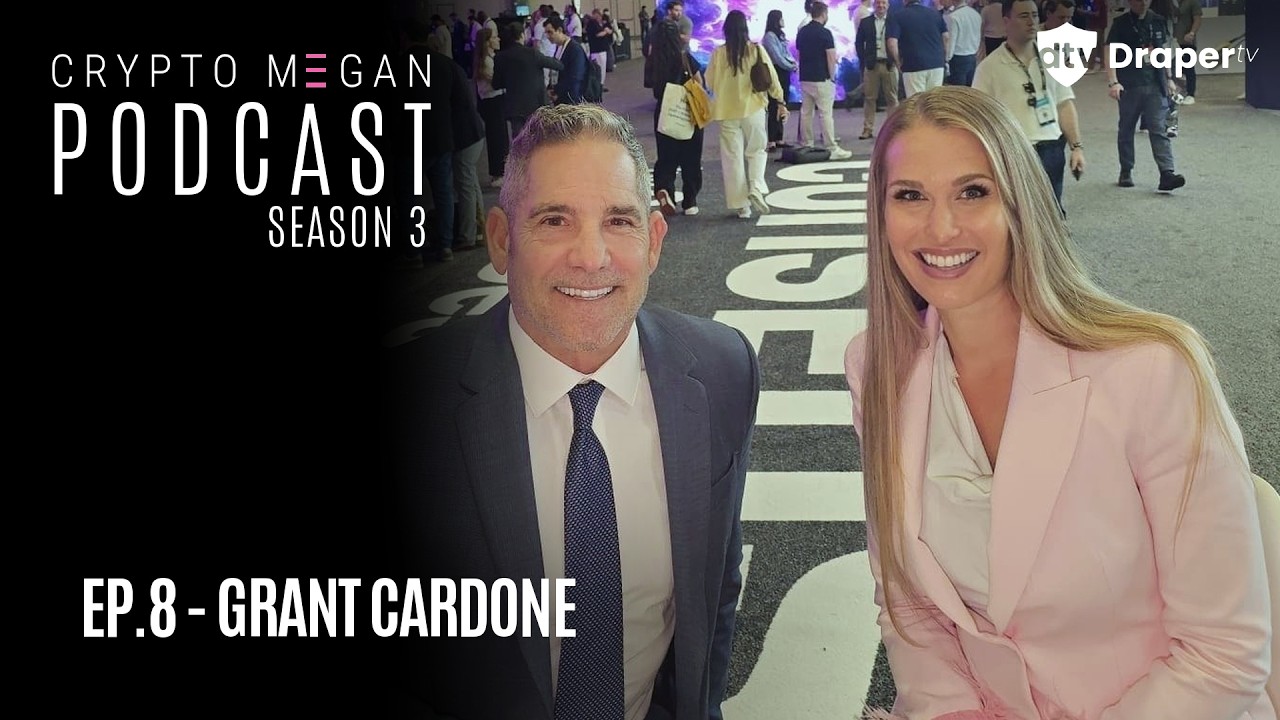
In this on‑camera interview at Consensus in Miami, Crypto Megan (Megan Nelson) talks with real‑estate mogul Grant Cardone about his pioneering “real‑estate‑Bitcoin hybrid” strategy. Cardone explains how he views Bitcoin as real estate without tenants, gutters, or maintenance, and describes the world’s largest combined deal – $235 million of cash‑flowing property paired with $100 million of Bitcoin, allocating three BTC to each of the 366 units at 101 Meissner. He details the origin of his Bitcoin exposure (a gifted 150 BTC), his meeting with Michael Saylor, and the decision to purchase discounted real‑estate and fund the price gap with Bitcoin, keeping the asset below replacement cost. Cardone argues that traditional finance is entering crypto because banks earn fees, and that REIT structures, which must distribute 90 % of cash flow, prevent them from holding Bitcoin, giving his private syndication a legal moat. He notes a shift in investor demographics – older, wealthier investors committing larger, faster capital – and highlights the liquidity benefits of holding Bitcoin on a balance sheet for cap‑ex, refinancing, and mortgage pay‑down. Cardone shares his market outlook, believing Bitcoin is roughly 50 % undervalued and could double, while emphasizing the need for concrete examples to educate skeptics. He envisions future financing with Fannie Mae/Freddie Mac, long‑term debt secured by both property and Bitcoin, and aims to scale the model to become larger than traditional REITs with far fewer units. The conversation also touches on regulatory sentiment (the Clarity Act), the role of JPMorgan’s presence at the conference, and the broader narrative of upgrading an archaic real‑estate system with blockchain‑enabled liquidity.
Chapters
My name is Megan Nelson, AKA Crypto Megan, coming to you from Consensus in Miami for Tim Draper's Draper TV and my podcast there. And I'm really so excited to be running into Grant Cardone at this conference. We have a lot to talk about. I mean, a lot has happened. It's a huge moment in the industry, and, uh, you're the best person to be sitting here with today talking about it.
Yeah, well, thank you so much for having me.
Yeah, yeah. So, so tell us a little bit about First of all, the vibe here at the conference and, you know, your feeling here on the ground.
Well, I mean, look, we're in Miami, so that's always a positive. And you take Miami or Vegas or Nashville. Come on, Miami, dude. Miami's a winner. It's like a— it's a winning city right now. It's on a big roll. This is going to last for decades, by the way, down here. I was in New York City yesterday. You walk the streets of New York City and you're in Miami the next day. You're like, wow, dude, this is crazy. It's a very new city. It's very modern.
Yes.
Blue water everywhere, palm trees, great weather.
Big energy.
You know, the humidity is great for your skin, much better than California.
Yeah.
You know, and, you know, this is a beautiful conference. So it's a lot of space. It's not as jammed in and crammed in. So I'm super excited to be here.
Yeah. And, you know, we noticed some differences such as like JPMorgan has one of the biggest booths at the event. That's a big change for our industry, right? Like it's the Wall Street and traditional finance is coming in in a big way.
Yeah.
And so the shift, how have you seen that shift and what are you paying attention to right now in the market?
Yeah, well, so I mean, why wouldn't they, right? They get paid fees. So I was, I was on Wall Street yesterday. We, we did a, we did a pitch to a number of banks last year about our real estate Bitcoin hybrid. And I can tell you they're coming, guys. I don't, you can read whatever headline you want to read or see where they said no to this and yes to that. They're coming. Why wouldn't they? Banks are fee-based businesses.
Right.
They don't care what they sell. Okay? Like, this is just the fact. Okay? They get paid. Their love language is 9%. Somewhere between 7 and 9. If you can multiply 7 or 9 times any number, by the way, the bigger the number, the happier the bank is. So whether it's Bitcoin, Or Solana or food or healthcare, biotech or AI, all they want to do is raise money. This is their formula. And so you can fight that if you want to. But when they see enough people want to hold Bitcoin, they're going to be like, why would you hold it over there when you can hold it right here?
They're not going to want to leave that on the table.
Of course not. I mean, they would be— it would be a fiduciary irresponsibility of the bank To say no to that.
Absolutely. And so we see them coming in in a big way. How important do you think the Clarity Act is in the grand scheme of things?
I don't think it matters.
You don't think it matters? Interesting take, because a lot of people say it's literally the barrier to entry.
I don't think it matters. It's just, you know, do I think quantum? No, I don't think any of this matters. I think all this keeps people on the sidelines, not buying what you should be buying right now.
Absolutely. I mean, you've been super vocal about Bitcoin. In fact, One of the biggest real estate transactions, the biggest in history.
Yeah, that's right.
Tell us about that.
So look, I mean, I'm a real estate guy. Real estate guys buy in all cycles. And I've been buying real estate for 40 years. There's never been a bad time to buy real estate. If you buy it, hold it long enough, you're going to be just fine. Don't over-leverage it. Buy great locations. Sit on the cash flow. Take care of the property. Take care of the resident. And it's just a matter of time before you get rich. Now, what does that have to do with Bitcoin? Because Bitcoin is real estate. Bitcoin is real estate without the gutters, the HVAC, the roofs, the siding, the termites, the tenants, the toilets.
Absolutely.
I like that. The evictions, the property taxes. So, you know, I've been looking at Bitcoin as a public real estate guy and a closet Bitcoiner for 13 years.
I like that. It's portable digital property.
Yeah, exactly. Right. And I've been looking at You know, I was introduced to Bitcoin. Somebody gave me Bitcoin. They gave me 150.
Somebody gifted you a Bitcoin?
They gave me 150.
That's a pretty good friend.
Yeah. Well, no, I worked for it.
Okay.
So they said, look, we don't have money to give you. They wanted me to speak at an event.
Okay.
Okay. We don't have money, but we'll give you Bitcoin. And I literally said, what is Bitcoin? They said, it's BTC. I said, is BTC like an STD? And they said, no, it's not an STD. I said, okay, if it's not an STD and you can't pay me any other way, I'll take it and I'll figure out what to do with it.
So that's the origin story.
That's the origin story.
Wow. That's pretty cool.
And so I still have that Bitcoin today.
Wow.
And then I started looking at what is Bitcoin? How could the two go together? I got a lot of misinformation on the way. People were like, oh, you need to put your real estate on the blockchain. Or they would say dumb stuff like, you need to get rid of all your real estate. And buy only Bitcoin. I'm like, which is, is, I have a $5 billion—
Not feasible.
No, I'm like, I'm going to throw away a whole career. Like, right. It was this all or nothing kind of thing, you know? And, and so it became a bit confusing, but I was always trying to figure out, I wonder if there's a way to put them together. Well, I met with Michael Saylor about 2 years ago. And he said, Grant, what you should do is you should take your audience that already trusts you. You should go public. You should raise money against the public company and buy Bitcoin. I said, but I'm not public. He's like, that's your problem. I'm telling you how to do it. So I went home with Michael's advice and said, okay, how can I do this? Well, I didn't go public. What I did was I went and found a piece of real estate. I paid cash for it. I bought it below what it would cost to build it.
Okay.
So we stole the real estate. And then what I did was rather than just taking a discount on the real estate, I filled in the discount with Bitcoin. So I paid $72 million for the real estate, $15 million for the Bitcoin, put the 2 together, and I was still below replacement costs on the asset, the physical asset. And it's still cash flow. We did our first project in January 2025. We just closed one. Largest real estate Bitcoin project ever done on the planet. $235 million of real estate, quarter of a billion dollars of real estate.
That is massive.
Even a big deal for Draper.
I can't believe it. Yeah.
And $100 million of Bitcoin. So we have for— there's 366 units in this project. Every unit has 3 Bitcoin in the unit.
Wow.
So the investors now have the combination of a real asset that's very heavy, Very constant, consistent, long-term growth. And then we added the Bitcoin. So we have the volatility and the stability of 2 asset classes, one that's ancient and one that's very new.
That's massive. I mean, that's a massive step forward for the industry, sort of like a hybrid of what Michael Saylor's advice was, right? Because it's not all or nothing in this world.
Yeah, exactly. And the cool thing, Megan, is that the people that have invested with us in these projects, The money came faster. The money was bigger. And the age of the demographic investor, do you think it went up or down?
I don't know. I'm guessing down, but—
No, it went up 15 years.
Went up.
Older investor, richer investor, and the money came in faster. And the check size came bigger. Because basically I'm explaining, I'm not explaining Bitcoin. I don't have to explain the Bitcoin. I explain the iPhone. If you have an iPhone and I'm like, hey guys, new iPhone. Oh yeah, what is it? But if you go back 16 years ago before there was an iPhone, you had to explain it. And that's where we're at with Bitcoin today. Nobody's doing a very good job of explaining it.
No, it's too complicated. It's too nuanced. They really need something concrete, right? They need a concrete example of why this is better. Concrete. Yeah.
Concrete, steel, and glass.
No pun intended.
So I have 366 units. The address is 101 Meissner. I show the asset. It's beautiful. Beautiful. Already have tenants in it. They're already cash flows. Everybody, if you're in Boca, you know the location. It's premium real estate. That's the real estate. Oh, by the way, guys, it's going to do like a 4% return and we got Bitcoin with it. Oh, wow. That's cool. When do I get one or the other?
They have to— So they get exposure to both of the assets.
They get exposure to both.
It's a match made in heaven.
Yeah, exactly.
It is a match. It should be.
It's polarities. It's opposites attract.
And the fact that the average age went up, is just astounding to me.
Yeah.
Because you actually showed them why it's feasible and logical to do this.
Yeah, we showed this to one of the biggest banks in the country. And it's the bank most connected. I'm not going to drop the name, even though you have already.
Okay, well, yeah.
It's the bank most connected with the REITs. There's 193 REITs in this country. It's about a $4.3 trillion industry. They control all the institutional quality real estate in the country. And the guy that created the REIT system looked at my model and said, if I understand what I'm looking at, this is a 2.5-hour meeting. If I understand what I'm looking at, you're going to disrupt a 65-year-old business.
And that is actually what you're doing right now. I mean, this is like an archaic system that you've upgraded.
66 years, real estate has not changed the way you buy it.
It's not accessible. It's not— you can bring more money in this way.
Well, you can, you can not just bring more money in. The most important thing is you're going to be able to solve the long-term problems of real estate, which is every 20 years you need a new roof, right? Every 15 or 20 years you need gutters. Every— you're going to need plumbing. You have problems, CapEx, on hotels, office buildings, apartment buildings. They age.
Right.
The Sistine Chapel has probably had a few remodels over the years.
Yep.
If you had Bitcoin on your treasury, for lack of better words, on your balance sheet—
On your balance sheet, you would cover those.
Then you could fix the roof when you need to because you're liquid, or you could pay off the mortgage when interest rates go too high.
It's brilliant.
See, the way the REITs are set up right now is they have to distribute 90% of their money. We discovered this glitch. Accidentally. They have to distribute 90% of their revenue every quarter. I'm sorry, their cash flow. Their free cash has to be pushed off their balance sheet.
It can't sit there and accrue any capital.
Yeah, which means they can't reinvest their money.
That's not optimal at all, is it?
No, it's terrible. So that also means they can never hold Bitcoin on their balance sheet. So I have 193 companies, all of which, most of which are bigger than me. Some of which are 50x bigger than me. Wow. I'm $5 billion. Starwood's $140 billion. Well, I now have a competitive advantage in the marketplace because Starwood can never hold that asset and I can.
And is that because it's just written in the rules and the laws?
It's written in the REIT structure that they have to distribute all their free currency.
Do you think they'll be looking at you to change their structure now?
Well, if they change their structure, they would lose their REIT status and then they would lose their public It's impossible to unwind it.
Wow.
Basically, I have a built-in legal moat around me that will prevent anybody, any of the REITs anyway, from coming in.
That's huge.
So then it has to be a syndicator like me, a private hell guy that's got a lot of courage and understands it. And unfortunately, or fortunately, most real estate is owned by white guys over 45 or 50 years old that are well connected into the real estate community. And most of those guys are fiat guys.
Right.
And they don't understand Bitcoin.
No.
So I found myself a little spot in the universe.
A moat, like you said, a niche where you can appeal to a lot of people who want that exposure. It makes a lot of sense. So when you explain to these investors the value that's going to accrue over time and what the projection is for Bitcoin, what do you say?
So guys, look, we got a piece of real estate. 12% is a great real estate return. 15% is better. Add the Bitcoin, I could be at 30%. I could be at 30%. It's just win. Every year, by the way.
Right.
You know, I can have real estate that, that grows every 7 years. We, we, we expect— I've done 76 real estate deals. Every 7 years or so, I have a chance to refinance that asset because the rents have grown enough in 7 years. 7 times 5% is 105%. So if the rents have grown 105%, I should be able to refinance that property every 7 years and pull all my capital out.
Wow.
Refinance it, pull my capital out. Let's say I had a $100 million project, I added $30 million in. 7 years, I get my $30 million back, but I still keep the asset. This is how the wealthy—
This is how it works.
Wealthy people do not sell their assets.
No, they never sell. They borrow against them.
They borrow against them. So I still have my asset. I have my $30 million and I pay no taxes on my $30 million. Okay, now put the two together. Now I have real estate banging, slow and stable. And I have Bitcoin doing its freaking thing, but a CAGR of 30 to 40% a year. Every 7 years, I don't end up with a real estate project. I end up with a real estate project that paid for a Bitcoin project. And I got cash flow and I got write-offs. I get the best of 2 animals, 2 beasts, 2 like super Marvel action heroes joined together.
It's kind of tough to even comprehend what you're doing right now with such an old system, legacy system. I mean, you're upgrading the entire system. And I'm sure there's going to be a lot of people who want exposure to that now that they understand it, especially from somebody like you in the industry who can show them, lead the way.
It's what Michael Saylor says. So look, you got a trusted audience. I got about 20 million people follow me online. 20,000 of them have invested with me, given me, trusted me with $2 billion.
Right.
And we have 47 projects now. We outperform most of the REITs, if not all of them. Our fees are lower than all of them. And, you know, I communicate directly with my investor. We do a monthly call, Zoom call. I answer their questions. They see my face. They have access. And the big banks just can't do that.
No, they can't. And it's going to take a long time for them to get there. So you beat them to the punch.
Yeah, exactly.
You're ahead of the curve.
Yeah.
And it's because you took the risk and you got involved in this new technology, or because of that happenstance circumstance where they paid you that Bitcoin.
Yeah, that's right.
And that made all the difference. So, um, on behalf of the industry, I'm happy to have you representing and, um, showing, leading the way, right, to all of those people, uh, investors that are maybe older and more traditional that see that this is the new way of doing things, right? So real estate is a huge, huge use case for blockchain, and you've found a way to hack it to make it essentially like a treasury with Yeah, that's right. Real estate investment built into one.
This is the perfect Bitcoin treasury company. Yeah. Because they actually—
you're going to give Michael Saylor a run for his money.
Nah, I, I, I, no, no. I mean, what Michael's doing is unbelievable. And I think Michael is going to help me in the future go to Fannie or Freddie Mac. Who does— Fannie and Freddie do $200 billion worth of loans every year. Every year. They're trillion, multi-trillion dollar debt. Servicer. I believe in the future, I'll be able to go to Fannie and Freddie and say, hey guys, my $335 million project is now worth $700 million. I want a long-term loan on the 2 of them together, not just the property. I want 15-year debt. Not, not, not— I don't want any margin debt.
Right.
I want 15 or 20 or 30-year debt against the property and the Bitcoin. And I want my money to be cheaper because I'm liquid.
Right.
And no real estate project on the planet is ever liquid.
No. And that's the problem. Yeah. That is the problem. That's the problem that's been for decades.
That's right.
And now you're solving that with this new system, this new hybrid system. I know I said real estate is a good, perfect use case for blockchain. You know, Propy is bringing property on-chain, which we discussed earlier, and that's really cool. It makes it accessible and solves the title deed problems and the title insurance and all of that, the fraud. And you found a way to bring liquidity into the system, which isn't there and hasn't been for years. So that's massive. Now, to the market as it is now, to wrap this up, traditionally midterm years have been bottoming years.
What kind of year?
Midterm. Midterm elections.
Midterm.
Okay. So where do you think Bitcoin is in the grand scheme of things right now? Where do you— I mean, Kevin O'Leary, for example, who was on my podcast, he said we're going to be oscillating between $60K to $200K until the end of time, until the Clarity Act is passed. I don't know. How do you see that? Where do you see us in the market?
I don't think, you know, good on Kevin. I remember when I was like Kevin.
Woo! I think we're going to have to get a roundtable going.
You know, I don't think anybody should think that they know what the hell Bitcoin's going to do. Bitcoin's going to do what Bitcoin wants to do. And, you know, I just don't, like, I just, I never know what anything's going to do. I just know I want great assets. And there's very few great assets on the planet. There's just not a lot of great assets. This is why the S&P 500 keeps going up. You have more shit assets, cash. We have trillions and trillions and trillions of dollars floating around this planet. Since the 2008 bust, we've probably printed $12 to $15 trillion. That equates to probably $100 trillion new US dollars. And the US dollar is still the superior dollar on the planet.
Absolutely.
So, um, I, I don't think anybody knows what this thing's going to do. I think we're probably 50% of what the actual value should be today. So every time I pay $80,000 for something, I think it's probably worth $190,000. But again, the real estate I bought, I think it's worth $400 million. I paid $235 million. I got a deal.
Okay.
And by the way, I didn't have to put the $235,000 down. I got a loan on it. I only paid $100,000 for the real estate. And I think in the future it's worth $400,000. That's what I'm banking on. And I get paid to wait. When I combine the Bitcoin with the real estate, we have investors in that address, 101 Meisner. I'll get you the data so you can see it.
Yeah, we'll pull it up here so you can see it. Yeah.
We go to our tenants. We rebrand the property 10X. Managed by Cardone Capital. And the first thing we do is we offer the tenants to the investors in the building.
Wow.
So we say, look, you're paying $4,500 a month.
I mean, you're revolutionizing a lot of systems at once right now.
Yeah, you pay $4,500 a month. Would you like to be an investor? Well, how much would it take? How much would I have to invest to pay my rent? $1 million, approximately $1 million should Cover your rent. And then we start moving into an explanation. Well, we have people in that building that are not just tenants, but they're investors in the fund. And that fund's 10 years. So they're saying they're going to live there for more than 10 months.
I mean, this is mind-blowing.
Yeah.
I'm so glad we caught up with you today.
We're going to scale this out. I'll have the largest real estate company in the world. I'm going to, I'm going to get bigger than the REITs. Just imagine this mind blow. With fewer units, I'll be bigger than the biggest real estate company on the planet with fewer units. Because now all I need is 25,000 apartments. I'm at 15,000 and 25,000 Bitcoin. And I'd be one of the largest real estate companies in America.
Just like that. Just like that.
But my units, my other 25,000 100,000 units don't have any gutters or sewer. Now, if Bitcoin goes to zero, it was all just a dream. They're going to read about me and didn't make it.
I guess they'll read about all of us then. I mean, it's just the bet on the future. We're going there. It's inevitable, like gravity. We're headed there. Look around. We got JP Morgan, the biggest bank, biggest booth at this event. It's happening.
If Bitcoin fails, that means the internet failed.
It means we fail in a lot of ways in this world. Like Tim Draper said, it's either going to zero, it's going to infinity. That's why he bought it at $600. And it actually went down by 50% right after he bought the Silk Road auction for $600. And everyone was calling him the biggest fool in the room. And he felt— and, you know, he thought, yeah, this is how it is. It's either going to work or it's not.
$21 billion fool.
And it's working. It's working. And it's so exciting to see this. I'm so glad that we got to hear this story today. I'm sure a lot of people are going to be inspired by it and going to want to have exposure to it. So, um, thank you for representing us in this way. And, uh, this interview is powered by AIBC, which is a massive event coming up in Rome. We'd love to invite you there as well.
Dude, I'd love to. I'm Italian, so.
Oh, there you go.
You know, I know you invited, uh, Eric Trump, right?
Yep.
He's not Italian.
No, no, no. We gotta have some Italian blood on the ground. Yes, absolutely. So, um, thank you so much. We'll catch up with you again soon.
Thank you. Thank you.
More from Tim


He Sold His Car to Build This Startup, Then Pitched It for $1M 😳 #Startups #AI

This Startup Moves Your Crypto BEFORE Hackers Can Steal It 😳 #Crypto #Cybersecurity




15 Months Without Refrigeration?! This Startup Thinks It Can Go Global 🥥 #FoodTech #Startups



