Great People Take Advantage of Opportunity, No Matter the Field | Astrophysicist Alex Filippenko
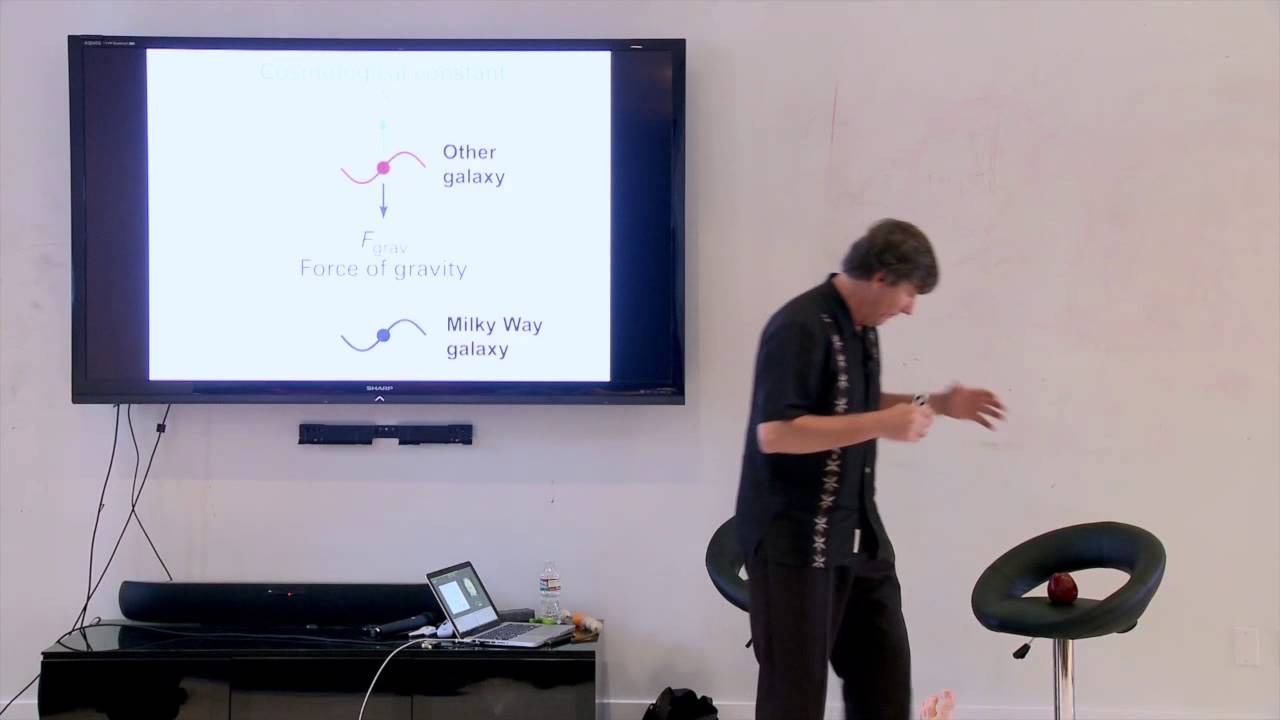
This content was created by Tim Draper. This content was uploaded by Tim Draper. This is a YouTube talk titled "Great People Take Advantage of Opportunity, No Matter the Field | Astrophysicist Alex Filippenko" (posted 2015-04-08) featuring a lecture-style monologue by astrophysicist Alex Filippenko. The speaker discusses the discovery of the accelerating expansion of the universe (crediting postdoc Adam Riess and two competing teams), the cosmological constant and dark energy, the role of competition and collaboration in science, observational strategies using the Hubble Space Telescope (including piggybacking and large collaborative proposals), and general advice about seizing opportunities and being bold in research and innovation. The excerpt references the Nobel Prize recognition and includes informal anecdotes (wife Noelle, a T-shirt).
Chapters
Greatly credited with the discovery was this youngster, this postdoc, Adam Riess, in my group. Here he is, you know, in Time Magazine before the Nobel Prize, Adventures in Antigravity. But, you know, he persevered. He got us moving faster than we would have been. He kept on saying, hey guys, come on, make the measurements. I've got to analyze them. Let's all work as a team. Let's do it. He kept pushing us, and he did it very carefully, very correctly. And Very enthusiastically. Yes, he was at the right place at the right time, but he also took advantage of an opportunity that landed in his lap. So sometimes you have to be ready to take advantage of opportunities. I've known plenty of people who had all kinds of opportunities, they just sat around on their butts. Not like you're— I mean, kind of like what you're doing now, but what you're doing now is useful. You should be doing that, right? But, you know, I've known people who should have taken advantage of opportunities and didn't. They didn't do anything. What's the difference between being ready and being prepared? So take advantage of the opportunities. Jump on leadership opportunities as well. Often the official team leaders are just too busy organizing the whole thing. I mean, they're busy. It's not like they're not doing anything. But they're too busy to do the nitty and the gritty work that leads to an actual discovery or an innovation or getting the venture capital or something. Right. You sometimes have to jump into the position and take advantage of an opportunity that exists. Be alert for chances to play a leading role in whatever it is you do. Well, by the end of the year, the editors of Science magazine proclaimed this to be the single most important discovery in all areas of science that year. And we were very pleased with this, but, you know, we— We still weren't sure we were right, but 2 teams had the same result, and, you know, that meant that other people had to take us seriously. And this is actually an important point. There were 2 teams. There was a lot of competition. And that was good. Both teams wanted to be first, so it accelerated progress, if you'll pardon the pun. Right? If there were just one team, we'd all just kind of go to the beach all the time and not do anything. But we knew that the other team was there. All right? So it accelerated progress. It improved the quality. Both teams wanted to be best. If one team is taking into account some subtle effect, like a possible difference in the speed of light, and the other one is not, then that other one would look bad by comparison. And thirdly, with 2 teams, people had to take notice, because both teams came up with the result at about the same time. So the competition was actually good. And we weren't always at each other's throats like this, although, you know— Sometimes it wasn't perfectly friendly either, but nevertheless, it was a good thing. So embrace competition. It accelerates progress. It improves overall quality. Leads you to become more careful, more thorough in your work. The agreement in results increases the credibility. Sometimes people tell me about a result, and I'm all, well, who else has a similar result? If no one else has anything similar, then it's probably wrong. Others will take you more seriously. So again, this is something that can be taken, that applies to many, many walks of life. And ultimately, it's this competition that led to this result now 15 years ago. It's amazing how time flies. And over the years, enough people were so interested in it that they confirmed it using other techniques. And that's why the result was recognized with a Nobel Prize, the highest accolade possible in science. So you might wonder, why is the caricature of Einstein surprised here? You might think it's because he's blowing universes out of his pipe. See that? There are multiple universes, and they come from the pipes of theoretical physicists. Well, maybe the first part of the statement is true. There may well be multiple universes, but we don't think they come from the pipes of theoretical physicists. He's surprised because this one universe that he blew out of his pipe is expanding faster and faster with time, Rather than more and more slowly, as would have been anticipated with normal gravity. Okay? And he's doubly surprised, because he has a sheaf of papers here, where he has an equation: the Greek letter lambda equals 8 pi G, Newton's constant, times the density of the vacuum. And you might say, density of the vacuum? Why was this bozo from Berkeley invited to speak, after all? You know, I mean, you were taught on your mother's knee that the vacuum is zilch, nothingness. How can it have a non-zero energy density? Well, this was Einstein's idea, not mine, and he was a lot smarter. He came up with this possibility of a repulsive energy of the vacuum in order to maintain what he thought was a static Universe. One that is not collapsing or expanding. Gravity, acting between galaxies, should tend to make them move together. But at the time, in 1917, it was thought that the Universe is static, neither expanding nor contracting. And so Einstein came up with a weird thing called Lambda, the cosmological constant, which acted in the direction opposite that of gravity and with exactly the same magnitude. So gravity is pulling down on this apple, the Lambda thing is pulling up— here it's my hand. If the net force— excuse me— is zero, Then the apple doesn't move. Okay? If the net force is not zero, then it accelerates. So, you know, Lucas kind of got it wrong. He said, may the Force be with you. No, no, no. May the net force be with you, right? The Force may be with you, but if some other force is against you, you're going to lose. So Lucas maybe, you know, needs to go back and study freshman physics. But whatever. May the net force be with you. Here, the net force would have been zero, and the Universe would have been stationary. But when Hubble discovered the expansion of the Universe 12 years later, the whole physical and philosophical motivation for the cosmological constant vanished. Einstein renounced it as having been the biggest blunder of his career. Had he not introduced it, he would have predicted that the Universe is in some motion, some dynamic state. He could have been famous. You know, Einstein could have been famous had he not introduced this. So here he is, sort of sad, That he ever introduced the idea. I don't know that that's what he's thinking, but it might be. What have we done the better part of a century later? We've reintroduced it. Not to have a static Universe, but one which, over the largest distances, is accelerating. So here in this room, the down arrow dominates. In our Solar System, down. In our galaxy, down. But as you get out to tens or hundreds of millions of light-years, the up arrow dominates, and the Universe accelerates. So rather than being the biggest blunder of his career, which is how he called this, it could have been his greatest triumph, the idea of this antigravity. And if he were around right now, maybe his reaction would be something like what was on the COVID of Science magazine. Well, so, you know, the lesson here is, think outside the box, all right? The biggest breakthroughs often require this. You know, this idea of a weird repulsive thing, sound completely— sounded completely repugnant at the time. And when we reintroduced the idea, people said, oh, you know, the cosmological constant has reared its ugly head in the past. You guys are making the same mistake that Einstein made, but in a different context. And we said, well, this is what our data appear to tell us. We need a way to explain the data. Here is a way to explain the data. And, you know, we checked and rechecked our measurements, our analysis. We couldn't find any mistake. Maybe there was a mistake, but at some point you've got to be bold. You know, if you've checked and rechecked your work, you've had a bunch of independent minds looking at it, and you think you're right, go for it, right? Make the announcement. If you're wrong, well, that's the way it goes sometimes in life, right? And if you're wrong for some subtle reason that ends up telling you something interesting about the universe, well, then that's how science progresses anyway. There's no shame in that. If you're wrong because your computer program added 2 and 2 and got 5, That's a little bit more shameful, OK? But it's not the end of the world, all right? So just at some point, don't be sloppy. Don't be sloppy. But at some point, if you're pretty confident, but it's a weird result, go for it. If you've got some idea for an innovation, a new gizmo, and you think it'll work, go for it. Get the venture capital. Make a big splash. Do it. Don't be timid and reluctant to go forth with With your most innovative ideas, alright? So, finally, you know, what is the stuff that's causing this acceleration? It's not the visible matter in the Universe, because it pulls. And there's stuff called dark matter, it pulls too. It's not antimatter. Antimatter, it turns out, has positive gravity. So, for want of a better term, we call it dark energy. It's some new form of energy. We don't see it, it's dark. We don't understand it, it's mysterious, it's dark. Alright, so we call it dark energy. Perhaps regrettable, because a lot of people know the equation, or at least have heard of E mc². So they ask us, is dark matter and dark energy, are they the same things? They're not. Dark matter pulls. Dark energy is what's doing the pushing. And as a consolation prize to the rest of us, my wife Noelle, who's in the back of the room there, came up with this t-shirt: Dark Energy is the New Black. Limited edition, but you can find it, I think, on her website, piezone.org. Thank you. So, anyway, just to finish off a little bit, you might say, okay, you know, this technique might be wrong. The supernovae might be messed up. So, you know, you should use other techniques. And we used other techniques to verify the results. And then, we also used this technique to ask ourselves and measure, what was the Universe doing early on? Was it decelerating? Was it accelerating? Well, to do that, we needed a lot of resources. We needed a lot of time on the Hubble Space Telescope, and one team couldn't get so much time. But we really needed to find distant supernovae, okay? So what we did— and this applies to much of life as well— is that we piggybacked. We joined forces with another team. We wanted to search for extremely distant supernovae, so Adam piggybacked on a project being done by another group. Astronomer, where they were going to take lots of data with the Hubble Space Telescope anyway, to study galaxy evolution. And Adam and I and others said, well, look, just take your data in chunks— one week, then another week, then another month— and we'll look for supernovae in those images. Don't just sit there with the telescope, you know, for a couple of days consecutively. Spread your observations out over months, and that'll give you the data that you need. But, But it'll allow us to look for supernovae. So that was a great thing. Consolidate resources. Sometimes you must combine resources from several projects to achieve your goals. Capitalize on innovative opportunities. These other guys were doing an approved study anyway. So hey, piggyback with them. Join forces. Synergy, cross-fertilization, all improve projects, typically. Well, we found that the universe, in fact, was slowing down for the first 9 billion years, and then it started speeding up. That transition is known as a jerk, and so the headlines that came out were, a cosmic jerk that reversed the universe. And here's my old postdoc, Adam Riess. So people started calling me up, hey, who's this jerk you work with who reversed the expansion of the universe? And, you know, he didn't do it. He just, you know, he just made the measurement. Okay, he didn't do it. But anyway, you know— What's the difference between a jerk and a jerk-off? To do this even better and better, we have to study the supernovae more. We have to make more precise measurements. For years, I tried to compete with the other team and make measurements of the nearby supernovae, and I kept applying for Hubble time, and I kept being rejected. So one year, I finally said, hey, guys, look, you know, the community clearly will not support all of us working individually anymore. It's just too— Too expensive. demanding of the resources. So instead of competing, it is now time for us to collaborate. And I put together a big team that put in a big proposal for the Hubble together, in unison. And lo and behold, it was approved. So at certain times, you need to recognize when to collaborate, not just to compete. Okay? Some projects are just too big for different teams to do them from start to finish. You need to collaborate in order to free up resources for other astronomers. And so, then, the committee that allocated time said, okay, these guys are working together. We'll give them a bunch of time that still, you know, allows time for other astronomers to do their worthwhile projects. And so, this was a great recognition, and it led to, you know, a better understanding of supernovae and stuff. Thank you.
More from Tim


He Sold His Car to Build This Startup, Then Pitched It for $1M 😳 #Startups #AI

This Startup Moves Your Crypto BEFORE Hackers Can Steal It 😳 #Crypto #Cybersecurity




15 Months Without Refrigeration?! This Startup Thinks It Can Go Global 🥥 #FoodTech #Startups



