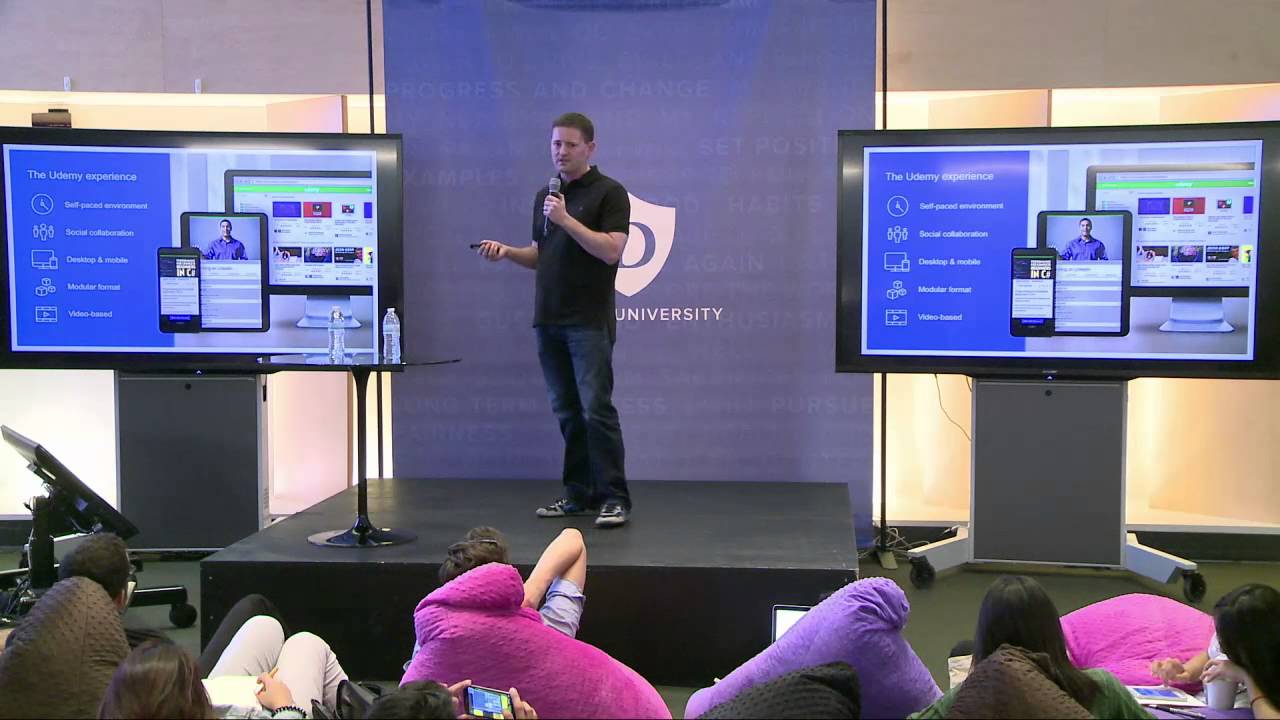
This content was created by Tim Draper. This content was uploaded by Tim Draper. This is a YouTube video titled "Hardships of Online Learning | Udemy Director of Product Management, Stephen McCurry" (uploaded 2015-07-17) featuring Stephen McCurry, Udemy's Director of Product Management. He delivers a talk about Udemy's early history and pivot from live to on-demand courses, the marketplace business model and network effects, student demographics and consumption patterns (including ~20% mobile), pricing and promotional strategy, instructor economics and success stories (mentions Seth Godin, Rob Percival, Len Smith), and platform metrics (courses, students, instructor earnings).
Chapters
So let me talk a little bit about Udemy in the early days. The company's been around since 2009, and it was founded by 2 Turkish guys. The original incarnation of the product was built in Turkey, and the original concept was live teaching. So an instructor would go on at a particular time of day, and they would teach a classroom live. Like this. So basically internet-enabled webinar-style teaching. It didn't work. And they figured that out back in kind of 2009, 2010. And they pivoted to something that was more on-demand. And as they went to something that was more on-demand, they started seeing the seeds and the signs of success that would lead them to the later success story. The other point I'd make is that when you look at the vanity metrics now, it just looks like an incredible success story. We've raised something like $120 million to date. Our last raise was $65 million a couple of weeks ago. And it just looks like— and I could say the same for Airbnb or other marketplaces. Once you're successful, it just looks like it was easy. But I know for a fact that the founders in the early days were iterating and iterating. They were grinding. They were putting their own money into it, their friends and family money. One of the founders had another job whilst doing this. It was hard. I know it was hard. For probably the first 3 years, they weren't sure whether it was going to work. Yeah. But their persistence paid off, and it was really the culture of experimentation and pivoting and trying different things that led them to the success. So our business model today is really about network effects, and this is the beauty of the marketplace. Once you get liquidity, and liquidity is a marketplace term that speaks to the balance of supply and demand. Once you have 30,000 courses on your marketplace and 7 million students, there's a deep pool of liquidity, and the network effects start to take place. And that's really what our investors see when they look at the business today. We have a diverse marketplace. If you check out our website, We have courses in everything from development to yoga and everything in between. The marketplace, the earlier slide I showed, had a lot of entrepreneurial courses, and that's really one of the niches that Udemy started with. We have a very diverse catalog today. The experience itself is is very much multichannel. About 20% of our consumption comes from mobile, which is kind of low when you look at other businesses like e-commerce. But a lot of the courses relate to development, for example, where people are actually following along and coding stuff in their Xcode or their development environment on their desktop at the same time as watching the video. So, who are the students? As I mentioned, we have students from every country, and I think we actually have purchased courses from every country in the world, which is really incredible. The ages skew between kind of 30 and 40 for the majority of students, and it's really a diverse set of people. So here's a couple of examples of students on Udemy. And, you know, it's really— when I speak to customers, they talk about the benefits of on-demand, fitting the learning around their busy lives. You know, they have jobs, they have families. How do they learn these skills on their schedule, at their time? And for the right price. A lot of our courses, and we can talk about the promotions that we do, we run a lot of promotions which has led to significant growth. But a lot of our courses are available at the kind of $10 to $20 price point. And we found that by pricing the product something comparable to an ebook, for example, people really by a lot of courses. And many courses, you know, it just makes the courses very accessible to people on a global scale. So, why would you teach on Udemy? Really, like, we're not exclusive to any instructor. You know, if you're Seth Godin, for example, we launched Seth's course a couple of months ago. And he's kind of a well-known brand in Silicon Valley. Why would you publish on Udemy? Well, the benefit for Seth is he's tapping into a different audience, like 7 million customers from 190 countries. It's a great distribution channel for Seth's content and for his brand. So really what we're doing is we're partnering with instructors to distribute their content more broadly than they could before. And at the same time, we don't publish any content. So, you know, we're really giving the opportunity for anybody, anybody here could publish a course on Udemy. If you're a subject matter expert and you want to monetize that knowledge, that skill, and you want to have the opportunity to teach people in all these different countries, you can do that through Udemy. And we have some success stories. Actually, the next slide, but we have some success stories I'll talk about where instructors have— maybe they've taught offline before, or maybe they haven't taught at all, and they've come onto Udemy, and they're making significant money, like hundreds of thousands of dollars through the Udemy platform by creating really good content. So, here's some statistics about what it means to teach on Udemy. We have more than 17,000 instructors. Our average earnings, more than $7,000. We have 60+ instructors who have earned more than $100,000 and $17 million revenue for the course sales of the top 10 instructors. As I mentioned, the average time, 3 to 4 weeks to publish a course. And here's a couple of examples of successful instructors. So, Rob Percival, he's from the UK. He did some offline teaching before, but I don't think he really wasn't focused on online teaching. He's created a couple of the most successful courses on Udemy. He created a complete web developer course and a complete iOS course. He's just published an Apple Watch course. He's been really successful. He's like a, you million-dollar-plus earner on Udemy. And Len Smith, Len was a copywriter, and he's managed to create this additional income stream that's supplementing his copywriting contract business.