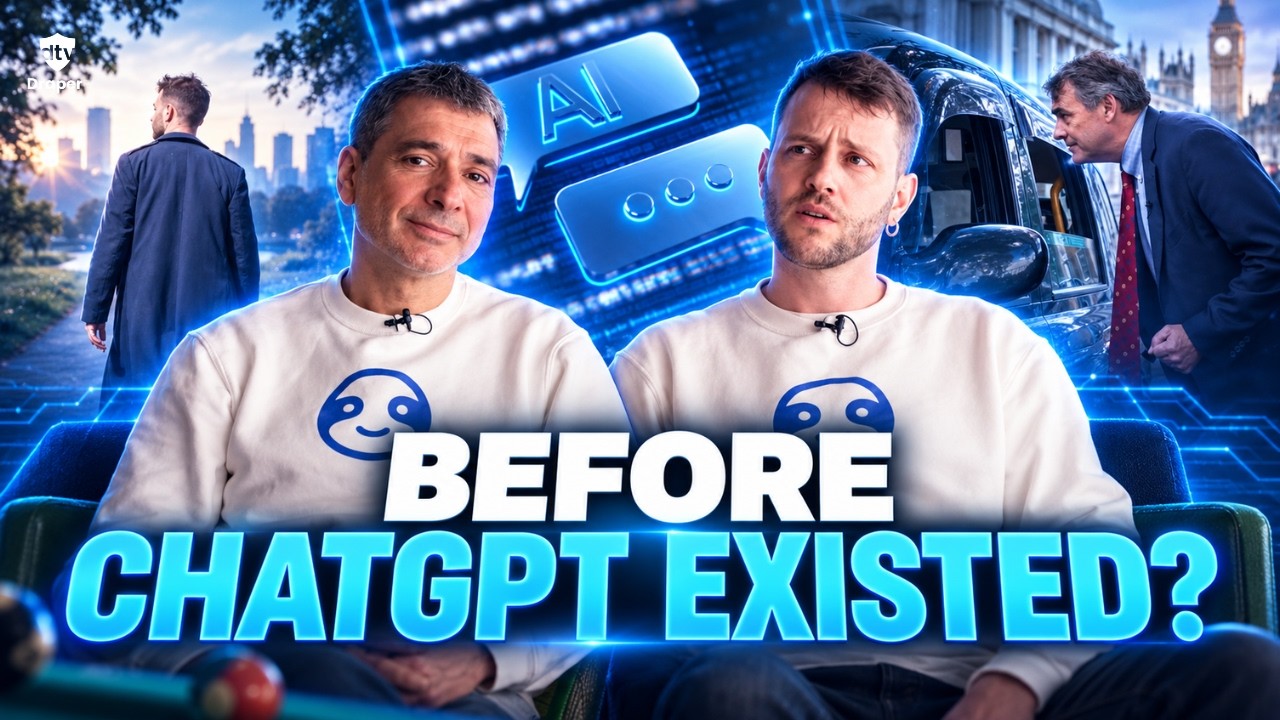
Peter Salontai and Michel Lalanne built Lazy AI, a platform that generates and deploys complete applications from natural-language prompts. Salontai worked on ChatGPT-era technology back in 2015, and the founders realized AI could move beyond code generation to actually run finished apps. They're seeking investment from Tim Draper to scale the platform.
Chapters
It's interesting how life is, right? Sometimes it starts way before and you don't even know how to connect the dots exactly. But I was working on some of the technology that went into ChatGPT as far back as 2015.
That's how we thought of the technology that will help them with selection of the right program and make it like 3 times cheaper. A lot of families come to us from the middle class, from the lower class. They want to also see how people live outside. It's not only about studying abroad, it's also about connecting people. This AI consultant, we call her Tina. She consults with the students how to select the proper program, internship. And also on the other end, it helps companies and universities to select the candidate based on cognitive skills. So it's not only hard skills, it's also soft skills and how it is combined in the person, so it can be perfectly matched to your university or your company. So that's how we try to create a history in the process of admission and recruitment.
From the pioneering tech hubs of London, Peter Salontai and Michel Lalanne are redefining the future of software creation with Lazy AI.
Well, we were sitting in New York, I remember, about 11 months ago and playing with AutoGPT, BabyAGI, all those little things. And it was just a moment that we started talking about, okay, what if we could actually make something useful on the same idea where AI will actually make the software for you, will deploy it and everything so people can take their ideas and just Just type them in and they will become alive. That was the moment.
Hi, my name is Peter Salentai and I'm the CEO of Lazy AI. Lazy AI is a platform for people to develop software using natural language.
Hi, I'm Michel Allen. I'm a co-founder at Lazy.
I think part of this experience that's been particularly cool with Lazy and AI in general is it's really broadening the possibilities of what a single human can do. In other words, you suddenly get access to all of these skills that were compartmentalized in parts of society, whether that's drawing something or creating video or writing code, whatever it may be. And you can stitch them together in novel ways that maybe other people didn't think. And that leads to a lot of opportunity. Primarily, it leads to an immense amount of space to be creative.
This AI-powered platform takes the complexity out of coding, letting users, whether seasoned developers or complete beginners, build everything from sleek web interfaces to advanced AI agents with just simple text prompts.
Yeah, we've been doing Lazy for about 12 months. Now, I think.
Yeah.
Honestly, it started with us. And so as we were playing around with some of this new software that was coming out, and it was quite exciting, I think, for everyone in the software industry, we just kind of felt like there was an opportunity to push it further, further into particularly allowing us to not just ask ChatGPT to spit out code and then having to then take it somewhere else and plug it back in, but creating this platform around it that you could ask it to build software for you and it would work and you could just press a button and run that application and see an actual real piece of software that you created as a result of that conversation. So for me, it was a relatively large, long journey that led to a moment of inspiration primarily sparked by ChatGPT.
I've been doing games for the last 12 years of my life, probably even more than that. And every day people would come to me and say, okay, I have this game idea. What do I do next? I say, well, you have to develop a prototype. How do I develop a prototype? Well, you have to have, you have to get somebody to write the code, you have to get somebody to make the art and so on and so forth. And that would often stop people right there, right in their tracks, because they would start calculating all those thousands of dollars that need to be spent. Now they can just come into the tool and they can type whatever they want. And they can actually create a game, the prototype and see if it's useful. And I think that's amazing. I mean, it opens up Opportunities for people that have ideas. Everybody has ideas, pretty much everyone. They come with different sort of ideas, but when it comes to writing software and making it happen, it's difficult. Software is complicated no matter how much you apply AI to it or any sort of assistance. But if you can express your ideas and say, here's what I want to build, do it iteratively. Get to a product that you actually happy with. I think that that's just absolutely mind-boggling opportunity for the world.
So what would it mean for me to have the opportunity with Tim? Ultimately, I think everything I've learned to date in business and my experience has made me really believe the phrase "Your network is your net worth." I think of myself. I see myself still as very young and inexperienced, partly because all of these failures that I've had in my life where I made all the mistakes that everyone told me not to make, and then I, I didn't pay strong enough attention. So I'm trying to avoid that this time around. Um, I get really excited about people like Tim who have seen so much, and therefore developing a relationship with them And having the opportunity to soak some of that knowledge in is, I think, the coolest part about it.
Tim is somebody who looks at the world's biggest problems and thinks long-term. We're trying to tackle a really big, big problem, right? So it's really exciting to talk to somebody who understands.
By streamlining development and making it more accessible than ever, Lazy AI is tearing down barriers and empowering visionaries to bring their boldest ideas to life. The future of software creation has never been this seamless.
So what would a million bucks do for us right now? I think it would do like an extra 12 months for sure for the business. But more than the sum, I think what we need is alignment around the problem and a message out to the world that we are here to support the community that we have long-term in building their ideas out. Right. So If this show goes well for us, I believe that a lot more people will join this mission that we have. A lot more people will create more software. A lot more investors will give us more money to do what we do. And ultimately that will lead to humongous impact down the road of apps that were built on top of Lazy AI's platform actually delivering value to society. So the sum itself may be not inconsequential, but the spark is what leads to eventually the fire going.
We'll probably spend this money on promoting things that our community builds.
Yeah.
So that's very exciting because that just fuels the fire.