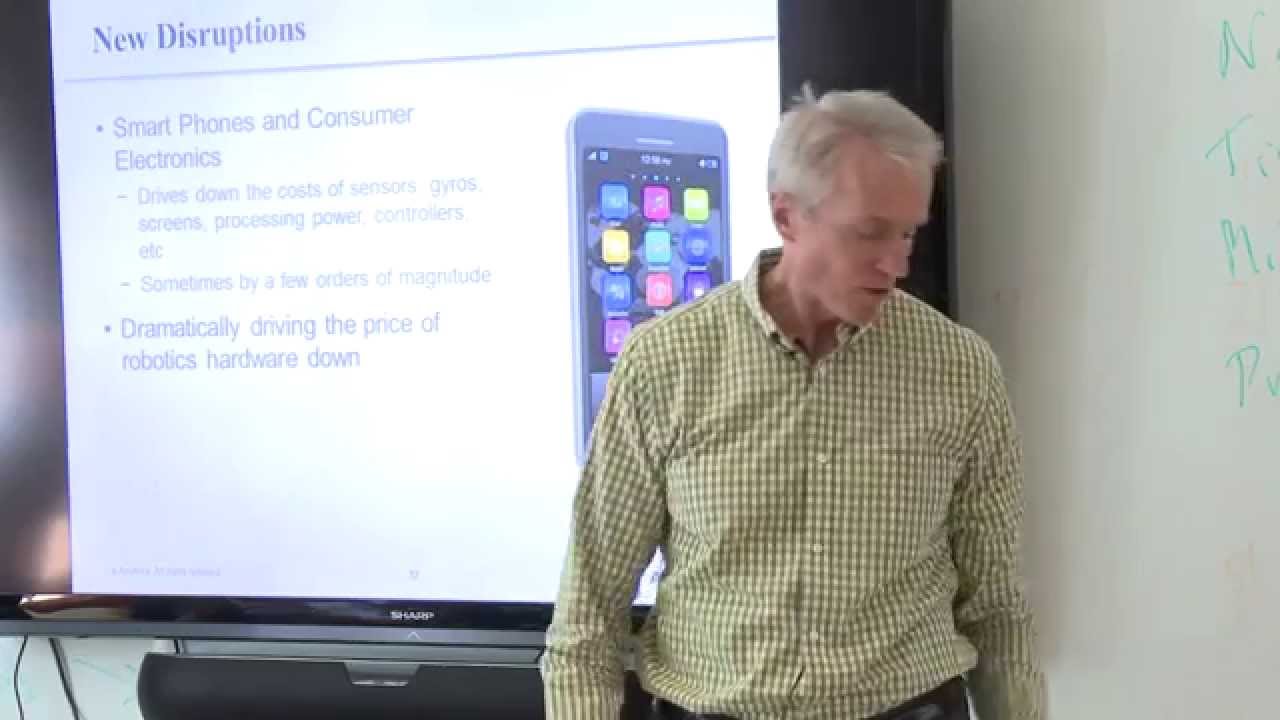
This content was created by Tim Draper. This content was uploaded by Tim Draper. This is a YouTube talk titled "Here are Some New Disruptions in Robotics | Board Member of Anybots, Tim Lenihan" (posted 2015-06-13) featuring Tim Lenihan speaking to an audience about major disruptions in robotics. Lenihan explains how smartphone components (sensors and ARM processors), cloud computing for cheap processing/storage, and open-source software have driven down costs and democratized robotics development, enabling low-cost hardware, outsourced manufacturing, and novel designs (e.g., soft inflatable robotic arms).
Chapters
So the interesting thing about robotics now is there's this major disruption that's going on. And the disruption is really being driven by the little device that all of you guys have in your pocket, your smartphone, right? So what's happened is, is this smartphone, all the components in the smartphone, are the same stuff that are used in robotics. So accelerometers, GPS systems, microphones, screens, Wi-Fi, ARM processors, memory, all that stuff is what you use in robotics. And the fact that these things are being built in the billions of units has driven the cost for those components way down. We call it the peace dividend from the smartphone wars. It's the ability to now take basically a device that costs you $200, and it is sophisticated enough to be the autopilot for a 747. So that's what you have, everyone has in your pocket, costs you $200. So all of a sudden now, instead of having these massive billion-dollar, I shouldn't say, maybe hundreds of billions of dollars, tens of millions of dollars projects to develop robotics. You now have these super low-cost devices. You have this device right here who can be the brains of the robot. And so it's drastically driven down the hardware cost. The other piece that's a disruptor as well, and that is the access to massive amounts of processing power in the cloud. So not only can you store stuff for virtually nothing, but you can basically get processing power for almost zero. So you can run all sorts of really kind of complex and processing-intensive applications like video, voice recognition systems, computer vision, autonomous navigation, all these kind of sound processing optimization type applications that run in the cloud that cost you almost nothing. And so now you have these devices that are basically built out of the same components that our smartphones are built out of, and they're connected to the internet. And so you have all these data centers running around on the internet. So now you've got the ability to combine these smartphones with this massive amount of processing power that's in the cloud. And so that's really dramatically changed the price-performance ratio. So it used to be, in order to run some of these things— remember I was telling you about the feedback loop? Mm-hmm. That's what that is. That's why we didn't have the microphones turned on. So what I was saying is that in order to run these really intensive applications that you'd want to run on a robot, like to be able to navigate by itself around a room, or to be able to recognize a person's face and then do something with that person, all those applications used to be very expensive. And you'd have to put them on the robot. And they were very intense. as far as sucking up energy and sucking up processing power. Now those are all hosted in the cloud and they cost almost nothing. So this has dramatically changed the entire cost structure, so your hardware and your software. And then the third piece is this whole democratization of the innovation. So there's a whole bunch of open source software and most of the kind of the, what you guys might consider the drones and these kind of things are all run on open source software. And people spend— they work at Google or they work at Apple and then they come home and they will spend 40 hours a week writing code for an open source robotics application because it scratches their itch. They just like to do it. And then they put it out there for free. So you have this huge community of people in the world who are interested in robotics who have put together massive amounts of open source open source software that's virtually free for you to use. So now you've got the combination of super low-cost hardware, you've got access to the cloud so you can process stuff, and then you've got all this low-cost or free open source software. So it's really kind of, you know, you think about, it's kind of like this robotic industry is kind of taking on some of the characteristics of the software industry, where you've got really low barriers to entry, right? You've got this web-based open architecture innovation that's going on. And you've got the ability to now outsource your manufacturing. So you can use all these different— everything from TaskRabbit to big supply chain management things that allow you to then build stuff around the world and bring it to one place and assemble it at very low cost. So it's taken on kind of the characteristics of the software industry. And so as a result, the innovation that you're seeing in robotics has accelerated dramatically. Because the cost has come down. So, I mean, I kind of, as a point in case, so what happens is you've got now low-cost hardware, access to the cloud, low-cost software, free open-source software. So now there's a whole bunch of people who never could play in the robotics space, all of a sudden they're like, geez, in my living room, if I wanted to, I could make a robot and it'll cost me— $100. $199 and a couple of trips to Fry's. And so this used to be kind of— and you can think, well, that's really expensive and that's really hard to make. But then these guys come up with these— now that it's so cheap, these guys up in San Francisco have built these arms. They have no servos. They have no bearings. They're just inflatable. No joints whatsoever. So if you unzip that thing— All it is is a bunch of balloons basically inside that arm. And then you have a couple of valves that control compressed air. And they open and close and that arm moves around. And so they were able to build this. So now, and you go back to that first picture I showed you of that big giant robot in automobile assembly. That thing costs maybe $200,000. These arms, they're gonna cost $200. And they're soft and they're compliant. So if you see some of these videos of these guys on the internet from this thing, the arm will come around. If you don't want that arm in front of you, just push it out of the way. It's basically a balloon.