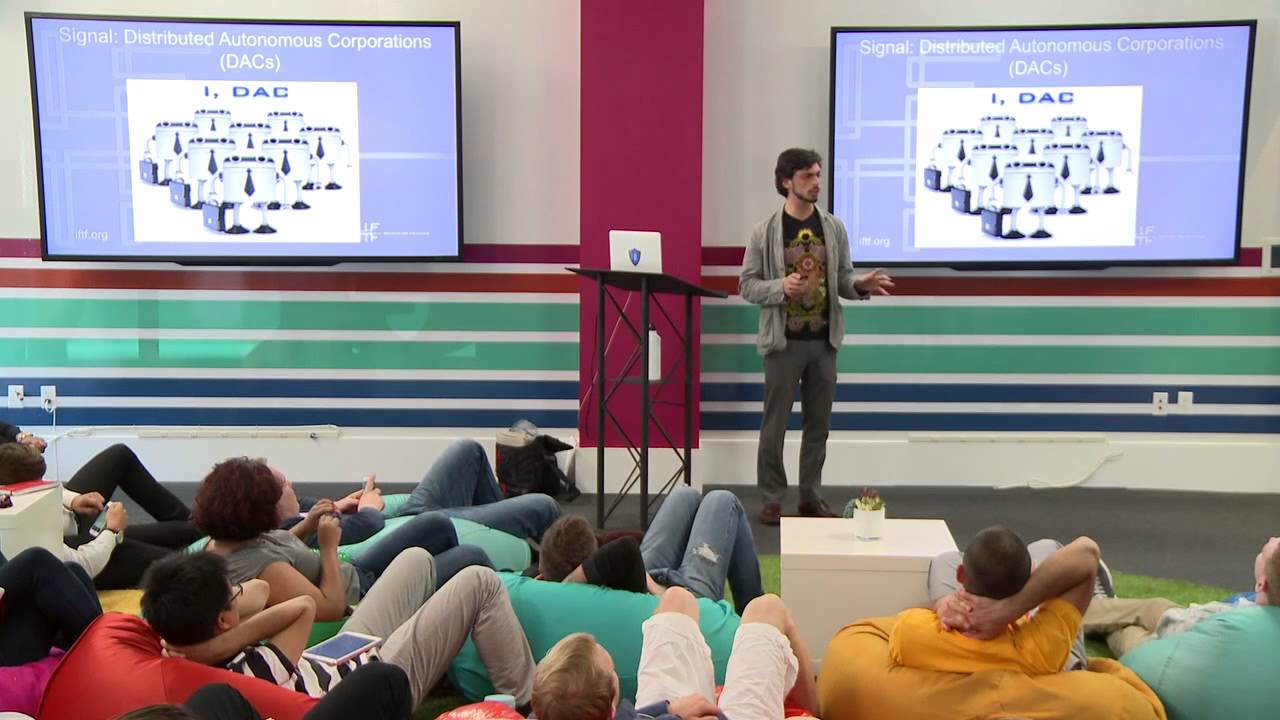
Jeremy Kirshbaum from the Institute for the Future explains how founders can spot signals of coming change, like 4D printing and blockchain. He argues leaders need clarity over certainty, and introduces the second curve framework for shifting your business before disruption hits.
Chapters
So returning back to our future leadership skills, clarity is expressed in stories. This is what a leader has to express, is the story of how we're going to get there. Certainty is expressed in rules or absolute shalls. You need to moderate your certainty but enhance your clarity. So in, in the words of a couple of people, but Jeff Bezos in particular, you should be very clear about where you're going with your team. Be very clear about where you're going. Be very flexible about how you get there. In a VUCA world, you can't predict everything. So now moving on to the future. We look for the future using signals. Now you've probably heard of this quote, the future is already here, it's just not evenly distributed. So we look for pieces of the future in the unevenly distributed present. So a signal is not necessarily something that's gonna succeed. In fact, they usually fail in an interesting way, but it's something that's an indication of what's going to come. It's an— and one signal on its own doesn't really mean anything, but when they're made as part of a story, it illustrates for people and helps them understand. So, for instance, we talk about global matter routing. Part of that is 4D printing. So, this is from a collaboration between Harvard and MIT. It's a little bit old. Some of you might have actually seen it before. And it's an example of what 4D printing might look like, if I could get this to play. Oh, there we go. So this was a 3D-printed polymer, and you'll see it is forming itself, it's assembling itself, and then it eventually folds itself up, and then at the end it walks away. So this is— Wow. The polymer just reacts to heat. And again, this is a very early signal. It wasn't actually fully printed all at once. It did require some hand assembly, and it's not exactly about to carry like a package or something, but it's an indication of how manufacturing and 3D printing are collapsing. Another— and so that would be part of a larger story. Another example of a signal might be something like distributed autonomous corporations. Is anyone familiar with this? Is anyone working on blockchain projects? Cool, so these are companies that are built on the same underlying structure as Bitcoin. So everyone, a lot of people are talking about Bitcoin right now, but at the Institute we don't really think it's about Bitcoin necessarily, it's about blockchain, the underlying methodology that was used to build Bitcoin. And you can build a currency with that, I don't really consider Bitcoin a currency, I consider it more of an online metal or a derivative with no underlying company. But you could also build a company. You could build a programmed machine that operates itself and could theoretically own itself. There's someone in Palo Alto who, as a joke and also to make a point, started a company called Robot, Robot and Huang, and 2 of the members were distributed autonomous corporations. And that was an early signal. There's now actually a Chinese venture capital firm that has elected a machine learning AI algorithm to their board. So again, not necessarily happening right now, not necessarily successful. We're not saying that that venture capital firm is going to do very well. I have no idea, but an example of what's to come. Another framework we use is the 2— the second curve framework. This is some videos of our former president Ian Morrison who helped popularize this. The 2-curve framework is a way of knowing when to move to your next business. So— What's the first curve? Let's say— we'll talk about this later— digital immigrants moving to digital natives, or let's use the example of landlines moving to mobile lines. So, for a long time, landline phones were making a lot of money, and that's the thing. When the curve is on its way down, it makes a lot of money, so you don't want to jump too soon, but you also have to start building your future business while it's happening, or else you wait until it's too late and you aren't able to jump. So, the 2-curve framework is a way of thinking about how we move from the present to the future.