Jonathan Hsu, lead data scientist at Social Capital, discusses how data teams evolved at Facebook from 10 to 300+ people. He explains why data scientists work alongside product managers and designers to help companies make better decisions, drawing on his background as a physicist and former Facebook data lead.
Chapters
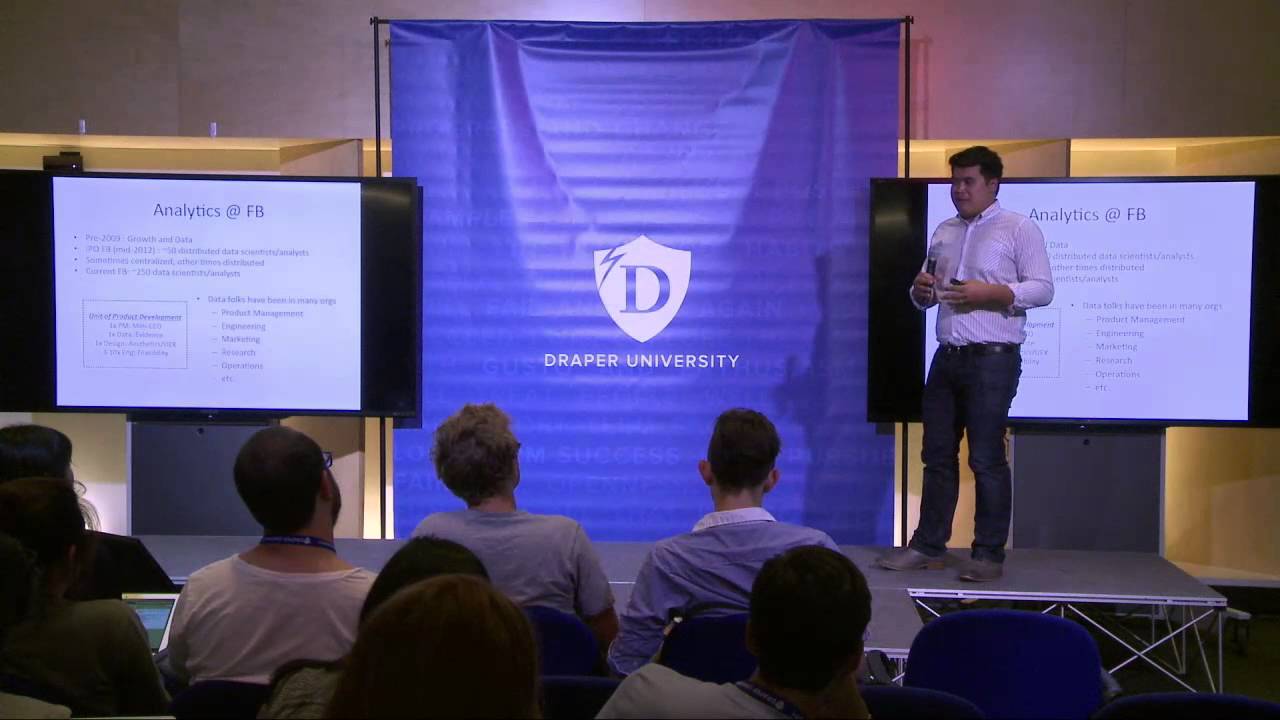
Okay, so who am I? So I'm Jonathan. I spent the— I'm currently at the Social Capital Partnership, as mentioned, where I work on a bunch of stuff. About half my time is spent advising a bunch of companies, helping them with their data science activities. It's really about taking their data and helping them to grow. The data can be valuable in many ways. Typically for an early company, the thing that is most important is growth. So it's really about taking their data and helping them To make that happen by whatever sort of means necessary. So these are all the guys I work with right now. In the past, I was at Facebook, as mentioned before, built out the data science and analytics team there. I started a company back in the day called SuperPoke. Do any of you remember SuperPoke? Zero people. One dude. Awesome. Oh, OK. What is that? Prior to that, I actually did my PhD in physics at Stanford, so I used to be a physicist. This stuff is actually foreign to me. Cool. Oh, I now have a clicker. Which button? This button? Yeah. All right, cool. What is this about? This is a quote from Chamath. Chamath is the founder of the Social Capital Partnership. He started the growth team at Facebook. When he left, this was in his exit email. He emailed the entire company and said, "Don't be a douchebag. This is self-explanatory. It's not about the right to ripstick, the quality of the candy bars. It's about winning. Everything else comes second. Nothing else matters." Right? And so the purpose of the data scientist is really just sort of the natural extension of that, which is to help the company win with data as the main tool. So you know people talk about a lot of different things with regard to data science. You probably read about it. Oh, data scientists. these fancy guys, they do all this math, but it doesn't really matter if it doesn't help the company win. So in some sense, that's the core of it. And anybody who tries to obfuscate it as to make it something else is likely straying from the core purpose of this stuff. It's just like software engineering. Software engineering, the purpose of it is to build something that will help the company succeed. It's not just to build things or to build interesting things. It's about building things that help drive success. Okay, so how does it fit into a company? So, you know, with companies I've worked with, with companies I've been at in the past, it fits into several different ways. You know, data people can be in engineering. They help build data products. You know, things like feed ranking, maybe ad targeting. Oftentimes in what's termed analytics, which is really about enabling data-driven decisions. You know, you have decisions to make. How do you make them? Business intelligence is kind of an older term. It's some sort of mixture of the above 2 things. Research, sometimes there's a research team which will be like more academically oriented. Sometimes sales and operations, sometimes marketing. It's not mentioned there. But there's many ways in which this sort of function can fit in your company as you're growing it. So yeah, it's like data literacy is this kind of broad thing that's going on, and that's kind of the area that I'm talking about here. To tell you a little bit about how it works at Facebook. I joined there around in 2009. Prior to 2009, there were some data scientists that really worked on growth, but we didn't actually have a lot of data expertise outside of growth. We didn't have a lot of understanding with regards to how users use the product, which might strike you as surprising. You might think, oh, 2009, company's already 5 years old. They must have known everything about how people do everything. That's not true. That's not the case, actually. They knew about how users were acquired and base-level retention stuff, but the details of how users dug around in their profile or how users were consuming their feed, not really that well understood. We didn't really start figuring it out until around 2012 was when we started putting a lot of effort into it. We've made a ginormous team to do this. When I joined, there were, I think, about maybe 10 people, 12 people total. out of 1,000 that really worked on this kind of stuff. And then around 2012, it was like maybe 50 people. So reasonable growth. Currently, I think it's actually more than 250. I was just chatting with one of my old teammates over there. I think it's about 300, 350 right now who work on this kind of stuff. The way that the bulk of them are distributed in the company are in these little units of product development. In Facebook, we think of having a PM, a data person, some engineers and a designer. It's kind of like one atomic unit. In some sense, that's there to— we want those units to be as atomic as possible to sort of recreate that feeling that you guys have when you're starting companies, where you can be fast and you can just do stuff and feel free to break stuff and hopefully not break things too bad and have the autonomy to make— to have impact. I write down the notions of what these guys do. In some sense, the data scientist is like the voice of evidence. What does evidence have to say with regards to what we're trying to do? The design person is kind of like the voice of aesthetics and the user experience. What should it be? The engineers— I think of engineers as really like a voice of feasibility, because in some sense you have some engineers, you have 5 of them, and they tell you, well, we have 6 months. We can only build this much stuff. We cannot build everything. So it's sort of a voice of feasibility. PMs are really there to sort of make sure we actually get stuff done. Mini CEOs. Thank you.