How to Raise Money for your Startup | Lawyer Jared Brubaker
Lawyer Jared Brubaker walks through the legal structures startups use to raise money: debt, preferred stock, common stock, convertible notes, and convertible preferred stock. He covers valuation caps, discounts, typical note terms, and what happens to each when you get acquired or convert.
Chapters
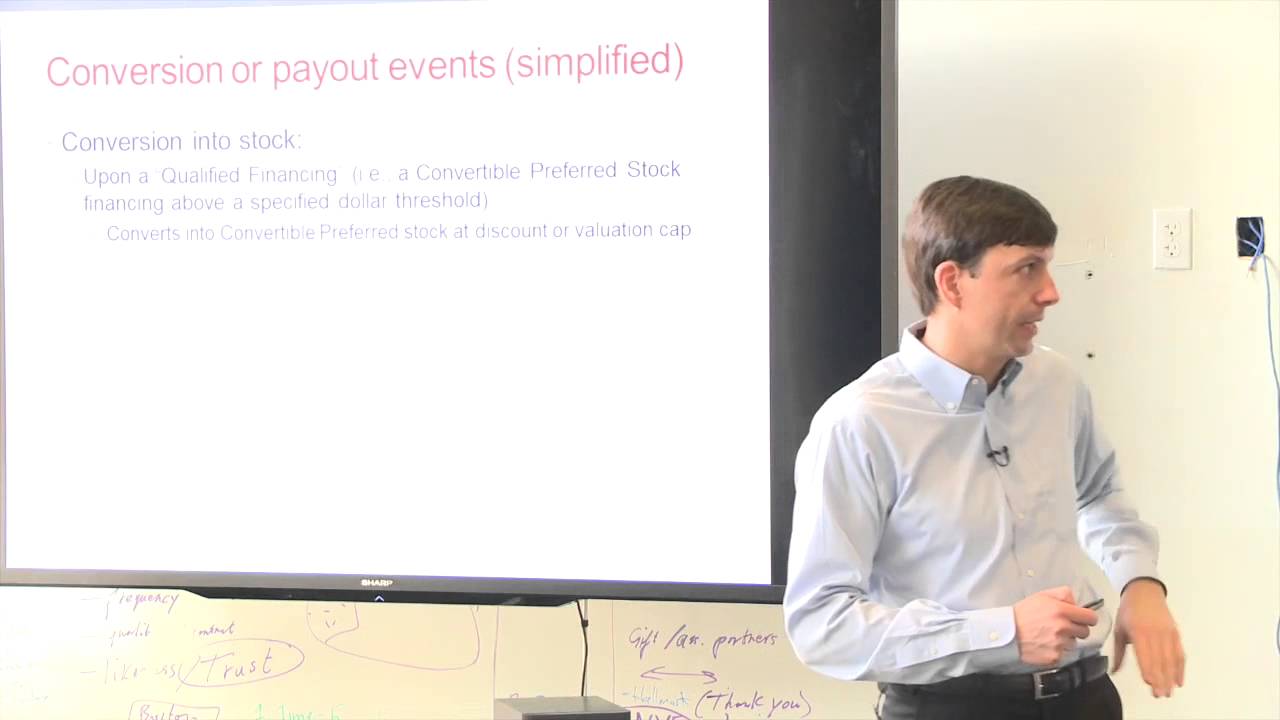
All right. So, if— so at this point, if you've done all this, you have your startup, you've incorporated, and now in order to do anything, you have to raise money. And so, in order to understand what the standard legal structures for raising money are in in Silicon Valley, it makes sense to go through some of the— some legal background for terms. One, the first type of basic corporate security is debt. So the company owes principal, they owe the money invested plus interest. There's a maturity date where the holder can demand repayment. You're first in line for payments if If the company dissolves, then the debt holders get paid first generally. And unfortunately, investors' profits can't exceed the interest rate. So this is not something that a venture capitalist would be interested in. There is also preferred stock, which is similar to debt. There is no maturity date, but— and It is senior to common stock, which is what is issued to founders and employees, but it's still— but the payouts are still typically limited. And then there's common stock, which is the last in line in payments, but it captures all the profits once the debt and preferred stock are paid. And the stock that is traded on stock exchanges is almost entirely common stock. And so when a company has an IPO, for example, the people that get the big payout are those that hold common stock. All right, so with that in mind, investors would like to have both the preference and the big payouts, and so there are these hybrid instruments that were created. They're convertible notes, which start out as debt and then end up eventually converting into common stock. And then there's convertible preferred stock, which starts out as preferred stock and then eventually, if things go well, will convert into common stock. So companies do not use common stock to raise capital at this early stage. Major reasons, the investors like the preference over the common stock. There could also be very bad tax consequences to the founders if the IRS sees that that stock is sold for 1 penny a share to founders and then immediately you sell it to— for $1 a share to the investors, then the IRS will say, okay, wait a second, like the difference— like what the investors paid for it was obviously that was the real value of it and so everything else is compensation and we're going to tax— we're going to tax the founder as if that was income on that year. So you don't want that, obviously. And It's a lot easier to reward employees, contractors, and advisors with stock if the price is— if the price of the common stock stays low. So, a bit more review on convertible notes. As I said, it starts with debt, converts into stock, common or preferred, upon certain predefined events. It typically converts at either like a specific valuation, which is often called a valuation cap or at a discount to the price that investors are buying the stock and I'll get to what that second part means. So this is very popular with early-stage startups. This is effectively— it's become effectively the only way that early-stage startups raise capital now. Very low legal expenses, there are some clients that I have as companies where I've spent less than an hour on their legal documents and they've raised $1 million. It's easy to do on a rolling basis, so you can say my goal is to raise like $1 million and then you can take like $100,000 from this investor, you're trying to close and then you take like $250,000 from another investor and you can do that on a rolling basis. It's very easy to do that. Okay. It's very— it's simple in comparison with preferred stock. Yeah, I get it. I wanted to go through some of the events where like the note turns into something else or it goes away. The first is conversion into stock upon a qualified financing. And a qualified financing is basically a convertible preferred stock financing above a certain dollar threshold. This dollar threshold could be $1 million, it could be $2 million. or whatnot, but the note converts into the stock at either at a valuation or at a discount or at the valuation cap. And I'll go through an example of that. It could also convert into stock at the maturity date at the option of the holder. So, if the holder sees that the company is doing well and figures they'd rather have the benefits of common stock, of getting the profits of common stock as opposed to being first in line for payments, they may decide to convert. It may also convert on an acquisition. So, and this is one of the major ways that note holders get compensated if a company is acquired before they end up raising a lot of A lot of capital. So, and then there's obviously some examples of that. So cash, another one might be a cash payout upon an acquisition. So an investor may be able to choose whether they get a cash payout or whether it— whether it— their note converts into stock. The cash payout can be 1.5 to 3 times the principal plus interest. That's sort of the normal range that I've seen. In a lot of acquisitions that aren't very spectacular, this means that the note holders can get everything. And I've seen that a fair amount. And then also like the note holder can demand at or after the maturity date that they be repaid because it is debt. This is something that doesn't happen all the time. But it does sometimes happen and this is the motivation behind YC and other groups trying to create other types of securities that don't have this attribute. But for now, as I said, convertible notes are what we have. All right. So, I wanted to run through an example. So, let's say Hero Corporation issues 8 million shares to its founders. That means they followed followed my recommendation to issue only 80% of their authorized 10 million shares. Then they issue a $100,000 convertible note. At some point in the future, they raise $2 million by selling Series A convertible preferred stock at $1 per share. So they're doing well. So this, by the way, would imply an $8 million pre-money valuation. So you take You take the stock that's outstanding, you take the price per share that the investor is paying and you multiply them. The post-money valuation would be $8 million plus what they're getting, so plus $2 million, so it would be $10 million. In general, venture capitalists talk in terms of pre-money. The notes convert based on pre-money. If there's a question about whether you're talking about pre-money or post-money, you should definitely ask because it can be significant. All right. So, how does the note convert into stock? As an example, at a discount. So, let's assume the note has no valuation cap but has a 20% discount. Then it would— the $100,000 would convert at $0.80 a share. they would get 125,000 shares. The idea being here that the note holder invested earlier than the Series A investor, and so they should be compensated for that extra risk, and so they're getting 125— or they're getting 25,000 extra shares for that, for taking on that risk. So another example, at the valuation cap, let's assume that the note has a $4 million valuation cap and a 20% discount. So in this case, they would— the note would convert at $0.50 per share. So you take the valuation cap and divide that by the total number of shares outstanding before the capital raise, you get $0.50 a share. They would get 200,000 shares of Series A. That is a very high valuation. In a lot of cases when it is— when there is a valuation cap, the investors that invested early at a lower valuation cap can get much, much more stock than those that invested later. So yeah, and we went with the valuation cap rather than the discount because it gave the investor more shares. So typically that's— That's the way it is. So other— so what are the typical convertible note attributes? Maturity date, typically it's from 1 to 2 years. Some venture capital firms claim that California law says that they can only do it for 1 year. There are many that don't claim that. Obviously, it's more company-friendly if the maturity date is farther off in the future. So, the interest rate can vary between the lowest that the IRS requires for tax reasons, that's about 2%, or it can be 8% or higher. Valuation cap varies from company to company. And the discount, in a lot of notes there is no discount or it can be as, I think 20% is sort of like a normal on the high range. And like these factors, interest rate, valuation cap, and discount, they all sort of like are balanced, they all sort of like play together. So it depends on your philosophy as a company and also the investor's philosophy, the initial investor that you're negotiating with. Some investors like a high interest rate with no discount because they figure like they'll be compensated for for like the longer amount of time, if it's like a couple of years before it converts, they'll be compensated and they'll end up getting more stock because of that. So, what the right values are for this is something that you should really like talk with your advisors. It varies based on the industry and like who your founders are and so on. It can— there can be a very wide range. So I just wanted to touch briefly on convertible preferred stock and again as I said it starts as preferred stock and then it converts into common stock at some point. This is when you hear about people talking about Series A, Series B and whatnot, it's convertible preferred stock and it's set up so that the last people that put money in are generally the first to get it out. So Series A, Series B is senior to Series A, Series C is senior to Series B and so forth. It converts into common stock on an IPO or if desired by the holder and it comes with a lot of rights and restrictions on the company. This is what's used with larger financing led by VC funds and it obviously comes with a valuation. So when you hear valuations on companies, based on some financing that they got, it was— it's based on the price that the investor paid for their convertible preferred stock. So, the attributes of this are very, very complex. This is just some examples, liquidation preference, right to redemption, and pre-liquidation rights. This is something that like you can't do a whole lot about right now, but you should obviously discuss with the knowledgeable lawyer if you're lucky enough to get to that— get to this point. This is where investor controls— a lot of entrepreneurs are concerned about maintaining control of their company. This is where the investors really start to impose some amount of control. They add a board member. The company cannot take certain actions without permission from the investor like selling the company, raising more capital, et cetera, and there are many, many others. There's also, as I mentioned, restrictions on the founders selling their stock.
More from Tim


He Sold His Car to Build This Startup, Then Pitched It for $1M 😳 #Startups #AI

This Startup Moves Your Crypto BEFORE Hackers Can Steal It 😳 #Crypto #Cybersecurity




15 Months Without Refrigeration?! This Startup Thinks It Can Go Global 🥥 #FoodTech #Startups



