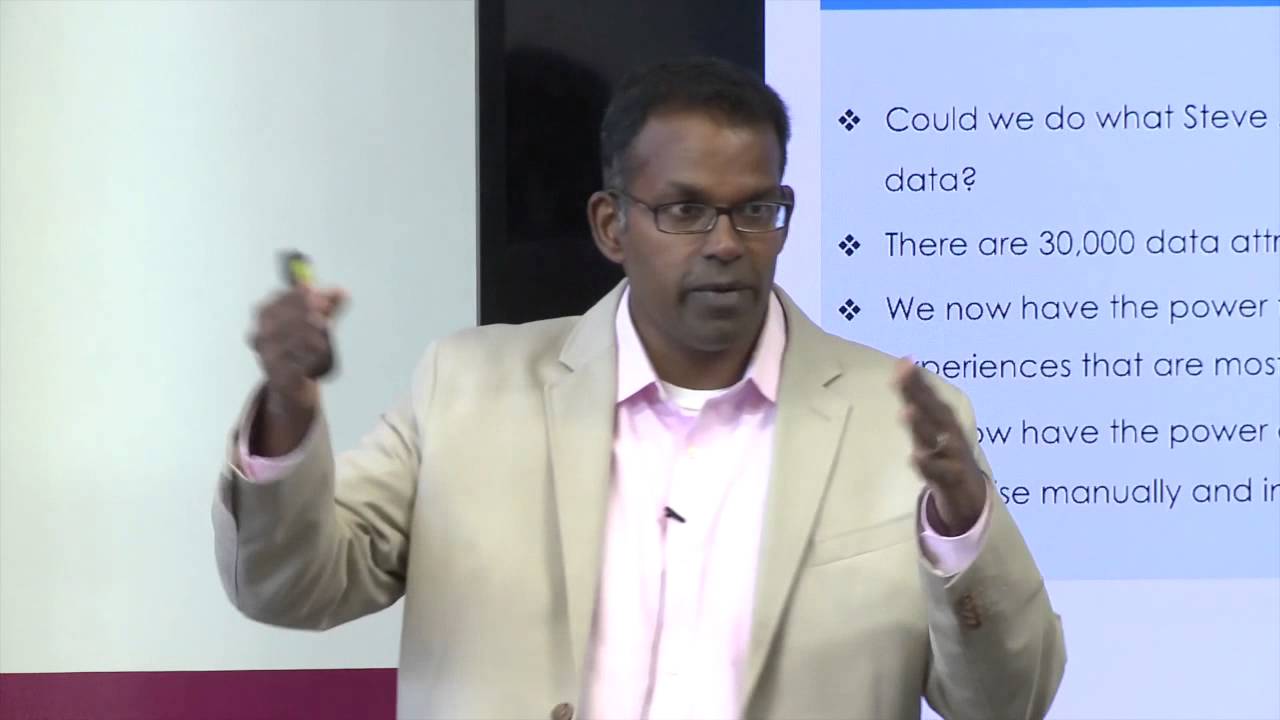
Sodan Selvaretnam argues startups need data as a guide, using a four-force framework to assess opportunities: societal and technology trends, macro-economic conditions, industry dynamics, and market segments. He cites Steve Jobs, Atul Butte, and Andrew Hoog as examples of leaders who used data to accelerate insight and build products.
Chapters
This is very important. I wanna touch on this in the last 5 minutes left and then wrap up with the other piece. Data is a very important guide. From Napoleon, who says, war is 90% information, to Atul Butte, who's a biotech researcher, who says, hiding with these mounds of data is the knowledge that could change the life of a patient or change the world, to Andrew Hoog of Foursquare, who says, for every 2 degrees The temperature goes up, check-ins at ice cream shops go up 2%. Data is incredibly powerful, and the amazing thing is we have access to all of it today, right? This is part of the data. I want you to think about 4 key forces as you think about your businesses, right? One are what's going on as far as society, technology, culture, socioeconomic, right? Before you— as you get into that, think about it in that context. Think about the segments that you're planning to go after, what their needs and demands are, right? This is MBA in 5 minutes. Macroeconomic forces, right? Global markets, capital markets, what's going on, is it the right time to get capital, the commodities that you need to make your business, right? Industry forces, your suppliers, your competitors, new entrants. Cygnus Ventures, Sonny Dillon. I know these guys, like them a lot. Look at the way that he encapsulates the— well, I took what he said in Forbes on September 14th, 2015, and I'm like, he basically in one paragraph captured the 4 forces as far as the virtual reality marketing is concerned. Read what he says here. I'm really excited about the potential of the virtual reality for virtual reality in the near intermediate future. And while we've only made one investment in VR to date, we plan to do more. It is the next major computing platform changing the way we interact with one another and the world around us. What is that saying? Society, culture, socioeconomic, he's making a statement, right? He's got a view on what's going to happen. It's still very early days. He's recognizing that, hey, I can see the future, but it's still early. It may be 1995 in music or whatever the analogy is, right? Before enough VR headsets are out there. However, before mass penetration occurs, that's market trends, market segments, right? He's identifying the niche market where it could happen. Before mass penetration of true interactive VR takes root, mobile-first VR will provide a more near-term solution. Right? And then he goes into industry forces, who are the new entrants and suppliers, and if you read this, he's talking about Felix and Paul, Jaunt, NextVR, and Oculus Rift, Sony Morpheus, et cetera, et cetera. He's calling out all the players. He's done that in one paragraph, right? And then he's also going back to market trends and saying, if I'm going after this, I'm going after this market segment of the early VR gaming adopters. It's great, right? So you can go through this exercise. If you can say it in one paragraph like he did, you're being crisp and you're having some clarity about what you're projecting, right, for your vision in the future. So I wanted to provide that example. Steve Jobs did this intuitively, I think. I wasn't there when he did it, right? But he used data as a source for imagination. He knew who his people were. Watch the campaign he did when he took over Apple called Think Different. Have you guys seen it? Okay. He says, I'm making this for the rebels. I'm making this for the people that don't fit in, the oddballs. He understands his audience, probably because he is one of them, right? And then he is keeping an eye and pulse on it, and he says, this mobile phone sucks. I hate tons of mobile phones, right, that are not consolidated. Oh, and by the way, my friends who use mobile phones also are heavy email users. They are big music listeners. Right, and he's intuitively making these correlations, right? And he brilliantly imagines visions and pieces it together, together with his team, brilliant team of course, to create an iPhone, right? Started with the iPod, it went with iPhone, but it's a Clear understanding, right? Now my company, and this is not a plug, but I'll tell you, what if I could correlate— Steve Jobs is a Picasso, right? Picassos are born how often? Every generation. Picassos are not born— everybody's studying Steve Jobs. Steve Jobs is a Picasso, right? Picassos are born like once a generation. But the data and intelligence you can predict to make correlations, right, has the power to accelerate insights. So you can have 30,000 attributes and third-party data in a marketplace, and what if I told you the correlations that he made, I can predict? I can predict it, and I can give you a guide. So you weren't born with the DNA of a Steve Jobs, and you can watch all these movies to try to be like him, but you know what? You use the power of what's available to replicate and accelerate. And that's one of the things that I'm doing at my company is using data to shape product and marketing. And it's not simple data. It's what they're calling big data, which is like a marketing term. I've been dealing in data all my life in my career. And they put the word big in front of it, maybe because everything in America is big. I don't know. It's just data, right? But it is lots of data, and you can use it to inform, and I will boldly say, the intelligence of Steve Jobs, right? There's evolution of things. I mean, if you watch basketball, we went from an Elgin Baylor to a Julius Erving to a Michael Jordan. Wow, right? Each— and then Kobe Bryant, who I feel copycatted Michael Jordan a lot. Right, but he wasn't as transformative, but they learned from each other and they accelerated those learnings, right? And so the analogy here is you can do that with data, right? And concretely what that means, right, is that there's pre-revenue and post-revenue. So what I was talking about is, hey, I'll give you intelligence to tell you what new products to test with the consumer because I have data. It's not just an imagination exercise and an incubation and a hackathon right away. Right? I'm introducing that, right, in some of the stuff that I'm doing with my company, right? But then you go into what you're hearing in Silicon Valley, right? Pretotyping, product prototyping, growth hacking. You're continually testing and iterating very, very fast, right? And post-revenue, and this is what we're doing at Chia Ventures too, is we're using the data to increase the value of the customer. Right? And so data is surrounding you all the way, right, from concept to completion to acceleration, right? And let me do a few quick definitions. Prototyping is a partially mocked-up intended product or service which you're testing very quickly, so you're not building it before they come, you're just iterating very fast. Eric Ries has talked about The Lean Startup. There's a gentleman— Tim Draper. I forget his name right now, who's written stuff on pretotyping. Product proto— what's that? Alberto Savoia. OK, there. He did. OK, excellent. OK. So I like what he says. And then product prototyping, iterating quickly, and then growth hacking you've all heard about, right? It's like testing with data to find product-market fit and also the channels that work. I would encourage you when you have time to do an exercise on your own where you Pick the area that you're moving into and try to be Sonny Dillon. What Sonny Dillon did to virtual reality, do to your area. Test yourself, right? Test yourself for that clarity. 2 things that are very important: creativity. I'm going to recommend 3 books. One of a person who I respect and I think was a pioneer, right, in this space is David Kelley. He wrote a book called Creative Confidence. Every human being is creative. It's just about freeing your mind and being open to all the possibilities. There's Think Fast and Slow. There's The Art of Possibility. A ton of creativity books, but primarily it's a mindset. Execution, do, do, do, learn, learn, learn. Don't sit in your cubicle, just keep doing and doing. My only advice for execution is find mentors who've really done it before. Because the learning will be tremendous as you go through your own thing because they've actually done it. But in the end, you can only execute by doing yourself. And so you have to be in the doing. Don't over-intellectualize stuff, just do it. Okay? A final word as you move in to change the world. How many of you are after this program at Draper University going out there with an intent to change the world? That's like 3/4. What happened to everybody else? Are we falling off? OK. Good. Good. OK, so let me leave you with one thing. And this is by a spirit that walked in flesh and blood, who says, it is better to travel well than to arrive. It's better to travel well than arrive. Thank you. Bon voyage. Change the world. Have a great journey. And I thank you for your time listening, patience, engagement, interacting. Good luck. Thank you.