Humans, Virtual Reality, and Neurohumanism | CEO of Meta, Meron Gribetz
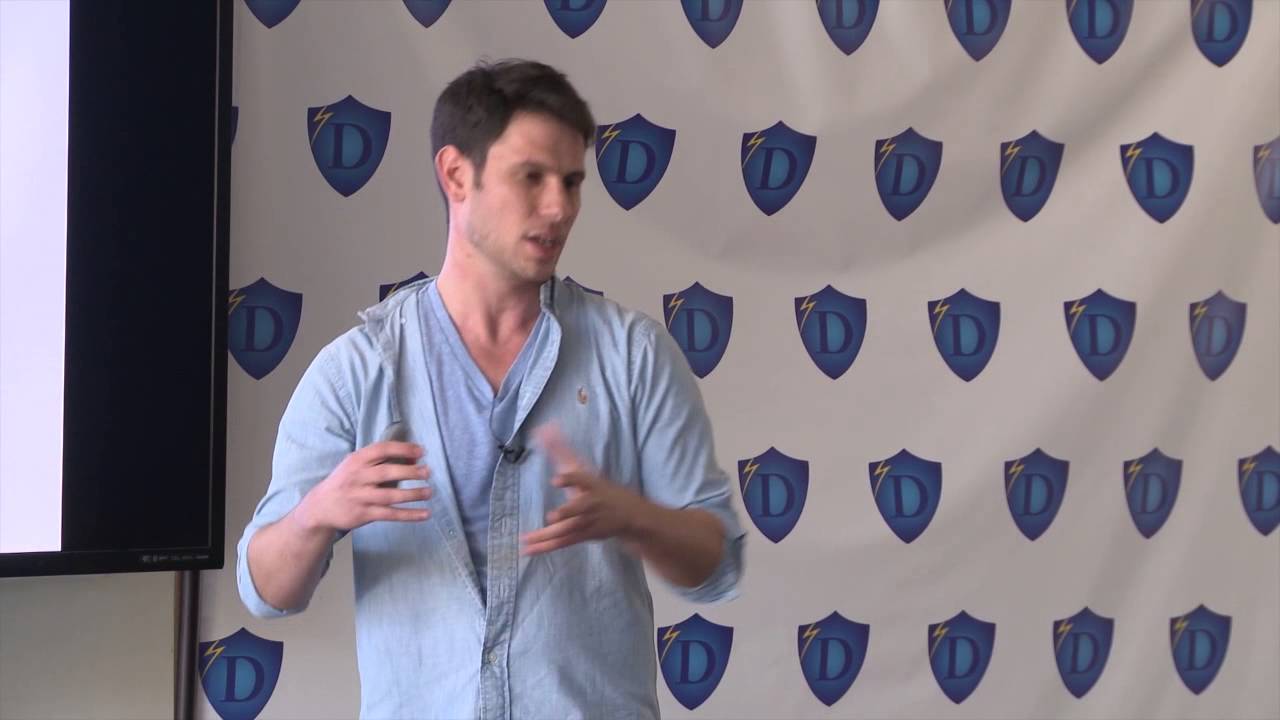
Meron Gribetz discusses neurohumanistic interface design, arguing that VR should engage the brain's visual, vestibular, and somatosensory systems together. He traces how interfaces evolved from terminals to mice to iPads, and demonstrates why presence in VR matters through a roller-coaster Oculus Rift example.
Chapters
So, we're going to dive into virtual reality as our first case study. This was a scene from The Simpsons a couple of years ago. And we want to analyze it and, you know, and ask, is it a neurohumanistic interface? Because on the one hand, it causes what we call presence. You're in the device and you feel It's engaging with every part of your brain. I'm surrounded by, you know, I'm on my yacht, I'm surrounded by my virtual AI buddies. Or even better, I'm going into the, teleporting into the mind of my friend who's hiking, climbing the Everest, right? These are some of the use cases that you may have heard of from Sundance recently. This is very apropos stuff. It's just becoming real now. When you're in this thing, Clearly, it's engaging every part of your mind, of your brain. And so, we ask, you know, is it neurohumanistic? Let me give you a few specific examples through that brain framework that I explained earlier of how VR is engaging with your mind. Your visual system is euphoric, clearly. You have the— your rods in the center, your cones, everything is engaged. In really low latency, everything looks hyper-realistic, right? So, that's how the visual system is engaged. Your attention is grabbed by the sheer stimulation of someone climbing the Mount Everest, so your parietal system is hyper-locked on the moment. And your prefrontal cortex is imagining how awesome it would be to be in that space for real. The whole brain is really having a great time. Is it neurohumanistic? Yes or no? Yes if it's neurohumanistic.
Yes.
All right.
So, we have one or two. A few slides back when I spoke about interfaces that engage with the nervous system, I mentioned there's the brain, the central nervous system, and the peripheral nervous system. And one thing that VR does very well is it cuts your brain off From the rest of your body. Okay? So, while your brain might have the feeling that you're climbing Mount Everest, you don't have that tingling on your finger as— that I'm climbing. So, your somatosensory isn't engaged, but neither is any of your peripheral nervous system. And what does this cause essentially? It causes cognitive dissonance. Have you ever tried virtual reality? And have someone come behind the screen and start talking to you while you're—
did this—
yeah, we have one. Tell us about that experience. Yeah, go ahead.
Oh, it just— I mean, so I'm a student at Cal Poly, and we have— what is it, Oculus Rift there?
Yeah.
And you're on a roller coaster.
OK.
And it's cool, and you're going around it, but then someone stands in front of you and says, like, hey, what is it like? And it's just like, well— It doesn't feel very real anymore because it takes you out of that—
It broke the magic.
Yeah.
Okay, interesting. How about you? What was your feeling when you tried it?
It was weird for me because I felt like it was harder to tell where the source of the voice was.
Yes, yes. So, I felt a similar feeling. I felt like I was still engaged in the roller coaster demo. I actually tried that same roller coaster demo when someone came behind me. And I was so like, you know, I felt my vestibular vestibular system pulling me down, and it was really— I was really present. And then my CTO starts basically smacking my head and yelling at me from in front of the camera. And I felt like it was a ghost. I felt like I was real, like this was real, and like my CTO was a ghost. And he felt like everything was broken, all of the presence was broken, and he goes back out into the Realizing this is fake. Either way, there's something very philosophically deep that's happening here, in my opinion, and it's rooted in a cognitive dissonance between what your brain thinks is happening and what your body thinks is happening. Okay, so your sound, your temporal lobe is hearing someone talking for you. From there, your peripheral nerves on your forehead are feeling someone smacking your forehead, and you're out of the moment. So, And that dissonance, that disconnection breaks the neurohumanistic aspect of this interface. Yes?
You were saying that before at the beginning, you said there's all these different use cases of neurohumanism, there's AI and virtual reality.
Yes.
So what did you mean by that, that virtual reality is an application of neurohumanism?
Great question. Virtual reality is not an example of neurohumanism, but it is an example of half of neurohumanism. It engages many, many, many neurons, and it causes you to be present, but it never achieves the full sort of neurohumanistic vision. And, you know, I was holding up a slide earlier of of Doug Engelbart holding up his computer mouse, and I could see you guys kind of sliding away, taking notes. Is that a technology that is neurohumanistic in your guys' opinion?
The mouse?
The mouse.
Over like the terminal?
The mouse, yeah. Let's hear your analysis. Hit me.
Previously, the terminal, it's all just been like typing in, you had to think logically, like what I want at the target, something like that. The mouse, though, doesn't make sense. He's looking on the screen, he's wanting to move it, and wherever you move your hand, Jared, the mouse goes on the screen.
Yes.
So the connection just makes sense.
Yes, yes. So that's a great analysis. What you said was profound. Relative to the terminal, this is a near-humanistic interface. Interesting.
But I think there's also some interesting subjective elements, because when you use a mouse over time, that's going to change your interaction with it. And with the terminal, For some people, I would say it is a neurohumanistic element because they get so engaged in the flow of it and they script it so well. But for other people, there's no engagement.
That's great. And so we go back to that idea that neurohumanistic interfaces need to engage many parts of your brain at high throughput. And things that are learned tend to be eventually high throughput, but at the beginning not high throughput. And so that's very interesting. But I think when you look at virtual reality and you compare it again with previous gaming technologies where you're sitting with a joystick and you're looking at a screen much like the one that you're looking at now, this is maybe more neurohumanistic, right? And so that relativistic way of looking at it is really interesting. Any other questions or thoughts?
Yes.
I think it's actually pretty interesting, Luke versus Chris's Luke said that relative to the terminal, it's good and allowed him to feel like the computer was matching what his needs were.
Yeah.
Whereas Chris brought up some people can just understand the terminal better, and you get the realization that there's 2 ways that we can become more neuro-humanistic. It's that we match ourselves to the computer and change what is humanistic, or we match the computer to ourselves and make them more humanistic.
Yeah, that's a great way of looking at things. What neurohumanism is concerned with in the longer range, as I mentioned in the introduction, is expanding the subset of humans that can use computers quickly. And so, we want grandmothers and we want 2-year-old kids to be able to learn it fast and not only the subset of people who can learn how to use a terminal. And so, although I experienced the flow, the full neurohumanistic connection with terminals when I was a coder, it's not something that I believe should continue into the far future.
All right.
So, that's VR. Case study 2, from the PC to the iPad.
All right.
So, perfect introduction. So, we have the terminal. And from the ENIAC terminals in the '50s and '60s that are highly encoded. Why is it maybe objectively not as neurohumanistic? Because how much does this engage your visual system? It does in a way, right? But I'm seeing symbols here. I'm seeing symbols that only a subset of people that know English in the world can understand, and I'm seeing words that are encoded in a way that even many of that subset of people cannot understand. And so, it's a very, very limited group of people that would experience neurohumanism through that technology.
Yeah? Yeah, so would you say there's certain groups of people that start to encode them as more complex things, those pieces of the terminal that start to become larger images and concepts in the brain?
Absolutely.
For most people, you're right.
Absolutely, absolutely. So, you know, I used to build these kinds of pictures in high school, and I've come— and I've looked at these kinds of images for a long time, and my visual system, that area of the brain that I mentioned is an object recognizer, can look at this and determine exactly what the imagery is. But many people look at it and see symbols, increasingly so over time. So that's the first step. But we took this pixelation here and we applied it through Xerox, of course, to the early Macintosh GUIs. And you can see these are pixelated again. And if I showed this to a kid now, they might say, this is just a bunch of squares and lines and I don't—
I don't know what it is.
I don't know what this is. But the people here that were around in the '70s and '80s could see and know exactly what these kind of encoded pixelated icons are. So, relative to the previous, this may be seen as near humanistic, but relative to the iconography of the future, this is probably not. And then things become more visual in Windows 95. And then we move to the true climax of this era, which is iPad 1. Steve said, I want to build interfaces that people feel they can lick. OK? So he didn't say that computer geeks could feel like they could lick, like myself. He said everyone. And that was the first really truly inclusive interface. And it was the first time And noteworthy is my grandma could never use Windows 95 even though we tried to train her and help her with it. And I think it's all of our grandmas that couldn't. But they're all hacking away at the iPad like it's their birthday. I mean, it's perfect for their minds because for the first time in computing really, the iPad took on the same metaphor As the picture. So what's the killer app on the iPad? If you ask my grandma, she'd say the picture viewer, where I could watch my grandkids all day long and obsess about them. And so she's looking at this square, which is the iPad, and moving around a photograph just like she would on the real desk. She knows exactly how to do it, no explanation needed. This is the epitome of the last 30 years or so of computing in terms of near-humanism. So, And then there was a grandma. And then there was a step back towards Windows Metro, and that's really interesting. More grandma pictures. So it increases your target market, guys. Come on, let's learn how to build in this way. The future of computing is even more extreme than those early Steve Jobs interfaces. The future of computing is meta, where there are no more metaphors. There are no more limitations for the brain to understand how to use a new interface. Okay? In the grandma case, it's the photograph that has the physicality. But when I ask her to delete a photograph, she doesn't know what the heck to do. Right? Long press. That's a metaphor. That's something that isn't necessarily neurohumanistic for her. It doesn't engage with her neurons. She has to do a long press, and then she has to find something with an X on it and press it and still answer the question, are you sure you want to delete this? Yes, no. Another encoded message that only English people— Anyway, the long story short is this is not neurohumanistic in many ways. That this can be. And this truly is the last device of that lineage. This is the end of the line.
Okay?
Now, when I want to delete a folder, there's something that looks like a folder and there's something that looks like a garbage can and my grandma can do that, right? So, let's trace back how we would delete things through these things. So, here I'd have to—
What do you mean?
Write something with very, very specific syntax, right? Very, very specific. And I would always mess up and I would always have garbage in my folder because I didn't— I missed a letter. And I'd have to memorize a really complex— here I'd have to drag it into this pixelated thing that sort of looks like a something and then right-click on it. Again, remember you have to still right-click on it, which is a metaphor. Answer another thing and then you can delete it. And finally here it gets a little bit easier but still not. So really the— and that was hell to delete stuff. And here it's like magic. So we believe strongly that this is where the future of computing is going to be and that's what we're doing.
More from Tim


He Sold His Car to Build This Startup, Then Pitched It for $1M 😳 #Startups #AI

This Startup Moves Your Crypto BEFORE Hackers Can Steal It 😳 #Crypto #Cybersecurity




15 Months Without Refrigeration?! This Startup Thinks It Can Go Global 🥥 #FoodTech #Startups



