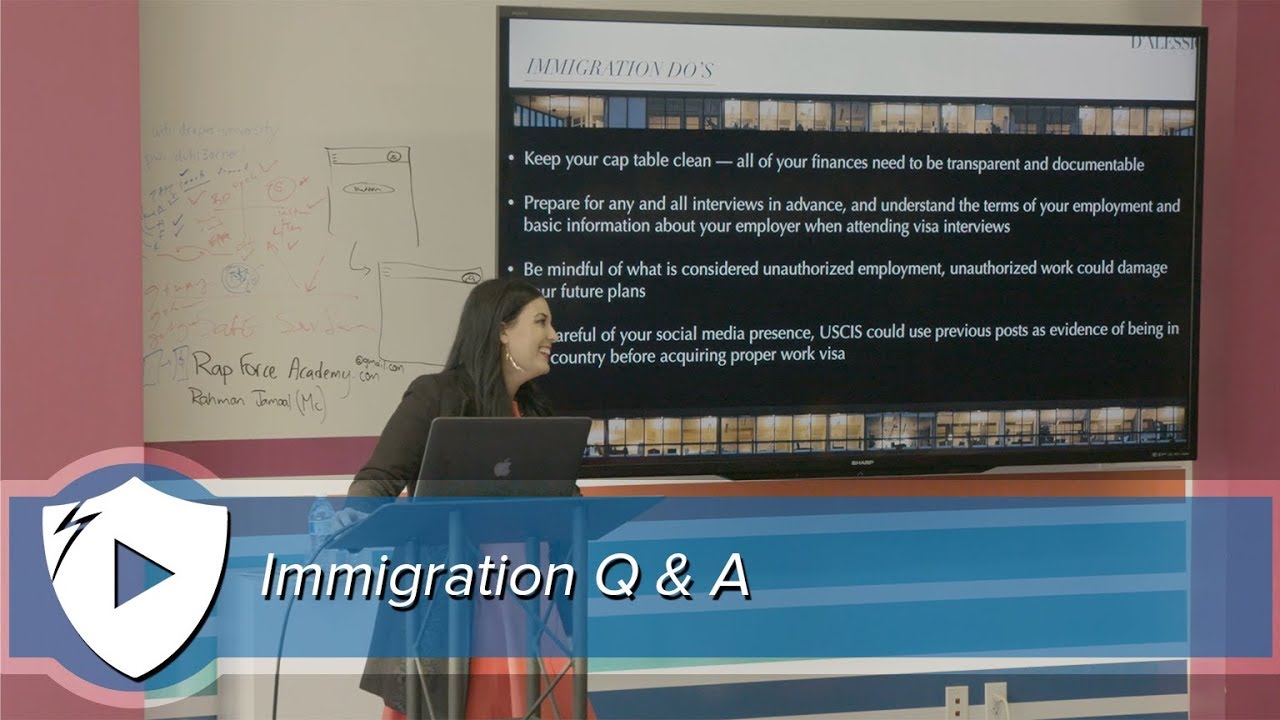
This content was created by Tim Draper. This content was uploaded by Tim Draper. This is a YouTube Q&A titled "Immigration Law Q & A | Immigration Attorney Kelly Decsy" (recorded August 15, 2018) featuring immigration attorney Kelly Decsy answering questions from an audience (multiple participants labelled SPEAKER A, B, D, E). The session covers U.S. visa topics including J-1 intern visas and their 2-year home residency requirement, O-1 and L-1 options as workarounds, H-1B lottery and employer sponsorship criteria, B-1 duration and extensions, F-1/OPT/CPT transitions, EB-5/"millionaire" investment issues, visa fees and typical attorney costs, waivers, and issues around owning or operating a company while on visas (especially F-1). The talk appears to be an on-campus informational session with offer of free consultations for partner schools.
Chapters
J-1 visa. I was here on J-1.
Yeah.
So that's an intern visa.
Yeah.
So J-1 visas are intern visas. They can be gotten by schools. They can be gotten by certain companies. It would be dealt with through them. But that's intern, short-term. Some of them will block you from being able to come back in the country for a certain amount of time after you've gotten it. There are ways around it. That's why a lot of people like the O-1 visa because it tends to be a loophole through a lot of these kind of blockages when they have a 2-year home residency requirement after you have the visa. You're able to kind of bypass that by getting on the L-1.
Can you explain that again?
I'm sorry.
With the J?
So, some, not all of them. So, some will have a 2-year residency requirement, which means you have to go back to your home country and stay there for 2 years before you apply for another visa. There's several that exist like that. The O-1 is a loophole through that. So, you're able to still apply for the O-1 and bypass that 2-year home If you had a J, for example. So, some— so, there's different types of J visas. Some have what's called a home residency requirement, which means, let's say it ends today, you go home, that means you have to be home for 2 years before you can apply for another visa. Okay? So, some of them will have this requirement in them. They're all different. There's different types of visa that have this as a part of it. If you are under those certain circumstances, the O-1 is going to be your option because that gets you a loophole through it. So you'd want to get an O-1 and then you can jump to a different green card or one of the other options. But an O-1 is a loophole beyond that 2-year residency.
And I believe there's some— in some cases you can waive the 2 years with the J visa, correct?
Through the O-1? There's always going to be certain circumstances where waivers can be done. I'm not going into the waivers because there's a million different kinds. So, but yeah, there's always going to be if something happened, if you committed a crime, if you need a reason that, you know, you overstayed, There's a waiver for everything. Each waiver has its own success rates, and we can kind of talk about that if you have specific issues. Yeah.
You mentioned that the immigration process can be expensive other than the E-5. How expensive is it? What do you usually pay?
Yeah. So, I mean, they're all different.
So— Is it expenses for the lawyers or expenses of—
So the government does have expenses. So for the legal fees, the legal fees depending on the visa is going to be $3,500 on the low end, some of the easier visas. For the more expensive visas, it's going to be— or the green cards, it can be, you know, $8,000, $10,000. The EB-5 is a lot more expensive. So EB-5 is out of that category because those are a lot more. The filing fees also come into play. So the government wants its money. Government always wants its money. They want you to pay to be here. So each separate visa has its own filing fees and its own government requirements on that nature. So those vary greatly from, you know, $460 up to, you know, up to thousands.
You know, for the millionaire's visa, is there a certain amount of time that you've got to be a millionaire or just have that, say, $502 million in your bank account for like 2 weeks?
So they'll question it if it's only in your bank account for 2 weeks because they want to know that it's your money again and not being invested. They want to know that this money is coming, A, not from drugs or from some sort of other illegal activity, you know, Obviously, other kind of illegal activities. So they're going to want to see a paper trail. They're going to want to know where this money is coming from and that it is your money to lose. And if you lose it, it's on you. Does that kind of make sense? Yeah. Anybody else?
Is that like for the H-1B visa? Is there like a higher probability to get hit if you go to like a bigger company compared to a startup?
No. No. They don't look at all. So you— they get your paperwork. They just put a cover sheet and they put a number. And if your number gets drawn in the lottery, then they look at your application. They don't look at it before. So they don't even look at it until you get your number drawn. And then if it doesn't fit, then they say no and pick a new number. But no, you're not even looked at beforehand.
Is there like a criteria about what kind of company can like sponsor people for H-1B visas?
Yes, there is. But that's a whole different conversation because they have to show that they can pay someone. They can show that they have money. Obviously, the smaller ones might be, you know, but that's a whole conversation of who can and can't sponsor as a company.
So if I apply for this visa in my home country, is the process different from applying here?
No. Every visa that you— every visa and green card that we've talked about can be applied inside the United States if you're on the appropriate visa currently and you have the time to wait it out, because some of these visas do take a long time to process. Or you can apply outside of your country. Or I mean in your home country outside of this country.
Yeah. One very short question. For the B-1 visa, it's like always six months, or is it depends on like what your situation is?
Well, you can get an extension. So the the technical max is six months. You can request an extension to the B-1 visa, but it doesn't have to be granted. Yeah.
Can you talk about the F-1, J-1 journey and the OPT, and then that transition?
Well, okay, so OPT will be done by your actual school. They're the ones that set up the OPT. So the F-1 is a student visa for those of you who don't know what that is. That's done by the school, and F-1 is, you know, pretty common. You can transition into OPT if your, if your program that you're in is allowable for OPT. There's also something called CPT, which you can work during your program, but that will be up to your international advisor. Each school has different rules that they set up with their own OPTs. So At the end, you would want to apply— again, you have to remember there's wait times for these visas. You're not going to get something overnight. So if you're thinking of switching on and wanting to stay in the country, give yourself much time. Talk to us when the start of your OPT. We can tell you whatever visa you're going to be jumping on, what the wait time is.
You can't run your own business on OPT though?
No.
Can you run it with O-1?
Can you run your own business with O-1? You can own a business under the O-1, but you can only be employed by the business under the title you're granted. So the O-1 is very title-specific. So you come in as an actor, a model, right? You come in as a model. She can only work as a model. You come in as a software engineer. They can only work as a software engineer. So you can have a business. You can make money off a business. But the actual employment title needs to be whatever you're granted under the O-1 structure.
Entrepreneur.
So it can be entrepreneur. So those titles are, you know, if you have the criteria for it. I know it's it's gray. It's a longer conversation. Yeah. Then you're gonna have issues. Don't drop out, kids. Stay in school.
Too late.
Too late. You all dropped out.
Oh no.
Anybody else? I got five minutes. Yeah.
So I always want to like. I want to consult some legal firms, but I'm just worried about they charge me every second. So I'm wondering, like, which question I can consult is for free and what things they are charging?
Okay. Well, you guys are in luck because we do free consultations for anybody that we come to their school and we partner with their school, do these kinds of talks and stuff.
Oh, yeah.
Woo!
I can't believe I got an applause for that. That's really exciting. Yeah. So you get 30 minutes to an hour depending on where you're coming from. Usually that's enough time to kind of talk about all your different aspects and what you're looking at. So I can pass out cards later so you can contact me so I know you get the free consultation for that. So we can set you up. 'Cause a lot of these things are just too many gray areas to talk about in one kind of lecture. Some of the more specific questions. Anyone else? Do you have your card? Yes. I'll pass, I'll pass out my card. Yeah.
Is it common to sort of have a local co-founder and then being employed? Because you can still own equity in the company and sort of getting the dividend.
Yeah. So you can own a company and you can get money out of that company. Any foreigner can even own a company in the United States and get money from it. It depends on who's sponsoring you, who's being your petitioner, where that might help.
Okay.
So about that thing, right now I'm actually having this problem because I'm here on an F-1 visa.
Okay.
And last year I incorporated my company into C-Corp. And then I had a bit of a weird time because apparently you're not supposed to earn any money outside of university unless you have a special permission for that. And then right now I'm having this problem, this issue right there that I do not know once we get investment, because right now we're actually in the process of one investment.
Uh-huh.
Once the money comes in, Then what will happen?
Right.
I'm the guy who incorporated the company, and apparently it's not illegal to incorporate the company, but once you start earning money outside of university, then that is problematic.
Yeah. So there is gray areas. Anytime you're trying to work on, you know, an F-1 visa, which doesn't have work authorization, or any other visa that doesn't have work authorization, there's going to be gray areas. So technically you can be making money because you can be in, you know, let's say England, and invest in a company here and just be getting money back. It's when you're here opening it and then incorporating it because then you're doing business. Because what are you— how are you incorporating it without working in it? So that's where the gray area is going to come up is how like they're going to look at it basically saying, well, you must be working at this company then. Especially if you're getting money from other people, from investors, that's money coming in. You know, it's going to tiptoe that gray area.
Right.
What if you're an incorporator? Because incorporated can be different than CEO. Or the actual owner of the company.
Yeah.
I think it could be anyone.
So this will be a longer conversation than the 3 minutes that I have. I'm more than happy to have it. We can have a whole discussion about it. But it is, because it's very much a gray, murky area. So that's why it's going to be a longer conversation. So it's not clear-cut. It's not black and white. So definitely would love to have the conversation. But I know I have like 1 minute left. Because they keep holding up my sign saying how much time. It's you that's holding up my sign. I'm taking your time as well.
Cool.
All right, guys. Any last questions? No? All right. Well, it was lovely meeting you. I'll pass out my card. Thank you for your time.