Interdimensional Physics Scales | Co-Founder and Chairman of eMeter, Cree Edwards
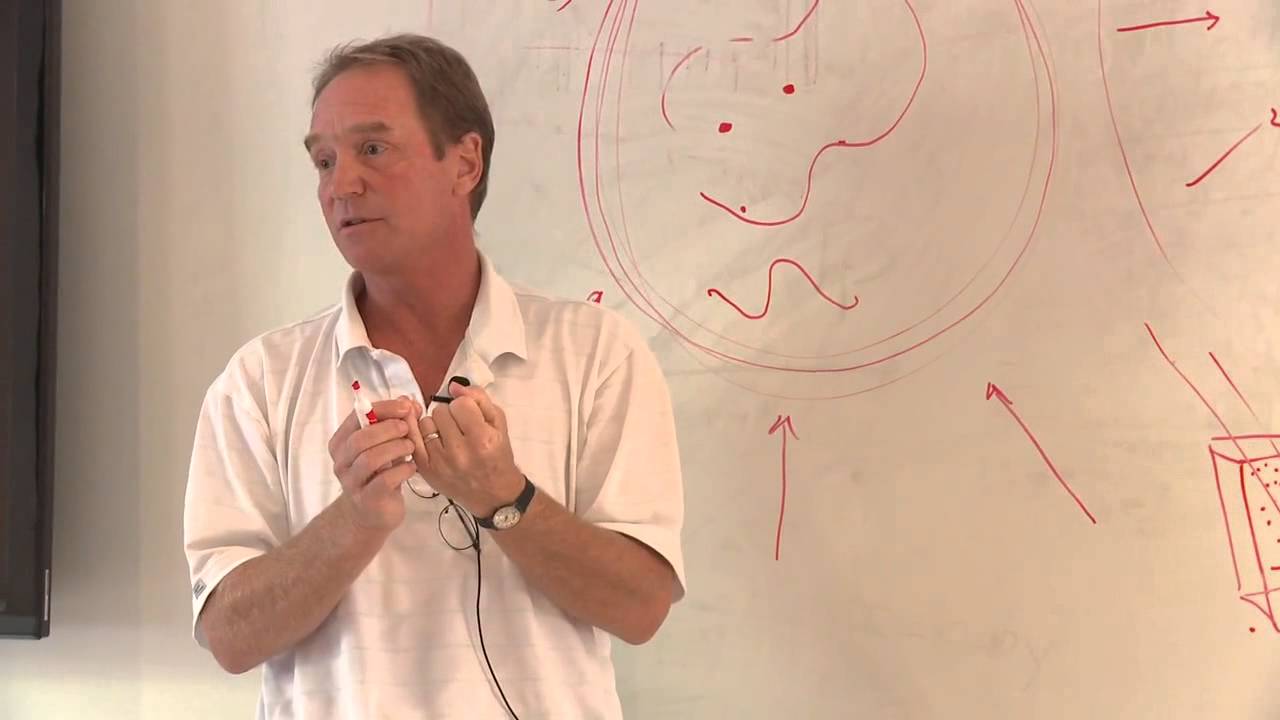
Cree Edwards proposes that protons trap massless energy from a fourth dimension, which condenses into what we call electrons. He reframes gravity as drag from concentrated energy through massive objects, and claims the Sun's 20,000-mile-thick conversion layer transforms incoming energy into photons. He dismisses gravitons, the Higgs boson, and CERN as misdirected science.
Chapters
So I'm gonna scale this. So here's the smallest particle in building block in the universe is the proton. It is trapped energy, trapped energy with physical properties in the 3rd dimension. And I'll tell you where they come from in a second also. In order for the proton to operate, it needs energy. The proton sucks in, and the energy source for the proton is clear energy. It's massless energy from the 4th, massless energy, the pool that we, the universe floats in. It is sucking in clear energy from a large distance. As the clear energy comes in and condenses, it forms a footprint. And I'm going to redefine plasma too, but the footprint, we'll call it, it's an electron cloud. Cloud, plasma cloud. Now, one of them, as it comes in and gets close enough, the concentration, as it gets sucked in, like a candle sucks in oxygen or a jet engine sucks in oxygen, maybe to show more of the violence, the energy per unit volume decreases to a point where the energy reaches a concentration where it actually begins to occupy physical space. The electron shell around a nucleus of an atom Is not orbiting atoms, is not orbiting electrons. Electrons do not orbit atoms. And I think the physics community now understands that. They've got all these different theories of jumping from point to point around and so forth and so on. But there is no electron orbital in an atom. Now, you'd say, well, there's got to be. We learned that in school. There's zero proof for that whatsoever. Matter of fact, one of the main reasons that quantum physics came out, which is basically probability math, is try to predict the orbits of these things, which are unpredictable. And they ended up giving them things like wave-like properties because they see them appearing here and here and here. And it's a connect-the-dot function. And they give them wave— particles wave-like properties. They don't orbit. Out of this densely concentrated clear energy flashes energy, primarily photons. And in certain cases, photons flash in an area, the same area at the same time. And they form, and they have a relatively short life, and they form as what we observe as electrons.
Yes? Do you think there's any way of potentially tapping into that potential?
Yeah. You do?
Yeah. That would be interesting to me.
It happens constantly at the subcellular level in your mitochondria today. But yeah.
Right, but then for like—
Yeah.
—use. Yeah, yeah.
Somebody smarter than I will figure it out. But yeah. This process actually is going on when we're generating electricity. We are doing this, and we're removing excess energy from the system. We'll talk a little bit about that in a second. But so it's the concentration of clear energy on the nucleus of the atom that creates the footprint that is the boundary for what we see as physical matter. Now I'm going to scale this really quickly. Gravity.
Gravity.
Same thing. You have an object. What is common with everything that has gravity? It's really big, right? When we observe a gravitational effect. This is the Earth. It has gravity. The gravitational attraction's some, you know, several thousand miles. The Earth is made up of, to us, an infinite number of protons. In different configurations, different elements, and so forth. A huge number. The cumulative energy draw for the Earth begins about a million miles out in space. And you can see the energy effect. And I call this an energy— these are energy bubbles, basically. But it's an energy system. It's a— where there's a dominant object, the energy is moving in toward. The Earth is a dominant object in our bubble. It is doing exactly the same thing that the proton does. What's the energy draw? Because it is just a series of enormous protons, it is drawing in energy from open space. Now, it's not a perfect circle because it's being influenced by the Sun and the Moon and some other things that are going— other planets and so forth are going on. But it is drawing in energy from 360 degrees in to provide energy for the protons that are operating inside of the Earth. Yeah.
I'm just kind of wondering, like, you talked about the footprint around Earth. Is kind of the boundary definite or it kind of extends out infinitely?
It is, uh, you lose the ability to measure it because it's washed out by the movement of energy toward the sun. But yeah, it's finite. Its effect is finite.
It's infinite. So if you had like 2 things in space across spacetime, at some point they would You know, after billions of years or whatever, at some point—
No. No. Right. Gravity has nothing to do with attractive forces between objects. Give me a second, and you can ask the next question, which— yes?
So you're basically making the argument that the Earth is somewhat like a giant electron-proton sort of thing, so that it's just building up on a scale. So each one building block is getting bigger and bigger. And so gravity isn't necessarily physical attraction. It's just the electron— it's the energy getting pulled closer to us. So we're trying to conceive things Give me a second.
Yeah. It's not 2 objects not attracting each other. There's no such thing as a graviton. There's no such thing as force-carrying particles. Particle physicists are ruining the scientific world right now. They've hijacked the consensus scientific community. Particle physicists and mathematicians. And they are desperately— we're in a period now of defensive science where they are looking so hard for For the missing link, the Higgs boson. It doesn't exist. We're wasting billions of dollars over in CERN that could be redirected at good stuff. But if they lose that battle, all those guys who've got tenure at all these universities that hire professors, get full tenure, are going to have a real tough time. So as the energy concentrates— and I've got numbers for all of this, and we'll show you the— In a second. But as energy concentrates, it reaches a point several thousand miles above the surface of the Earth where the concentration gets great enough to begin to have an effect on other physical objects. So let's look at a physical object. Let's look at a— let's look at a gold bar. A gold bar. It's 1 inch by 1 inch by 1 inch. It's made up of billions and trillions and trillions and trillions of different atoms. But if you remove the energy fields, the plasma fields, from this object, you end up with something that's about that big. The residual matter, the protons, about that big. An atom, like 99.99% or 99.95% of an atom is made up of what they think of today as open space. It's not. It's a plasma field. It's a high-energy field, but it is— there's no physical matter in here. So if you remove all the physical matter from an object, you end up with almost nothing from that object. Gravity is high concentrations of energy. So as it gets closer and closer and closer, the volume decreases and decreases. Now, volume's not really important because space is not a— in the 4th dimension, space is not a quantity. For our conversion, it is important. Decreases, and you end up with an energy concentration per cubic meter of space that reaches a point where, as it moves through objects, it provides a drag. Gravity is clear energy, energy without mass, at concentration, moving through objects That have mass. Physical objects. It is a drag effect. If you take this object farther out in space where the concentration of clear energy is not great enough, you won't see a drag effect. You won't see any drag. There'll be no gravity. So you put a human in here. You put us up here. You know, if you Strip away my plasma fields from my atoms, you know, I'm pinhead size as far as physical structure. The vast majority of me is energy in a non-physical state that is combined molecularly to create a single system that has drag going through it as energy is heading in toward the Earth. That's gravity. So exactly the same thing goes here. Now let's scale it one more time. The sun. In all solar systems in the universe, the sun is the dominant object. It's unique in that it is pulling energy from a very long way away. The sun's reach, if you believe— and again, I'm using numbers that they're using in the science world today, which may or may not be right. But they're looking at the edge of the solar system being approximately 1 light year. Which I think is 6.2 trillion miles. The Sun's effect is seen at a galactic level at about 1 light-year in radius. The Sun is pulling in energy from way out here. The energy concentration way out here is roughly, I think it's 10 to the minus 10th watts per cubic kilometer. It's extremely weak. Low energy. And it's being pulled in toward the sun. Exact same thing. Planetary orbitals are this energy passing through the fields. It's not gravity. It's passing through the fields of planets orbiting in the solar system. Same thing. It's the movement of energy toward the sun combined with lateral momentum of the planet. You end up with a stable orbit.
The—
The Sun, the current theory of the Sun is it is a giant ball of hydrogen. And that the powering of the Sun is a fusion reaction. Well, there's no proof that fusion reaction is a self-perpetuating exothermic reaction. They also say that the, all of the complex elements in the universe come from stars. So at some point stars have to convert through Fusion reactions into complex elements, blow up, and then become planets and so forth. The Sun is not a giant ball of hydrogen. It is a large accumulation of complex matter. The Sun radiates an enormous amount of energy every second. It's 10 to the 26th watts per second infinitely, which is a huge amount of energy. So the question is, where does the energy come from? Where does the energy come from? When the clear energy approaching the Sun, pure energy approaching the Sun, begins to do the same thing that's happening at the subatomic level inside of an atom above the surface of the Sun. The Sun is so large, the demand is so great, that you begin to reach these level of concentrations. The sphere is about 20,000 miles above the surface of the Sun. And you end up with what's— what we call a conversion layer. The energy being radiated from the Sun is a conversion of energy without mass into a physical structure and radiated out of a dynamic plasma field back into space. Those are photons. Gets back to the speed of light. For photon, time stops. It has the benefit of the relaxation of linear time. And it'll travel third dimension function in a straight line infinitely until it runs into something. Or will dispatch its energy and— yes?
Sorry, could you just say that again?
Around the Sun is a conversion layer. We're calling it a dynamic conversion layer because it is not attached to physical matter like this, like a static conversion layer is at the subatomic level. In the dynamic conversion layer, which is 20,000 miles thick around the Sun, kilometers thick around the Sun, is an incredibly violent conversion reaction with energy coming in to service the body of the Sun, which is huge. And the size, the scale simply allows it then to begin converting. And out of this mess radiates 10^26 watts of energy per second. And about 15% of the energy that converts on the Sun actually gets through the conversion layer And goes in and begins— feeds the Sun.
More from Tim


He Sold His Car to Build This Startup, Then Pitched It for $1M 😳 #Startups #AI

This Startup Moves Your Crypto BEFORE Hackers Can Steal It 😳 #Crypto #Cybersecurity




15 Months Without Refrigeration?! This Startup Thinks It Can Go Global 🥥 #FoodTech #Startups



