Immigration attorney Elizabeth Jamae explains L-1 intracompany transfer visas for executives and specialized knowledge workers, E-2 visas, O-1 visas for extraordinary ability, and H-1B options for startups. She covers green card pathways, tax implications, and how company structure and ownership affect visa eligibility.
Chapters
Okay. I know we started a little bit late. How much time do I still have?
Do you think?
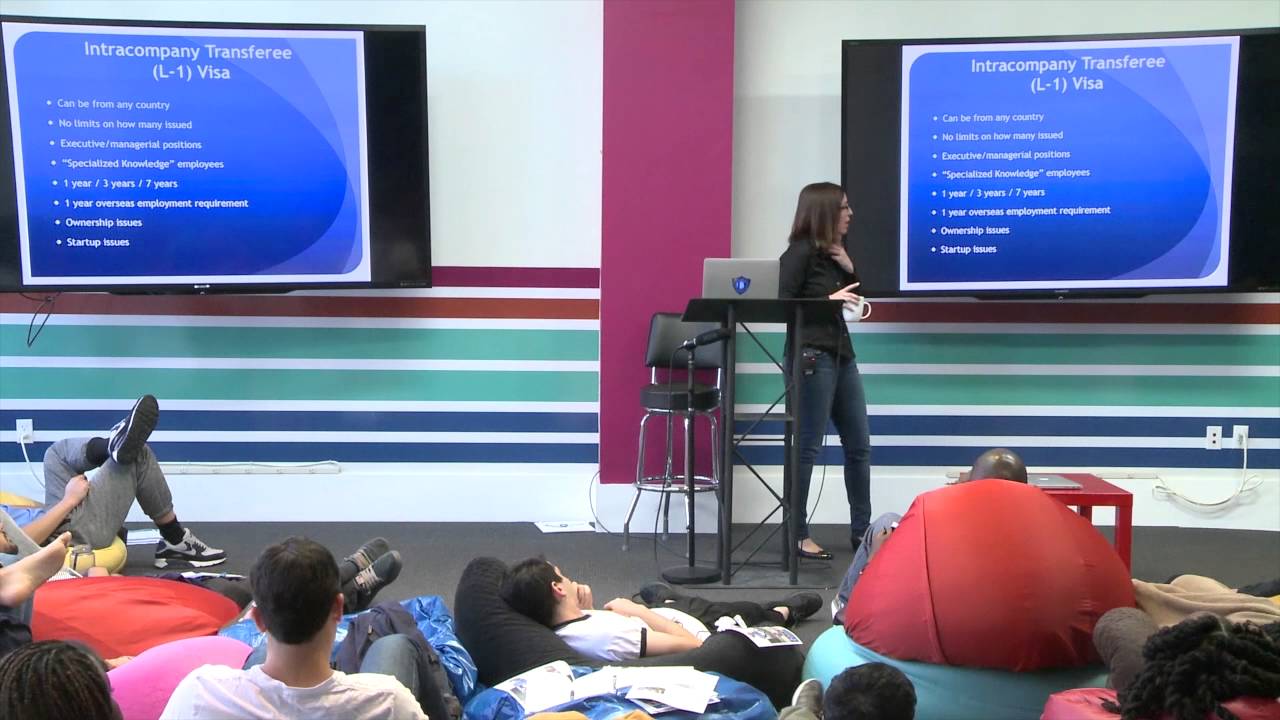
Like half an hour. Okay, good. Okay. So I still have time for scenarios. Thank you, Zach. Okay. So a lot of times, companies that are owned by foreign nationals that come here will see a mix of E-2s and L-1 visas. This is very common because A lot of times, the founders will, say, be from Greece. Okay? But they have developers from, I don't know, Bulgaria or Romania. And they want to bring them here, too. So, since we can't bring the Bulgarians over on an E-2, we use the L-1 visa. This is an intercompany transfer visa. I have it— can be from any— the national can be from any country. Because unlike the E-2, where you have to have everybody from the same country, the L, it doesn't matter where you're from. As long as you've worked for that company for at least 1 year outside the United States, then that company can petition you to come over and work for them temporarily. If it's a new company and you haven't been established for more than 1 year, you'll get a 1-year visa that can be renewed for 3 years. after that and another 3 for a total of 7. So it's a very— it's a pretty long visa. You have 2 types of L-1s. You have the executive and the managerial. That's the more CTO, CFO, CDO roles. And then you have the specialized knowledge. This tends to go more towards the developers. The ones— the marketing specialists, maybe, that have built the company overseas, and you want to bring them here to help you build your marketing team. That's where I see that a lot. Ownership issues. With an L-1, it's a good visa, but you do have to watch the structure of your company. So, for example, if you have a Greek company and you're opening up a U.S. company, The easiest way to structure it from an immigration perspective is for one of those companies to own 100% of the other. Just keep that in mind. You don't want to have it where you've got this holding company somewhere that owns 10%. You have a trust that owns 20%. I mean, it just becomes— we can figure it out, but it— I'm always trying to help people keep things simple because it keeps costs down. So just keep that in mind. And then startup issues. We have kind of the same issue with the L-1 that we do with the L-1— with the H-1B as far as your startup issues. You really need to have a place of business, which is a little bit frustrating for everybody in the startup world because, again, you don't really need a lot of space initially. We've been successful in getting immigration to understand that a coworking space is a viable option. So, I think over the last year, that's been— Acceptable. I don't like it, but it's been acceptable. You need to include an org chart. You even need to include potential hires, not just what exists now, but you really need to show immigration that you have the capacity to hire more people. You need to show that you've been capitalized. And your business plan and your financial projections are also important to this as well as the H-1B. I'm going to try to speed through this a little bit faster. Just briefly on extraordinary ability O-1 visas. I know most of you have probably heard of these. Traditionally, they've been reserved for the more kind of elite, very top of your field individuals. Now, I see that they're— the officers are much more— they'll consider people that have been successful in business. That's what I'm trying to get at. So, if you've run a company successfully in your home country, you have a lot of publicity about it, and you want to build a company here, I've— we've been able to use the O-1 visa to get people over here to build their companies. That's been— it's just something— I'm not going to go for— We don't have a lot of time, and I want to get to the scenarios. So, just kind of keep that O-1 visa in mind. It's a pretty practical visa because you don't have a salary attached to it. And it can be renewed indefinitely. So, it's a pretty good option. And I've— I think this is going to be available. If it's not, somebody can— you can always email me. These are the criteria for getting an O. I was going to go over them, but— We don't have a lot of time. And I think I'm going to skip through the green cards as well. Is anybody interested in hearing about how to get a green card? Or should I skip over to the scenarios? When does the lottery end? The application? The deadline was yesterday, I think. Oh, but I actually have it on here. Just do it. Whenever you have a chance, go ahead and apply because you will be amazed at how you could luck out and get it. And it's a really easy way to get a green card. And just for those of you who are in process for some reason, either on the family-based or employment-based, just so you know, when you hear the word Visa Bulletin, this is what the government— this is what That's what attorneys and the government go by to determine your ability to get a visa. I just put it up there because I wanted you to hear the word, at least know what it is. But we're going to actually skip over—
Is it wise to get a green card if you don't plan to live here permanently? Because I heard that once you get it, you're liable to pay taxes no matter where you live afterwards.
Yeah. There's lots of tax implications. And it's individually based. So you would just need to get some tax advice. OK? Because some countries, it's fine. We have treaties with some countries. So you only have to pay taxes in one location. But it's a bit of an issue. Thank you.