Invent the Future with Khosla Ventures Partner Andrew Chung
Andrew Chung, a partner at Khosla Ventures, talks about innovation and venture investing. The conversation covers how founders think about building the future and what makes certain bets worth taking in early-stage companies.
Chapters
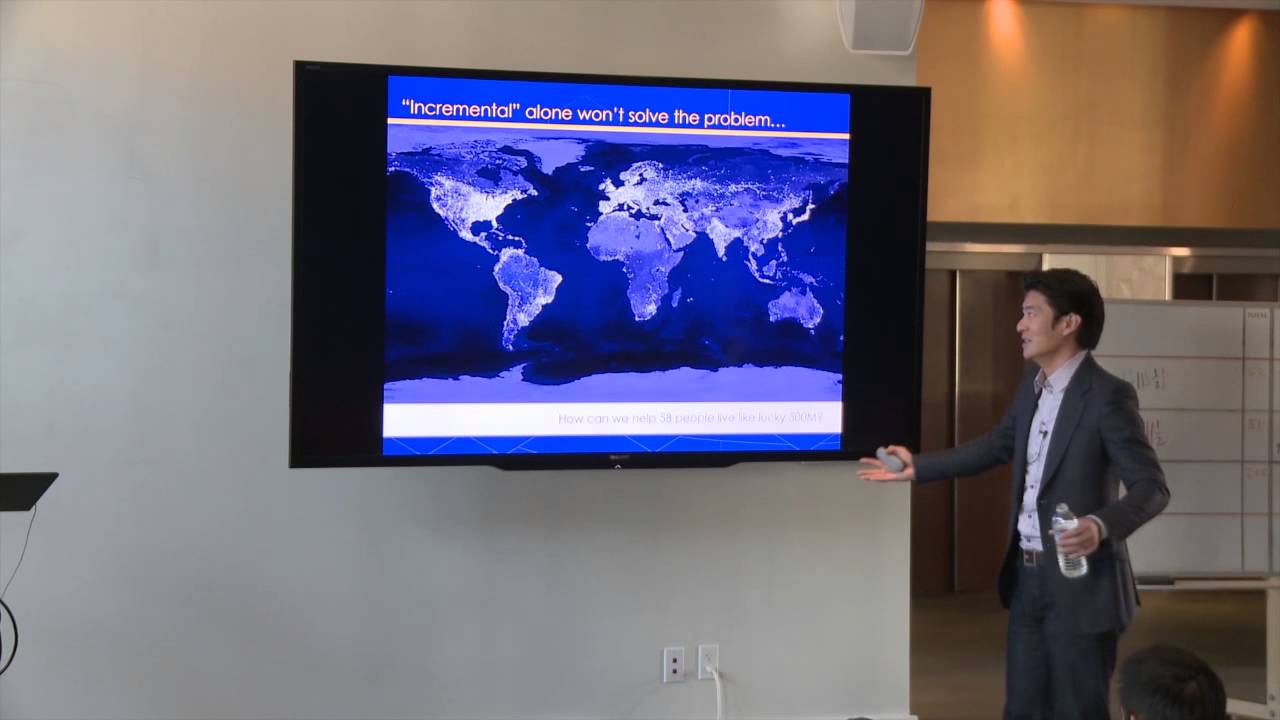
Hey guys, well it's such a pleasure to be here and to learn about what you guys are going to be accomplishing over the next 7 weeks. Draper University sounds like a really exciting opportunity, so hopefully I can be able to contribute to that. So I have to start with a story because since I'm speaking after Tim, which I didn't expect to do, I have to recall about a decade ago, I was begging for a venture capital job, living out of this little small ghetto hotel on El Camino Real. And I went to a Harvard Club event where Tim Draper was speaking. And he was talking about all this exciting change-the-world stuff that venture capitalists were doing. And I, as kind of the lowly young business school chap, was so excited about what he was talking about that it kind of reaffirmed my— Passion. desire to push on and try to beg for that venture capital job. And had an opportunity to sing with him briefly because he does this like thing, he sings this song called Risk Master every time. And being one of the few people in the audience that could actually sing, I harmonized with him briefly and got called out. So it was pretty fun, my first interaction with Tim. And it's nice to come full circle now 10 years later and have an opportunity to help him out on this. So I'm gonna be not talking necessarily about venture capital investing trends, but more broadly about inventing the future and the philosophy around how, at least at Khosla Ventures, we think about making investments. And often a philosophy that we talk to new entrepreneurs, CEOs of large companies, folks who are working on R&D development at mid-sized companies, we often talk about this philosophy of inventing the future and why it's important for making investment decisions, making startup decisions, and enterprise decisions. decisions. So feel free to interrupt me at any time, but I'm going to plow on because there are a bunch of slides that I'm going to try to walk through. First, a little bit about Khosla Ventures. We're a global venture capital firm that's based in Silicon Valley. 6 partners that manage about $4 billion of committed capital. And very uniquely, we have a dual fund structure, which becomes important as I talk about this philosophy of inventing the future. We have a $400 million seed fund that focuses on high-risk, high-return experiments. So if you're a professor at Stanford, MIT, Tsinghua, and you're working on something really new and a new material, we can invest before there's even a company that's formed. That's how early we can get. And then we have a billion-dollar main fund that can take over at the right time, about half of which is in sustainability, the other half is in IT. One of the quotes that we often like to use to talk about the philosophy and idea around investing at Khosla is, The notion of being willing to fail. And Michael Jordan once said, our willingness to fail gives us the ability and opportunity to succeed where others may fear to tread. And this is a philosophy that's held very near and dear to Vinod Khosla, the founder of Khosla Ventures' heart, because in many, many situations in his life, you know, he was courageous and willing to fail and as a result was able to achieve a lot of great things like founding Sun Microsystems and and being the managing partner at Kleiner Perkins for about 20 years. So a little bit about me. That was a great introduction. But again, kind of along the lines of inventing the future, I had to invent my own future because I came from a very different background from some of the venture capitalists on Sand Hill Road. My parents were immigrants that came over from China, didn't speak English. So they put me to work at age 5 as a cashier at the restaurant, right? Because I was the only one that could speak any semblance of English. I was lucky enough to be able to go to Harvard and Wharton to study. And along the way, I did a lot of things that were orthogonal to what my friends and family thought were the right things to do, or the things that were part of the normal path. So I had an offer out of college to go to Goldman Sachs, fixed income, to do mortgage-backed securities and all kinds of really bad things, as it turns out. And instead, I decided to go to Trilogy, which was this enterprise software company that was really hot down in Austin, Texas, in the middle of nowhere. Got to Trilogy and within several weeks I decided that, hmm, maybe I should start a company and get the CEO of Trilogy to fund my company. And that's exactly what I did weeks into my experience there. Shortly thereafter I decided to flee the US and work for Bain Company in Hong Kong and spend a few years learning about international stuff. And along the way almost, almost chose a career in professional singing. And both Tim and Andy have put me up on the spot. I have to sing a few bars at some point, so I might do that. Yeah! So I actually competed in a couple of different idol competitions, in the Hong Kong Idol and Chinese American Idol, and I won them and got to finals, singing stuff like, Yeah, yeah. Yeah. Something like that. Something like that. So instead of doing that, I ended up going to Bain and then Bain Capital because the terms were really bad. And then I was lucky enough, after my interaction with Tim, to have an opportunity to work at Lightspeed, which was my first sort of real venture gig. I was there for about 5 years, was the X-Man in the sense that I helped start a lot of new areas that were outside of the power alleys of Lightspeed, things like cleantech 10 years ago, personalized medicine, education, a lot of things that were off the beaten path, which led Vinod Khosla to sort of take notice over a 5-year, 4-year period. We did a bunch of investments together and then he brought me on board. So suffice it to say, that was my back in the fun days. So what attracted me to Khosla Ventures, and in general, why I like venture capital in the first place, is because it defies the usual notion of how innovation happens in a lot of large companies and in most startups, unfortunately. Most entrepreneurs think about the past. And they figure out, how did a market develop? How did the market get from point A to B? And then I'm going to try to get to point C by drawing a line. Maybe it's linear, maybe it's exponential, but it's in general about extrapolating the past. And Vinod's philosophy is very different. And I'd argue Tim's philosophy is very different. It's a lot about inventing the future. It's about coming up with something that no one has come up with before that transforms and revolutionizes the market. So we're going to talk a little bit about the folly of extrapolating the past and what that means, and then we'll talk a bit about how We try to create a systematic approach to inventing the future. So let's talk about what some of the experts have said over the years. Now, if you were an entrepreneur in 1895 and you were thinking about building an airplane, you might have consulted Lord Kelvin, who was the president of the Royal Society and one of the most well-known scientists of the day. And he said, heavier-than-air flying machines are impossible. In 1876, the Western Union said, the telephone has too many shortcomings to be seriously considered a mode of communication. Ken Olsen, in 1977, was the chairman and founder of DEC, Digital Equipment Corporation, the foremost computing authority at the time. He said, there's no reason for any individuals to have a computer in their home. And then more recently, Steve Ballmer, CEO of Microsoft, said, there's no chance that the iPhone is going to get any significant market share. Now, if you're an entrepreneur like the Wright brothers or Alexander Graham Bell, Steve Jobs, and Steve Jobs again, these would have been the people that you would have consulted. You would have died for 5 minutes of time with these experts to tell them about your great startup idea or your great invention, and they would have put you down. They would have told you that there's no way this is going to work. And of course, some of the greatest inventions of our time would not have been invented. Let's talk about predictions. The Energy Information Administration is the foremost authority in the US on a lot of energy markets. And so this is what they had to say in 2005 about the development of the wind market. So they, over a 20-year period, this is the projected gigawatts of wind deployed. A year or two later, they had to adjust their forecast because there was an unexpected blip in the first 2 years of their original forecast. They had to do that again in 2008 and 2009. This time they finally shifted the slope a little bit. And by 2009, 2010, they were just horribly off. Completely irrelevant data that came in 2005. So if you're an entrepreneur, large company owner, or someone focused on R&D in the wind segment, you would have been horribly off in terms of making decisions about how a market would have developed. Because you would not have expected what to happen during this time. China. China became an aggressive developer of wind, put a lot of policies, tens of billions of dollars into the development of this industry. And no one sitting in Washington, DC could have ever expected that. And it took them a while. I mean, you can obviously see that they're going to be wrong again. But they could not have expected that shift in the market that was enabled by a large power that was willing to invest in the technology. technology developments that were happening in China that weren't expected. The top 10 wind developers in 2005, only one of them was Chinese. In 2010, 4 of them were Chinese. So no one could have expected that. I used to work at Bain, so of course I'm gonna bust on McKinsey. In 1980, they had a 20-year-ahead forecast for the development of the mobile industry. Now, of course, you guys probably are too young to remember in 1980, the mobile phone was a little bit different. It was a suitcase, it was, you know, the battery life was terrible, there weren't a lot of people using them, and it was like the Gordon Gekko, actually even Gordon Gekko was like in the late '80s, right? So they were trying to make a forecast for this technology and how it was gonna develop. They were a factor of almost 100 off, so almost 2 orders of magnitude off from what they originally projected. So if I'm a large telco, if I'm a startup that's sitting in a place on your side of the shoe, and you're making a decision based on what the foremost authority— McKinsey maybe, right?— but experts saying about how a market's going to develop, you would have missed a major opportunity. And of course, 2000 is just the tip of the iceberg. Obviously, between 2000 and now, mobile phones are much more ubiquitous in developing countries and so forth, right? What they couldn't have counted on was the dramatic pace by which technology changed. So your suitcase turned into a more tablet-sized thing. Your battery life started to improve. The Gordon Gekko version of the phone turned into a more Star Trek kind of communicator-sized phone, StarTAC, right? More people started to use it. And then something interesting happened, which was people started to realize you can use it for purposes other than to talk on the phone. You can actually do things like text or surf the internet. And right now, only 15% of the amount of time that you spend on your phone is for talking. No one in 1980 could have ever projected that, and they could not have seen how technology would have dramatically affected the development of this industry. So why is it that forecasters keep forecasting? It's just— it's such a— there's a professor named Philip Tetlock who actually spends a significant amount of his time studying how badly people forecast things. And this is the S&P index for 2013. All the top banks that get paid tens of millions, hundreds of millions of dollars to make these projections, it grew 28.2%, but the firm that projected the highest was off by a factor of 2, and then most of the firms were well short of the actual amount. So why do they— Why do they keep forecasting? It's because people pay for it and people generally feel like they need to lean on an expert opinion in order to have conviction to do anything. And what Tetlock showed was across 10,000 different forecasted efforts, some of these experts and their rate of success was worse than if you just had a dart-throwing monkey throw things at a chart as yes or no or like picking a stock or whatnot. And of course, with a lot of the the developments over time, time and again, the analysts have missed the biggest changes in our time. In January of 1985, when you guys were either really young or before you were born, there wasn't a PC in every home. In 1995, internet was not ubiquitous. January 1st, 2000, despite the last chart that I showed you, mobile wasn't even pervasive yet. Not everyone had a cell phone. In 2004, no one knew what Facebook was on January 1st. So for all of you guys that are gonna do a status update during the course of my talk on your cell phone, that did not even exist at that time. And of course in 2007 there was no iPhone and Steve Ballmer when it came out thought that it was gonna be a— not gonna take off. So as you can see over time so much has changed just in your lifetimes and just in the last few years that have completely rocked our world, it gives me a lot of optimism. I guess as I stand here in 2015, not '14, that as a venture capitalist, I have no idea what's gonna happen in the next 5 years. That's what makes me excited to be a venture capitalist. And that's why the notion of extrapolating the past is just not a good philosophy if you want to start a company or work with a company and develop something that's truly groundbreaking. 'Cause the experts don't know what they're talking about. And no one really knows what the future holds in a lot of these industries. You know, more recently, you know, we— I know Tim spends a lot of time in China these days and Andy, of course, does as well. And as you think about a lot of the developments that have happened that, you know, folks just aren't even aware of here. WeChat and KakaoTalk and Sina Weibo, like a lot of these companies that have somehow just amassed these these 500 million person communities and your grandma has never heard of them. Or frankly, your dad or many of your friends and your classmates probably haven't even heard of these companies until all of a sudden there's a big acquisition or there's big news in the U.S. And that's again another part of why I think it's really exciting because there are so many people around the world that are doing things to invent the future that if you don't think that way yourself, you're going to miss out on some really big opportunities. So I'm going to kind of have a segue into the inventing the future part by talking about some of the problems that we have in the world. So for those of you who have ever visited Beijing— how many people have been to Beijing? OK, so this is a more global group than I usually see. Usually I see maybe like 20%, 10% of the people who have ever been to Beijing. But this is what— the first time I ever went to Beijing, which was 15, 20 years ago, it looked more like this. And of course, those of you who have been there more recently, it looks a lot more like this. And 60 days out of the year, Beijing's particulate levels are at toxic levels where in the US they would be considered deadly. So you should not walk outside because you may be at risk of getting some kind of pollution-related disorder. And yet, Beijing is only the 17th worst city in China. There's 16 cities that look worse than this and have more regular problems. There's one city up in the northeastern part, close to Harbin, for those of you who know the geography, that I think it's 120 days a year where the particulate levels are at toxic levels and 200 days of the year where they're at very, very dangerous levels. So imagine living in an environment like that. India now has the highest incidence of chronic asthma in the world. So if you're a child like these kids, this is Delhi. This is the capital of India. So we're not talking about some backwards industrial city out there. This is Delhi. And you have kids that are living in this type of environment creating significant problems. This is my daughter. My least favorite photo, but most impactful photo, which is for all my friends who are having kids in China, in Beijing, this is how they come out of the hospital. They've got a little nebulizer that goes on their face because the little babies can't deal with the toxic levels of particulates in the air. So what does that mean? It means that the reason why it's important to invent the future is because incremental alone will not solve a lot of these large problems. So yes, when we were talking about the IT stuff, Pinterest and Facebook and Twitter have changed the course of humanity and changed the way that information flows. What I just talked about are things that fundamentally affect quality of life and whether or not people will survive past their 20s or 50s. So the question is, how do you help 5 billion people who are in developing countries live like the lucky 500? And by the way, now because of ubiquitous internet, everyone can see online the videos of how the lucky 500 million are living and they want it. They want food, they want education, they want access to cleaner water, access to energy. And so they all want it. And what is it gonna take to be able to solve that? It's not gonna be an incremental solution. It's not gonna be something that is just 10% better or 15% better. It's gonna be something that's 100% better. And that requires you to invent the future and not extrapolate the past. And so what we think about at Khosla is a lot about how one can systematically try to find these things. Because it's great, Andrew, you're talking about all this very theoretical, philosophical notion of inventing the future and why it's important. But how do you find them? Well, there's no secret formula. It's very much more art than science. I'm gonna talk about now a couple of the ways in which we do it and some of the examples and case studies so that you get a flavor of how we thought about it at investment and what they've meant over time. So before we get there, this chart, 'cause I used to be an ex-consultant, so I do have to think about things in this way. On the x-axis, you have the chance of a technology's disruptive impact. On the y-axis, you have the probability of that technology being successful. And most large companies and a lot of startup folks tend to hang out in this area. Chances are good that this is gonna work. I'm gonna get paid my bonus at the end of the year at Samsung if I do something that's incrementally better but adds a lot to the bottom line. Most venture investments are somewhere in the middle. About a third to two-thirds chance of success, but the level of impact is middling and it can generate some good return but not crazy returns. Some folks fall into this accidental venture category, which is they fall into a couple of these crazy investments but they can't do it systematically. And then on the right side are the black swans. Again, the companies that are doing something that is so fundamental that very, very high risk, so it might be a 90% chance of failure, But if it's successful, it can dramatically change the way people communicate, the way people consume, the way people think. Sure, yes. So sometimes I do this for audiences that deal with energy and whatnot. ARPA-E is one of the divisions in the government that bets on fundamental research in energy. They also have DARPA, which is the defense— the Department of Defense has a group that just bets on very, very experimental new technologies that can affect the military. And so this is one great example of a public entity that is doing this kind of black swan hunting. And as a result of what I just showed you, which is a lot of the investors kind of hunting in the mean, it's the reason why all VCs are not created And as you think about with your startups and talking to folks about funding and building your own team, not all VCs are created equal. The blue line here shows the upper quartile of VC returns over the last 30 years plus. And then the red line is the bottom quartile. So you can see that for a long time in venture capital's history, this was a great asset class to be in because everyone was making money. Up until about 1997, even the bottom quartile, the folks who were just clinging on and hanging out and doing the worst deals in the industry, they were making great returns. Obviously, the folks who were on the top quartile had some— up until about '94, '95, were making phenomenal returns. And then there was sort of a 2 or 3-year anomaly that was the dot-com bubble that came crashing down. Now, when the dot-com bubble did come crashing down, Right before that, a flood of new venture firms came into the industry. A lot of new money came into the industry. And you started to see some divergence. Because a lot of— there was just too much money chasing after about the same number of entrepreneurs. So there was a huge fall-off. And then come 2000, when the NASDAQ crashed, that was the clear rationalization. If you're not one of the best firms, you're not going to get access to the best deals because there are just too many venture capitalists out there now. So many venture firms out there. And so the concentration in terms of firms that are in the top quartile are doing great, but it's really the top decile of firms or even the top 20 firms absolute that are really the ones that are generating the crazy types of returns that folks were seeing in the early days of venture capital. And those are the folks that are hunting for these crazy transformative technologies that that, again, fundamentally changed these industries. So if there's nothing else that you take away from the conversation that we have today, it's these 3 things. Be bold, think big, and be willing to fail. Again, this is if you want to shake up an industry. This is if that is your objective. Robert F. Kennedy once said, only those who dare fail greatly can achieve greatly. And George Bernard Shaw once said, all progress depends on the unreasonable man, or woman, if you lived in this century. And then, very emblematic, I'm a Philadelphian, so I, of course, often think about what this guy went through in fiction and in real life. Sylvester Stallone, of course, was a nobody until he won the Oscar for Best Picture in 1976, which put himself on the map. I mean, he basically kind of wrote a story and everyone turned him down again and again and again. And finally, the group that picked him up, it was one of the lowest budget movies ever and highest return movies ever, I believe, 'cause it was filmed for nothing. And of course, it changed motion picture history. And the story itself is about someone who fought hard to beat the odds to invent his own future. So, At Khosla, I won't go into detail here, but just to give you a sense of the types of things that we've done and the breadth and depth of the portfolio, about half of our stuff is in sustainability, the other half is in information technology. And in each one of these areas, we've bet very broadly. We have, in the sustainability side, all across energy, food, agriculture, we've bet on a number of different technologies that are all very high risk. And then on the IT side, whether it's in social media or advertising, mobile online services, services and payments, to new health technologies and so forth. Big data, we've bet all along those areas as well. So in doing so, how do you make this systematic? What is it that we're looking for when we're trying to identify these black swans? First thing is a very simple value proposition. One of the things that Keith Rabois, former CEO of Square and now one of my colleagues and partner, one of the things that he often asks the entrepreneurs is, so tell me what you do in 140 characters or less. How do you express what you do in a very simple fashion? And why is that important? It's because whether you're in the consumer side or enterprise side or on the clean tech side or health, being able to express what is good about a technology allows you to spread like wildfire. Whether it's the basic word-of-mouth viral marketing that's associated with a web app to a new technology that all of the enterprise guys are buzzing about because it's changed their customer acquisition model, or on the cleantech side when a lot of these executives will talk about which technologies are changing a particular problem that they have, a very simple value proposition is critical and key. Irrational and emotional pull. So hopefully in the course of this presentation you've seen that I've talked about a lot of things that are somewhat irrational. When you think about inventing the future and not extrapolating the past, by nature that's somewhat of an irrational thing because you're throwing out past judgment, you're throwing it out the window, and you're trying to come up with something very new. And that's by nature a very irrational thing. Well, if you have a technology product or service that is able to generate that type of emotional pull where I have to tell my friends about it, or I have to implement this tomorrow. I've scoured the earth and I have found nothing that looks like what you do, so I need to have it today. Then that lowers your customer acquisition costs, that makes it easier for you to find partners to work with you, to buy it, to fund your commercialization, and so forth. And it also creates that type of network effect because all your friends need to have it and my grandma needs to have it and it creates that type of pull. So regardless of what industry you're talking about, that irrational emotional pull around a product or service is very important. Antithesis of incumbents. So I've talked a lot about, I mean obviously not all large companies or all incumbents are doomed for failure. But over time, the disruptions that happen in these industries make the incumbents more susceptible to startups encroaching and coming up with something brand new. So a lot of times what we're looking for in these black swan technologies is if it's something that's flying in the face of what the large companies are doing and something that creates a structural barrier for a large company to easily do. And that's what I mean by integrity. synthesis of incumbents. We'll talk about some examples of that in a bit. Unpredictable upside. So this is a word that I really like to use and Vinod likes to use. Kind of unpredictable upside or unknowable upside, something that you can't put on a graph, right? Where you just, if these things, 5 of these things, kind of improbable events all line up, all of a sudden it creates a very unknowable market growth or market growth story. That's really what happened with a lot of those social networks that we were talking about earlier, especially some of the ones in China. I mean, you just don't know what happens when you all of a sudden empower an entire billion-person population, you get 70% of them online, you get a bunch of— you get 60% of them all of a sudden into a middle class in the next 10 years. 10 years and every one of them has a mobile device and they're willing to spend an extraordinary amount of their income on mobile devices and services, what does that mean? Well, those things all lined up create the possibility for these social networks that can go from 0 to 500 million people in 2 years. No one could have predicted that. No one could have known that. But it's that kind of unknowable upside that we like to identify in these startups, where in your aggressive marketing plan, if there's like 3, 4, 5 things that all line up in the right way and some macro condition that lines up in the right way, you can have unknowable upside. And then that leads to industry-toppling potential. So for us, again, we're more aggressive and we're a bit bolder, I'd say, than your average VC firm, but we are looking for entrepreneurs that have the capability, if all the stuff lines up and all of the improbable things line up that you have the ability to change an industry and potentially topple an industry. And we'll go through some examples of that. Last but not least, now rock stars, I'm not talking about people who can sing, although if you can sing, that gives you an edge if you're pitching to me, okay, admittedly. But rock stars meaning people who are A-players across a couple of different dimensions. It could be that you on a technology side are the best in the world at X. So if you're Nobel Prize-winning quality in a particular notion of science, that is rock star quality. Or if you're a postdoc that studied under one of these people, or you're someone that is just exceptionally bright and someone that, you know, in any field on the technical side. It could be someone with a lot of consumer acquisition experience and someone who just knows how to create viral effects. It could be someone with a lot of entrepreneurial DNA, like they've started 3 companies before, so they've gone through that cycle before and have that experience. It could be someone with commercialization experience that has taken a plant and scaled it up, or taken a medical device and taken it through FDA. But we're always, in these black swan companies, we want to look for one— it doesn't need to be 5. I don't need to have all these dimensions in place on day one, but there needs to be A source that is the heart and soul of the company that makes me feel like some of these really improbable things can possibly happen. So this is the set of things that, in no particular order, we don't always get all of them at once, but the type of ingredients that look good. And we'll talk through a couple of examples to see what it all means. So Square. How many of you guys have either run a credit card through a Square machine or have a Square Square dongle. Okay, so this is a pretty good amount. It's actually pretty shocking that when Jack started the company 4 or 5 years ago with the idea that I am going to destroy point-of-sale systems and take over the payment space. I mean, most people, despite his heritage at Twitter, most people would kind of look at that idea and be like, what are you, insane? Like, Verifone, Visa, American Express, there's this infrastructure that's been put into place and has worked really well for 20, 30 years. Like, what makes you think that you can come in and try to topple or change that industry? Well, a couple of things that he saw at the time were that all of a sudden everyone has a cell phone, but more importantly, a lot of people have iPhones. including a lot of these small business merchants that historically get really frustrated when you, the customer, whips out a credit card as opposed to pays in cash. So there's a huge amount of— huge community of people that are like that that wish they could have a cheaper transaction fee, an easier way to work with point-of-sale terminals and the credit card companies. And that was what he would— and they all happen to have a cell phone. Right. The set of things that he was tapping into, the set of macro conditions as well as product requirement conditions that could lead to a disruption. We have a rock star here, clearly. I mean, the guy started Twitter and obviously did a great job there. And importantly, he's a visionary. He's courageous, he's bold, and he's a visionary. And he had a very good sense of what type of product would work with this community, and he was relentless about figuring that out. So industry-toppling potential. It's an emotional product. When you as a flea market operator, which again, many of us probably have never operated in a flea market, right? But if you're a flea market operator and you see someone next to you whip out their phone, let customers run their credit card, you're going to go over and ask, what is that thing? What is it? Oh yeah, it's a credit card terminal. Oh, charges less fees. fees, then it's consistent, the same fee every time. And by the way, I also have all my customers' email addresses, which I've never had before. And there's this thing called customer relationship management that I might be able to start doing as a small business merchant that I can do with this that I never did before. Oh, great. Where do I go buy one? And is this like $5,000? No, it's like $100, right? No-brainer. And all of a sudden, the entire flea market, everyone starts using it. As a customer, you guys have all run one of these. I presume most of you aren't an operator, right? But you guys have all run one of these, and for you, probably, there's an emotional response to, wow, that's actually pretty cool. I kind of like signing my name in the thing, and the fact that they have my record and I can kind of look up my records is kind of cool. So there's an emotional pull. It's almost irrational for the small, medium-sized business folks, which is why they now have amassed one of the largest populations of small to medium-sized business customers like in the history of man in the span of a 3, 4, 5-year period. It took Verifone, I think, probably 30 years to get to that level. From payments to energy, LanzaTech is an example of a company that is converting waste gas that comes out of steel mills, coal-fired plants, all the carbon and carbon monoxide, carbon dioxide gas that's toxic and was in the photos that I showed you earlier in China and India, they can convert that on-site into a valuable fuel or chemical. So China, right outside of Shanghai is a company called Baosteel. They have 24 steel mills right outside of Shanghai spewing out tons of waste gas. I've been there many, many times now. And if you go there, it's a great place to film a post-apocalyptic movie because it's like all this industrial stuff, all these gases. It's really dirty everywhere. I finish a day there and I don't wear a suit there anymore because it's kind of grimy and big dry cleaning bill. And what LanzaTech is able to do is actually cap, in some sense conceptually, cap the smokestack where all the gases come out. They run it through their system and they're able to create a valuable commodity on the other side very capital efficiently. Now what does that mean? Well, Baosteel has been scouring the earth trying to find a solution because the Chinese government basically said, you can't build plant number 25 until you get rid of your gas. So they've been trying to find pipelines, like multi-billion dollar pipelines to ship the gas to the ocean or drill underground to do these things. Again, multi-billion dollar things. Well, LanzaTech can do it for $20 or $30 million. It became a no-brainer for them. Emotional or rational pull? And so largest steelmaker in China signs a joint venture deal with small, tiny startup company based out of New Zealand, by the way, where they're our first joint venture partner and they're gonna fully fund our first commercial plant. Fully fund commercial plant. So I'm not raising money for it. It's a zero CapEx model that's enabled by this irrational emotional pull for this technology. So from energy to content. Wattpad is another— so LanzaTech is— I'm on the board of LanzaTech and I also invested in this company, Wattpad, based in Toronto, which very quietly over a long period of time was able to amass the world's largest community for reading and writing. So think YouTube, but instead of it being for videos uploaded, it's for the written word. It's for written content. And so I think last month they probably broke 6 billion minutes of engagement. They have tens of millions of stories that have been uploaded to this platform. And some of the authors on this platform have had people read their work like 200 million times or 300 million times. And they come from all over the place. Like this 17-year-old from Philippines is one of our most well-read authors. Now imagine that Put that into context. A New York Times bestseller can get on the bestseller list by selling 50,000 copies. There's a little girl— 50,000 copies. There's a little girl in the Philippines that has been read 400 million times. And so this is a type of platform that completely changes the paradigm for self-publishing and the way in which you deliver content. And people, in between chapters, will— you'll get 1,000 comments, people saying that Janie should end up with Jack and I didn't like the way you wrote chapter 2 so I'm gonna rewrite chapter 2 and post it and there's all this collaborative writing, different writing models that just don't exist in the offline world. And then One Direction, the reason why this is on here, how many of you guys have heard of One Direction? Everyone. Okay, everyone, right. So I actually never heard of One Direction before I invested in this company and they were talking about this boy band from UK. I'm like, I don't listen to boy bands, geez. And they were saying that, yeah, so we got contacted by them and one of the, they wanted to do some kind of writing exercise where 5 chapters, romantic interludes with each one of the band members and they wanted to run a test on Wattpad. And so they did that and in the span of a week, millions or tens of millions of views of the work. And now, over the history of time, One Direction-related content now has been viewed several hundred million times on this site. And there's 100,000 fan fiction stories, more than that now, that have been written about this band. So you imagine the type of interaction that people typically have with the band. I follow their tweets. I watch their music videos. I obviously listen to their music. This is a story about a band member that I'm really obsessed with. And every engagement is not 2 seconds for a tweet, but it's 30 minutes to read a chapter. So you think about the level of engagement that something like this can generate for these types of media properties. And you can get a sense of how the unpredictable upside for something like this. Is it free? Free. So you only get paid when I— We're gonna talk about rock stars, what I was saying about the Nobel Prize-winning people, because in this case, the guy just won a Nobel Prize. He's a professor out of UC Santa Barbara who was the inventor of the Blu-ray. So for those of you guys who have Blu-ray players, this guy invented the blue laser. His next project was to invent the green laser out of UC Santa Barbara, and Vinod got to know him over time and invested in in his technology. Again, before they formed a company and we came up with 2, 3 different ideas for how you commercialize the technology, not knowing what would stick. This is the result of one of them. His green laser enables you to create these wafers that can generate 5 times more light per unit area than any other LED material known to man. Which means if you go to Home Depot right now and you buy an LED bulb, you usually see like multiple There's multiple chips in there, strange optics. It's kind of ugly. It gets really hot. Some of them have little fans inside to dissipate the heat. They're ugly, clunky, and they're expensive. And they're still not cheaper than the— you can see the ones that are here have 3 little chips inside. They can do it all with 1 chip, which means that it's much cheaper to produce, much simpler design. The optics are much simpler. They got the folks that did Apple and Jawbone and really cool industrial design to make a very sleek shell that looks sexy, creates an emotional appeal, and is a heat sink all in one. So this, we think, is the first LED bulb that actually is the fastest to break even and is actually the first thing that can compete truly with incandescents. Started with a rock star, created an emotional product around it, something that everyone, once they see it, they They have to have it and it's just a better performing product. Jawbone is a company that all of you, how many of you guys have a Jawbone headset or a speaker or any of that kind of thing? Yeah, so Hossein Rahmon, who is a young entrepreneur who was able to bring this technology out of DARPA, it was a DARPA-funded noise cancellation technology that he originally was going to license to a lot of the large headset developers. So like Motorola or Jabra or Nokia, he was going to take this technology and license it. He met with Vinod and met with our team. And we said, this technology is disruptive enough where you could go to market with your own product that people will want to have. And if you apply good industrial design and create an emotional need for the product, you can build a brand and then capture a lot more of the value than if you're getting a 2% royalty for every headset that's sold. That's what he did. Hundreds of millions in revenue later, these guys have been able to generate a multi-suite of products that include obviously a lot of the headset and the communication stuff, sound and Bluetooth-connected stereo systems now that are much cheaper than the usual thing where you have to get all the installers to come in and put in all the speakers. These are all like computer— it's all algorithmically controlled and the sound is projected based on the separation and distance from each other. And then the Jawbone Up, which is a device that sits on your wrist and is able to track a lot of information about your health and monitor your health and open up a new direction there. So they've done a lot from what originally started as a technology that was suitable for licensing. And it's a good thing they didn't go that path. The last company that I'll mention, and then I'll try to wrap up and get to any questions, It's called AliveCor. So my dad has a heart condition, and every quarter he has to go to the cardiologist where they're gonna put all these leads on him. He does like a little running thing, and you know, you have to— you hope as a son that in that 5-minute interaction with the doctor, if there's anything bad in there, it better show up. 'Cause if it doesn't show up, I've gotta wait another 3 months. What AliveCor has done is it has taken a $20,000 piece of machinery, which is this EKG machine, and distilled it down into a $50 or $100 iPhone case. So now, what does this mean? So this is a medical-grade, FDA-approved heart monitor that I can tell my dad, after dinner every day, you sit there, you let the thing— don't worry about what it means, just hold the thing. It'll— the computing power of the iPhone now is able to process the signal. And come up with a medical-grade EKG signal. It sends it up to the cloud, compares it against the hundreds of thousands of other images that we have, and is able to render a judgment and sends me a text if there's any kind of issue. So if it's something where he needs to go call his cardiologist now, then we do that and we don't wait 3 months. You need to go to the emergency room right now because there's some weird arrhythmia going on. And then son gets alerted. Or, you are about to have a heart attack and you better do what you need to do. So this capability empowers the consumer in a way that has never been able— has never been possible in the field of cardiology. And you're gonna start to see a lot of other companies working on medical products that use that supercomputer in your pocket called the iPhone or Android device to be able to do medical diagnosis in in a way that has just never been possible before. And it's gonna change the field of medicine. And it's gonna make a lot of the simple things that we waste a lot of time in going to a doctor's office to get those basic diagnoses, it empowers you to do it yourself. So I won't go into any more of the other companies or other examples, but hopefully it gives you a flavor of the types of things that we're looking for and how we're trying to build great teams, trying to invest in things with unpredictable upside. We're trying to invest in products and services that have that emotional and irrational component. And again, as I sit here as a VC thinking about all the great things that can happen, a lot of really funny or neat headlines that can happen over the next 5 years. And there's not really an easy way of predicting what will happen, right? But suffice it to say, in all of these fields, there's gonna be so much change that the world will change and the pace of innovation will change, which will create some earth-shattering black swan type of events that I'm excited to look forward to as an investor. So don't give up on the moonshots. Others haven't. And I'll just close with, if you want to predict the future, you should just invent it. Thank you. Thank you, Tim. So questions? Yes, we have time for about 2 questions. Yes, sir. So I would like to know what do you think about adult education industry and how it works right now? And do you see if it has some future problems that should be solved? Adult education? Yeah. How professionals are done right now. What do you want to do? Well, I think it's— there's massive disruption potential there, and it's ripe for change. It needs the change. We are entering a generation where the traditional models of education and the traditional liberal arts degree and, you know, all of that is being seen very differently in the marketplace than it was 20 years ago or 50 years ago, right? I mean, essentially education hasn't changed all that much. And it hasn't been personalized nearly enough to be able to get everyone effective in doing their jobs as we can now with technology. And it also is kind of paired up with this weird recovery that we've had that hasn't created a ton of new jobs, and it hasn't taken the people who lost their jobs during the recession and all of a sudden employed them. So you have strange skills gap, you have evolving industries that require very specialized vocational capability, and you have a workforce that doesn't really know how to retrain themselves when these types of events happen. So I think in the adult education area, huge, huge opportunity for retraining, using technology to be able to allow people at an older age to be able to learn. I mean, you know, for those of you who have kids or families or whatnot, you can't go to a campus and do the traditional type of retraining that you can when you're younger. And so online education or other innovative boot camp type of education models, something like Draper University, right? These are gonna be the new ways in which this adult population has to cope with a lot of the changes that will happen in their careers. And the idea that now, unlike 20 years ago when people, you know, a significant portion of the population stayed in the same job in the same field for their entire careers. Now people are changing careers like 4, 5, 6 times in the course of their career. So that will create a lot of opportunities for this. And frankly, it needs to change. You asked a question earlier, so I'm going to ask, and then we can talk. Yes? So for some of the companies that come in and are very technical, do you go out and get the knowledge yourself on the industry, or who do you rely on for that kind of knowledge? Oh, I go back for my PhD and then come back out and I study it. No, yeah, it's a very important question because it also reflects sort of the resource constraint that you have as a VC firm. I mean, there's 6 partners that are managing a lot of stuff, right? So we don't really sleep, right? And we're always on planes. So what we— I think what the VC partners bring to the table is enough technical understanding to know that there's a kernel of there's an aspect of it that could be a black swan. Right. There's a certain pattern recognition that makes me feel like this, if it works, and I have no idea whether I can validate it myself, but if this works, then it'll create some sort of unknowable upside or a market disruption. That's my job as the VC. And I think that the 6 of us all, in different ways, approach the problem in that way. And then there's a very self-aware recognition that I don't know everything there is to know about green lasers, but there are people out there that are friends of Khosla or in our networks that understand the market. I was actually just up at Berkeley yesterday looking at a really cool quantum tunneling technology, right? And it has an application to a particular market area. Wow. I mean, I was a mathematician. That's what I studied at Harvard. I didn't study quantum tunneling or any of that kind of thing. I'll have an expert in quantum tunneling that might be on the Khosla team, might be in our network. One of the Khosla CEOs came along who really understood the market and happened to be a PhD in this area of interest. I might hire a consultant who has a third-party objective view on the technology. But basically what we need to do as a partnership is get excited enough to be willing to deploy some of these other resources to help us move forward. So you're saying that the studying it, and then we're the ones that will tie it, tie it all together to decide whether or not it meets the, meets the bar. Great. We want to present you with this gift. Great. As a token of our appreciation. Excellent. Thank you so much. Good luck to all of you. Thank you.
More from Tim


He Sold His Car to Build This Startup, Then Pitched It for $1M 😳 #Startups #AI

This Startup Moves Your Crypto BEFORE Hackers Can Steal It 😳 #Crypto #Cybersecurity




15 Months Without Refrigeration?! This Startup Thinks It Can Go Global 🥥 #FoodTech #Startups



