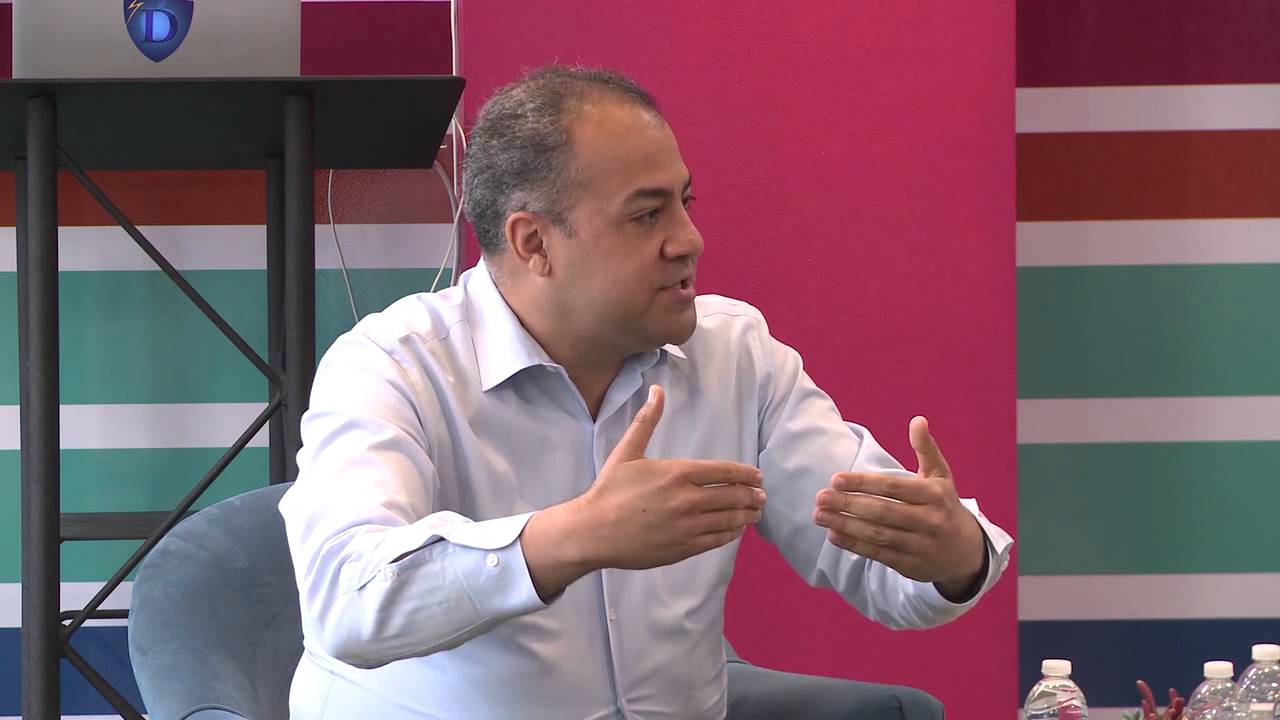
This content was created by Tim Draper. This content was uploaded by Tim Draper. This is a YouTube interview titled "Investing at the Turn of the Century | CTO of Cloudera, Amr Awadallah" (created 2015-06-16) in which journalist Heather Somerville interviews Amr Awadallah, co‑founder/CTO of Cloudera. The discussion covers Cloudera and its big‑data platform with concrete use cases (banking fraud prevention, agriculture sensors, government, genomics), Amr’s personal background (growing up in Egypt, Stanford PhD), his first startup VivaSmart/Booksmart, early fundraising in 1999, the sale to Yahoo, and reflections on timing around the dot‑com crash. Content type: YOUTUBE.
Chapters
Good morning.
Good morning.
Thank you for the introduction. I'm Heather Somerville. And we have— we both— we all have the really exciting pleasure of sitting down with Amr of Cloudera, which is a fantastic company. I don't know how much you guys know about Cloudera, but it really was a pioneer in big data analytics, founded in 2008 before everyone was talking about big data and how awesome it was. Amr was really on the bleeding edge. So let's just start a little bit, Amr, and tell us about Cloudera, tell us specifically what the software does and who your customers are. Sure.
So Cloudera, as you correctly said, is about big data.
We were one of the very first, if not the first company to start doing this big data thing. How many of you heard about big data before, if you can raise your hands? So I'm seeing about maybe 70% of the room raised their hand. But big data is this new trend about leveraging any type of data that we are able to collect. So historically governments, banks, organizations and companies, we were only collecting what's called structured data or transaction data. So very well-defined stuff. For example, person X took out Y dollars out of account Z. So very well-defined.
But today companies are collecting way more than that. So today when you go and take money out of an ATM machine, the ATM machine is taking a picture of your face.
The ATM machine is tracking how you're moving your finger on the touchscreen. And actually each one of us move our finger in different ways. It's kind of unique to us. They are tracking if you have the mobile app for the bank, then they know that you're standing right there in front of the ATM machine. So in addition to the very well-defined transaction, which is Person X took Y dollars out of account Z at time T. They also have all of this mountain of data around that transaction that is not structured. Some of it is images, videos, GPS location, et cetera, et cetera. So how can they leverage all of that? And that required a new type of technology that can work with any type of data and that can scale to ever bigger amounts of data.
And that's what our company provided.
You might ask in this case, why should I give the bank all of this information? You're giving them all of this information to help protect your account from somebody else trying to pretend they are you and steal money out of your account. In this case, they would only be able to take money out of your account if they're able to take your face with them and take your phone with them so they have your location, et cetera, et cetera, which makes it much harder to do.
So that's just one example. We have companies in agriculture using us with sensor networks to track how crops are growing in fields. We have governments using us to catch bad guys. We have companies in the medical space using us for genome sequence analytics and for predicting diseases before they take place, et cetera, et cetera. So that's what Cloudera does.
And let's step back a little bit and talk about when you kind of— when the entrepreneurship bug might have bitten you. Now you're from Egypt and you came to Silicon Valley to attend Stanford where you got your PhD. and virtual machines. So was it when you got to Stanford that you kind of got the idea that you wanted to start a company or before that? And also tell us a little bit about the predecessor to Cloudera, VivaSmart, which of course was your first company.
Yeah.
So as you correctly said, I am from Egypt and I was there all of my life until I was 25 years old, that's when I came here. And since I was very young, I didn't have any thoughts about becoming an entrepreneur or starting a company. My dad is a professor at Cairo University in Egypt. He teaches economics, and he always wanted me to also be a professor.
So ever since I was young, I was always building my career towards I'm going to finish a PhD and become a professor.
And I didn't have any thoughts of becoming an entrepreneur or starting companies or any of that stuff. But then as soon as I came to the Bay Area, when I landed in the Bay Area, I land and then I see the headquarters for HP, which is, as you know, HP, they're one of the very first, if not the first company to start the Silicon Valley kind of revolution. I saw the headquarters for Oracle, the headquarters for Intel, all of these big companies that I could— that I only heard of, I saw them, they're actually a company, they're right there in front of my eyes. And then that started to grow in me like, what is this entrepreneurship thing? I want to learn more about it.
And then Stanford, I have to give them credit, Stanford as a university, they just hit you with the entrepreneurship virus as soon as you land in the campus, right?
You see founders from companies coming in to give talks about how they started these companies. Lots and lots of classes and courses similar to the one you're doing here that teach you how to build a business plan and how to build an idea and how to potentially approach investors to raise money.
So right away they start to inject you with that virus.
I frequently would say, so that's when I got corrupted in the sense that forget about this teaching thing, I'm not going to be a teacher.
Teaching is a very noble cause obviously and instead let's go build a company instead. And I teamed up and it was 1999, I teamed up with another student at Stanford University and I started my first company which was called VivaSmart.
And VivaSmart started Originally it was called Booksmart and you guys can relate to this. It was about how can you find good prices for books online, how can you very quickly find where should I go get my book from.
So it started like that, though we very quickly shifted to becoming more a comparison shopping catalog in general.
And within a year of starting that company we were just 5, 6 people in the company, 1 year old, we had raised a very small amount of money, about $200,000, $300,000. We sold that company to Yahoo and that's how I ended up at Yahoo and Yahoo paid $9 million within a year worth of work. That wasn't bad. So that was my first success and my first kind of introduction to the entrepreneurship world.
And talk a little bit about your decision to sell because you started a company in '99 which is, as we all know, was the internet was raging and everybody and their brother and their mother and their aunt were starting companies. But you saw the writing on the wall to an extent, right?
Yes, that is very true. We were very fortunate actually. So first in 1999, it was so easy to raise money, I don't think it will ever happen again.
People say it's easy today, no, it's not anywhere close to as easy as it was in 1999. In 1999, you just sniff as an investor and they write you a check.
Seriously.
So my experience with VivaSmart, I mean, we met with an angel investor, a very nice guy, and we spent literally with him 30 minutes, And by the end of the 30 minutes he was writing a check for $300,000, just like that. That would never happen—
I don't think that will happen again. I'll give you the name offline.
He doesn't do that anymore though.
But that was because of the— just the excitement was amazing in 1999. We're starting to see signs of that again right now, but not anywhere close to how it was back then. So that's how we got our funding for VivaSmart, and our goal definitely was to build a big company, continue to take this public and change the world and et cetera, et cetera.
But what happened in early 2000, we started seeing the signs of the crash. There was a huge crash starting to happen and we saw it coming.
We actually did see that the funding levels are going down, the valuations of some of the public companies started to shift in strange ways.
And that's when our— essentially myself and my co-founders decided we should sell that company.
And we actively pursued that. So we reached out to a number of companies.
Yahoo was one of them, but there was a number of others. And told them we're selling out, give us an offer if you want to take us.
And we were fortunate that Yahoo came in and they gave us the offer that they gave us.
And we ended up joining them. A few months after that happened, when we joined Yahoo, that's when the market completely collapsed.
We had something like 20 other competitors trying to build something similar to what we were working on.
they all shut down. None of these companies succeeded. Yeah, they all went out of business.
So we're really very fortunate from that perspective.