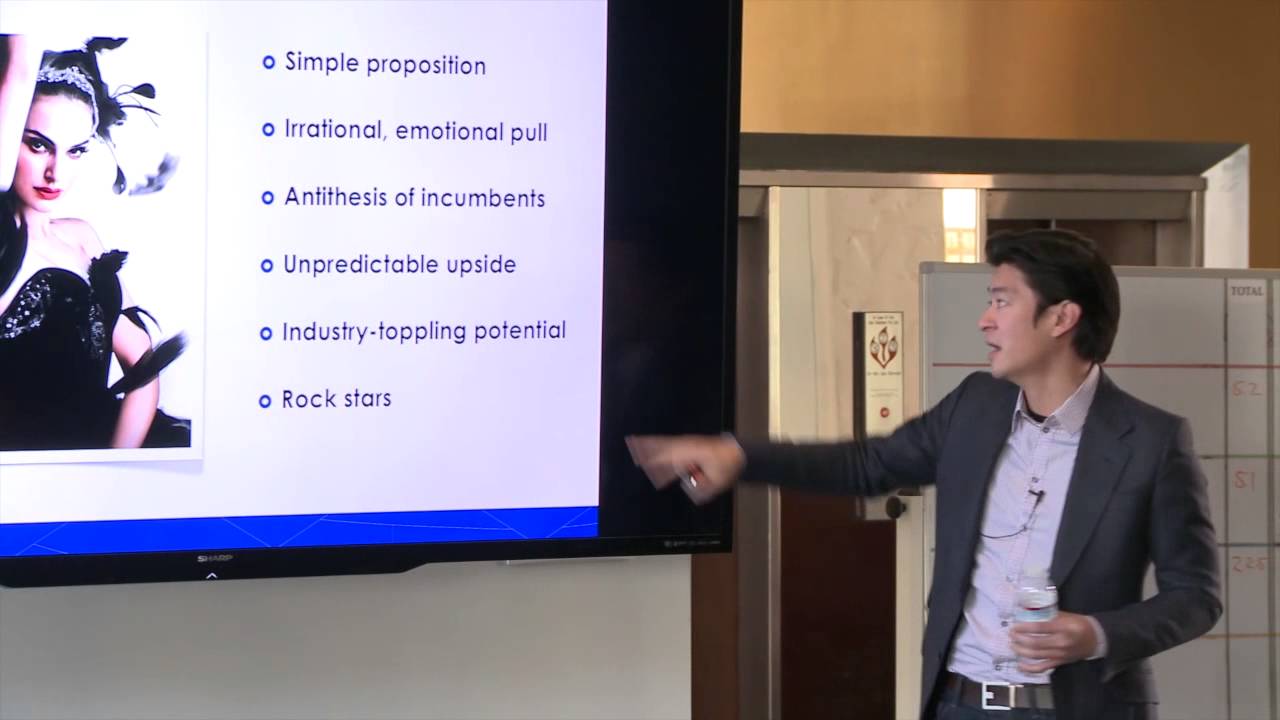
In this talk, Andrew Chung of Khosla Ventures outlines the mindset and systematic criteria he uses to identify "black‑swans"—high‑risk, high‑reward startups capable of toppling entire industries. He closes with three guiding principles for founders: be bold, think big, and be willing to fail. Chung describes Khosla’s portfolio as roughly split between sustainability (energy, food, agriculture) and information technology (social media, advertising, mobile services, health, big data), each pursued with a broad, high‑risk bet. He then details the five core attributes he looks for in potential black‑swans: (1) a very simple value proposition that can be explained in 140 characters, (2) an irrational, emotional pull that drives viral, network‑effect demand, (3) an antithesis to incumbents that creates structural barriers for established players, (4) unpredictable or unknowable upside arising from improbable macro‑level alignments, and (5) a "rock‑star" founder or founding team with exceptional technical, commercial, or entrepreneurial talent. Throughout, Chung emphasizes that while not every dimension must be present at day one, there must be a compelling core that convinces him the improbable can become possible.
Chapters
So if there's nothing else that you take away from the conversation that we have today, it's these 3 things: be bold, think big, and be willing to fail. Again, this is if you want to shake up an industry, right? This is if that is your objective, right? Robert F. Kennedy once said, only those who dare fail greatly can achieve greatly. And George Bernard Shaw once said, all progress depends on the unreasonable man. Or woman, if you lived in this century. And then, very emblematic, I'm a Philadelphian, so I, of course, often think about what this guy went through in fiction and in real life. Sylvester Stallone, of course, was a nobody until he won the Oscar for Best Picture in 1976, which put himself on the map. I mean, he basically kind of wrote a story and everyone turned him down again and again and again, and finally the group that picked him up It was one of the lowest budget movies ever and highest return movies ever, I believe, 'cause it was filmed for nothing and of course it changed motion picture history. And the story itself is about someone who fought hard to beat the odds to invent his own future. So at Khosla, I won't go into detail here, but just to give you a sense of the types of things that we've done and the breadth and depth of the portfolio, about half of our stuff is in sustainability, the other half is in information technology. And in each one of these areas, we've bet very broadly. We have, in the sustainability side, all across energy, food, agriculture, we've bet on a number of different technologies that are all very high risk. And then on the IT side, whether it's in social media or advertising, mobile online services, services and payments, to new health technologies and so forth, big data, we've bet all along those areas as well. So, In doing so, how do you make this systematic? What is it that we're looking for when we're trying to identify these black swans? First thing is a very simple value proposition. One of the things that Keith Rabois, former CEO of Square and now one of my colleagues and partner, one of the things that he often asks the entrepreneur is, so tell me what you do in 140 characters or less. How do you express what you do in a very simple fashion? And why is that important? It's because whether you're in the consumer side or enterprise side or on the clean tech side or health, being able to express what is good about a technology allows you to spread like wildfire. So whether it's the basic word of mouth viral marketing that's associated with a web app to a new technology that all of the enterprise guys are buzzing about because it's changed their their customer acquisition model, or on the cleantech side when a lot of these executives will talk about which technologies are changing a particular problem that they have. A very simple value proposition is critical and key. Irrational and emotional pull. So hopefully in the course of this presentation you've seen that I've talked about a lot of things that are somewhat irrational. When you think about inventing the future and not extrapolating the past, by nature that's somewhat of an irrational thing because you're throwing out past judgment You're throwing it out the window and you're trying to come up with something very new. And that's a, by nature, very irrational thing. Well, if you have a technology product or service that is able to generate that type of emotional pull where I have to tell my friends about it, or I have to implement this tomorrow, I've scoured the earth and I have found nothing that looks like what you do, so I need to have it today, then that lowers your customer acquisition costs. That makes it easier for you to find partners to work with you, to buy it, to fund your commercialization, and so forth. And it also creates that type of network effect because all your friends need to have it and my grandma needs to have it and it creates that type of pull. So regardless of what industry you're talking about, that irrational emotional pull around a product or service is very important. Antithesis of incumbents. So I've talked a lot about, I mean, obviously not all large companies or all incumbents are doomed for failure, right? But over time, the disruptions that happen in these industries make the incumbents more susceptible to startups encroaching and coming up with something brand new, right? So a lot of times what we're looking for in these black swan technologies is if it's something that's flying in the face of what the large companies are doing, and something that creates a structural barrier for a large company to easily do. And that's what I mean by antithesis of incumbents. We'll talk about some examples of that in a bit. Unpredictable upside. So this is a word that I really like to use and Vinod likes to use. Kind of unpredictable upside or unknowable upside, something that you can't put on a graph, right? Where you just, if these things, you know, 5 of these things kind of Improbable events all line up, all of a sudden it creates a very unknowable market growth or market growth story. That's really what happened with a lot of those social networks that we were talking about earlier, especially some of the ones in China. I mean, you just don't know what happens when you all of a sudden empower an entire, a billion-person population, you get 70% of them online, you get a bunch of, you get 60% of them all of a sudden into a middle class in the next 10 years, and every one of them has a mobile device, and they're willing to spend an extraordinary amount of their income on mobile devices and services. What does that mean? Well, those things all lined up create the possibility for these social networks that can go from 0 to 500 million people in 2 years. No one could have predicted that. No one could have known that. But it's that kind of unknowable upside that we like to identify in these startups where in your aggressive marketing plan, if there's like 3, 4, 5 things that all line up in the right way and some macro condition that lines up in the right way, you can have unknowable upside. And then that leads to industry-toppling potential. So for us, again, we're more aggressive and we're a bit bolder, I'd say, than your average VC firm. But we are looking for entrepreneurs that have the capability if all the stuff lines up and all of the improbable things line up, that you have the ability to change an industry and potentially topple an industry. And we'll go through some examples of that. Last but not least, now rock stars, I'm not talking about people who can sing, although if you can sing, that gives you an edge if you're pitching to me, okay, admittedly. But rock stars meaning people who are A-players across a couple of different dimensions. It could be that you, on a technology side, are the best in the world at X. So if you're Nobel Prize-winning quality in a particular notion of science, that is rockstar quality. Or if you're a postdoc that studied under one of these people, or you're someone that is just exceptionally bright and someone that, you know, in any field on the technical side. It could be someone with a lot of consumer acquisition experience. and someone who just knows how to create viral effects. It could be someone with a lot of entrepreneurial DNA, like they've started 3 companies before, so they've gone through that cycle before and have that experience. It could be someone with commercialization experience that has taken a plant and scaled it up, or taken a medical device and taken it through FDA, right? But we're always, in these black swan companies, we want to look for one, it doesn't need to be 5, I don't need to have all these dimensions in place on day one, But there needs to be a source that is the heart and soul of the company that makes me feel like some of these really improbable things can possibly happen.