Issue Voter | Maria Yuan
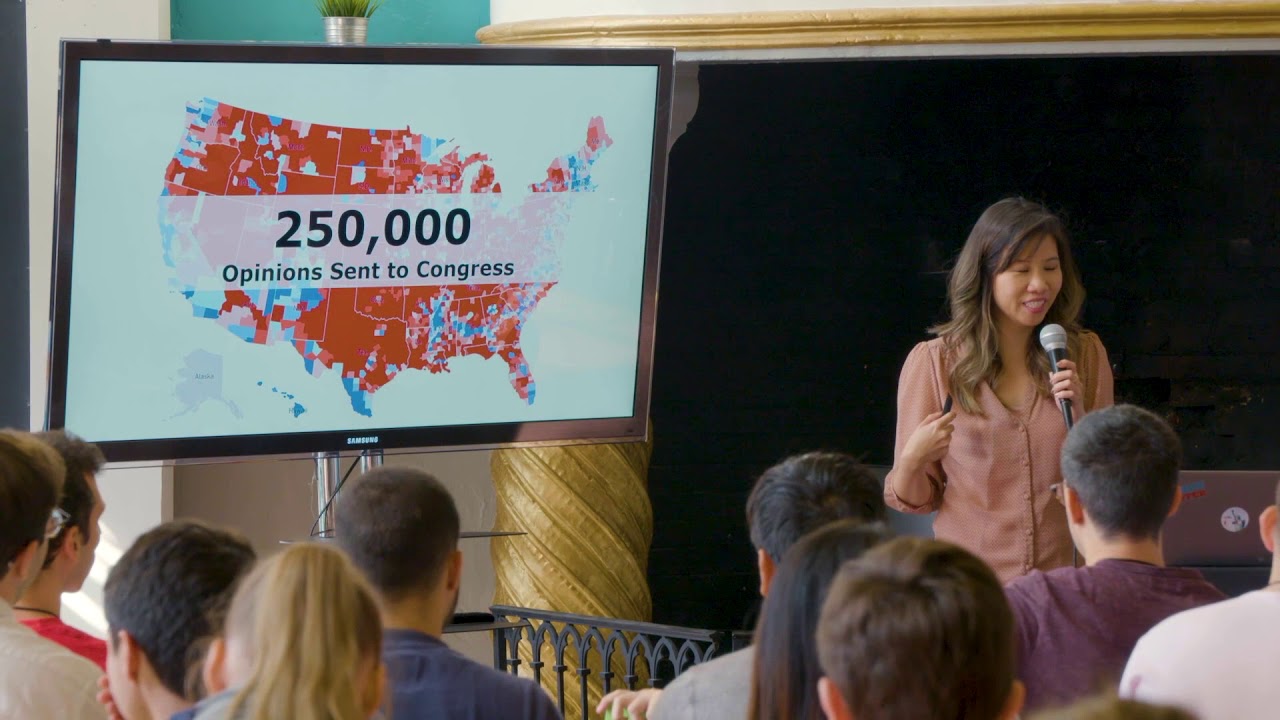
Maria Yuan presents IssueVoter, a nonpartisan platform that alerts users about bills and lets them send one-click opinions to their representatives. The platform has reached users in all 50 states and facilitated roughly 250,000 opinions sent to lawmakers.
Chapters
All right. So hi, everyone. Good morning. I'm Maria Yuan, as they said, and I am the founder and CEO of IssueVoter. IssueVoter— so in this talk, I'm just going to give some background on IssueVoter so that you know what it is. It's about 3 minutes, and then I'll talk a little bit about what I think were some of my biggest lessons learned or things that I— that helped me, and they may be helpful to you. And then we'll just open it up for questions. I think for me, like, the part that I like the most is just Q&A. So the presentation is actually not that long. So Issue Voter, it's a nonpartisan online platform that I think has the potential to revolutionize politics. So my dad came from China and where democracy does not exist. And so voting and our responsibility to be engaged citizens were values that I learned from a young age. And inspired by my parents, I went to work in politics as a campaign manager in Iowa, a state that is known for an incredible amount of engagement during presidential elections. But like most Americans, people disengage during the offseason. But at the same time, engagement on issues is very high. So how do we connect the issues to the voter? And that's where IssueVoter comes in. You want to switch? Uh, sure. So each session of Congress, over 10,000 bills are introduced. About 1,000 of them are voted on. And how many have you heard about? 1? 5? So essentially, you've missed 995 bills. And, and why is that? Probably because you didn't know they existed, or you may have spent time on the few famous ones like the healthcare bill. You may have tried to call, sent snail mail, which is very outdated but we're still using it, or signed a petition, but then never heard back. And so IssueVoter changes all that and is politics made simple. So here's how it works. Let's take Amrita, who cares about the economy. So she chooses that issue-on-issue voter, and then we send her email alerts before Congress is about to vote on one of those issues that she cares about. For each bill, we put it into layman's terms along with what both sides are saying. And with one click, she sends her opinion directly to her representative. In doing so, she creates a personalized scorecard that tracks year-round the percentage of time her rep is voting how she would want that person to vote. So in other words, am I being represented? And also to help Amrita become a more informed voter at the next election. So, you know, we, we have a democracy. We have the right to fire our reps if they aren't representing us, but we don't. And why is that? Because we don't necessarily know whether they're representing us. And that's what the— this scorecard is intended to do and intended to change. Change. So I would say that we have 3 key distinguishing factors. One is that we focus on issues, not parties, and that is important today because 40% of voters are registered as independents and almost half of all millennials do not identify with a political party. And people really do want the facts. Also, we send emails, not petitions. Representatives' offices have to track every constituent contact, and according to the Congressional Management Foundation, 88% of staffers say that, um, electronic messages do influence their bosses' decisions. And also, I mentioned this aspect of the personalized scorecard. Uh, I think the thing to point out there is we're the only site that does this. So there are things out there like advocacy organizations that will rate candidates, um, but we're really the only thing that's literally matching your opinions to how your rep voted on the actual issues. And really how they voted is showing their actual actions versus just what someone might say in a campaign. So, because, because the problem, one part of the problem is 90% of Congress is reelected despite a dismal 13% approval rating. So where IssueVoter is now, it's actually fairly new. So we went live the day after the election and Congress just started this January. So in that time, we have acquired users in all 50 states and sent over a quarter of a million opinions to Congress in less than a year. Wow. And our engagement is really high. So our click-through rates are 8 times the industry average. And we can talk about, you know, why we think that is or how that happened. The other thing I'd mention maybe that's relevant to you guys as you're thinking about, you know, things you want to do is for us, it was a conscious decision not to be an app. So IssueVoter is a website. And I know that a lot of times when people think about doing a new product, they think, okay, we're going to build an app. And that makes a lot of sense depending on what that product is. But for IssueVoter, we want to be where people already are. We didn't want to be a separate app that people have to remember to download. We didn't have to have— want to be something where everyone's just going to turn off our notifications anyway. You know, people have 50 to 100 apps on their phone, but they might— you might use 5 a day, right? Like you use your email, text message, Facebook, etc. So we started off by sending our alerts through email. Text message is something that we are looking to do next, as well as integrating with publishers. So in other words, imagine you're reading an article about a school shooting and at the same time you can send your opinion to your rep on a gun law. Oh, I'm going the wrong way. All right. So really the future vision is, you know, imagine if all 200 million registered voters spent just 5 minutes a day on IssueVoter checking their legislative bill status. And that would be total engagement. And we could have a more representative Congress than ever before in the history of this country. And so that's, that's my vision and that's what keeps me going and that's what drives me. So I would say that, you know, kind of transitioning into things that I've learned, some of the background, I mentioned that I worked on a campaign. Some of the background is that when you think about things you're passionate about, it's not, at least for me, it's not always something that was, what you were studying in school or what career path you started to take. It might be something that when you reflect was a theme throughout your life. So I was a finance major. I worked in investment banking. I worked in financial services for like 10 years. But this idea of democracy, voting, et cetera, it was always really something that kept popping up in my life. So I remember mock voting when I was in 2nd grade. In college, I had the experience of introducing and passing a piece of legislation. So I got to see things from the constituent side and went to Iowa. And then I also worked for a state rep at one point. So that's where I really saw that reps do track every contact. It's not just going into a black hole. So the point there is just, you know, thinking about what you're passionate about, and it's not always something that might be something you're doing every day, but it might be a theme that you start to realize. And for me, the other question I ask myself when I'm making decisions a lot of times is, Would I regret not doing this? And I think sometimes when you're making really big life-changing decisions, that can be a good way to just have a gut check. It's not that analytical, but it's, it's something that, you know, it's like if you would regret it, just do it. Let's see. So I, so that's really the question I asked myself before I decided to dive into IssueVoter full-time. I actually did start IssueVoter while I had a full-time job. Which is very difficult. It's very hard to do both at the same time. The other, you know, the other thing I would say about, you know, doing something new is that there's so many little decisions you have to make along the way, and sometimes you just have to trust your gut. So you'll probably learn a lot about, you know, data and what kinds of things you can track and metrics and KPIs, but when it— at the end of the day, like, you may not have any data or you may not have enough data, and so you just have to decide what you think is right. There's just so much going on, and there's only so much that you can really have control over. And so speaking of control, the third thing that I would say is that— is maintaining perspective on what you can and cannot control. So you can control your outputs. You can control how hard you work. You can't necessarily control the outcomes or how other people are going to perceive it. So the example here is that I wrote this op-ed and it was published in The Hill, which is great. And someone had a lot of time on their hands because someone went into the comments section and made all these comments about how, basically trying to sort of make the point that Ishiboda was not nonpartisan because I had worked for a candidate before. And when I, when I do interviews and when I speak, I actually never say, like earlier, like I didn't say if I worked for a Democrat or a Republican. I didn't, I never really say my own— political affiliation. And in fact, I'm— I don't have a political affiliation now. But someone took a lot of time to like somehow research me. It's very strange. And have all these comments about like, this person is like a flaming liberal is basically what the comments said. But there were like a lot of comments. So the point there though is really just, I mean, I can't control that, right? Like you put stuff out into the world. Some people will like it. Some people will love it. Some people will hate it. And that's fine. So don't worry about it. Try not to get stressed out about stuff like that. So here's this, this is this point about just focus on your inputs, focus on what you can control. Try not to worry too much about the outcomes. It doesn't mean don't track metrics of the outcomes, but don't let them, like, things like that stress you out. So that's it. That is the end of my talk. You know, just really thinking about what you're passionate about, not having regrets, trusting your gut, and focusing on what you do have control over. Thank you. And so I will open it up for questions. Oh, and I actually just want to add also is we actually are recruiting for interns. So if anyone is really interested and passionate about what we're doing, you know, you can definitely feel free to reach out to me and start to explore some of those opportunities. I'm based in New York, and actually a lot of our interns are remote. And the way that they typically work with us is they'll usually have like one specific task that they have ownership of. So you would have complete ownership over something and then just work on that thing on an ongoing basis. And then there sometimes are, like, research tasks or things that pop up along the way. Yeah. And then all of you can sign up for Issue Voter if you feel like it, too. Thank you.
More from Tim


He Sold His Car to Build This Startup, Then Pitched It for $1M 😳 #Startups #AI

This Startup Moves Your Crypto BEFORE Hackers Can Steal It 😳 #Crypto #Cybersecurity




15 Months Without Refrigeration?! This Startup Thinks It Can Go Global 🥥 #FoodTech #Startups



