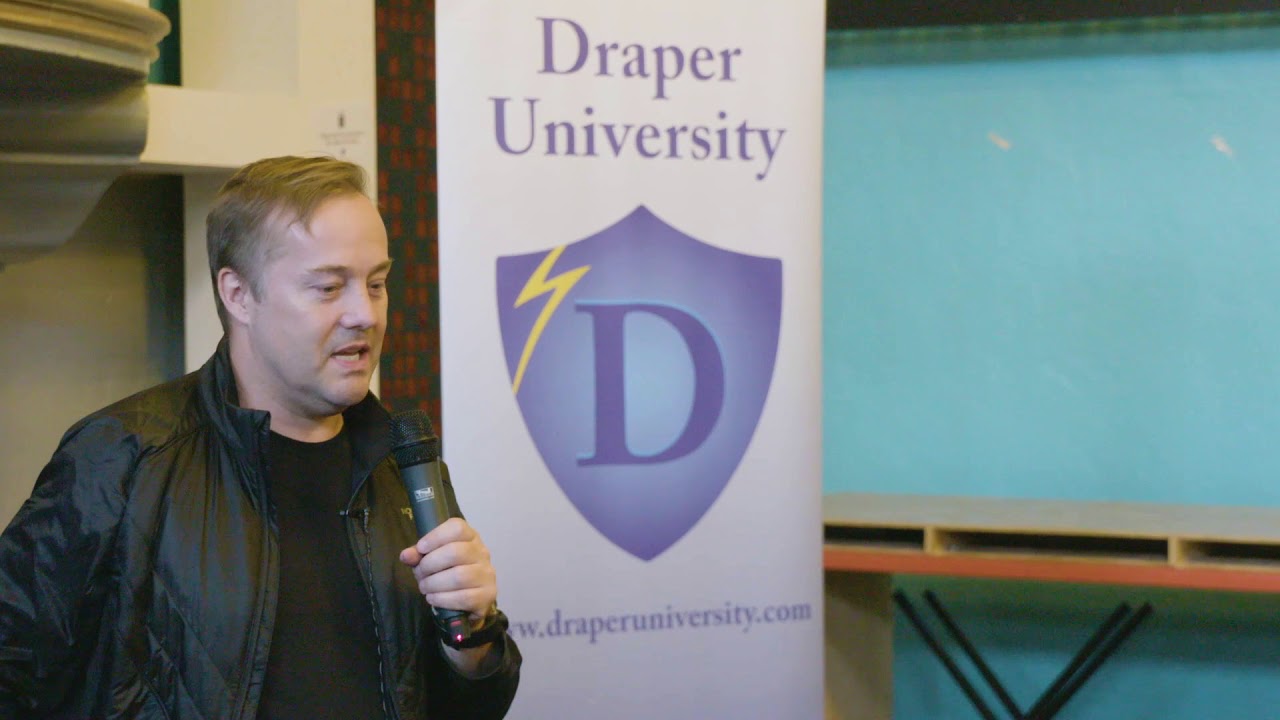
Jason Calacanis speaks at Draper University about building in the Bay Area. He discusses how the region's companies reach global scale, the job displacement from AI and automation, and why entrepreneurs need focus, resilience, and constant skill-building to survive.
Chapters
And we're going to make the most of it. How many people here would like to be an entrepreneur when they grow up? Good. Meet you. How many people in the room are angel investors, by chance, if there happen to be any? 1, 2, 3. So now you know who to attack at the end and get their money. That's the way to do it. All right. Listen. It's my great privilege to be here because it's such an international crowd. People from Arizona, Pakistan, Southern California, Covina. Argentina. So many different places. Argentina with the great beef, Brazil, São Paulo. It's great to see such a representation from around the world. Innovation can happen anywhere, but the large and the great companies grow in one place by and large, and that's here in the Bay Area. So by coming to Draper University, you've taken the first step, which is to come to an area where there are 10,000 investors and hundreds of thousands of people building the future. There is no city like this in the world. Stockholm has 9 unicorns. It's pretty amazing on a per capita basis. China— somebody here is from Shanghai— doing pretty well. You got some great companies in China. But there's nothing like the Bay Area, and there's some very unique aspects to what you will experience here during your 12 weeks, or most of you will probably wind up staying. So your next 12 years here. What's great about this area is that everybody in the Valley believes that the world can change and that small groups of people Can make the world change. This is not how everybody around the world feels. Only about 50% of the people in the world today live in a democracy with capitalism. The other 50% live in places with socialism, communism, and any other system other than the greatest, most flawed one in the world, which is American capitalism plus democracy. Things aren't perfect here, but the companies we build here travel around the world. Uber, Airbnb, Google, Facebook, Apple, Microsoft, Cisco, McDonald's, Netflix. I could go on and on and on. We build the companies that the world consumes. Tell me the company from China or Korea or Japan or Pakistan or Brazil or India that the world consumes. There are some. Samsung in Korea, Sony in Japan. Alibaba. Yeah, we don't know what that is here. It's big, but nobody cares here. We don't need Alibaba here. We have Amazon and we have Google. So thank you for proving my point, which is this little experiment in democracy known as America with its 300 million people. We're going through some hard things right now. It's very polarized. It's a bunch of people probably burning Berkeley down right now because of Some idiot wants to talk about women being inferior to men, or gays not being— gays being inferior to straights, or who knows what madness is going on. But while all that madness is going on and craziness, entrepreneurs can stay focused and build teams that build products and services that solve the world's greatest problems. It's your job as entrepreneurs to block out the noise. There's always going to be something that's going to just try to disrupt your ability to stay focused. It could be your family, it could be the friends you grew up with who are jealous of you being an entrepreneur, it could be reading the newspaper. It's your job as an entrepreneur to ignore the noise and focus on your product, and your mission. And the greatest skill entrepreneurs need going into this 21st century is the ability to add skills. Things are moving very quickly. The world is changing, and it's getting flipped on its head every 10 years. And the changes that we see— computing, artificial intelligence, Sensors, chemistry, DNA. The people I talk to in those fields can't believe how far things are coming. In other words, the people who are building the future and who are experts in their technology, their particular areas of technology, they can't believe how fast it's going. And they're the experts. So the world is changing very quickly. What does that mean for the young people in the room here? It means that you need to get your shit together. You need to work hard. And you need to understand that you're entitled to nothing. And that you live— thank you. Hear it for nothing. I say this to you because I know that you can handle hearing this because you've taken the journey to come here to Draper University to try to become entrepreneurs and try to change the world and try to not have it all be handed to you. And you're not wasting your time at Coachella or taking selfies. I mean, if you want to take a selfie with the book, that's cool. But there is no substitute for hard work. And if you think about jobs, There's 30 million people in this country who drive trucks and work in retail. Anybody here ever do either of those 2 things, drive a car or work in retail, a bar or restaurant? I did. Great, almost all of you. Those jobs are gone forever in our lifetime. Every retail job, or 9 out of 10, are gone. It's already starting to happen. Anybody ever order from a kiosk instead of from the cashier? Like, if you haven't, you will. McDonald's is kicking out the cashiers. So a whole layer of jobs are going away. Now let's talk about the more skilled labor in the world. Anybody here a developer? Great. Good job. Designer? Raise your hand if you're a designer. Great. Sales? Product management? Marketing. Great. These are good skills to have. Anybody here's job today harder than beating Garry Kasparov at chess? Whose job was harder? Unless you're a parent or a teacher, it probably wasn't harder than beating Garry Kasparov at chess. But Garry Kasparov has been beaten at chess. Anybody here think their job in the last month has been more difficult than beating the top 3 Go players heads up? Or the top 3 poker players heads up. You think your job is harder than that? It isn't. But that's fine that you think that. And that's because when we focus artificial intelligence and machine learning on a specific narrow task, it crushes, crushes humans. And these are humans with extraordinary gifts. The greatest poker players, the greatest Go players, the greatest chess players unable to beat artificial intelligence and machine learning in that very narrow space. What that means is if you're an attorney, an accountant, or a developer, product manager, perhaps even sales, some portion of those skills will be replaced by AI. And soon you'll be able to design an app by just taking out your phone and saying, Build me Uber, but for dry cleaning. And your phone will build it for you. And you'll just talk to your phone and watch the app change in real time without a developer. It's quite possible this will happen in the next 10 years. So the world's changing very quickly. What does that mean for young people? What does it mean for y'all? Well, it means the opportunity is to be able to learn new skills. Because there's always going to be something new around the horizon. The greatest skill you must attain is the ability to acquire new skills. You must be fearless. You have to look at yourself in the mirror when you wake up in the morning and say, whatever I learned up until this point in my life does not count. What matters is what I can wake up today and learn. What can I wake up today? What new challenge can I face? And what can I overcome and figure out? And what kind of team can I build? What kind of culture can I build at my company? And how resilient can I be in pursuing my startup and my company and my product or service? Most days as an entrepreneur are horrible. 9 out of 10 days are brutal and horrible, and the 10th day is just annoying. There are no good days as an entrepreneur. It's all suffering. The day you sell your company, you will have an amazing 3 or 4 hours. You'll pop champagne, you'll high-five each other like Brian Alvia and I did when we sold our company 10 years ago to AOL. And then that night you will lay in bed and go, what the fuck did I do? I should have never sold it. What a mistake. I should have kept building it. And you will be Anxious and angry and perturbed at your stupidity at taking tens of millions of dollars off the table. And then you'll feel okay about it when you go buy a house and a car.