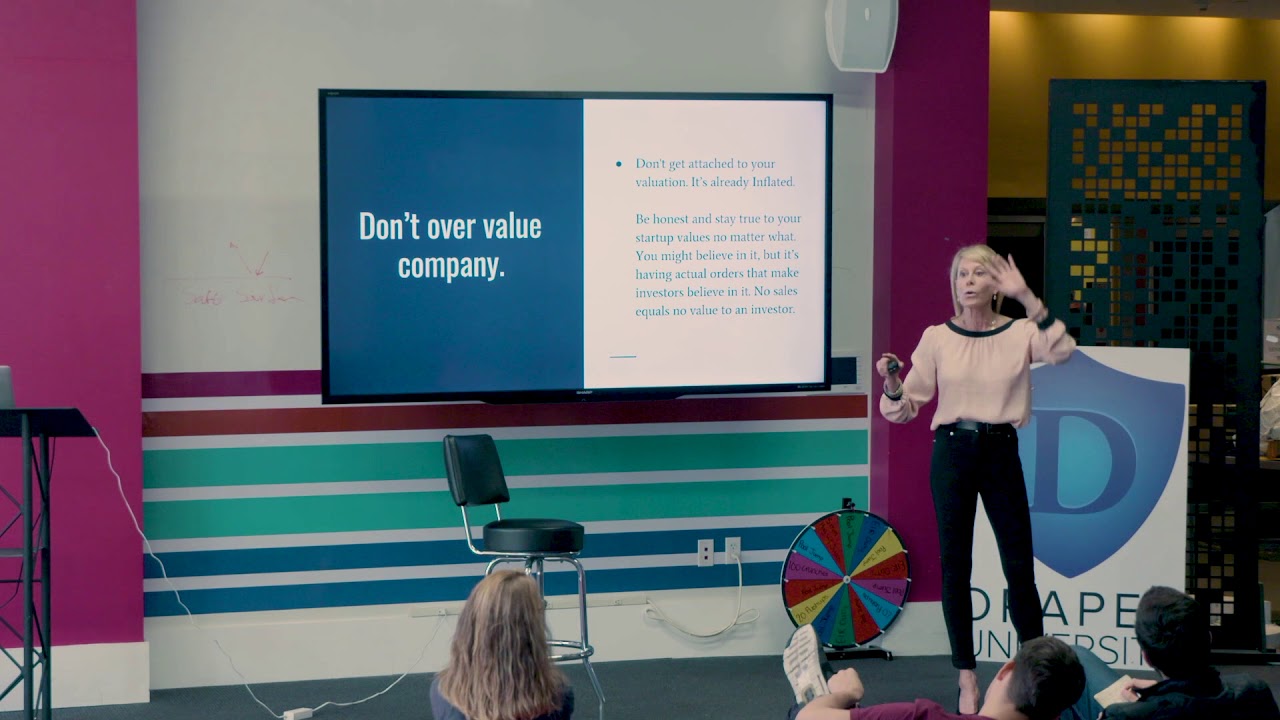
This content was created by Tim Draper. This content was uploaded by Tim Draper. This is a YouTube talk titled "Jillian Manus | Do Not Overvalue Your Company" (published 2018-02-27) in which Jillian Manus delivers advice to entrepreneurs about startup valuation, seed fundraising (seed rounds, seed extensions, Series A), dilution, and leadership qualities (grit, management, the ability to inspire). The excerpt includes instructor-led guidance and brief audience Q&A about setting the right valuation, how much equity to give up at early stages, and practical fundraising strategy (start small, prove product/traction, avoid down rounds).
Chapters
Wow. Okay, don't overvalue your company. First of all, did that answer your question? Yes. Okay. Strong, you can be strong in an I don't know. Okay, and always finish your arc, please. Finish your arcs of thought. Okay, don't overvalue your company. Okay, let's talk about valuation. Does anybody know what that is? Yes. Okay, so basically when you ask for money, I'd like $1 million, and I think the value of my company company right now is 3 times the amount that I'm asking for. And here's the reason why. I've got some traction. It's not just in beta. Or we see— here are the 1,000 people we'd sell to. Here's the problems it's going to solve. Here is my team that is just crackerjack. Here's all these different pieces, and that's how I'm valuing my company. But I cannot tell you how many entrepreneurs come into me and say, all right, I'm just launching this. Got a little bit of traction. We're in beta. So what's your valuation? $10. $10? $10? How is that? How do you come up with $10? You're telling me that, forget you have no cash, you have no revenues, you have a little bit of capital, not a lot. You've got friends and family. Mom and Dad believed in you, and a couple nuns believed in me. And you've got some different people, and that's all good. How is it that your company is worth $10? 10 times the amount because of what? Now, I have never, ever invested in a company that is at the very beginning with a 10, with an 8, with a 7, with a 6. OK? Yes, 5, and sometimes— well, no, that's not true. Sometimes 6 if I really understand it. But you have to have all the bells and whistles. You've got to have a great team. You have to have at least one use case that has been proven out. You have to understand, you have to have a forecast that I believe in. You have to have financials that I believe in. You have to have advisors that I believe in. You have to have a network. And what do you have to have most of all? You have to have the ability to lead. And what does that mean? You have to be able to manage. And what's the other thing you need in order to be a good leader? Grit. Grit. And perseverance. Perseverance. The ability to? Lead. Lead. Keep going. Communicate. What's a leader? Who said that? Inspire. That's it. That's it. That's being a leader. And do you know why that's important? Because it's not just the ability to inspire your team and me in your pitch meeting, right? I want you to be able to inspire the world, your little world, the big world, and inspire me to invest. Inspire your team to come to the office. Inspire people You need to be inspirational. And you need to have some management skills in order to also be able to inspire, I would say, effectively. OK. I have a question. Yeah? How to know the right valuation? OK. That's a good question. The valuation is basically what are the assets that you have so far? Do you have a fully built product? Do you have traction already? OK. There are a lot of different variables that go into valuing your company. If I were you at the very beginning, you want to value your company about 2 or 3, just to get the first seed and just get the small bits in. Get $500,000 in and then start to prove out your product. Because to tell you the truth, as a seed investor, like we were in Uber at 3. Valuation was 3. We like that because we see an opportunity. We're saying, OK, valuation is very I'm just going to raise $250,000 or $500,000, get some proof out there, and then go raise for double that. But that starts small because— do you know what a down round and an up round is? No. Okay, so when you raise some money, the next round that you raise, you either— it's going to be a flat round, which means it's going to be at the same valuation, or an up round, which you want, which means that you're worth more. that you've had some success. The one thing that you do not want to raise is a down round because that's like a kiss of death where your company starts sliding into a slippery slope because you didn't hit the milestones that you said you were going to. So when you have a valuation, be careful not to take it too far up because you want to overdeliver, right? At the very beginning, you want to overdeliver. And that is going to create the confidence in your brand and your leadership and in your product, it's okay to go from a $3 million valuation to a $10 million. Go for it. Prove it out. But it's really difficult to go from a $10 million and start there on a seed round. First you get seed money, then you get Series A, you know, you can get a seed extension, then you get Series A, then you get B, and so on and so forth. Don't start so high because I think that sets you guys up for failure. Can you explain the seed extension? Yeah, yeah. Seed is first is like friends and family. Okay, I call that seedling. Your seedling round. Okay, then you get some angels. That's still seedlings. And then you get into seed. We are seed in Series A. So our first checks in are around $250,000 to $500,000. Okay, that's in a seed round. Now in the Valley and pretty much all over the world right now, it's crazy in terms of the seed. You know what that means? A Series A in England right now. A Series A here, I'm doing a, right now, $12 million Series A, right now. And my last one, I did a $16 million Series A, okay? So the seed and the terminology is kind of crazy a bit, but if you're doing seed extension, you're still in the seed. You don't need a lead. That means you don't need an institutional investor. That's usually in the A round. And with seed, you can fund yourself. You keep adding onto the seed, right? The problem is, don't keep going, okay? Raise what you raise. The first raise is what you need to prove out one use case. Then start building from there. Does that make sense? Yes? If you set your valuation at like a 2 or a 3, does that mean that you give up— so that means you would give up 50% equity, right? Yes and no, because you're going to get out of the pool. You're going to get an option pool, which is actually going to be refreshed. continuously around the raising, all right? So you're actually, you're not gonna be totally diluted. You're starting just that for just to launch, but you can actually refresh as you go along. And you're not giving up the house on that. That actually is not true. That's not true. There is, and I'm trying to think if I can remember, there's one really great article that was written about valuation, like all the fallacies. And that would be actually a really good topic. I probably won't be back here again to see all of you because you graduate very, very soon, but that would be a good talk for me to do around valuations. And valuations are so ridiculous. We have no— to tell you the truth, that's one of the big unknowns. Yeah.