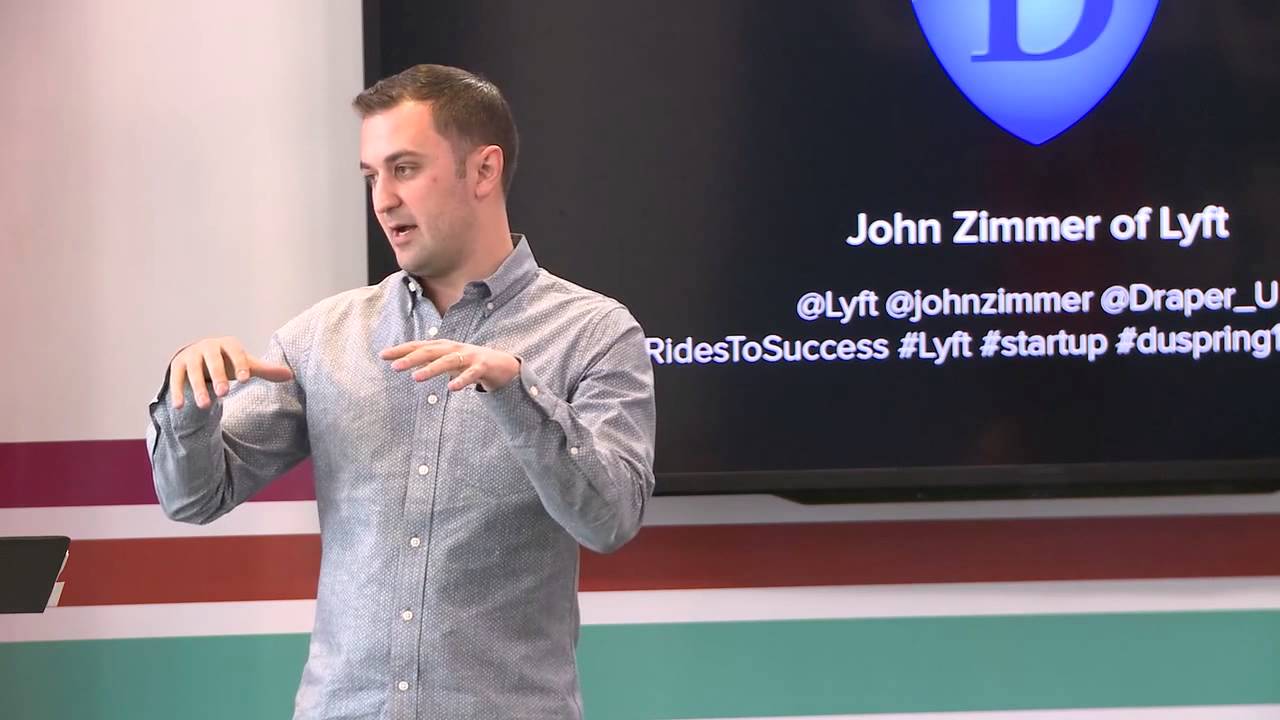
John Zimmer, Lyft's co-founder and president, talks about growing up in Connecticut, his hospitality background, and how he came up with Lyft. He walks through the problem: cars sit unused most of the time, and transportation costs drain household budgets. Lyft's bet is that shared rides can shrink car ownership and free up city space.
Chapters
So our vision is to reconnect people and communities through better transportation. And so for me, that started— I grew up in Cos Cob, Connecticut. Where are you from? From Connecticut? Yeah. Nice. Sorry, I got real excited. Nice. Born in New York, grew up in Connecticut. New York! Oh, nice. I should throw out some other— I live in California now. Anybody? Woo! All right. Nice. Nice. All right. So growing up there in Connecticut, finance is a big part of the culture there, right? And everyone— I actually grew up in Greenwich, Connecticut, where there's a lot of hedge funds and finance companies and everyone says, oh, whatever you do, you got to get into finance, and that's how they define success. And at a young age, I had a few experiences both in high school and later in college where I really saw the value of community and that's what made me the most happy. And so when I pursued college and my first job before college, it was in hospitality because it was that balance between entrepreneurship and people. And so I love service and serving people and so I went to Cornell Hotel School, studied hospitality, and by my senior year I had finished up most of my courses and I'd also had experiences when I was driving home from college. I drove home and often found that Maybe I'd get a friend to come along with me, but there were always empty seats, at least 3 empty seats in the car. And I thought, well, how could I be studying hospitality where the main business metric was occupancy, and then everywhere we drove we had low occupancy? It was like a failing hotel. What if you took the same principles of a hotel, which is you need to have at least over 60% occupancy to survive, what if you took those to the car or to any other system? And so what I really saw is a massive opportunity to upend the future of transportation, and in the process bring people together. And so now talking a little bit about what we see as the future of transportation, the way I like to think about it is if you zoom out on history and you think about infrastructure, there were a few different infrastructures. There was— in the U.S., there was canals, there was railroads, and then there was highways. And being from the East Coast, when I think of a city, I think of New York. And so I think of New York City, it's basically 80% paved. And I don't imagine that changing anytime soon. And so seeing that, and then I started asking questions or doing research about, well, if we're not going to get a new physical infrastructure, how could we make what exists better? And what are the existing problems in that system? And I learned that in the United States over $2 trillion, $2.25 trillion is spent on the auto infrastructure. That's car payments, insurance, everything, maintenance, everything that goes into the car. $2.25 trillion goes into overall consumer transportation, $2.15 of the $2.25 is spent on cars. So when you think about planes, public transit, everything else is the small part, it's the difference between $2.25 and $2.15 trillion. So really, and then globally, 13% of GDP is tied up in this auto transportation system. And yet a car, all these cars, we see them here, are parked outside and they're utilized 4% of the time. So you have 13% of GDP used 4% of the time, and when those cars are used, they're typically under 20% occupied, meaning there's 80% of seats are empty. And so you basically have virtually 1% efficiency in 13% of global GDP. And that will change. That will absolutely change. Because population density in our cities is rising rapidly. We're all stuck in traffic. And the average American household spends over $9,000 every year on owning and operating a car. The only household expense that's higher is the house. And nothing's been done about this for a really long time. And so what we see happening is that in our lifetime— well, one, so I'm 31. I believe when I have kids that I will not teach them to drive, number one. I think that's interesting. I don't think they will need to own a car, and I don't even think they'll need to drive. So now I'll talk about kind of how we get from there to there and then how Lyft fits into that. So if you think about what happened to DVDs, right, when you go out— I don't know if you guys ever did this, but we used to buy a DVD. It seems so irrelevant now because you can watch something on Netflix. I think the same will be true of car ownership, and it's cool that you're actually using parking signs as art because I actually think that all of the infrastructure is like— or maybe that's actually functional, I don't know. But I think a lot of the infrastructure that we have today around transportation will no longer be necessary, and our cities will be— we will need roads, less roads than we have. Probably 50% of roads will be unnecessary. Parking lots will be unnecessary. And so let me tell you about what we're doing at Lyft and how we get to that future. So Lyft is a ridesharing company.