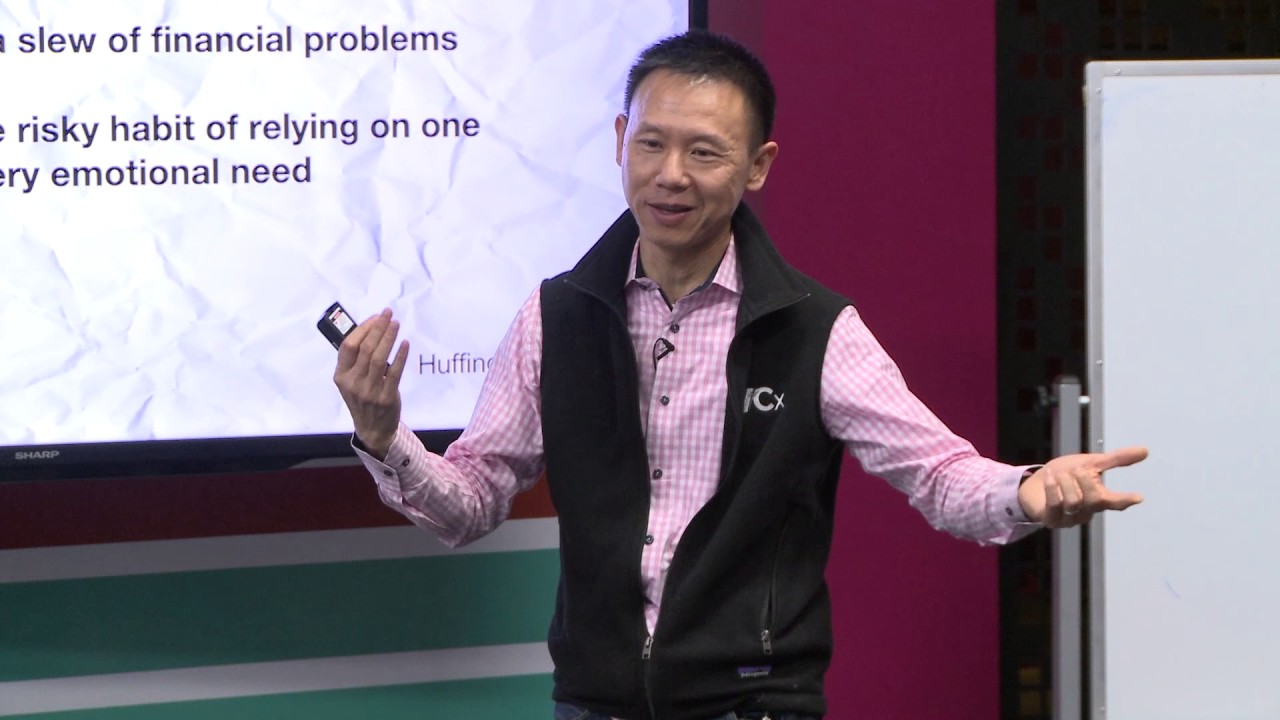
In this talk, Andy Tang discusses how a venture fund’s size and typical check amount shape the valuations of the startups they invest in, arguing that larger funds writing larger checks tend to produce higher implied valuations, while smaller funds lead to lower valuations. He advises founders to run auctions and not obsess over valuation, treating it as a minor factor akin to choosing a marriage partner. Tang then introduces the "law of large numbers" for investors, explaining that backing many companies reduces randomness and improves overall success rates. He warns against over‑reliance on a single insider investor across multiple rounds, describing it as a "damaged‑goods" signal that can deter new capital. Tang shares his own investment track record: about $300 M deployed since 2005, with roughly $200 M returned, highlighting that seed and Series A deals have outperformed Series B in his portfolio. He notes a pattern that successful founders are often engineers in their 30s, reflecting his own bias toward technical teams. Finally, he outlines his investment discipline for early‑stage deals—focusing on market size and founding team quality rather than detailed financial modeling, a contrast to later‑stage investing.
Chapters
Intangible. Oh, it's very intangible. I mean, it's like the— it's like you're selling a piece of paper. That piece of paper happens to be called a stock certificate. That piece of paper to one person could mean $5 million valuation, to another person it could be $50 million valuation. One thing I have noticed, if you talk to a fund, and this is an example of why— how crazy this is. If you talk to a fund that's $1 billion and their average ticket size or check size is $10 million, then all of their valuations tend to be bigger, right? So they write big checks. And if you write a $10 million check, obviously they can own 90% of the company. So they own 20%, right? And suddenly your valuation is what? It's $50 million, right? But if you talk to a fund that's $100 million. $100 million and they write $1 million checks. Again, they cannot own 90% of the company, nor can they own just 1%. So they own 10, and your valuation is $10 million. So there's also a little bit of tactical choice you have to make in which fund you talk to at what stage. So the simple logic, the wrong logic would be, well, I'm always going to talk to a billion-dollar fund because they write $10, $20 million checks, but then their hurdles are much higher. They may want to see more proof points. So at the end of the day, I probably didn't give you a very crisp answer, but it's such a complicated issue, you could go at it from different directions. The best way to ensure the best valuation is to talk to many people and have an auction. Let the market decide. Right. It's probably not worth— I'm actually a believer in don't get hung up on valuation. I think it's a complete waste of time. Because the market will decide. If you raise money when you can and you spend money when you have to. So when you go raise money that you can, someone offers you something, you talk to a few more people and see The best offer, right? And I will say this just to confuse you, valuation is a small part of the consideration. It's like marriage, you know, you don't always marry the richest person. Oftentimes people don't, right? It's not linked to the happiness. You may become richer, but you may not be as happy. All right, before we get too philosophical, we'll keep going. So now we could get even more philosophical with— well, did I address this? Oh, so think big, right, from this. The other thing that's important is, so for investors, the attrition rate is so high, the law of large numbers— is anyone familiar with this? So law of large numbers basically means— yeah, I'll quickly go through this. You have to have enough shots to get rid of the randomness. Sometimes it's just bad luck, right? I back you, you're really smart, this is a great market, business model works, everything— I mean, I should make money but I don't. But if I back 10 people like you, then I may have 80% success rate. That's chance. But if I just do it once, some freak thing may happen. Okay? Okay, some more interesting facts. Why getting married is tough. So marriage could present a slew of financial problems. That probably doesn't need a lot of explanations. Tax, you know, dual income, dual expenses. Your spouse may spend more money than you do. This is interesting. It never occurred to me this could be the case. And how is this— so oftentimes— and by the way, this came from Huffington Post, so I didn't— I'm not qualified to come up with these points. So apparently you could become overly dependent on your spouse for emotional need, right? And that creates a burden on the relationship. How is this relevant in investing? I actually have seen this in companies. They raise money from 1 or 2 investors. And initially it was really great, but for whatever reason, right, to no fault of the founders, they can't raise money from outside. Right, so you do another inside round, right? So it's one round after another. Suddenly the investor is on the hook, right? We became the largest investor. We keep investing. What kind of stock? It's a good company, right? So that is one risk you should watch out for, both from an investor perspective and the company's perspective. And new investors, and if you do this a couple times, new investors don't even want to jump in. Like if I see someone who has the same insider for like 2 to 3 rounds, I actually remember someone fairly naive, And thinking I was also naive, maybe I just looked naive, told me, oh, their insider really likes this deal. They invested 3 times. I'm thinking to myself, that's not right. They didn't really like it so much they invested 3 times. They were probably stuck with the deal. Right? And that becomes somewhat of a damaged good issue. Okay? You don't want that because then that's just bad optics. Okay, anyways. Andy. Sorry, a question. What do you mean by stuck with the deal? Like no one else will fund? Is that it? Not no one else will fund, but it's just many investors are very busy, right? Just like if you're dating someone, if there are these certain signals you see, if you have so many deals, people may start forming these habits. Correct or not, I'm not sure. Right? From what I have observed, if a company has the same investor investing 3, 4 rounds, typically it's a— there's a sign that the market is rejecting the deal. The insider has to keep triaging the company, and that is not a good situation to be in. Not for the investor, not for the company. Yeah? Yeah. Okay, so I'll share with you a little bit of my portfolio from the last 15 years, and there's some insights we can kind So I started my career with Infineon Ventures, used to be part of Siemens Ventures. It's a corporate fund. I also spent some time with ABB Technology Ventures. I managed their US portfolio. And then in 2005, I joined Tim along with my Chinese partners. We launched the China Fund, and we're on our fund 3. So, All told, it's about $300 million deployed. I've done about 15 seed deals and close to 60 Series A investments. And I kind of dabble into Series B a few times. But predominantly where I feel most comfortable is Series A and sometimes seed investments. So out of these— so this is kind of the running tally, right? So $300 million deployed. Returned about $200 million. How long now? Hmm? How long now? 2005 to now, 10 years. Yeah. So not everything has been exited. So the ones that we've exited, about $200 million, this is what it looks like. So these are the ones that are looking like winners. So there are 9 companies that I looked at that are good. And basically over half are people in their 30s. And they turned out all to be technologists, founding team, right? Have some sort of engineering background. And surprisingly enough, it's mostly seed Series A investments that turn out well, right? So Series B hit rate actually weren't that high. So a few conclusions. One, there's something unique about people in their 30s, at least in our portfolio, right? they tend to do very large disruptive things and sometimes it works out. And then when it works out, it tends to be a big outcome. That's one. I'm an engineer by training, so I may have a, I may have a natural bias towards funding engineers, right? But it turns out most of these barriers to entry they created are based on technology, okay? Surprisingly, our seed deals actually were, you know, did pretty well compared to Series A. And Series A certainly did better than Series B, right? Now Series B I can kind of understand. I think My discipline in investing is a little bit different from late-stage investments where they are really big on number crunching. So for me it's looking for a big market, looking for a good team. It's more of an abstract evaluation of character as opposed to financial analysis. So that technique doesn't apply to later-stage investments. So I probably have made some— Bad investments? errors in Series B in not doing enough financial due diligence. Or the judgment I made wasn't quite good. Didn't have the sample size, you know, 5 investments is very few. But on the seed side, which really surprised me, we only made 15 seed deals, but 4 of them turned out to be pretty good. So basically the approach that we use, it's proving out to be more and more appropriate for the seed side where you have very little information. The only judgment you're making are— the 2 main judgments you make are the market size and the people in the founding team. Whether they have— this group has the ability to navigate. Through a lot of abstraction and a long investment horizon.