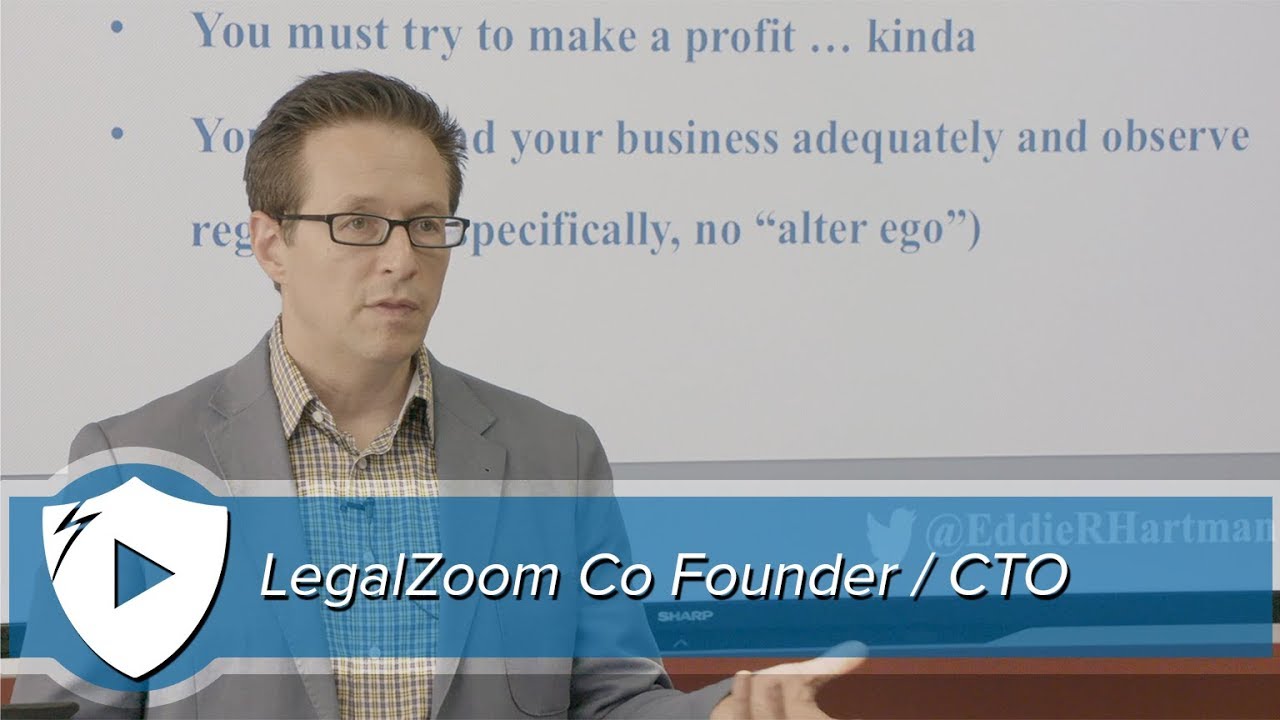
This content was created by Tim Draper. This content was uploaded by Tim Draper. This is a YouTube video titled "Limitations to Liability | LegalZoom CTO Eddie Hartman" (posted August 13, 2018) containing an English lecture/talk by Eddie Hartman (LegalZoom CTO) about limits on corporate liability. The excerpt is a recorded presentation with audience Q&A covering topics such as the ultra vires doctrine, benefit (B) corporations, the business judgment rule, piercing the corporate veil/alter ego, record-keeping and funding requirements, and examples (Patagonia, the Chicago Cubs/Wrigley Field, and medical malpractice).
Chapters
So are there limits? Well, there used to be. There used to be something called ultra vires doctrine, or ultra vires doctrine, and what this meant was you had to say, this is what the company is going to do. We are just going to do underwater exploration, right? But then people got around that. They began to say, ah, this business is set up to do all legitimate purposes. And this sort of went away. So this used to be a limiting factor, but now it's kind of gone away. The next thing is you need to try to make a profit. So if the government looks at you and says you're running this as a charity, you're not trying to make a profit, sometimes your investors can sue you, okay? Sometimes. And in response to that, they have created something called a B Corporation, a benefit corporation. Has anyone heard of this?
No.
So Patagonia, for example, is structured as a benefit corporation, and essentially they say, hey, I understand if you gave me your money to help me run my business and then I decided not to run it like a business, you would have a right of recourse against me. That's not fair dealing. But if on the other hand I told you upfront, this is structured as a benefit corporation, I'm going to try to make money, but I'm also kind of— I'm going to try to do things for social good. If you don't like that deal, then don't invest with me. That severely limits people's ability to sue you for not trying to make a profit. And by the way, the government says initially, hey, you know what, you don't really need to do everything to try to make a profit. There was a famous case. Who here knows anything about baseball? Raise your hand.
Right.
Okay, so the Chicago Cubs are a team in— and they've been around for more than a century. They play at a place called Wrigley Field. Wrigley Field is very famous. It's one of the most famous stadiums in the United States. And the fact is that Baseball is big business. You know, the Cubs are worth billions of dollars. And the person managing the Cubs is essentially managing a billion-dollar business. And someone said, you know, all these other teams, they have night games. If you did night games, you'd be able to make more money. You'd be able to sell tickets at night. More people would come in. He refused. They said, he's not trying to make a profit. And they brought him into court. And the court said famously in this case, hey, you know what? We're not going to look into how you're running your business. They established something called the business judgment rule. So as a person running a business, the court will say, we're not going to look into how you're running your business. If you think that night games don't work for the Cubs, particularly because Wrigley Stadium has a certain ambiance and you don't want to lose that, we're not going to try to settle that in court. If you are grossly running the business in such a way that it's clearly a charity, then we'll look into that. Because we don't want people to invest with you and then you just suddenly pull the rug out from underneath them and say, no, no, no. I'm a charity. I'm not going to run this like a business. But in general, you're protected. So let's review. You're shielded from personal liability. Your investors are shielded from liability. Your business gets rights just like a human being. And in general, the courts have said, we won't look into how you're running this thing. You just do the best job you can. That's a hell of a deal. There's only one thing you really have to do. You have to avoid something called alter ego. You have to fund your business adequately. That's what we were talking about a second ago. You have to observe regulations. You have to actually file all the paperwork and keep all the records. By the way, the record-keeping for an LLC is quite a bit less than for a corporation. And then finally, you can't use it as your own piggy bank. If you're basically using your corporation as a cash drawer and you're, you know, putting your hand into the cash drawer and taking money for your own expenses and then paying the money back, That's a no-go. That's the main reason that people lose this corporate protection. And by the way, sometimes they lose it at the last minute. You thought you were protected. You went out there. You're hauling nuclear waste or whatever it is that you're doing. Somebody comes to sue you. You say, ha ha ha, no problem. I've got my liability limited by the fact that I incorporated. And then you discover at the last second, uh oh, I don't because I've been failing to observe that bottom line there. I didn't fund it adequately. I didn't file the right paperwork, or I've been treating it like a piggy bank. I've been taking money out, putting money back in for my own purposes. These are the 3 things that will, at the very last second, turn out to have voided your insurance policy.
Does taking dividends count as using the premium?
No. No, that's completely legit.
So basically cutting profits and then turning them into dividends and using the premium.
That's fine. It's more if you're like, hey, you know what? I need to take a plane. To see my mom, I'll borrow $400 from the business and then I'll pay it back next week. That you can't do that. You had a question in the back?
Me? No.
In the Jeff Bezos example, yep. Remember, they give to the drivers like a pretty complicated thing to do, and someone says, "Hey, that's dangerous," and then they give people his response. Because if someone told him, like, hey, that's dangerous—
Probably not. So even if, even if the board of a company was advised that something was dangerous, even if they discussed it, even if they weighed the options— there's a famous case of a car that they discovered had a defect such that it would explode or become unsteerable at high speeds. And they discussed it internally, and they did a calculation of how many lives would be lost versus the money that would be lost. The corporation was held liable, but oftentimes the people who make these decisions are not. It's really at that level.
What about, say, private healthcare providers? Say, for example, if they have a negligence case against them, that the doctors weren't, or the medics weren't treating the patients correctly, does that specific— does the company or the entity itself Does the hospital itself get sued or the actual physician?
So a surgeon leaves a sponge inside you. Usually the surgeon will be sued and the hospital or other medical facility will also be sued. However, that's called a medical malpractice claim. Those have really shrunk, 90% diminishment or so in the last 2 decades. So it does happen. Doctors have to carry a lot of insurance for that reason because they do get sued personally. But in general, no. So for example, if a hospital, on the other hand, had surgeons that were leaving sponges inside people and sewing them up, which has happened, by the way. I'm not making these up. That happens. Would the people running the hospital be held liable? Generally, no.