Andra Keay surveys robotics and AI developments in the Bay Area, from soft robots inspired by octopus anatomy to microswarms that could handle surgery and construction. She traces the field from Shakey to present-day challenges: hardware takes years to commercialize, but robotics could solve global problems if built responsibly.
Chapters
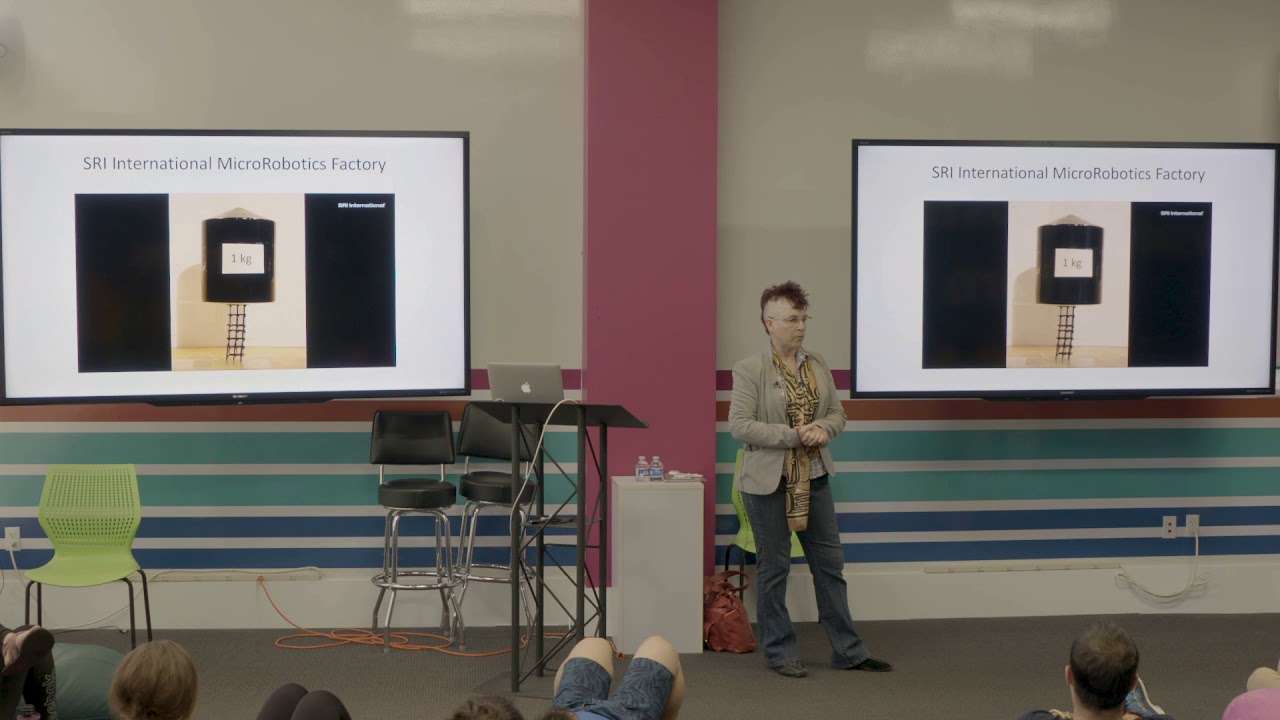
And let's look into the future. This is my favorite robot documentary because this is inspired by the robotics that's happening here in the Bay Area, okay, and beyond. Baymax, okay, what do we know about Baymax aside from awesome personality? It's inflatable. It's light. It's soft. Has anyone seen any soft robotics in real life? No. Okay, it's game-changing. This came out of DARPA funding for surgery in the field. Okay, and this is where people started to think, you know, how do you manipulate human organs? We can't use these harsh metal objects, you know, not if we want to, you know, not do instant surgery. So People looked to nature, to the octopus for example, and they've developed hydraulic or pneumatic silicon robotics. Doesn't require a skeleton, is innately compliant, is incredibly light and hugely inexpensive. So we're starting to see This might even play if I'm lucky. Okay. We're starting to see things like this. You can do hands out of it. You see the tubes to inflate that grip or not. You can do whole arms. The video's not playing. And you can do, well, there is a company who's commercialized this that's starting to use end effectors. Any old robot arm, you put The soft robot grippers, imagine an octopus arm, can pick up any e-commerce item. But even better, it can handle food. Food is a huge industry that robotics has not done terribly well at because food damages terribly easily. And all of it is uneven shapes. With the possible exception of eggs, but they're so fragile. So soft robotics solves that. It also solves handling textiles, but so does electrostatic adhesive gripping. which is another technology that's come out of SRI International. And anyone remember the swarm robots? Not science fiction. Probably early days of commercialising it, but there are swarm robots being deployed in a range of labs, and there is, for example, it'd be super if I could play this. There is a lab at Stanford International that— back, play. Okay. Producing magnetically actuated microrobots for advanced manufacturing. People haven't really worked out too many applications for this technology yet because it's just such a game changer. One of the things could be space because atmosphere is not required for the operation, or gravity for the operation here. One of the other things is inside contained spaces. And you think, yeah, but what can these robots do? And, you know, this is a key thing. This is real time, because, you know, so often you look at robot videos online, they don't always say how much they've been speeded up. Good research always says how much it's been speeded up, and most robot videos have been speeded up. 3 to 10 times. This is not speeded up. Okay? So each robot is tiny. It's smaller than my thumbnail. So what construction can that do? Well, you can do quite a lot with carbon fiber tubes. In fact, they— these robots right here are engaged in building a truss out of carbon fiber that can hold up something like 5 kilos of weight. So for their size, that's orders of magnitude of effect, of impact. I believe that they've had trials now where they've had over 100 robots operating, and it scales up infinitely. You can do this with thousands of robots. So this was— the soft robotics was the inspiration for Baymax. And I mean explicitly, the makers of the film were looking at the robotics research labs to work out what sort of robots to put into the film. And these microrobots were the inspiration for the nanobot swarm. in Big Hero 6. So I always call it my favorite documentary. And this does go on for quite a while, but if you go to SRI International— has anyone been there or heard of SRI International? Yeah. Yeah? Amazing. It's just down the road in Menlo Park, and it used to be called Stanford Research International, But most of the funding for the government projects was coming from the Department of Defense. And in the '70s, that became politically a bad thing to have Stanford University being funded to build weapons. So they split it off, became a completely separate entity. It's a nonprofit research and development center. And we all use things that have been developed in out of Stanford. Like the internet. Okay, it was one of the first 5 sites for the internet. Siri. Many other things. The Intuitive Surgical System. What they haven't necessarily done well is get money for their work. And you've heard of Xerox PARC as well. So all of those early technologies like the mouse, the keyboard, what have you. These guys had 20-year licenses on the technology, but they only became really commercial about 20 years after they first built them. So as they will tell you, they've got a very poor history of commercializing robotics. But SRI, in partnership with Stanford, built the first autonomous robot 50 years ago, Shakey, which is now in the Computer History Museum, Computer Hall of Fame. Claim, autonomous navigation with almost all of the sensor packages that we use for autonomous cars these days. So the history for robotics in this area goes back a really, really long way. But people don't recognize that Silicon Valley is the home to, to me, the next generation of robotics and AI technologies. And for me, it's the revolution technology, the technologies of the 21st century. It's quite clear computers highly limited in where and how they operate. But when things went online, opened up a lot of possibilities. Now, when things have mobile hardware, semi-autonomous or autonomous. It's going to expand. We really are looking at a world full of robots. We won't call them robots anymore. It's just going to be everything is smart. Everything will be connected. And this is our opportunity to steer the agenda, to shape what's coming. And that's what excites me so much about robotics and AI. Also the fact that we do need people to shape the technology. You know, this was where the first traffic light was put in. Okay? We're at that stage where traffic lights, we're kind of negotiating those sorts of things for robotics. And it's interesting, but no, they will not steal your jobs. These technology changes don't happen that Rapidly, no matter what you hear, and no matter that some aspects of this technology are happening. For me, one of the big things is this is hardware. This is infrastructure. It takes a long time to bring those changes in. What's exciting is that this means that some countries where there's less built infrastructure or environment may be able to jump a whole step over and start to put. things into place that are far smarter than anything we have here. So there's opportunities to be sought here. And finally, that's how you've got to look at robotics. What are the global challenges that face us? This is how we're going to solve them. And we have a lot of global challenges. I get really excited when I see the ways that robotics and AI can make the world a better place. I think you can always talk about how do you make money out of robotics, but I get really excited when we talk about how do we make the world a better place with robotics. And I hope you do as well. And thank you. Woo!