David Theroux explains Independent's "Love Gov" video series, which personifies government as a toxic boyfriend to reach millennials worried about student debt, job prospects, housing, healthcare, and surveillance. The humorous shorts are designed for mobile sharing and connect to the MyGovCost app, a calculator showing what government costs individuals.
Chapters
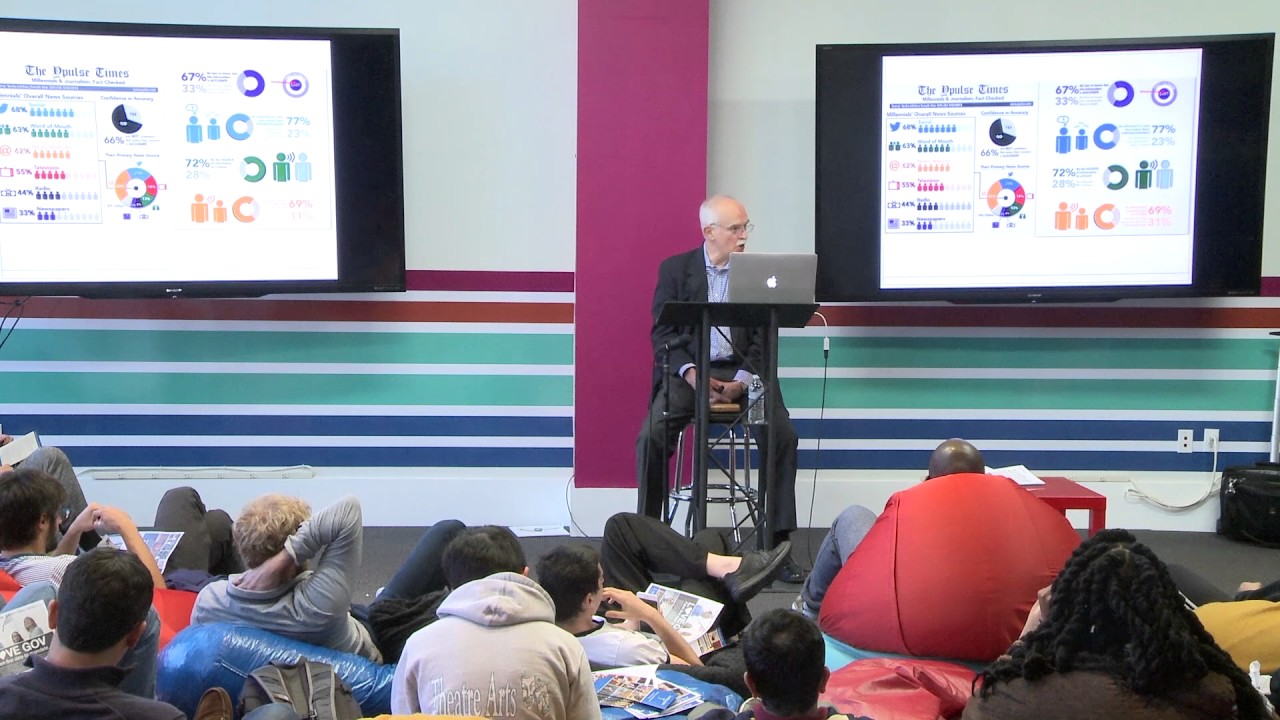
So as you can gather, Independent has a very specific mission. And the mission is to educate others and in the process boldly advance peaceful, prosperous, and free societies grounded in a commitment to human worth and dignity. But what does this really mean? We're full of masked information, in fact, information overload, not to mention heated and conflicting views. And how do you know who and what kind of information to trust? Where do you go to find information that's reliable and will be trustworthy? The noise and the data and the images, of course, in the information age are massive. And the question is, how can we better understand our world so that we can be successful in pursuing our own dreams, as you all here are aiming at doing? and the process of lifting the lives of others. Clearly, the caliber of ideas presented and respected in the public squares of society is crucially important. Now, I understand, and you can correct me if I'm wrong, but I believe that everybody in this room, myself excluded, would qualify as a member of the millennial generation. That's ages 18 to 34. Any exceptions? Yes. So we're in good company. As you may know, millennials are the largest generation in American history. It's about 80 million Americans. And clearly, as with each successive generation past and future, you will soon be the leaders of this country and perhaps around the world. At Independent, as I mentioned, next year is our 30th anniversary. And in our work, we've always sought to make information that's sound and then essentially pursue it to make it critically influential. Now, over a year ago, we decided to pursue a new project that would specifically seek to target millennials, this huge group of individuals, and to do so based on what you and others in your generation care most about. The first question then is, what is that? So are millennials really different in their habits and their views? Clearly we all have the great desire to be loved and to love. We're relational beings. We want to make a difference in the world. But to pursue exactly how people put priorities in your generation, we first had to begin an analysis of what we could basically determine was most concerning to you and others. So it turns out that— make sure I get this right— by May 2013, 68% of news sources for millennials had become social media. And 66% of millennials did not trust traditional news sources at all. Indeed, word of mouth was viewed as more reliable than TV, radio, and newspapers. 72% would prefer a friend as a source of information, and 67% would prefer not knowing things in a timely manner at all for fear that it might be less accurate. Ignorance is bliss, was the view. More recently, we know that millennials spend more than 5 hours a day interacting with peer postings on social media. 5 hours a day. They find user-generated content 50% more trustworthy than other media sources like TV or newspapers. Smartphone users, which is 86% of millennials, average 30 hours per month on 28 different mobile apps. Even more remarkable is the share of millennials that are mobile-only users, an extraordinary 18% as of January 2014. That's nearly 1 in 5 millennials that do all of their internet browsing, emailing, Google searching, social networking, and online news reading on a smartphone or tablet. And a large portion of this communication was not standard news, but a mix of entertainment and entertainment that actually mocks the pretensions of the standard view and conventional views more broadly. Hence, we decided to undertake a new approach to education, not one that was exceptional as far as our previous approaches, but would simply use new technologies and adapt to what the market was looking for. And one that was essentially attuned to millennial habits, concerns, and aspirations. So from surveys by Pew Research and the Harvard Institute of Politics and elsewhere, we decided to focus on the 5 core questions, but by far the biggest ones, not the only ones. And they are, why is my student loan debt so high and how can I ever repay it? Why can't I get a good job? Why can't I find healthcare that I can afford? Why can't I find a place to live I can afford? And why is the government spying on me? We then sought to craft a video series that was funny, compelling, and thought-provoking on these issues. We invited numerous video producers to submit proposals for such a series, that needed to be part of a multiplatform campaign that would connect to the app we already had for a website that was mentioned in the video called MyGovCost, the government cost calculator. And here's the bottom line. For the video series to reach millennials, we needed to create compelling mobile-friendly content. In other words, the series had to be friendly and mobile. and also would direct people through an app to further information. But we also needed to package the content effectively so it would be easy to find, to watch, and to share. Theme-wise, we needed to focus on the 5 key millennial concerns. Now, as citizens, most people, it turns out, want to trust the government. Even love the government. But it seems like politicians and bureaucrats are mainly interested, or perhaps too often interested, in taking advantage of that trust. Crises, as the video discussed briefly, are a way to get trust. You turn to the government because you're afraid. It could be a real fear, a real danger. It could be exaggerated. Or it could be fake. Today the government tells us where to live. It tells us what to buy. It reads our emails. When you think about it, you might say that our relationship with government is sort of like a toxic love affair. As a result, with the Love Gov series, we created what we believe is a funny, thought-provoking series that personifies this toxic relationship between young adults and the government. As you may recall from viewing it, the video series focuses on 2 characters. Does anybody remember their names? Gov and Alexis. Gov and who? Alexis. And Alexis, that's right. Alexis Smith and Scott Gov Govinski. There are other characters too, as you mentioned. The main characters are 2 20-ish millennials who meet and fall in love. It's a classic boy-meets-girl love story, but with a disturbing twist. Our heroine, Alexis, is a free-spirited young woman in college trying to make sense of and her way in adult life. Her new boyfriend, Gov, is, well, the government. Gov personifies government's worst tendencies. He is, of course, Appealing to Alexis because he's handsome, he's clever, he's conscientious, he seems to care. But he also personifies government's worst tendencies. Having started an online business that is increasingly successful, Alexis wants to quit college and grow her business with her friend Libby, who you mentioned. As Alexis cannot afford the student loans and is increasingly leery of college delivering on its promises, However, Gov manages to step in and snookers her into staying in college with student loan mounting, giving up her business, and essentially causing her all manner of problems. Gov makes life more complicated, more expensive, more absurd, and far more difficult. He even stalks and spies on her and listens to her cell phone. But every time Alexis tries to break it off, Gov somehow finds a very easy way to weasel back in and create even more problems. Love, Gov follows their relationship from the first blush of romance straight through to the bitter end, and each episode on one core question is also sprinkled with other issues that you may have noticed, and we can discuss that.