Ron Ploof teaches how to craft pitches that stick. He breaks down three elements: make it interesting with unexpected twists and a "then one day" moment, memorable through emotion and extremes, and persuasive by bonding over shared human experiences. He uses stories like a garage rattlesnake encounter to show how curiosity and emotional hooks work.
Chapters
All right, so I told you at the beginning we're going to come up with ways of making your pitch interesting, memorable, and persuasive. So we now have that baseline story and story structure. We now understand that. Now we're going to build upon it. All right, what makes things interesting?
Common interest between 2 parties.
A common interest between 2 parties? Okay. What if there aren't any parties? What if it's just you? Perhaps something they don't know about. Something they don't know about, so something new? Okay, yeah.
An unexpected twist.
An unexpected twist? Yeah, absolutely. Yeah, like a, wait, what? Uh-huh, yeah.
I would say context.
Context meaning what?
I mean, if you're given a random event or situation, I have no reason to care. But if you give me some context around it, at least—
OK. OK. A reason—
Something to grab onto.
Yep. A reason for me to be interested.
Yeah.
Yeah. OK. Yeah?
I think things are interesting when you don't know what it is. You don't know what that is. You get curious right away.
So curious. What sparked your curiosity?
Yeah. Mystery magic.
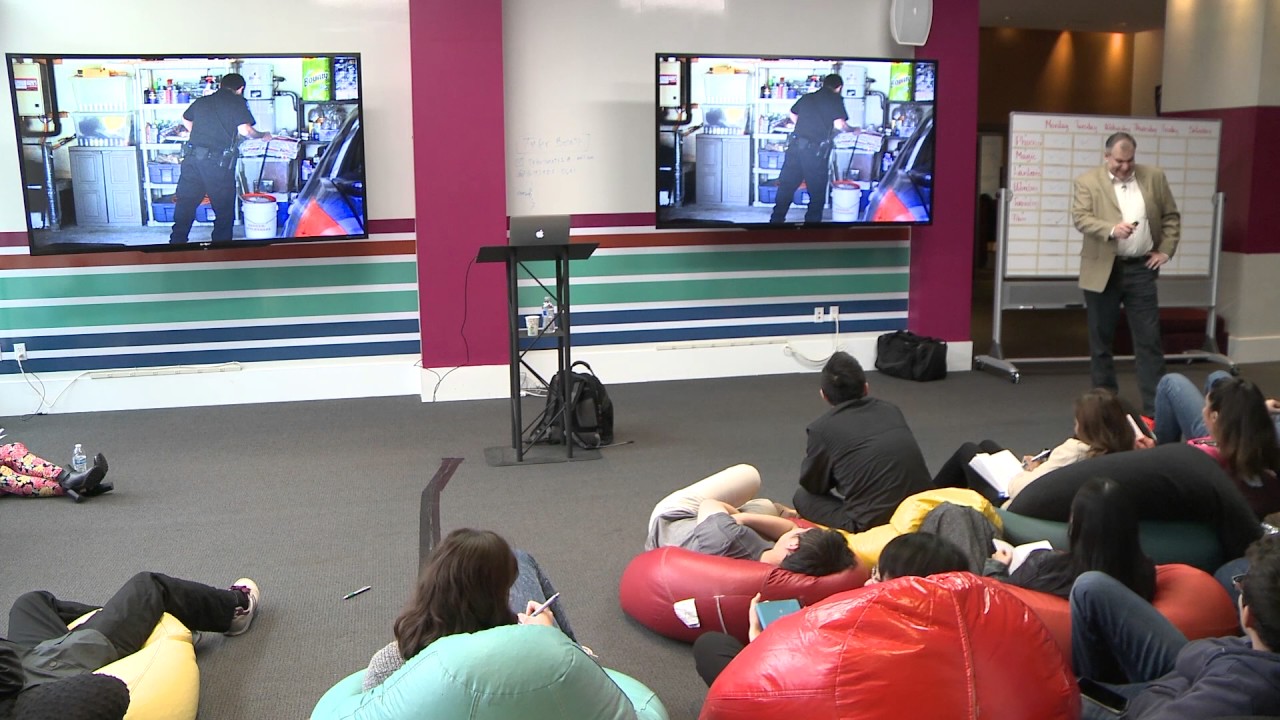
Mystery magic. Absolutely. You watch a magician and like, how'd they do that? Yeah. Yeah. Great. Yeah. Our interests peak when our expectations are violated. That's what really peaks our interest. When we expect You expect something to happen, and it doesn't. It's a wait, what? moment. It's a uh-oh. Uh-oh. Right? That's different. So our interest is piqued when our expectations are violated. It's the then one day in the story structure. Right? Every day things were going great. And then one day, you know, I'm on my way to a client and I'm running late and I get a flat tire. That's the beginning of a story. Because if I had gotten there and had the meeting, there would have been no story. It has to be a then one day. Let me give you an example. Let me give you an example. I live in Southern California. In our garage, we have these shelves, and on the second shelf, we have a— where you put the dry goods, the wax paper, the Reynolds Wrap, things like that. Okay? So my wife goes to the grocery store, and she's taking the grocery stuff out, and she's putting it onto that shelf, and she runs into this guy. What's his name? Yeah, I heard a couple gasps, right? That's an and then one day, right? So let me ask you a question. All I did is set up a story. What are some of the questions going on in your mind right now? What did she do?
What did she do? Is she okay?
Is she okay? Yeah, absolutely. You want to know. Right? You want to know. That's why it's so important when you're pitching is you need to have an and then one day. You want the people, your audience, listening to you and saying, okay, what happened? What happened? You can't leave me hanging here. Okay? Just so you know, we called animal control and he came and took care of the guy. So I wasn't going to deal with him. Yeah?
The same thing happened to me in my office. I was working, I opened the door, and there was a snake.
A snake? Yeah.
And she was mad. She was standing up.
I ran to my desk and I called someone to come. Absolutely. Yeah, no, I'll tell you, there's something primal about running into a rattlesnake, right, that I'll never forget it. I can't even walk in the garage without going like this anymore. And it happened 7 months ago. Every day, then one day. We need to have it. That's what makes things interesting. So make sure that you have an and then one day. All right, so now let's talk about memorable. How do we make things memorable? What are some of the things that you actually remember?
The purple cows.
Purple cows?
Yeah, like there's something different in the story.
That is Seth Godin's book, is that right? Yeah, Seth Godin's book Purple Cows. Yeah, that's true. If you see a bunch of cows but then you see a purple cow, yeah, that would be memorable. Yeah. What else? What else do you remember?
Yeah.
Bold, impressive, got it.
Some things that are attached to feelings.
Things that are attached to feelings, yeah, actually our strongest memories are touched with feelings and emotion, yeah.
Paradox.
Paradox, yeah, and that might even cross over into interesting too, right? Like paradox, we're trying to understand how can these 2 things coexist? Paradox, that's a great one. Maybe I'm going to use that one. I like— thank you. If it's okay for me to use that, I'm going to use that later.
Fear.
Fear?
I think it's— I don't know what it's called. It's like that triangle that tells you like the human perspective, how they think of things, and fear's like the first thing we like engage with.
Yeah, so in terms of us as humans wanting to Yeah. That there are things that we need to stay away from, like rattlesnakes.
Like the snakes in Forbidden Kingdom.
Exactly. So fears, fears. And those might even be kind of like programmed into us without us having to even think about them, you know? Okay, memorable. Yeah, here's what we know about our memories. We remember beginnings and endings, and we don't remember middles. Beginnings and endings. We remember firsts and lasts. We remember our first kiss, not so much the 27th, right? We remember the last time we saw somebody. When you haven't seen a friend for a long time, what's the first thing you ask?
How you been?
How have you been? Or how about, when was the last time we saw each other? Right? Oh, it was at that party. So we remember firsts and lasts. We remember the best, the worst, the most, the ugliest, the cutest, right? The highest, the lowest, the happiest, the saddest, right? We remember things at the extremes. So if you are going to be Creating a pitch and you want something to be memorable, it has to be one of these things, right? Beginnings and endings. Now how about super memorable? Because we can overlap these things, right? That A then one day is a beginning, right? And imagine if it was also a first or a last, and you had emotion tied to it. Think about our most powerful memories are tied to emotion. They really are. I think about The day I got married.
The day I got married, right?
It's seared in my head. It's almost 30 years ago, but I remember so many details about that day. When my children were born, I remember those days. I don't remember the average days, right? The day my grandmother died, I remember that as a sad day. I remember everything about 9/11. Where I was, what happened. There's something about emotions that are really tied to our memories. So imagine if you had a triple threat. If you could work within your, within your pitch, a then one day, that's a first, a last, the biggest, the smallest, and a little bit of emotion tied to it. Now you've got the triple threat. You've got a rattlesnake.
Right?
How can you put the rattlesnake into your presentation? That's what we're trying to do. Where's the rattlesnake? All right. So we've talked about interesting and memorable. All right. Now let's talk about persuasive. How can we be persuasive? What do we have to put into a story for us to be persuasive? Remember from memory, we remember the beginnings and the endings, right? It doesn't mean that those middles are not important. We actually bond over the middles. The middles have the things that we share as human beings, right? That it's maybe not the first kiss or the last kiss, right? But we all know what it's like to be kissed or to be loved, right? We all know what it is, what it feels like to succeed. We all know what it feels like to fail. It's those common things that we all experience together as humans that we use to bond with one another. What are the common experiences that we have? You've noticed me, maybe you haven't, but you will now because I'm pointing it out, but as I'm talking, I'm trying to do that. I'll say like, Have you ever been in this experience where— Right? What I'm trying to do is saying, look, you've been here before just like me. And I'm trying to use that commonality to transmit my message to you. So what are the things that you have in common with your audience? What can you use within your audience in that common experience of just Being a human, right? Or maybe just being in the same industry or being from the same town. Have you ever run into someone— you're in the middle of nowhere, but you run into somebody who you didn't know too well, but you came from the same hometown or you went to the same school, right? And for some reason, you're instant buddies? You have nothing in common except this, we both came from the same school. And it probably would last, it lasts for about 5 or 10 minutes, but then you're ready to say, okay, bye.
See ya.
See ya. But for that short moment, you have a similar experience. Do you remember that science teacher that we liked, we really liked, or the history teacher that drove us crazy, right? There's that common. It's that bond. When you want to be persuasive, you need to find a way of bonding with your audience.