Meet the Drapers Season 6 Episode 13: Semifinals 1
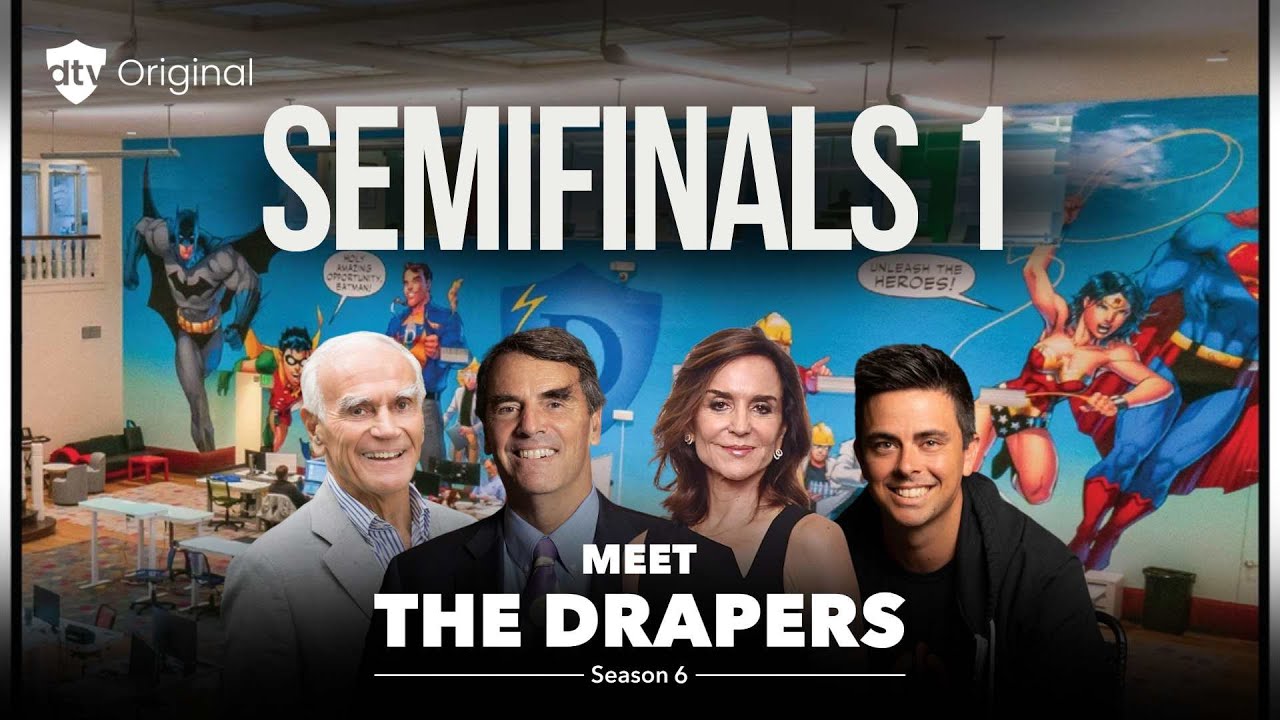
The episode is a reality‑competition segment hosted by billionaire venture capitalist Tim Draper and his family (Bill, Adam, and Polly Draper). Thirteen semifinalist startups from ten countries across six continents are introduced and pitch their technologies to the Draper judges for a chance to advance to a Silicon Valley finale and win a $1 million grand prize. The show opens with a montage of iconic companies (Tesla, Skype, Hotmail, Coinbase) to illustrate Draper’s track record of backing transformative ideas. The judges each explain what they look for in founders – energy, enthusiasm, global impact, and scalability. Behind‑the‑scenes footage shows the entrepreneurs arriving at Draper University, sharing personal motivations, and interacting with the judges. Each startup delivers a concise pitch: 1. Spectrify.ai (Sri Lanka) – AI‑driven spectral analysis for food quality, already deployed with major tea producers, claiming massive cost and time savings. 2. TakaDAO (Saudi Arabia) – Sharia‑compliant, blockchain‑based cooperative insurance platform targeting the under‑insured Muslim market. 3. Gather (Brazil) – AI‑powered workplace safety and productivity platform using camera‑based monitoring for manufacturers. 4. Zeal (Egypt) – POS‑plugin that extracts transaction data from card terminals, enabling merchants to build customer profiles and loyalty programs; early revenue and contracts with major manufacturers. 5. Airflight (Denmark) – Heavy‑lift, autonomous drones for wind‑turbine maintenance, with EU regulatory approval and a $1.5 M raise. 6. Bonvi Aero (India) – Heavy‑lift electric aerial vehicles for logistics, secured a $20 M Indian Army contract and a $600 K pilot order. 7. Additional entrants (e.g., Rufo’s Gather, other drone teams) are mentioned. The judges probe each team on technology feasibility, market size, unit economics, revenue models, team composition, and valuation. Valuation figures and funding rounds are disclosed (e.g., Spectrify pre‑seed $300 K SAFE at $5 M cap, seeking $3 M at $15 M post‑money; Zeal post‑money $11 M; TakaDAO seeking $15 M at $4.5 M post‑money). Throughout, the Drapers emphasize the importance of cultural diversity, global impact, and the entrepreneurial spirit. The episode ends with the judges deliberating, expressing difficulty in choosing, and hinting at the next steps toward the finale.
Chapters
Tesla, Skype, Hotmail, Coinbase. What do these revolutionary companies have in common? Billionaire venture capitalist Tim Draper, who invests in big ideas before they become the next big thing. Now he's traveling the globe to find game-changing startups. Entrepreneurs from 10 countries and 6 continents will share their ideas for changing the world. changing the world.
There are some entrepreneurs everywhere, and they all have a different approach, and those cultures bring more creativity.
Then 12 finalists will fly to Silicon Valley to compete for a once-in-a-lifetime chance to launch their company on a global scale.
100,000 units.
But only one can walk away with the grand prize— $1 million.
It's go time.
This is a true entrepreneur here.
Meet groundbreaking technology.
We've built Denmark's first flying car.
Meet rejection.
I've seen 15 of these.
How are you going to be better?
Meet innovation.
The blockchain is built for trust.
The sky's the limit.
Meet the Drapers.
We've got the semifinalists here. We have scoured the entire world.
Taiwan.
Kenya.
Canada.
India.
Denmark.
Germany.
Hong Kong.
Egypt.
Saudi Arabia.
Sri Lanka.
Brazil.
For these 13 entrepreneurs.
Everything in my life brought me here. I'm sure that we are going to win. Welcome to the It'll be grueling.
It'll be rough, horrible, scary. It'll be tough.
We're gonna give it everything we got.
They've been vetted from all over the world, from thousands and thousands of entrepreneurs. The winner is— get it! Talk it out! SpectraFi AI.
ZealPay.
Airflight.
Bibi!
Inshallah, we will win the final.
We are down to these 13, and we're gonna be moving 3 We should be backing all these guys. Welcome back, everybody, to Meet the Drapers. We are so excited. We've got the semifinalists here. We have scoured the entire world, all over the world, for these 13 entrepreneurs And you get to see them. But before we bring them on, I'd like to introduce our judges. And our judges are not guest judges. They are actual Drapers. All 3 of these judges are actual Drapers. As you know, we've adopted many Drapers. Gurudev Sri Sri Ravi Shankar Draper, Cardinal Turkson Draper, Joe Montana Draper. And now these are the original Drapers. On my right, we have the original, the OG, Bill Draper. He has done amazing things. pioneer of venture capital. He ran UNDP. He ran the Export-Import Bank of the US, and he was the first venture investor going into India.
And first investor in Skype.
That's our ongoing discussion. Dad, welcome to the show.
Thank you very much. I'm delighted to be here.
And on my left, troublemaker Adam Draper. Adam runs Boost VC, the venture firm. He's got the biggest deep tech accelerator in the world. Adam, welcome to the show.
Thank you so much for having me back. I've been on a few of these episodes and I'm glad I got invited back.
It took us a while.
So thank you.
And on my far left, but actually in deep space, we have Polly Draper, the actress, director, producer, writer. Polly, welcome back to the show.
Thank you. I was going to be there in person, but I unfortunately have Oh, that! But I wouldn't miss this, so I got out of my COVID bed to meet all these incredible entrepreneurs.
Totally worth it.
Totally.
What are you guys going to be looking for in these entrepreneurs? I mean, these are 13 vetted from all over the world, from thousands and thousands of entrepreneurs. We are down to these 13, and we're going to be moving 3 to the finale.
When I look at entrepreneurs, I'm always looking for enthusiasm and energy. I'm just gonna— Oh, I like that. I'm gonna be looking for good opportunities and a great personality.
Excellent. Polly, what are you gonna be looking for this time?
I always like to look for the entrepreneur that feels like they're going to be helping the world the most. And I know that they may not necessarily be the one that's making the most money, so that might be defeating the entire purpose of this, but I think that that is my goal.
Well, those things usually go hand in hand, So you're in luck.
I think they do.
They usually do. They make money if they do really great stuff. Dad, what are you going to be looking for this time?
Energy, which you mentioned, and can I imagine working for this person? Is it a crazy idea or is it manageable?
You've clearly had an impact on me and a big impact on Adam because Adam wrote the book Breakfast with Pops, and you can get How to Be a Startup Hero, the book I wrote, And Dad wrote the first of these books, and it's called The Startup Game. Hey, so we turned this into an advertisement.
Are we finished?
Okay, that's pretty much all we need to do except for there are 13 entrepreneurs that we would like to see. But before we do, let's see what's going on behind the scenes. And this is where the Draper eyebrows Hey guys, we're in Silicon Valley.
We're at Draper University.
Follow us.
Like, let's do it.
We have bunk beds here. We have a great view of San Mateo. Best view, actually. You know, don't tell anyone.
We're here for a home run.
Here for a Hail Mary.
Who's going to be most proud?
One is like we'd be personally proud of ourselves because I mean we were up against COVID crisis to economic crisis to you name it, we had it. So just to get ourselves here, like that in itself was like problem solving. So we'd want to like, you know, probably pat ourselves on the back for if we achieve a certain level of success.
You know, we work extra hard, we keep focused, and we keep, you know, plugging along. But I think Spectrify is really something we both believe in and we want to take Global, and I think we knew that it would take our commitment and our time, and we're ready to put that in.
I mean, it's something we're passionate about, right? So for us, yes, it's work. I mean, it gets tiring sometimes, but it's not the same psychological impact because we feel like every, you know, move we do forward has like a multiplier effect down the line, and we are like part of a program which is bigger than ourselves, that is to change the world and make it a better place.
It's really to create an impact in the world, and I really want to drive this, and we've been doing it for the last 2 and a half years, right? So we really want to take it forward. This trip has really taught us think like global. Even though we say it, our mindset was very much what can we do in our backyard? And you know, coming to Silicon Valley, we now just see like so many possibilities.
Hatch, which is like where we are based out of the coworking space, it'll be a success story for what we're doing, what we believe in. I mean, the broader ecosystem in Sri Lanka and our friends, family, and our well-wishers, I feel like would also be.
part of it.
I think the community will be super, super happy. My wife, Brenda, I think she'll be super proud and grateful. And I also just want to say my granddad, who's probably looking at us down from heaven, is, is going to be happy too.
Yeah, we have a good feeling about this.
I hope we're going to win this.
Okay, let's hear from our Our first semifinalists here from Sri Lanka. This is Lakshan and Jeevan from Spectrify.ai. Go ahead, give us your pitch.
It's a lot of work to get here, like in Silicon Valley talking to legendary venture capitalists. This is a dream.
The economic and environmental impact of food loss globally is close to $1 trillion and 3.3 gigatons of carbon. We need a better way to look at our supply chain and understand quality better. This is where Spectrify.ai comes in. We can look at quality parameters understand contaminants, look at pest and disease, and also ultimately flavour and taste. And we do this across the supply chain to improve efficiency, taste, and quality. We basically use spectral analysis, which understands the chemical profile of the food. And by marrying both the physical and the chemical characteristics, we can say about 80 to 90% of what you require in food. We are building the world's largest AI/ML platform for food. Our technology works across multiple standards where we've already Created significant traction is in the tea industry, where we've put the largest tea companies in the world on our platform. What used to take six hours, put it down to three seconds, and we've made it two hundred times cheaper. What's the most rewarding thing is we've been able to create impact for one million lives directly and directly in tea, and we're able to increase our industry by two x.
Are they paying you? Yes, we're starting to pay the tea companies.
The tea companies are starting to pay us.
Terrific.
And yeah, I mean, we have great unit economics. So as you can see, it's a very scalable model. We have LTVs which are very lucrative at present. And then on top of that, what we're trying to do is build up our B2C funnel. And we're also raising funds to go into different value chains like wine. We're focusing on coffee because we feel like the application is just not for tea like we used to use as a testbed, but we're looking at other avenues as well.
So you've built the hardware and the software that can analyze the tea?
Yeah.
Yeah.
And can it analyze wine and beer too?
Yes.
Now, is your third founder the tech guy? Is he full-time?
He will be coming full-time once we do the fundraise. He's based out of New York. He's an adjunct at Columbia.
How do you divide up your work between the 3 of you?
I'm the tech person with an AI/ML background. He runs operations.
Who is the CEO?
Who's the CEO?
We're actually in the process of hiring like a CEO.
Ooh, no leader.
I'm the CEO. I was still kind of running like CEO back then as well. It's just that I didn't want to put myself out there because in Hatch my role is to encourage other entrepreneurs. So I didn't want to put myself as CEO and compete.
How do you two know each other?
We're from Sri Lanka. That's the caveat. So both of us have been in the startup space like for the last 10 years. We've worked together on other projects and then we realized, okay, we have a good chemistry going on, so why don't we like, you know, tackle a problem Can you show me how do you make a tea bag or a wine bottle show its contents?
I don't get it.
It shines light at a particular wavelength, and from the reflection of light back, we understand something about the chemical profile. So you can understand, for example, in tea, the caffeine levels, which leads to bitterness taste, or you can understand the moisture levels, the level of fermentation, the amount of sugar.
By doing what? How do you do it?
Hold it next to the whatever you're studying. It sends a reading to your phone. So this is like a sensor.
Your wife runs Hatch, and that is a great incubator. And you've been exposed to hundreds of companies.
I'm a serial entrepreneur.
Funded a few. Why this one? And then if this one, will you be here just for a little while while you launch it?
Tim, I—
Or are you going to be full-time?
I'm going to be full-time.
As a serial entrepreneur, how do we know that you're not going to just hop to the next one?
I think what makes this relationship work is the mutual respect for each other.
Exactly.
Like, you know, we know that we can take the company forward together.
These are like marriages, right? I mean, it's not like for a year or two, it's like 10 years, 15 years. So you have to start like with full disclosure.
I truly believe that this is going to be a globally impactful company. To do that, I'm 100% dedicated to this if I can take it and scale it globally. So 100%, I will be there. What were your last preneur Sri Lanka's largest IT park, grown it from 10,000 square feet to a million. One of Sri Lanka's first high-density data centers. So I'm a serial tech entrepreneur.
All right, thank you. Spectrify AI, good job.
Thank you very much.
Thanks.
So relieved pitching to like 3 generations of pioneers of venture capital in this world. It was an exhilarating experience.
And we can say we did it, so we'll always keep that memory.
Yeah, it's like, you know, one for the road.
Coming up on Meet the Drapers.
How do you know that this is gonna sell?
Um...
Welcome back to Meet the Drapers. Hey, let's see our next entrepreneur. But before we do, let's see what's going on Behind the scenes.
So the story with the chair, TechCrunch said if you want to rent a chair for 3 days, it's $150. I was like, uh-uh, I'm bringing this chair.
We moved to Middle East 20 years ago from California. Coming again, we see that the vibe is quite amazing. As entrepreneur, you connect with your own local ecosystem, and you know, your ecosystem is as big as whomever you know. We got to meet people from all over the world. So you see all this vibe actually that's quite interesting in Silicon Valley that is really unique to the region, really inspiring.
Doing this actually is a morale booster for us, obviously, but even more so for the team. Even just being a part of it, it makes the team proud and they understand that, okay, it's not just us who believe what we believe, but there are other people who do believe what we believe too.
If we go to the final and we We win the final, of course, that makes all our community, especially back home in Saudi Arabia, people are looking for startup buildup from the Middle East and shining to the world is something that Saudi are pushing. So it's great to see that. And of course, that makes us happy to bring the trophy back to Riyadh if we have to do that, you know, and to show the world that we can really build technology in those regions and globally.
Insha'Allah, we will win the final. We're a very good team, so I'm not really worried about it.
I'll be sitting next and try to support.
Need some coffee.
All right, let's hear from our second entrepreneur coming from Saudi Arabia. We have Takadao, Shireen, and Murad. Give us your pitch.
It's really exciting to be able to pitch in front of literally 3 generations of entrepreneurs. So I'm really excited to really be grilled by those, I would say, 300 years of talent.
Billions of people around the world are underinsured because life insurance is either too expensive, not available, and in the case of the Muslim, impermissible in our religion. Takaadaw is a Sharia-compliant cooperative insurance platform that allows people to pool their money together mutually insure one another. We use the blockchain for transparency and DAOs for governance. Tekkadao is decentralized and community-owned. Because participants share in the risk, they will also share in the profits. The underwriting surplus is not the profit of the insurance company, rather it is distributed among the participants. The blockchain and cryptocurrencies enable global access for the unbanked, and we use Stablecoins for insurance payouts as a hedge against inflation in countries with failing currencies. Takedao is a global—
Could I make a suggestion?
Absolutely.
If you're going to be the spokesman for the company, you've got to show your whole face.
So I was a little bit like, um, and then I realized I was I was like, you know what, this old guy is really cool because, you know, he's just calling out the elephant in the room. Lots of people wonder, they're like, why is this woman here with this veil? Why is she dressed like this? Nobody will ever ask, right? But it's good that you ask. It's good that you, you engage because then I get an opportunity to explain why I do certain things, and that helps us bridge the gap. Well, this is my religion. This is who I am.
I know that's the— I understand why you're doing it, but could you ask him to be this Absolutely.
We are partners.
I think it'd be much more effective.
I appreciate that.
Actually, she's pretty good.
Honestly, I have to say something. I have to say something. I think you're remarkably effective. And I was thinking how hard it would be for a person of our culture to be able to be so animated, filled with expression in what we would consider to be A hampered situation.
Okay, well, they outvoted.
But you're outnumbered. No, but I do want to address that.
Say yes to the women.
Tim jumps in and he's like, I think she's doing a great job. And then Polly jumps in and she's like, I think she's excellent and she's able to be very engaged despite wearing this, etc. I was a little surprised at first. At the end of the day, I was like, you know what, I love this guy. This is a cool old dude, he's just saying what he thinks, and it's fantastic. I do want to address that because it is, it is a thing, and we understand that. But we also do understand that our market is the developing world, and that is the majority of the world today. Just the Muslim population alone, that's 2 billion people. And we also are the fastest growing population in the world.
How do you know that this insurance program is gonna sell, that people are gonna want to do this.
The thing about insurance, the system is fundamentally broken. The insured has to lose for the insurance company to make money, to profit. So what we're building is we're flipping that on its head and we're saying we're gonna be community-owned. People, they feel it, they believe it, they want this. Not only is it more fair, more just, but they don't have it today. They don't have insurance in the developing world because insurance companies don't make money when they go to those places.
Modern insurance, basically, they don't cater to undeveloped nations. It's too expensive for the AXAs of the world to come there and to deploy a contract. And actually, the demand is very high, very high in those Muslim-majority nations. So they're looking for only one thing: making it acceptable to their beliefs. And that's what we're doing: removing uncertainty, gambling, and interest. When you remove that, and you put the community together, then you have a winning product.
How far along is it?
We should launch completely June of 2024. Insha'Allah.
And the crypto world, basically people who adopt to the crypto space, there are 2 types of categories: the have and the have-not. The less fortunate are getting into crypto. Why? Because it's a necessity. There's no bank, no payment, nothing. So they go right away into the crypto. So the first time in the world we have this have and have-not coming together, and that's beautiful because we can build technology that can combine people together.
But the poor would put in $10 a month, and the rich will say, I want to put in a million dollars Those 2 things don't come together in a—
This is why the token is so cool, because if you put in $10, then your benefit is going to be $10 times your multiplier, which for a young man like Adam, say, would be 200x. 10 times 200, he'll get $2,000. Now, if you put in a million, then it'll be a million times 200.
No, but won't it mess up your business if there's somebody who puts a million in?
So this is where the underwriting comes in, and this is the cool part, right? So we have an algorithm that powers the underwriting model, and this kind of balances things out. Stuff out. So we actually try to even it out so that young people don't get an overly high benefit multiplier and the old people don't get one that's too low.
Terrific. Well, thank you so much for coming on Meet the Drapers.
Thank you.
We're thrilled to meet you guys all.
Yes, thank you.
We're glad to have you here.
Thank you.
Bye-bye.
I just really liked him. He's such a nice guy, and I think we connected. He's traveled around the world He's traveled so much and he sees, you know, how the rest of the world lives. And so he has this very global context. That's what we're trying to build for.
Okay, so let's bring on our next entrepreneur. But before we do, let's see what's going on behind the scenes.
Bay Area is amazing. All of the vibe here, people around, all of the preparation, the time to, to get in and do this competition is awesome. Life is about what we are doing today. Today is the most important day in life. How the people look at us and remember us and see The things that we are doing. Innovation for me, entrepreneurship for me, is about people, is about all of this transformation movement. Being an entrepreneur is about putting your life, your dreams, all of your energy and time in a way to generate impact and transformation. My daughter of 11 years old is waiting for me. in Brazil, and this is awesome. Sarah, I love you, and you inspire me on all of that I do every day. Everything in my life brought me here. Let's do it.
All right, now let's hear from our 3rd entrepreneur. This is Gather from Brazil. Let's hear it for Rufo. Come on, give us your pitch.
I have energy naturally. When I go to an important stage like that, it explodes. It's where the show happens, and it was magic. I came from Amazon, the middle of the forest in Brazil, to introduce Gather. Millions of people die every year in accidents in workplaces, in manufacturing. We work with some of the biggest manufacturers in the world, not just work with safety but with productivity. We detect using cameras and we point, we detect, generate notifications, alarms, and indicators through a continuous improvement based on data. We are bringing data to power to boost industry and manufacturers. That's our big purpose. Recently, we plug cameras over the lines to count in productions, and if the line stops, we generate alarm. To worker justify why it stops, generate data, track record about these inefficiencies, and improve continuously. We don't watch just the production, the products, but people. Behavior is something very important in industries. Sometimes the worker makes deviations of the process, is out of the workspace, and we look all of this all the time. And now we are in Amazon for 2 years. We love that place. We created together with Brazilian—
Why is that the best place? Place for you to run this business out in the middle of nowhere.
I love Amazon. Not all of the people understand why my headquarters is in the middle of the floor.
What is he doing in Amazon? Because we have 600 companies there, but like thousand companies all over in the south part of the country.
But there is a purpose, and it's about the human future. We have three simultaneous. Projects with the government to bring AI to local communities and generate a huge impact. Our team is worldwide. We are a distributed team.
So your biggest customer is the government? Is Brasilia?
Yes, they are funding our strategies, creating solutions, AI for the floors to prevent, to map. And we are looking to blockchain each tree classified by AI and connect with a green coin to That's on our roadmap.
Is this something that's about getting the workers to be more productive, or is this something about getting the workers to be safer? Because it starts feeling a little Big Brother.
I'd like to make it more clear for her that we watch the people for their well-being when we work with People, their rights are the priority, and tech is the way to provide more safety and well-being. We are looking for safety and production simultaneously.
So you have a charge for this?
You charge the company for this service?
Yes.
What's your sales volume?
We grew five times since our last round. This year, close to one million dollars of revenue. We have around. 30 people in the team, and now we are preparing to expand our business to the USA.
Is it just going to be a SaaS business for the government? Is it going to be a SaaS business for corporates? Or is there something you can do for the end user?
We have 2 arms: SaaS for industries and SaaS for the government. Government wants to take care of the forest and the environment, and the industries want safety and performance.
When you go into a company, hat in hand, you want the order. What do you ask them for?
We connect our software with their cameras, and their cameras start to be alive and intelligent cameras. If the worker puts their hands in a risky area that can get an injury, an accident, we power off the machine. The camera is watching. Hey, why stop your production line? Do something. Justify it. We learn the main problems in the production line and we do a kaizen, a continuous improvement.
What's your background?
My background is in tech and software, more than 25 years. The most part of this in entrepreneurship, more than 4 or 5 startups, failed some, okay? But I'm a tech guy managing business and tech guys.
Terrific. Well, Rufo, thank you so much for being on Meet the Drapers. We're happy to have you here.
All the best. Terrific. Thank you.
Bye-bye.
When you finish, relaxed. A program like this is about to create relationship, friendship, and I'm loving all of this. Now, time to celebrate. Coming up on Meet the Drapers.
We've got to figure out who goes on to the finale. Welcome back to Meet the Drapers. Hey, let's see our next entrepreneur. But before we do, let's see what's going on behind the scenes.
You're you're you're gone.
عمر يا مجنون.
You're so close to winning the million dollars.
There's a lot that an entrepreneur has to go through to reach this level. At this stage, pitching to Tim, it's a no-brainer to any investor. It's a no-brainer to anyone. I feel like we're in a very, very lucky, grateful position to be in. So I'm very excited. I think the timing is perfect. My family is super proud of me being here. One of the main motives of me actually doing all of what I do is being an inspirational figure for my nephews and nieces, and I think it's super important for kids to have like a role model figure, and I try to do everything to the best I could just to be an inspiring figure for them. So in that case, I think even the kids are very proud to see me here, and I think that drives me as well. If we win the million dollars, it just adds more fuel to the tank, just makes sure we got more money in the bank, turn that million into $100 million, turn the $100 million into a billion dollars. That's what I'm here to do.
I'm sure that Omar is going to nail it. He's always done that for us.
We're looking forward to getting the backing of the Drapers.
This is Omar from Zeal, and he's from Egypt. Omar, go ahead, give us your pitch.
I walked on the stage, I was very excited. I was very much looking forward to At the end of the day, my goal is to turn this into a unicorn. Whenever you pay on a card machine, the merchant has no idea who you are. If you compare that to ecommerce retailers, you always put your name, your email, your address. So why is it that the ecommerce retailers can get this data but not the physical retailer? We've developed a smart plugin, a piece of software that integrates on card machines worldwide. We've actually signed the world's largest credit card machine manufacturer in China. And they're actually sponsoring this pitch. Signed Worldpay to launch with them in the States. We're basically— our vision is to—
What are you holding in your hand?
This is a card machine, sir. You can have a look at that.
That's the credit card machine, and it's got access to $40 million.
Yeah.
So are you pulling data off this machine?
Yeah, exactly, sir.
And then you're aggregating that data and giving it to the retailer?
Absolutely. And it's all GDPR compliant. It's basically, if you think about it, we're giving the same data that the e-commerce retailers have The beauty is we don't do any merchant acquisition. We go to the likes of Worldpay. They tell us we have 1 million terminals on the ground. Boom, we launch an over-the-air update and we're on those 1 million terminals.
So it's like one of those things that if you're online and you buy something, other people know that you bought the same thing applies in a store.
Exactly. And if you think about it as well, let's say I'm a coffee shop owner. You come in, you pay on the card machine, you leave, you don't show up for 2, 3 weeks. I don't know who you are after you leave. I'll be able to start reaching out to you, etc., etc. So there are so many use cases.
You build a social network? Like, you know that Polly and her friend buy things together?
We call that correlations. So we're definitely building a lot of correlations, and we use AI to predict consumer behavior.
Is your business model B2B2B2C?
Yes, exactly. B2B2B2C.
Okay.
So you sell to the merchants, the big distribution networks.
Exactly.
And for them, it's a new revenue stream. We get an 80-20% revenue share with them. Because they want to get a revenue stream other than the transaction.
How many of those are there? How many companies make up the $200 million?
Thousands. There are so many payment facilitators and PSPs and so many companies.
So Ingenico is the biggest with $40 million.
Ingenico is the card machine manufacturer. So normally how it works is you have the card machine manufacturer and then you have the regional distributors and then you have the WorldPays and the network, which are the acquirers. We literally deal with the whole value chain and we're a new revenue stream for all of them. I feel like we had a very good energy with the judges. I'm genuinely excited for this inflection point at Zeal, and I was glad that I could pass that energy on to the judges.
Does Square already have this?
So that would be one of our partners. So that would be someone we would work with to integrate with. That falls under—
Why wouldn't they just— they want to take over everything. Why wouldn't they just do what you're doing?
All of these terminals are sending notifications or SMS to download the Zeal app. So as a consumer, whenever I pay on a terminal that has Zeal integrated with it, I can see all my transactions, my e-receipts, my points, everything. So eventually we have this platform that has literally millions of users on it.
What kind of stores do you find yourself in more like?
So actually the clothing stores. I'll give you an example, Harrods in the UK. Harrods has their own loyalty app and they have their own e-commerce, but if you go to Harrods, pay in store and you don't use their loyalty app, they have no idea who you are. So what we do is we link their loyalty app with their card machine. In that case, we white label our API. We find ourselves in petrol stations, in pharmacies, supermarkets. It's everywhere.
So what got you started?
So I went to Ingenico in the first place to buy card machines. Like, I was going to set up my own card payment facilitator. Yeah, they were like, show us a demo. They literally challenged me. I was like, sure. They told me, we don't want to sell you terminals. We want you to integrate on all our terminals worldwide. And so from that, we had a huge pivot. We became a plugin. We literally integrate on any card machine. This is my first fintech. I think there's a lot behind this, sending a message to Egyptians and people in the Middle East. That's what drives me, to be honest.
Are you getting paid now? Do you have revenue?
Yeah, we, we have very early stage revenue, but the investment we got was on the back of the contracts. Currently, we, we make around $10K MRR But honestly, the whole value is in the contracts we have.
Great. Well, thanks for being on Meet the Drapers.
Thank you, man.
Thank you.
Thank you.
Great to have you here.
Thank you. I think overall it was brilliant. This is the kind of startup you want to back before it literally hits that inflection point. And I was glad that I could pass that energy on to the judges.
Okay, so what did everyone think? Think we had SpectraFi AI that did quality control on food and tea and any other agricultural thing. We had Takadaw Insurance Company for Sharia compliance. We had Getter, the program that evaluates people and what they do and how they operate. And then we had Zeal, program with a point-of-sale terminals. I'm still torn, but we've we've always got.
Really great decision-making algorithm.
It is.
Let's bring them all out.
You know, we've got to get a picture of these new guys. I should take a picture of us here.
All together.
You do.
Anybody got a camera? I'll do it, Brad.
I'll do it.
So now we have the entrepreneurs here. Will it be Spectrify AI? Will it be Takadao? Will it be Getter? Or will it be Zeal? You know, we're really torn and we've got to figure out who goes on to the finale.
Getter, what's your valuation for this deal?
We did our first round of $300K multiplied by 5, our revenue. Now we're looking for $1 million to multiply by 10. Our valuation is open to negotiate between $10 The most important is growth together.
Spectrify, what's your valuation?
We just did— finished our pre-seed round at $300K, so we're looking to raise $3 million in 6 to 9 months. We were looking at a valuation of $15 million post-money. More than money, we'd rather— we like partnerships.
What was the valuation of the $300K?
The $300K was a SAFE at a $5 million cap.
Zeal? What's your valuation?
We're at a post-money valuation of $11 million.
How much money has come in so far?
We've actually just in the middle of closing the round. We've received in total $3.9 million so far.
What was the valuation of that? Was that all $11 million?
No, it was different stages, but that last funding round was $2 million at a post-money of $11 million.
TakaDAO, what was your valuation on this deal?
We just closed a pre-seed round, $1.6 million. We're looking for $15 million for a $4.5 million post-money.
What are you offering?
So in about 6 to 8 months, we'll start raising again, and we're hoping to raise $5 million. Hopefully at that time it'll be around $15 million.
Terrific.
Thank you all.
We're really struggling, so we're gonna have to go to the crystal ball. Ooh, yeah. Sham, yeah. I'm not gonna— and it's Takadal. Moving forward. Congratulations, you move forward. All I can do is fist bump her, but I can hug him.
You should send that picture to all of them.
Coming up on Meet the Drapers.
We have been put against another drone company.
We make a heavy-lift drone, they make a heavy-lift drone.
How would you be able to compete with them? Welcome back to Meet the Drapers. So I'd like you all to notice that Adam and I happen to, without talking to each other, happen to wear the exact same Bitcoin socks. Dad has dots on his socks. It's just a thought.
I'm not wearing socks.
And Polly is not wearing socks or shoes. With that, let's bring on the next entrepreneur. But before we do, let's see what's going on behind the scenes.
Hello, Travis.
When you look at all of the competition, there's a lot of really strong startups here, especially for 2 competitive people to not focus so much on the competition and focus on what we can do for ourselves and what we can control and just go out there and perform the best that we can. But a lot of respect for the other startups. Because there's some, there's some extremely good companies here.
We know what we're bringing to the table, and we're very confident in ourselves. We thrive in the competition. Winning this challenge here and going to the final and winning the $1 million, that would just prove that the resiliency that we've had throughout this journey is getting rewarded.
Being on a show with a chance to win a million-dollar investment with a world-class family, it's an amazing opportunity. At the end of the At the end of the day, we're also— we're happy to be here. We're happy just to have the opportunity to be here, get our company out there, pitch, do the best that we can. So once in a lifetime experience. We're gonna give it everything we got.
We have Travis and Mikkel from Airflight based in Denmark. Give us your pitch.
It's a really exciting feeling to be able to pitch for Tim and the rest of the Draper team today, and it's gonna be even better doing it with my partner Miguel.
Oh yeah.
Airflight is disrupting the wind industry with a faster, cheaper, and greener approach to transporting tools and spare parts for service and maintenance with our revolutionary flying cranes. With a 450-pound payload capacity, our flying cranes can transport over 97% of all tools and spare parts in the wind industry today.
This industry is exploding with over 250,000 turbines These turbines, they're getting older and older by each year, requiring even more service maintenance. And that's providing us with a unique market opportunity because wind is the first market that we're penetrating. We plan to sell these drones and then maintaining them. Since we met you last time, Tim, we raised over $1.5 million, gotten the regulatory approval to fly within the EU, both onshore and offshore, done numerous customer demonstrations at our test facility. Not only do we have a great product, We have a great market that's growing year by year. We have a great product that is also developing in the world, as we know, with drones. But I believe that we have what it takes to have the resiliency and the willingness to push through even when it gets hard. And as you know, hardware, that is hard. Thank you.
So you said $1.8 million a year in value.
Yeah.
What does it cost for you to make the thing?
About $300,000 approximately, selling it for $650,000. This accumulated savings It's something that needs to be here in the beginning, split it out between us, the end customer, and a service provider.
You just sell these things and maintain them.
Yes, exactly.
You're not going to rent them to people.
It's a very complex thing to grab a hold of. To be fair, the judges had a hard job because we had a 2-minute pitch with 1 minute of explaining why we should be the ones they should pick.
That is something that we're open to going further into the future.
Seems like it makes the most sense.
Right now, regulatory approvals, they are providing a scalability problem. because of operators being attached to the drones. But once we go into a regulatory approval where we can have autonomous operations, then we can go fully autonomous, and that takes out the scalability problem of the operators. And there we would like to provide a service.
How do the two of you function? What's your job and what's your job?
We both wear a lot of hats being entrepreneurs. I'm focusing more on the commercial side, and Mikkel in the beginning was more product-focused, but now we both work together commercially.
Commercial side, meaning you're the sales guy. Is that right?
Yeah.
And who's the CEO?
I am.
Is this the most powerful, like, drone in the world?
The drone market is exploding right now, especially within defense, but we are out of a handful in the world that has something this powerful.
Yeah, if you're not counting military, then we're doing pretty good.
When you say that, what do you really mean? Most powerful in what way?
Once you go up in the scale that Airflight is in, then it's much more similar to a helicopter than it is to a small plane.
The drone is operated by who or what? It's a computer that oper— you said until we get the operator regulation.
What I mean by that is you have to have a pilot that is controlling the drone, but moving into a more autonomous world, you would have one operator that essentially sits with 20 screens, and then he can essentially control numerous drones.
Why wouldn't it be cheaper to just build a drone that can fly itself? put a pulley at the top of the wind turbine and drag all that stuff all the way up.
With safety regulations, you can never be in one place alone on these wind turbines, especially in the offshore environment. So 2 people have to go up, wire down, and then there has to be people below to connect it, winch up again. Then someone has to take the elevator down to pick up the person below and then up again. So they, they do use a crane that's in the wind turbine today, but it's an extremely slow process because of safety. So we can deliver it directly to the point of use, which saves tons of time.
You mentioned regulations kind of holding you up from being able to operate these things the way you want to. Can you come to America and do it in an easier way? And why wait around for regulations here when you can try it somewhere else?
We were a little too unclear to get the judges to really understand that we actually have approval. I don't think all of it came across 100% No, I would not say that you can do it in an easier way in the States, but the European Union and the States are actually working very closely to kind of synergize both drone regulations but also aviation regulation with the flying taxis and stuff like that. We are trying to take it stepwise so that we can actually generate revenue with the regulation that we have approved today. But as I said before, we want to move into a more automated world And that is coming, but it takes a little bit of time. And I project that within 3, 4 years, you have the first draft of the regulatory approval.
Now you need a technician to be at the top of that windmill, right? You can't do that all automated.
Yes.
Yep. We're actually the only company in the world that we've been able to find that has a pick-and-place payload mechanism. So we can both autonomously drop off the payloads and we can autonomously retrieve the payloads. And we don't see anybody else on the market doing that.
Thank you very much for bringing Airflight to us.
Thank you, Draper. All right, we're gonna win.
And come on, we make giant drones. That's cool.
What's not?
Giant drones are cool.
Let's bring on our next entrepreneur. But before we do, let's see what's going on behind the scenes.
¿Qué sería de la isca happy? रंग जाऊँ जो मैं हाथ लगाऊँ। This is our first time to Silicon Valley. We are really excited. After landing here, seeing the autonomous cars, the culture, the people, the vibrancy is terrific. We are here to explore the ecosystem and how we can bring in value.
We want to win this show and want to go back to India with lot of our friends, family who. Waiting for us to succeed.
Winning this competition means very strong validation of our vision. Definitely our families will be proud. We are putting a lot of hard work, and if we are here, we are not able to give time to our families.
It's a booster recharge to the entire team to get back to work and get to the next level of things.
Either we learn or we win. We never fail. So that's our mentality. We are really excited to meet the complete generation of Draper's family.
So our next entrepreneurs are from India, Bonvi Aero. Sacha and Gaurav, give us your pitch.
Meeting Polly Draper, his son Adam, and then Mr. Bill, they have seen tremendous startups. If they can guide us, also mentor us, it will be very valuable for us. At Bonvi, we aim to democratize aerial mobility to the masses. We are developing heavy-lift electric aerial vehicles for goods and people mobility. We are the only company in India to clear a technical trial of procurement of 163 logistic drones by Indian Army. The order amounts to $20 million, and we have received 50% advance for our previous 3 units of order amounting to $600K. And later—
Wait, what was that $600K thing?
$600K for our 3 units of logistic aerial vehicles for 50 kg platform.
But you said $20 million was the order and you got half of it.
For the twenty million order, we cleared a technical trial last month.
I see.
So it's still out there.
It's still out there.
We just haven't got there yet.
No, they're right there.
And the six hundred K is an order you got.
Yes, yes.
And it's for three machines. What do those machines cost you to make?
Less than a hundred K dollar.
So we have approximately healthy margin of forty percent. We have a unique capability of fifty kg class demonstrated at altitude height of fourteen thousand feet.
Fifty kilograms can be picked up.
Can be picked up.
Have you been flown? You have tested it.
Yes, we have demonstrated.
You guys were hanging on the thing?
Ah, no, no. We are hanging the goods.
Oh, I meant you. Did one of you hold on to it while it flew?
Now you're saying— you said goods and people.
Our vision is long-term vision is—
oh, long-term vision is people. Yeah, right now, right now we're just goods. Body less than 50 kilograms.
Who have you gotten the first money from?
The defense public sector unit.
The Indian Army?
Yeah, yeah.
Really?
Yeah. What did they get in return for it?
The drones. 3 drones.
Are there other competitors going after that $20 million order?
Yes, there were 5 of them, and we are the lone company who has qualified this technical trial.
And the thing you can do nobody else can do is to lift to 14,000 feet?
In terms of the performance, yes.
Because at 14,000 feet, and it has to go drop the payload, pick up another, and come back in the self-flying mode. Which this is the proprietary technology that we have as self-flying software, and it's it's all electric, right?
Yes.
So what's the range?
The range is twenty kilometers right now.
Twenty kilometers.
What has it been used specifically for? Dropping food and supplies to troubled war-torn countries that are hard to reach, or rations, ammunition, green vegetables, the army store supplies.
Is the Indian government investing heavily? In this general sector of defense?
Yes.
India just had a huge success. They landed on the moon.
Yeah.
But is that turning up the— are you getting more excitement?
India is a very growing market, one of the fastest growing economies, and also government is very heavily pushing the drone industry and the aircraft industry in India.
Space sector is democratized. Now drone sector, they are democratizing.
Huge push.
Huge push.
India wants to become a drone Hub of the world.
Now, can you sell these to the United States?
Yes, definitely.
Can you sell them to Pakistan?
So we need to, we need to be NATO compliant for this. We can't, we have, yeah.
You know, the guys who were on before you already have a 250 kg drone. How would you be able to compete with them?
That is not a competition for us right now. We have a very different use case.
The next platform for the 250 kg that we developed The technology that we are bringing is at the higher altitudes. The requirement, these are there for 50 kg class of drones, even at 200 kg also, which 250 kg are at 13,000 and above to 16,000, 19,000. Our active trial is going on for 19 such drones in the Siachen Glacier.
Altitude and weight.
Yes, the performance decreases by 50-60% of the propulsion system. We have flown in the Bay Area versus in the higher altitude, there's 50-60% difference in the performances. And we have a terrain follow which is embedded with a machine learning model.
Who's the CEO?
I'm the CEO.
And what's your title?
I'm co-CEO.
Leading co-CEO?
Yeah.
Oh, that's trouble. What if you disagree?
He takes the—
I take the call.
You win in a disagreement?
He takes the call. There is a very strong corporate governance.
How do you know each other?
From the college this last 15 years of working relationship. We were together in college where we built a satellite and launched with ISRO.
And when you disagreed, did he— he made the call?
Yeah, definitely.
You're okay with that?
Yeah.
We were not able to cover is the team part very good. Although we have some slides or we have some part of the presentation mentioning about the strength of our team, that I think we were not able to cover.
The 2 of you are a very small team for what you're trying to I think you're gonna have to add a lot of people.
25 people working with us. We're expanding to 100 people.
Are they in India or they—
India.
We are based out in India.
Sri Sri University is where we are based out.
All right, thank you.
Just wanted to say, definitely, if you are coming to India, welcome you to our facility.
Thank you.
Please do come. Thank you.
We were very satisfied that we have given our best, and rest is to the best wisdom of judges. We are very confident about it, and we were very satisfied. And we are already started focusing on what next we need to do.
Coming up on Meet the Drapers, we have been put against another drone company.
We make a heavy lift drone; they make a heavy lift drone.
What is your mission as a company?
Why does this matter to you? Is that going to be better for you long term?
We felt very confident.
We know what we bring, and that's why we're confident.
That is not a competition for us right now.
We're gonna win.
I I wish them very good luck.
That fucking sucks.
We've got to figure out who goes on to the finale. We're funding heroes!
For me, they were all winners, you know, to begin with. Entrepreneurship has no color, no religion, no border. So it's great to see this amazing diverse group, actually. Super happy to be the winner.
Just coming and seeing what's possible and what's happened in Silicon Valley for us just gives us More will and more purpose to to make it.
Yes, we're representing Spectrify AI, but we also feel like we're representing an ecosystem and a community that needs a few wins.
It didn't work as I hoped for. So if you believe on everything that we are building, let's go together. Let's go together.
I was very happy when the winners were announced, even though it wasn't us. Whether it's in Saudi Arabia or Egypt or London, etc. Everyone is working on amazing ideas all around the world. I was actually very happy for them.
I hope Tim will still kind of write some checks to those guys because they all deserve some help, you know, here.
Yeah.
Heroes and shakers, that's what we do. Only the Drapers.
More from Tim


He Sold His Car to Build This Startup, Then Pitched It for $1M 😳 #Startups #AI

This Startup Moves Your Crypto BEFORE Hackers Can Steal It 😳 #Crypto #Cybersecurity




15 Months Without Refrigeration?! This Startup Thinks It Can Go Global 🥥 #FoodTech #Startups



