Meet the Drapers Season 6 Episode 15: Finale
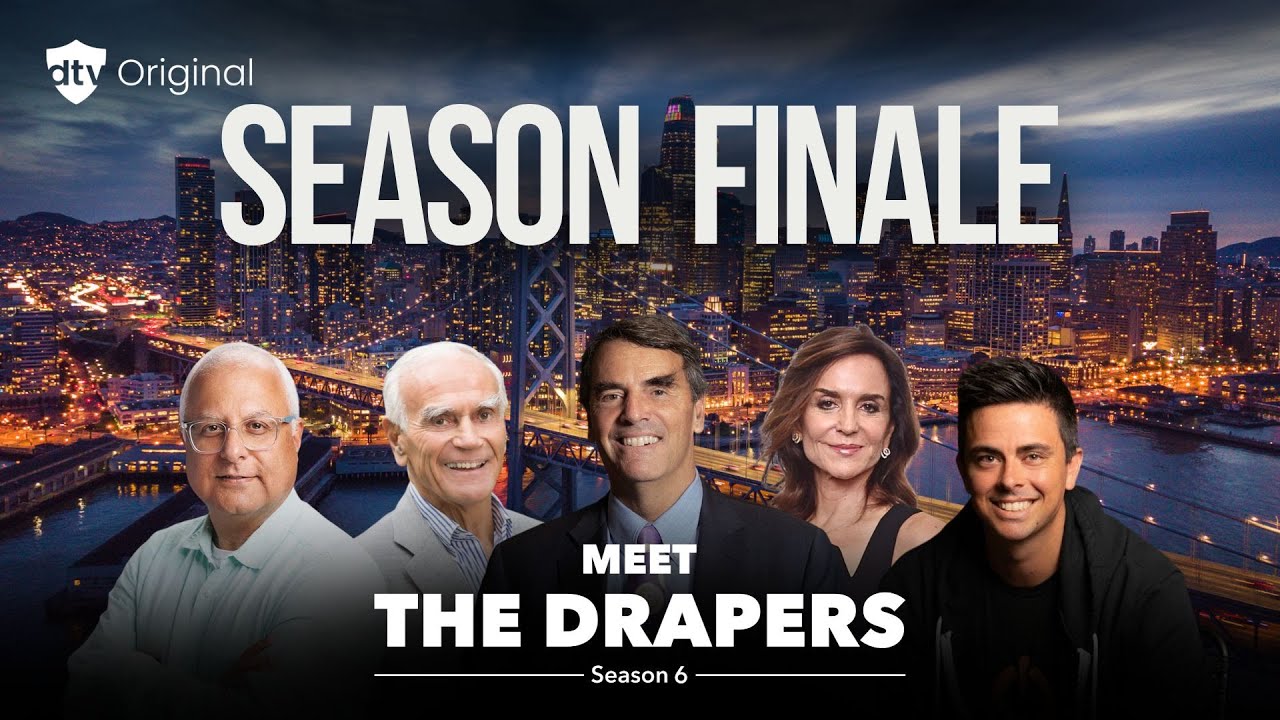
The episode is the grand finale of the global pitch competition "Meet the Drapers," hosted by Silicon Valley venture capitalist Tim Draper and his family members. Entrepreneurs from six continents present ten startups to a panel of judges (Tim, William Henry Draper III, Adam Draper, Polly Draper, Neville Tarapourwala, and guest judges). Each pitch covers the problem addressed, solution, market opportunity, traction, financials, valuation, and future plans. The startups include: BooPass – an African travel‑ticket platform digitizing inter‑city transport with a tokenised loyalty program; TechStream/DreamTag – a contact‑less patient‑monitoring device with FDA‑class II clearance; Tekkadao – a blockchain‑based mutual‑insurance platform for the unbanked; Renova – a no‑code neo‑insurance SaaS for traditional insurers; Voxell – a 3‑D bioprint tissue model for cancer drug screening; Paga Presto – a PSD2‑enabled behavioural credit‑scoring fintech; Bonvi Aero – an Indian heavy‑lift electric drone company for high‑altitude logistics; plus other finalists. Judges interrogate each team on scalability, competition, regulatory risk, revenue, valuation, and technical differentiation. After deliberation, judges allocate $200k‑$1.6M virtual investments via a "crystal ball" mechanism, resulting in a three‑way tie for third place (Voxell, BooPass, StreamTech) and a first‑place win for Bonvi Aero (renamed Fonviero). The episode blends on‑stage pitches, behind‑the‑scenes commentary, and personal reflections from founders about motivation, challenges, and future vision.
Chapters
Welcome to Meet the Drapers, the world's largest global pitch competition. This season, Silicon Valley venture capitalist Tim Draper travels to six continents and ten countries to find the next game-changing company.
We are officially in the game now.
The future of investing in Africa.
It's go time.
Introducing Bonvi, the business.
Carefully selected entrepreneurs from each region pitch Tim Draper and his VIP guest judges.
It's 5 cents.
It's 5 cents. Did you feel an energy there? I feel energy all the time. Mystery luck.
They all have a mission.
They're gonna have a lot of leverage. Tell me why you're different.
Uh...
The winners from each region travel to Silicon Valley for a chance to win $1 million.
They are ruthless. I don't even try. This is very depressing.
Let's see what we got here.
Which region will be crowned the winner?
Which region has the best entrepreneur?
We've built Denmark's first flying car.
The blockchain is built for trust.
Meet the Drapers!
Find out on season 6 of Meet the Drapers.
It's the big day.
All right, big day, big finale. I'm very excited. I can't wait to see these companies come through for us. We have traveled all around the world to find these entrepreneurs for you. And we've selected 3 of our favorite companies.
We should win this.
Let's get the $1 million.
It's a big number, isn't it?
Money's going out. And you, the viewers, have selected another 3.
We really need to take it back for Africa.
That's a lot of pressure.
This is like faith. I don't know.
And somehow we let another one come on board.
Here we are at the finale.
Entrepreneurs have to be pretty special to get past me.
Oh, geez.
This is the dream.
I'm getting emotional.
Everyone deserves to win, but I deserve it more.
The possibility of winning tonight is definitely something that is real.
I think we're gonna probably have a unicorn out of this group. I hope it's the one we invest in. Welcome to everybody to Meet the Drapers, the big finale. Very exciting. This is really amazing. And we've got 7 We have 10 amazing entrepreneurs that are coming on the show today. The quality of companies just keeps going up. Our guest judges have been from all over the world and really extraordinary, and we've adopted them into the Draper family. Gurudev Sri Sri Ravi Shankar, the grandson of the King of Saudi Arabia. We have had a beauty queen from Sri Lanka. We have covered the turf, and today we have— 10 amazing entrepreneurs. The most extraordinary guest judges that you will ever see here on Meet the Drapers. Four of us are actually born Drapers, and Neville has been an adopted Draper. I'm Tim Draper. I'm a venture capitalist with Draper Associates. This is Neville Tarapourwala Draper.
Boom!
Nailed it. And to his right, my sister Polly Draper, actor, director, producer, writer.
Bon vivant.
And mother of actors and writers and producers. Adam Draper runs Boost VC. He is an extraordinary venture capitalist, incubator, accelerator builder, and he also apparently has written a book. Adam, have you written a book?
I wrote a book and it's called Breakfast with Pops. It's about my journey through venture capital over pancakes and eggs with my grandfather, where we have breakfast every 2 weeks for the last 6 years and how much I've learned, learned about venture capital.
And speaking of Pops, Pops is what we call Mr. William Henry Draper III. My father was the administrator of UNDP, the head of the Export-Import Bank of the United States, one of the pioneers of venture capital. Dad, anything else?
Dad, one thing we don't do is brag. I'm happy to be here in this Elegant group, and I think we better get started.
And with that, let's bring on our first entrepreneur. But before we do, let's see what's going on behind the scenes.
Our journey has been interesting. So I did not even know anything about Meet the Drapers before I applied. It was just this poster on LinkedIn. We were one of the top startups from Africa to go to Italy to pitch. That was a very exciting experience, and just to win that was a huge validation. It was a huge confidence boost for us. Last year, we came to San Francisco to come to the semifinals. We did not make it.
Dream Tech, you move forward.
When we got the news that we'd been voted back in, definitely the whole team was excited. Even our client base, most of our clients are really the reason why we grow, and even breaking that news to them, they were very, very happy. Second chances are always difficult to get, so we prepped, revised our pitch deck, and prepped really to give our best and to take this back to Africa.
Our team is really keeping their fingers crossed. Our family and friends are really rooting for us as well because we really need to take it back for Africa. We are here to show people that the future is African. Boopas is going to uncover that.
Can't wait for us to take this back to Africa.
It's been a 2-year-long journey. Curious to see how it ends.
All right, let's hear from Sonia Cabra and Wycliff Omondi from BooPass.
Nervous about—
Investments. Hello, Drapers. We flew in from Africa, and we are here to tell you about one of the biggest untapped opportunities The opportunity to invest in movement of people and goods across Africa. More than 800 million Africans use intercity transport to move people and goods.
This market is undigitized, fragmented, and broken. And that's why we have built Bupass, the leading travel platform with over 16 million transactions. Our solutions give value to different players in the transport ecosystem. We have SaaS and point-of-sale for transport companies. We have consumer apps and USSD codes, as well as business travel solutions. We have sold over 16 million tickets. We are transacting over $3.5 million worth of monthly volume. And in 2023, we made over $890,000 in net revenue. We acquired our competitor based in South Africa and Nigeria that has also given us access to routes in 15 adjacent countries, literally making us the largest travel platform in Africa. It has also given us bank and telco partnerships. We got investments from Adaverse backed by Cardano to build a blockchain-based tokenized loyalty program. And you will not just get rewards and discounts, but also be able to trade these tokens and convert them into fiat and cryptocurrency. So the next time you're in Kenya, you can pay for your safari using Bitcoin. We have also unlocked another partnership with Transsion, which owns over 40% market share in Africa. Each of their phones will come with the BooPass app pre-installed. This is valued at over $25 million. We are raising at $11 million post-money valuation.
We believe we should win because the future is African. In six years, one in every five people will be African. Africa has more than 500 million internet users, and policies such as AfCats enable a $3.4 trillion market that enables transport and trade. Join the bus before it's too late. The future is African.
Nice.
My issue was always how big can it get? Once you get all the countries and all of the travel together, is there some advantage? Is there some network effect that you create by being the BooPass for all of Africa, for all different kinds of transportation? I'm not sure how big it can get. I don't know whether this grows into a trillion-dollar business.
That really made us widen our perspective. We then looked at more big-picture thinking, taking bigger risks. We think of BooPass Digitizing transportation is the first step in our journey. Then it becomes a data play, because we are collecting all this data for people moving from one point to another. This gives us an opportunity to partner with other brands and other apps. Opening up an advertising revenue would be one way. Another one would be to embed insurance within each trip. That would increase our take rate. Lastly, we would be able to provide this data even to governments.
Is there a lot of competition in this space?
In the region, not really. There have been a few people who have licensed their technology from elsewhere, but what we have done is built it in-house and adapted it to the unique needs of our market.
You said 60 million tickets you've sold?
16.
16 million.
16 million.
Yeah.
Still impressive.
Thank you.
Getting validation from an investor helps. Also an investor who has had a prolific portfolio.
I know something about the World Bank. What is their involvement with this?
Immediately after graduation, I worked as a transportation consultant for the World Bank. I was based in the DC office focusing on interoperability ticketing technologies in Africa and Latin America. So I worked there, then I transitioned to Bupass.
And Sonja, what makes you want to do this? What's your drive?
We really need to take it back for Africa. We are here to even show people that the future is African. Bupass is going to uncover that. It's personal frustrations that I've had combined with the vision for the future. I've had bad experience with transport. I grew up in a small town in India. When I reached college, there were players like Redbus and IRCTC, which digitized transportation in India, and that was a game changer. Wycliff and I went to the same college, and then we talked about how transportation enables connection to opportunities for people to get education, to get jobs, to access healthcare. And that's why we started Boopass.
Terrific. Well, thank you so much for being on Meet the Drapers. I'm looking forward to using Boopass. I'll wear it when I go to Africa.
Thank you.
Thank you. The more you do it, the more you believe you're going to win, and the more you also get scared about not winning.
Let's keep this baby moving along, and let's bring out our next entrepreneur. But before we do, let's see what's going on behind the scenes. And everybody, look, you're Drapers.
Show your eyebrows.
Come on, you got eyebrows.
This event, it helped us to grow up our mindset, how to extend our scale from the engineering side to the marketing side to the business side. When I do the first interview, I mean, the whole idea of this product is based on the loss of my mother. If I can have this product successfully launch all over the world, she will be proud of me. This is the dream. We believe that we can change the world and help people. This is the dream that my team, they're working very hard to achieve it. It's the promise I made to my mom. The whole journey is like you're playing a game. You finish one stage and you go into the next stage, and every stage you cannot predict what will be the outcome, so you just do your best. We do our best in every stage and step by step and then move from this to the next. We will do our best tomorrow.
What's one question you're worried about getting?
What's your valuation?
All right, let's hear from our next entrepreneurs. They run TechStream.
It's an honor to be here for Final. It's my pleasure to invite our local customer. Dr. Chang here with me today. I would like to have Dr. Chang to pitch for me first from a customer point of view.
Well, I feel nervous because I don't want to mess it up for Ken.
I want him to win the million dollars.
Well, hi, I'm Dr. Michael Chang. So one of the things he picked up since last time you met was he picked me up.
So here I am.
As a healthcare provider, we understand that patients do not want to have intrusive and invasive monitoring attached to their body. Typically, this occurs in intensive care units. Is continuous vital sign monitoring in this larger subgroup of patient population worthwhile? And the answer is a definite yes. Early detection of vital sign deterioration translates into better patient outcomes. We can apply the unintrusive, contactless patient monitoring, all vital signs continuously every second on all patients on the general ward. Anything, any patient clinical setting attached to the hospital. We can use this device to deliver more extensive, more involved outpatient home care. I would love to have my 84-year-old mother to have continuous vital sign monitoring in a non-intrusive manner from her home. So when she gets sick, I'll be notified, the appropriate healthcare providers will be notified to safeguard her well-being and her safety. With this technology, we can do so much more than what we could do before. Great device.
So how do we know it works?
Ken's DreamTag monitor works. It's been proven and has received FDA approval in Taiwan and in various other countries.
Yes, so basically our device is the first and only one currently certified by Taiwan FDA Class II medical device, and our FDA is in process, so we target to get the FDA approval by Q3 this year. When we're doing a clinical test, our accuracy is compared with a traditional patient monitor like Philips or GE.
I heard about 95%?
95%.
The 5% that isn't the same, what are you missing?
Plus minus 10%, that's the standard criteria, but I did not explain that. Even for the wired patient monitor, they are not able to measure 100% accurate, even when you are moving. So 5% is when the person on the bed is moving. So that's the bias.
Yeah, we say in medicine there's never anything 100%.
Is it the doctor that's your customer? Is it the hospital?
Purchasing selections is really done not at the nursing level or unfortunately even at the physician level, but they really look at how it improves the delivery of healthcare. Medicare and CMS uses that to gauge how much to reimburse the hospital systems. They are the ones who decide whether— is this device important to help us deliver better healthcare? They're looking for a way to improve the early detection of vital sign deterioration. Hopefully they can get Ken's machine real soon.
What's your valuation?
$20 million.
What's your income now?
We already delivered our solution to 10 hospitals. Our revenue last year was nearly $200K, and we forecast the revenue will be $2 million this year. We have built out the partnership globally, not only in the US, but also in Japan and South Asia.
And you're working to get it in home care too?
Yeah, home care will be our next. And also, this is the project we're working with Taipei City Government.
Do you also get like a monthly—
Yes, that will be our future. Like, we got the device fee and we also, we have We got new features. It's not only monitoring your heart rate, breathing rate, body temperature, but also we can detect your low blood pressure, sleep apnea, AFib, and mortality risk.
Terrific. Well, thank you so much for being on Meet the Drapers.
Thank you.
Congratulations for making the finals.
Thank you very much. The whole journey is like you're playing a game. You finish one stage and you go into the next stage, and every stage you cannot predict what will be the outcome, so you just do your best. Yeah, that's how I feel.
Coming up on Meet the Drapers. In first place, getting $1 million, is— Welcome back to Meet the Drapers. Let's bring on our next entrepreneur, but before we do, let's see what's going on behind the scenes.
The journey to get here has been actually quite long. It's been a journey of our startup growing, our startup at the early stages, now, you know, kind of coming to fruition. So it's a good chapter to have.
The great thing is about what we're experiencing, you have high-caliber investors, so the advice were like genuine, you know, and great advice. So, and we really implemented on those advice. And it's not every day that you get the chance to get great questions asked with great founders, I would say.
What we're doing is game-changing. And what we've come up with is something that can change this industry completely. If we succeed, maybe this will be the way people do insurance from now on. And I think this is the reason why we need to be funded to make sure that we can push this thing forward. Inshallah, we will succeed. But even if we don't, we've at least moved people towards that direction. Whatever happens happens, but I'm gonna win it.
May the best of us win, and let's grab Tim's money.
All right, let's hear from our next entrepreneurs: Takadao, Shireen Lee, and Murad Ersayn.
Insane.
Insane. Insane with an R. Insane. We're gonna be good with insane. All right. That's all of us. Okay, Murad, Shirin, let her rip.
It's a great feeling of being there now, you know. Whatever happens, if we win or lose, we're all here to celebrate with the founders who are making history in their own startup as well.
Death, it happens. People die, but we can plan for it. Life insurance was supposed to help those that were left behind, but has left billions of people uninsured today because insurance is a business that puts profit Before people. But not for long. Tekkadao is a technology platform that enables people to pool money together to mutually insure one another. We use the blockchain and cryptocurrencies to enable global access for the unbanked. Tim, when we met you in Riyadh, all we had was an idea and a white paper. Today, we've launched our pre-insurance product TekkaTurn live, and in just the past 3 months have garnered over 30 ETH, or $75,000, in deposits. Our community size has grown to 17,000 people, 8,000 of whom are registered users. The last time we were here, you said, well, how do you know people want to do this? We wanted to know too, so we launched a crowdfunding campaign, and in less than 3 weeks, we closed an oversubscribed round of $260,000 with 171 investors putting in between $1,000 and $10,000 each. So guess what? We know they want this. Now we are raising $5 million at a 50% $15 million valuation, but for the Drapers, we'll take your one at our last valuation of $10 million. Where's the checkbook? Whatever happens happens, but I'm gonna win it.
You said you raised a $260,000 round, a crowdfunding campaign, and what were they buying? Were they buying shares of Takata?
Yes, they were buying shares for Takata.
So you've had $75,000 inflow.
Yes, we have a pre-insurance product that has the same structure without the insurance event.
So there hasn't been a breakage where someone gets paid out yet? It's just a pool?
Well, now there's a scheduled payout. So everybody gets paid on a scheduled basis. So it's like a savings program. They asked a couple of more technical questions, which I always like. You very often don't have time to talk about details.
How do you think something like this would transfer into the United States?
Oh, I think you guys need us.
Because there are such powerful insurance companies, they have such a monopoly.
No, you're absolutely right. Here's the thing though, the insurance companies, especially in California, they're leaving. You guys need us. You need a way to insure yourselves.
So it's scalable in other countries is what you're saying?
Absolutely.
What we see in undeveloped, underserved countries like in Africa, 80% of the population is not insured. In Pakistan, when somebody passed away, it cost him $500 where he cannot find anywhere. So he has to do crowdfunding to get buried when we can actually help them get You two are married, right?
Yep.
So she's your first wife.
Only wife so far. Actually, he threatens me from time to time.
I read the Quran. You get four, but I can get four, but I might get in trouble.
Who wants to marry and have one problem and marry the second problem and the third problem? It's still you know a question.
Problem number one.
All right. Well, thank you so much, Shirin. Great. Oh, fist bump.
There we go.
Great.
Let's do this.
Here you go.
That was wonderful.
Everyone deserves to win, but I deserve it more.
We might take the slap, man. You know, we're ready for it.
All right, let's bring in our next entrepreneur. But before we do, you know what we have to do. Everybody, eyebrows.
Yeah.
Let's see what's going on behind the scenes. Let's see your eyebrows. I see them. I see your eyebrows.
How long have you been the bad person?
Actually, I started to be bad person Yesterday. When we met in Rio, we just started acquiring our first clients, and now we have pretty solid growth monthly.
I actually joined Renova after we went to Rio. I got the opportunity to see the company's real-time development, literally from launching the first pilot to acquiring the biggest brokers as our clients. So that's super, super exciting. It's really very cool that we have this opportunity only because of our Just by being voted back in, you know, having the opportunity to go for it again, it's just, uh, it's worth a million bucks, to be honest. Just the experience overall.
Who is most proud of you for being here today?
Our families, our friends. It's a really amazing opportunity, and just being able to share this with them is just amazing.
A lot of people behind us. We will do our best from our side. I will try to do my best work.
Okay, let's hear from our next entrepreneur. This is Renova Anastasia, and with her is Alejandro. Tell us about Renova and the kind of progress you've made.
We started feeling definitely anxious, a little bit nervous once you step in, but as soon as you start talking about what you're passionate about, the nervousness and the anxiousness starts We help low-digitalized insurance companies to meet today's customer expectations. Think about how the first banking apps revolutionized customers' expectations. They set a new standard, and now people expect the same high-quality experiences in all industries. But the insurance industry is lagging behind. Only 26% of customers have access to services through an app, even though 70% are willing to.
That's why we created Renova. Our product has 2 parts: no-code platform for insurance staff to provide excellent service, and white-label and user-friendly app for customers. Their application to bring their customers modern digital experience. When we met in Rio in May, we just started to acquire our first clients. Since then, we tripled our GMV from $500,000 to $1.5 million. We also increased our revenue 10 times from $18,000 to $180,000. With our current 9 clients, we will reach $2 million in ARR in this year just by expanding Within their existing portfolio. About myself, I built and sold two my previous companies, one of which I scaled to 100 plus employees. And now I want to create something substantial, and I strongly believe on the right stage of the market.
Wait, you you build a business that's $100 million, and you want to build something substantial?
No, it it actually it wasn't dollars. No, no.
Zero to hundred employees.
Oh, employees. Yeah, yeah, yeah, yeah. I was thinking wow.
We tried to pitch our product in 3 minutes. It's a little bit complicated.
So there's a neobanking space, and you're sort of saying there's this neoinsurance space that's emerging?
Traditional providers, they lack digital capabilities. So that's why we have neoinsurance companies appearing and raising hundreds of millions of dollars. What we do essentially is share the technology that we offer to the traditional insurance providers.
So it's the technology that you have that no insurance companies have.
Some of them have, for instance, Lemonade.
Explain that.
Yeah, why is that true?
How would you be alone in having that technology?
We are not alone, of course. We tried to be very clear for someone who is not from insurance, who didn't understand problems of market. We have competitors in different regions, in different countries. Our main target is Mexico. In Mexico, we have 1,300 insurance brokers. It's a very fragmented market. Customer expectations changed, and they expect to have some application, etc.
What happens when somebody comes up with a better technology for insurance companies? Do you have any staying power?
Yeah. Today I use iPhone; tomorrow I can use Samsung. But it's not a problem of iPhone. I don't understand the feedback actually. It's very hard to penetrate to insurance companies. But if you penetrate and they sign contract, it's at least 1-year contract. You're insured as an insurance company already use our application, and it's very difficult to change every year solutions.
What's the goal?
The goal, of course, it's IPO. We want to reach $100 million and to be a next unicorn.
What's the valuation?
$8 million. It will be very great.
Terrific. Well, thank you so much for being on Meet the Drapers. Great to have you on the show.
Thank you very much.
Well done.
Thank you.
And good job getting here.
Thank you.
Thank you very much.
It was challenging.
Yeah.
All the judges seem to be engaged. I'm really proud about the work that we did. Stay tuned.
Coming up on Meet the Drapers. Welcome back to Meet the Drapers. All right, let's bring on our next entrepreneur. But before we do, let's see what's going on behind the scenes. What's going on behind your scenes? Come on, tell me.
Who would you say is the most proud of you for coming back? My mother, definitely. I was very naive when I started the business, and right now I understand understand some things that I would never imagine that they're working that way. Finding people who not even understand your product, but they're willing to take some kind of risk, or at least if you're able to explain to them how they can de-risk their personal position, you can do magic. I think that the message of my startup resonated with a lot of people across the globe. Having access to credit is that especially in the Southern Hemisphere, people need that. It will benefit not just Italy or Europe, but also other countries. Being chosen by the popular vote to come back when our runway is getting, you know, a little bit thin, I do feel that maybe it's some god sign that this is something that people want and I will be very successful.
What are you going to do to jazz up your entrance?
I don't know, maybe put We Will Rock You on the background.
All right, let's hear from Paga Presto. This is Dimitri. Give us your pitch.
I felt great, to be honest. I knew what I had to say. I was like very chill. I'm one of the founders of Paga Presto. Our mission is to redefine the risk assessment space for lending. How we do that? Thanks to PSD2, which allows us to peek into the bank accounts of our users. We developed a behavioural credit engine that redefines the way that the assessment of lending is made. We can leverage transactional data in order to fully exploit the capabilities of large language models. Data is king, and Pagapresto stands on a gold mine of this valuable resource. We are not just data collectors. Thanks to our AI bot, we provide superior budgeting insights, estimate perfectly the credit risk of our users, and also actively suggest to them what they should do in order to improve their financial health. Since we met last time, we increased user base by 10x, our financial provision by 13x, and the most interesting part, our default rate stood at 1% across all these months. Our competitive advantage is based on 2 pillars: our algorithms and our access to proprietary data. This is the reason why we decided to pivot from a legal entity towards a technology-driven platform for financial services.
Great. So what I'm thinking here, you're doing something that the banks aren't allowed to do— profile.
Yes.
So you're kind of getting around that regulation.
Yes.
If the regulation were to change, would that How does that affect you? Are you at the mercy of the banks? Because the banks may say 10 years from now or 5 years from now, hey, there's a better way to do it, why don't we do this? And then your business is gone.
The next 10 years, if something won't change, it will be a huge problem also for the Americans. The future is there, but it will come like in 20, 25 years, not in 5 years. I do not really believe that there will be a better way to estimate the risk better than know how people spend their money.
I'm confused how this helps the customer.
When I pitched in Rome, they were kind of critical of my business.
It's like a gentle loan shark?
I actually felt that they were really much more tuned in. Our idea is that it can help for those who behave very well to have a better interest rate, for example, on the mortgage loan in the future.
Do you own any Bitcoin?
Yes, I do actually.
How does that impact your business long term?
There is a strong feeling from the Draper family regarding the crypto industries, but the current system as it is, it's too complex. We were discussing with Tim a little bit before. I do feel that the kind of customers that we'll be working with, they're not that sophisticated. Conceptually, I don't feel it would change that much. What it would change is the transaction will be on the blockchain so we can see them, but the algorithm that evaluates that is something that we made proprietary on the platform.
Terrific. Well, thank you so much for coming and being on Meet the Drapers.
Thank you so much, Tim.
Great. Good to see you again.
See ya.
Bye-bye.
Right now I'm in Silicon Valley pitching my fintech startup to one of the best VCs globally. I feel that I can do anything.
Let's bring on our next entrepreneur.
Before we do, let's see what's going on behind It's been one year when Tim came to Bhubaneswar and selected us. This show is kind of very unique. Draper TV show is seeing the entire journey of a startup and giving time to again come back with a new energy, new thoughts, and pitch it again. There's an immense learning when you are competing with other startups from the different nations, how the other startups from different nations are building the That is also a very strong learning for us.
And you get to meet the peer startups who are coming from different countries. You actually get to interact with them for a couple of days. There's a lot of exchange and we start also building business relationships. We are able to see 3 generations of investors in the same platform. We are super excited to present our hard work that we have done in the last 4 months.
We are working very meticulously. Our team is working day and night. We just want to present Our team hard work here in Meet the Drapers finale. Our team is our family, and we strongly believe we should win this.
Seeing all the other startups, we see that there is definitely you know something great happening today.
मिन रूपलियों नार्स्ट्रेट्स.
Okay, let's hear from Bon V Arrow. Tell us what you've done since the last time we met.
You are excited and obviously you go with all round of preparation, but when the moment comes, you pray to your God that all things goes well. Hi, my name is Gaurav.
My name is Satya. We are the co-founders of Bonvi.
You almost got that.
Almost.
It almost worked.
Take 2, do it again.
We are the co-founders of Bonvi.
Globally, the problem of logistics in hilly challenging terrains is trying to be solved. Introducing Bonvi Aero, a deep tech aerial mobility company for goods and people transportation, currently focusing on developing heavy lift electric aerial vehicles For high-altitude operations, which not only save money but time from 8 hours of mules operation to just 8 minutes. We are unique company in India having a 50 kg payload overflying for 10 km at 14,000 feet. There's a heavy push by Government of India for usage of these drones. Out of this multi-billion dollar industry, the $6.7 billion opportunity lies itself only in logistic drones. We have clocked a revenue of $420K by delivering our first batch of aerial platforms. Second, we have secured a $1.6 million order over and above 600K we have said last time, and we have a solid order pipeline of 20 mil.
We have secured an investment also of 720K with existing and new set of investors subscribed by 100%.
We also saved a life from our aerial platform, person drowning from a river.
How did you save a life? Yeah, how did you save a life? Out of the water? Did you put a—
so we right now dragged it to the shore.
This started as a military thing though, wasn't it?
Transporting weapons Yes, there is ammunition, rations.
What happens is at such high altitudes, your army has to stock for the rubbish basic ration. They don't have food supplies itself.
They use donkeys in the high regions of Siachen and whatnot.
Siachen, Leh, Ladakh, across complete Himalayan borders.
Neville coming from NCC, his college days where he was an Air NCC person, he understands aerospace quite a lot.
And these are gas-powered drones, right?
No, these are battery-powered or electric-powered.
We are in compliance with So the range is kind of short, right? Thirty forty kilometers. When Tim asked the questions, the flow was interrupted. Getting back to the same flow, I was thinking like whether I have missed some content or not in my mind, but then it becomes more conversational.
What's your big ambition?
And future we want to focus on people mobility.
You're focused on India.
We are focusing on India, made in India for the global good. Right now we want to create a very huge success story in India.
What's the valuation?
We are looking for raising three mil. 17 mil pre-money valuation.
17. Terrific. And you said ultimately you want to get people up. What's keeping you from doing that?
Before we get there, we are focusing on massive order. At least 100 million of revenue would be there and at least 5,000 RCMs.
How do you know 100 million would be there?
In a way that, you know, I really like. He's coming from a different generation and really wanted to check the basic fundamentals. There's a massive amount of logistic funds which are out there right now from the defense.
There is a 10,000 logistic drone requirement by Indian Army.
That's the highest.
Are there a lot of you competing for that money?
So right now we are uniquely positioned, having a unique capability no one in India has.
When you say there's nobody else doing it, you're saying there is competition. What are you doing different from them? We are able to fly, able to actually cross multiple hills at 10,000 to 14,000, 16,000 feet, which others are not able to get up to because of the uniqueness on the propulsion system, as in that So that propulsion system is patented by you guys?
Yes.
Terrific. Well, thank you so much.
Our mantra was very clear, and we were confident in our semifinale also. We are confident today also, and our passion was really high because we know what we want to achieve with our vision.
Coming up on Meet the Drapers. Who will it be? Welcome back to Meet the Drapers. Well, let's bring on our next entrepreneur, but before we do, you know what we got to do. We got to look behind the scenes. What's going on behind the scenes for you?
This journey has been quite exciting. All started in Rio when we met Tim the first time and I was there pitching, and that leads us to the semifinal last year where we got to meet this amazing group of people here. Voxel is quite excited to be in the finale. It has been a long journey to get to this point, and we are just here to showcase our amazing team and our amazing technology.
It's a very exciting time, especially having someone as impactful as Tim to, to believe in us. And if they choose to pick us as the winner, we very much believe in what we're doing at Voxel, and the endorsement from the Draper community to continue our hard work We just wanted to create a good impression about the company and all the hard work that our people have been putting in every single day.
And the most important part for us is the mission behind the company. We want to really impact people's lives out there. That's our mission, and that's what we are hoping to broadcast today. I think the beauty about this process is such an agnostic competition, so you see all types of business. So I think it's fair game to everyone, but I hope Voxcel takes that for sure.
Okay, let's hear from Voxcel. We have here Carolina Valente and Kevin Voss.
When we were walking on the set, what was going through our mind is to make sure the message is clear and people can understand. That was the most important thing. We are here to tell you why we should win. Voxell is really creating a platform that will revolutionize the drug development process. That process is expensive, it's time-consuming, and the failure rate is 90%. What Voxell is doing is cutting that time, decreasing the cost, but most importantly, decreasing the failure rate. We do that 100% with our own technology. So this platform is a bioprocess. And this tissue model looks very much like an artificial biopsy sample and has real blood vessels. Pharmaceutical companies will inject the drug candidates into the vasculature and select which drugs should work and which drugs are interacting with the cancer cells and should then be tested in humans. Since we were here last time, we have 10 pilot projects that have been signed with small to mid pharmaceutical companies, and we are now getting ready for our Series A, and our post-money for that Series A later this year is going to be close to $20 million. But we are here with a post-money of $10 million. We value your time, we value your money, and we want you in our cap table. And we'll definitely work quite hard to make this work.
Terrific. So your special sauce is that you have a 3-dimensional structure.
Correct.
And the cancer can kind of grow in that structure, and then you add drugs to it. You see which ones kill it.
It was definitely an enlightening moment to see someone that is not in the field be able to explain our technology, so it was quite, quite nice. So we use real human cancer cells, and we create these tissue models with your own cells. Our special sauce is the printer that we use to create these tissue models with the software that creates that blood vessel.
How do you get it out of the body?
We have partners with hospitals, so we have access to biopsy samples The idea with our platform is really to be able to screen different drug candidates and to select what are the best drugs to be tested in people.
You secured 10 pilot projects.
Yeah.
What are you proving?
So right now technology is being validated in-house, so we're screening different drugs and we're really focused on drugs that actually failed in humans, and we are proving that will fail in our tissue models first. The 10 pilot projects will come later this year with about $1 million in revenue associated to that.
If this works, they don't have to prove anything.
That's exactly what it is.
And you'd have different results for different people.
Exactly. So we can make these tissues as personalized as possible to different cancer patients. The technology itself is agnostic, which means that we can create any type of disease into our platform. Cancer is the low-hanging fruit, is the high failure rate, and it's the one we are focused right now.
How did you come up with this? What is your background?
So when I was a kid, my mom had breast cancer. I just took that personally and I wanted to make a difference. I had the idea during my PhD, but I didn't want the university to take any of my IP. So I worked on that after hours, on the weekends with my own money. And then the moment I defended my PhD, I incorporated the company a week later.
Wow.
And at that point, I had offers from the Mayo Clinic and from Stanford, which I rejected to stay in Canada and continue growing this company.
What is his job?
I'm the Vice President of Business Development. Carolina and I actually had shared lab space during our PhDs. She incorporated the company. She asked me to join the team.
Terrific. Well, thank you so much for coming.
Thank you, Tim.
Thank you. The mission is the most important part. What Voxell is doing is getting therapies to the market sooner, into the hands of people that need them. And that's the goal behind this company.
I would like to surprise our guest judges. I would like each of you to place $200,000 of my money with them. I mean, I'll end up with the equity, but you're gonna place it. The crystal ball is gonna do the rest of the work, but you've got $200,000 to put into a company if you feel it didn't quite fly with the crystal ball.
Big responsibility.
This is, of course, every Every time you see Meet the Drapers, it's slightly different.
So I have to run.
Okay.
Can I just give you my vote?
You can tell me, you can write here where your $200,000 is going.
Okay, good.
Our sweetie pocket.
Thank you, Adam, for doing all that. At least he saw them all and he has given me his vote.
They're all pretty good.
I'm not ready with a pick. I'm just ready to say why I'm having trouble. It's 4 that I like. The 4 are Boopass, Takadaw, Voxell, and Bonvi.
Where's it gonna go?
I don't know. I think I'm waiting for the rest of the people to weigh in, and the one who doesn't get their love, I will pick.
Because that's why I chose you first.
All the companies were really good. My first 3, I would split it between 3 companies: Voxell, Bonvi, and I would want to do something in Africa, and I would go for Bupass.
What if you can't split it?
I can't split it? Are you sure? Ask the crystal ball.
Okay, are you ready? We are going to bring all the entrepreneurs in. This is absolutely the best group of entrepreneurs We think we've got a number of unicorns here, but we have a limited amount of money. Takeda, it is very exciting that you're taking on the entire world insurance company, but it's also scary. It's not certain that your first product has really spread the way we'd all hoped, but it's spread. I think you got the beginnings of a great company there. Renova, love what you're doing digitizing insurance companies. They got a long way to go changing the whole industry. The concern we have, you could be there today and gone tomorrow for them. VoxCell, very innovative. It might be more complicated than it needs to be to detect cancer outside of the body, but it might be just what the world needs. BonViero, you guys showed incredible energy. You're making great progress. Valuation was a little high, but you were showing that you were looking into the future, and that's great. PagaPresto, I thought this was really interesting. Really need you, but you're going to have a similar problem to Renova because the banks might say, let's move on to these other guys. But that data could be really valuable. Bupass, at first I still thought this market's small, I don't know, but over time I think it could end up growing quite a bit. Finally, StreamTech, we love what you're doing. We're hoping it works and we're hoping you can get through all those medical bureaucrats. I didn't come Even if you don't completely understand the business model, it might be fun to sort of brainstorm on how to think about it. With that, we have had some early indications of where the money is going to go because every judge was allocated $200,000. Some of that is going to be spread amongst all of you, and some of you will go home empty-handed. As entrepreneurs, you know, there's always another venture capitalist. But as you know, it's the crystal ball that sees all and knows all. Throw your virtual power to the crystal ball, and will it be travel? Will it be cancer? Will it be insurance? Well, so all of a sudden numbers have flown up onto my page. Turns out there is a three-way tie. For 3rd place, 3rd place, we have $200,000 going to Voxell. Also 3rd place, we have $250,000 going to BooPass. Also in 3rd place, we have $250,000 going to ScreamTek. Congratulations. Now there are 4 of you left and there There are only 2 more numbers on the page. For second place and $500,000, Takada. Half a million dollars. Leaves 3 of you. And in this case, 3 of the judges doubled down with their $200,000. In first place, getting $1.6 million, is... Fonviero! Congratulations to all of you.
Wow.
And we'll see you next season on Meet the Drapers! We're Fonviero!
We feel really excited and also a tremendous gratitude to Tim Draper and his family.
We will deliver to the promise.
Break. I was so happy that we just got to half a million dollars.
I think it's a bit bittersweet. I'm a little sad that it's ending, but I'm excited as well.
Can we go back to work?
It's been a long journey.
It feels like the efforts have paid off.
Investment is a commitment, so we are now a family. We look forward to growing together. Creating history.
Feel good! $25,000.
$250,000.
Oh, $200,000.
He's keeping $25,000, I'm keeping the rest.
I feel like a relief. I know for Michael.
I'm thinking about going to Vegas and bet the $225,000.
It felt worse for me compared to if just 3 people would have won. This maybe is just a chapter that helped me to understand what I want from life.
We did our best. I believe it's the most upset part of this.
You should have been one of us. We should have been one of them, at least.
Heroes and champions, that's what we do. On Meet the Drapers.
More from Tim


He Sold His Car to Build This Startup, Then Pitched It for $1M 😳 #Startups #AI

This Startup Moves Your Crypto BEFORE Hackers Can Steal It 😳 #Crypto #Cybersecurity




15 Months Without Refrigeration?! This Startup Thinks It Can Go Global 🥥 #FoodTech #Startups



