Meet the Drapers Season 6 Episode 5: India
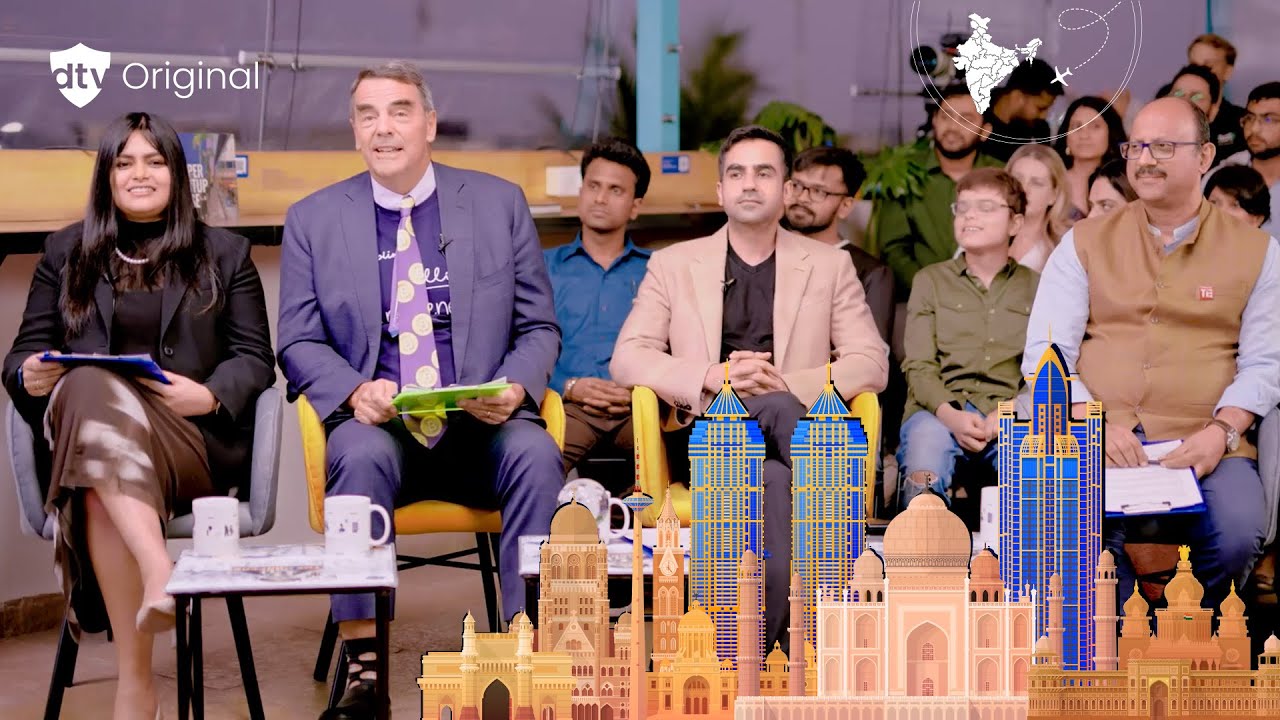
The episode of the TV series "Meet the Drapers" takes place in India, where billionaire venture capitalist Tim Draper and a panel of Indian investors (Nupur Hamad, Nikhil, Madan Padakki, etc.) evaluate five finalist startups competing for a $1 million prize and a chance to launch globally. The founders present their ventures: Karya, an AI‑enabled platform that creates ethical digital work for rural Indians to lift 100 million people out of poverty; OrthoHeal, a washable, breathable, lightweight orthopedic cast (Flexi‑Wedge) with fast‑curing silicone technology and strong margins; Unstop, an early‑talent engagement and hiring platform connecting millions of students with enterprise recruiters through gamified challenges; Neuropixel.ai, a generative‑AI startup that automates fashion‑e‑commerce catalog creation by synthesizing models and warping apparel, promising large cost and time savings. Judges probe business models, unit economics, market size, IP protection, and scalability, offering praise and concerns about competition, barriers to entry, and growth strategies. The episode interleaves behind‑the‑scenes moments, cultural commentary on India’s diverse startup ecosystem, and the emotional reactions of founders as they await semifinal selections.
Chapters
Tesla, Skype, Hotmail, Coinbase. What do these revolutionary companies have in common? Billionaire venture capitalist Tim Draper, who invests in big ideas before they become the next big thing. Now he's traveling the globe to find game-changing startups. Entrepreneurs from 10 countries and 6 continents will share their ideas for changing the world.
There are some entrepreneurs everywhere, and they all have a different approach, and those cultures bring more creativity.
Then 12 finalists will fly to Silicon Valley to compete for a once-in-a-lifetime chance to launch their company on a global scale.
100,000 units?
But only one can walk away with the grand prize— $1 million.
It's go time. This is a true entrepreneur here.
Meet groundbreaking technology.
We've built Denmark's first flying car.
Meet rejection.
I've seen 15 of these. How are you going to be better?
Meet innovation.
The blockchain is built for trust. The sky's the limit.
Meet the Drapers.
This is so exciting. We are here in India. Wow, that's some place.
Isn't it incredible?
That is one of the 7 Wonders of the World. Let's bring on these entrepreneurs who are going to change the entire makeup of all of India and maybe even the world. Ah, it's delicious.
My name is Manu Chopra, and I'm the CEO of Kaya.
Hi, my name is Safi Hussain, and I'm the Head of Research and Social Mobility, and I also head our foundation.
We offer 4 types of services to our clients.
By 2030, we want to bring 100 million rural Indians out of poverty through digital work.
My name is Dr. Pankaj.
I'm a founder and CEO of OrthoHill, the absolute washable, breathable, and lightweight orthopedic cast.
Hi, I'm Ankit Agarwal, founder and CEO of Unstop.
Hi, I'm Srishti, Head Communications at Unstop.
Unstop, what a great name.
Unstop is an early talent engagement and hiring platform.
This is Arvind Nair.
Yes, it is.
We are neuropixel.ai. We're a generative AI startup.
So if Tim picks you to win the million dollars, how would that feel? If we win, uh, $1 million, help me to reach 1 million patients.
I think we know what we want to do for the next So your 4 years, it's all about making it happen, hiring the right people, expanding our team, and expanding that energy.
I think the money is just one aspect of it. It also matters who and where it's coming from. And having a name like Tim Draper, I think that's incredibly valuable for the next stage.
I mean, Unstoppd, every employee is a family member, right? We are going to the next level, so prepare yourself to go to US.
Welcome back to Meet the Drapers. We are here in India at the Draper Startup House. It's the equivalent of like a Chamber of Commerce for the entire nation and the entire world. We now have about 25 of these Draper Startup Houses scattered around the world. I am wearing the Draper Startup House motto shirt, which says a million Entrepreneurs. The Drapers have upgraded. We have some of the most extraordinary investors and entrepreneurs here with us. We have Nupur Hamad, is an early-stage investor focused on consumer tech. She's focused on India and some of the Southeast Asia regions. She has an investment in Koo, an investor in Gevo, which is a silver jeweler, and Nikhil is the co-founder of Rainmaker and True Beacon. One of the 2 brothers founded Zerodha, and it's number one stockbroker in India. It's done extraordinary things, and they have 10 million customers. Madan Padakki is the co-founder and CEO of OneBridge, which is a village commerce network trying to get all the little villages— the co-founder of the Global Alliance for Mass Entrepreneurship. He's known for being co-founder of MeritTrack, and he currently serves as the president of TIE Bangalore. The question I really want to ask you is about the economy here. How does it feel to you right now?
Yeah, so the excitement is there, but much of the turmoil one might be seeing in the West is also here. I think people will have to be a bit more circumspect than they might have been in the last couple of years.
Yes, there's definitely a dip in the growth deals in India, but in the seed stages, we are looking at some amazing set of entrepreneurs.
Governments are waking up to the fact that startups are going to be a very valuable driver of the economy. We're literally in a golden era.
Well, let's bring on these entrepreneurs who are going to change the entire— all of India and maybe even the world. But before we do, Let's see what's going on behind the scenes.
We grew up in Shivkot Basti, a small urban settlement in Delhi, and growing up I saw a lot of poverty, which made me realize that the fight against poverty is existential. At the same time, I saw many nonprofit interventions not work or not be sustainable. I was constantly horrified by the amount of poverty we still had in the country, and I wanted to do something sustainable to tackle it.
I kind of grew up in Tajikistan during their, I guess, civil war. And I think I always saw a lot of people who had a lot of knowledge, who had a lot of skills, and who had a lot of potential never really get anywhere just because of the unfortunate nature of poverty. When I met Manu, it kind of made sense to join Karya and kind of start this social mobility vision that we had because I think for us, we figured out how we were gonna give people money, but we realized that wasn't enough and there was a lot more that we needed to do. And that's kind of, I guess how our journey started.
We have one solid mission in the company, which is by 2030, we want to move 100 million rural Indians out of poverty by giving them jobs they can do from their home. Karya, when I walked in, it just felt really cool.
I mean, like, people were cheering.
It seemed like a very supportive environment.
We are building a pathway out of poverty for rural Indians by connecting them to ethical and sustainable digital work, fundamentally tackling 2 key issues. The issue of poverty— it takes an average low-income Indian today 7 generations to make $1,500. A Karya worker can make that same amount in less than 3 months. Through 5 years of research, we have built an AI-enabled platform that can finally bring rural Indians to the AI We are doing this by building the world's first ethical data company.
So I think this makes us unique in 3 ways. The first is that we pay the highest wages anywhere in the data industry. Second, anyone can do our work. Finally, we actually give our workers royalties on every single dataset that we own, making them have income far into the future.
We've given more than $400,000 in direct wages to our workers, and our workers have done over 25 million paid jobs On our Android platform, we work with a lot of incredible clients. We work with for-profit companies like Microsoft and Tesla, nonprofits like the Gates Foundation, and a lot of incredible academic institutes like NovoMata, Stanford, and MIT.
Our vision is pretty simple. By 2030, we want to bring 100 million rural Indians out of poverty through digital work.
We believe very strongly that Kara is the fastest way to move millions of people out of poverty sustainably.
If I'm Microsoft, Why do I use you?
Great question.
In outsourcing to you, is it a PR opportunity for them or is it a financial?
You have a 3-minute period to tell people who've never heard of anything, you know, like exactly why you care about it.
Both of them. So when we go to clients, our costs are around 30 to 40% cheaper than competition, number one. Number 2, our quality is significantly higher. Time taken to execute projects is around 30% less. And the reason we're able to do that is we actually did 5 years of research.
Any of the big customers of yours that sign up, have they signed up once and then done it again?
Every single one of them. We've never had a client say no to us, which is super exciting because for clients, this is a win-win-win and the extra PR really helps.
Works out about $16 a person.
Right, so how does it tax these people out of poverty?
And you are talking of each of them having done a million tasks, right?
I mean, 25 million tasks, that's about 1,000 tasks per person. So yeah, numbers are not adding up.
It's a very difficult job, I think, in—
I was even thinking that, you know, like, imagine being on the other side and you have like 3 minutes to understand something, how to absorb all that, how to absorb all of that and try to make sense of It's, it's really difficult. That's a great point. So I think, I think the way to describe it is tasks are very different from work, right? So the way a task is defined is could be a sentence, could be sentence to validate, could be an image to annotate, or stuff like that. Last year, given that it was the first year and we actually started in June of last year, right, we still have the same workers. And our goal is this year we'll be able to give them enough work that they'll be able to do it.
And how much do you think they will earn in a year?
We expect them to earn around ₹4,000. In a career duration, so career is supplementary work, right? So on average, a below poverty line family in India makes ₹10,000. We are able to increase their annual income by 40% in a month. Exciting space where millions of rural Indians, Tim, 60% of rural Indian households now have a smartphone.
One quick question. I honestly feel in the growth stages, your revenue will definitely plateau because you cannot be just a data center.
I thought they were really—
they had like a lot of really diverse interests, which I thought was very lovely, right? Like, I think that they represented an entire microcosm of like Indian entrepreneurship.
Do you have any progressive plans on moving out of this model and maybe getting into lending for all of these gig workers, blue-collar workers?
Absolutely.
So we're already doing that, right? So we see that $40 billion cap on the data market. It's growing at 28% every year. So of course it will grow. We are in Interesting conversations with interesting people who are in the news recently is all I can say. But basically, what you want to do is move beyond that and move into the AI services.
Terrific. Well, thank you so much for being on Meet the Drapers.
We weren't nervous because again, like also everyone in Draper has just been so like supportive.
Like like I needed water, I needed cookies. I felt like a star. Like whatever I wanted was given to me.
We got makeup done.
We got makeup done. Oh my God! We got makeup done.
That's never happened before.
Coming up on Meet the Drapers.
Why have I seen this before?
Welcome back to Meet the Drapers.
It's India's century. If you want to do anything, any business, no matter which area, whether SaaS, technical, non-technical, you have all the right ingredients to start your business in India.
I would say definitely India is going to be the biggest powerhouse for the startups across the globe.
Speed of evolution is very high.
Very fast.
So we will not be very far behind compared to Silicon Valley.
And as and when I talk to new people, new entrepreneurs, the startup energy, the culture, that just hits you.
Any, uh, any thoughts on Karya, the business Karya?
I really like them. I agree when they said social interventions which are not-for-profit did not have a great track record. A social intervention at some level has to be sustainable or at least throw out enough cash to grow very organically. And they seem to be on point there. Outside of that, the two of them and what they're trying to build, I thought was very interesting.
One, I think it's a huge market, AI and therefore getting language. Then I would just— this is going to play a key role. So I think they're onto something.
I like the founders. I did ask them a question about growth. Although they did answer, I'm not very sure about how that would work out. Maybe get into deeper details and figure out a way to potentially get through better economic numbers, tries through different unit economics numbers, etc. So I think that we need some work there.
Okay, well, let's bring on the next entrepreneur. Before we do, let's see what's going on behind the scenes.
Personal level, there was always a challenge of making a decision, which is like taking the more rough pathway of entrepreneurship, but at the same time looking at the objective of helping more patients. From the medical school and school, I observed many issues in the medicine, and that struck my mind, like, why don't we work on the cast? My wife jumped in on the journey and she said, like, let's start together. And that's how she became a co-founder of Orthheel. I was kind of very excited that, oh, this is something where, like, I can reach to the million people. And I don't see it's a geography, but, like, I try to focus on each and every mankind or the person on the earth who can get benefited. She's very excited, but like, you know, we are expecting another baby in the next month. So like, she is very happy and she is like very much connected to me day in, day out for like what is happening here. So what I would wish is like my kids should inspire from us making world better and taking it to the next step.
Okay, Pankaj, tell us about OrthoHeal.
I like, you know, the excitement for presenting in front of Draper.
Did you know every year 210 million people get a fracture, and for that they need a cast? Introducing the absolute washable, breathable, and lightweight orthopedic cast, Flexi-Wedge. Flexi-Wedge is soft and elastic, made up of silicone, gets easily wrapped up around the skin. Once it is molded to the skin, with the exposure of 3 minutes it becomes really hard, which gives the support to the fractured cast, fractured bone. So it's very convenient, comfortable, and more efficient. We have 30+ IPR around the FlexioH, and out of which 3 has been granted in India and US. It is a Class 1 non-sterile device, so it was faster for us, but we completed the US FDA, CE, Australian TGA, and Indian CDSCO. We are able to produce this cast at a very low cost because we are having 100% in-house manufacturing in India.
What is the cost?
You know, it was anxiety, stress.
It's roughly $13 to $17.
And how much do you sell it for?
And the average selling price is $50. So we have a pretty good margin of 75% in each and every product sale. To reach through this journey, we raised like almost $600K from the government of India as a grant. We raised $1 million from family, friends in multiple tranches. And so far we have crossed the $750K of the revenue in the last 3 years.
Tell me, you don't require FDA approval for this?
We already did.
Oh, you have a 510?
Yeah.
So it, like, it is exempted from 510, but we need to have a basic listing with the technical dossier. So we have completed all the documentation. And yes, we have one of the largest markets from the US. We have our counterpart in the US as Ortho LLC. And where we have 50 clinics who has used our product and out of which 80 are having repeat uses.
Now, why have I seen this before? Aren't there other casts that look like this?
I was a little bit sweating because of the questions, but I, I could manage to give the answers. Yeah. So there are thermoplastic braces which are like covering 60% of the market share in the US. Like we are competing them directly in the US and there is a clear segment which can compete with us. And in India we don't have that segment, so we are trying to establish our segment here. I would like to hand over the soft and hard cast so that you have a touch and feel.
Oh, good.
Yes, it comes with the soft cast like this as a gel which can be wrapped around and it results into the hard cast like this when we expose with the blue light.
Nice.
So I put this on and zip it up.
Yeah.
And then you—
And you'll be exposed to the blue light.
Blue light.
Blue light.
For 3 minutes.
Blue light for 3 minutes and then—
Yeah, it's all like this.
These light, uh, does it hurt my hand?
No, it's a 420 nanometer, absolutely safe for skin and eye.
How do you take it off after 4 weeks?
So we need to just unzip from one side and we need to cut few of the ribs with the plier from the opposite side so it will come out into the 2 half.
Can you put on 2 zippers?
So like if you put 2 zippers, it does not give enough strength. So that's why we just went with ours. And the second thing is like patient should not remove by himself.
So that's why the one zipper will just give easy access.
But for children, I think this is not a very good use case because then children would— might want to just zip it off.
There are many questions which has been asked by the judges.
And like many of them were expected, but yes, obviously like it was the adrenaline rush.
Even if it has been unzipped, it will not be easy to remove. You can just try by yourself.
Okay.
It is so rigid, so it will not be opened.
Yeah, that's true. How do you acquire your customers?
Our typical business model is B2B2C, as like we engage the distributors who are the front face to the clinics.
And we got covered under the insurance, so they are giving around $350 to $450.
And what's your target market? Are you looking to sell more in the US, in India?
Yes, US is like for us a more bigger size in terms of the dollar value. And at the same time, there is a segment present there. In India, like it's a huge volume in terms of the patients because here we have 2-wheelers and more road traffic accidents.
More fractures, more business.
Yes.
Thank you so much for coming to Meet the Drapers.
I'm really excited about the Draper Show. This is the first time in our Ortel journey where, like, we are, we are getting an opportunity to be aired on any TV show and our invention which can reach to the million people.
Coming up on Meet the Drapers.
Why are you doing it? Why are you doing it?
Welcome back to Meet the Drapers.
India is a very vibrant and very diverse country where, like, you will find a different kind of slabs in the society.
Of course, there was this education boom that happened, and that sort of remolded the culture of the city to a one of innovation.
What did you all think of Punjab and the View Ortho Heal business?
It certainly seems to be an innovation made in India. There's a lot of focus for Make in India products, and the good news is that they're making it in India. I think we're looking at a huge opportunity here.
I think again, right, they're operating at 75% gross margins and also they see almost 200% repeat rates. So I think it is definitely a great market to enter and I really like the founder.
It seems as though it's easy to copy, even if you— it feels more like a product than a business so far. But that could be a very good business that gets then acquired by a medical device company. Yeah, exactly. Terrific. Well, let's bring on our next entrepreneur. But before we do, see what's going on in the city.
The opportunities don't reach you. You need to reach out to those opportunities. When I went into my MBA, I was that kind of a guy who wanted to participate in different competitions or activities. So that I can put them on my resume. Because see, understand that as a student, your resume is not your resume, right? In your resume, you only have your academics, nothing else. We believe that the best learning and the best opportunities can only happen when there is a community or a network that is getting created. And that basically was the pain point that I realized that I'm facing, and that was being faced by others. This was the root as to why we started Unstop, so that we can provide ample opportunities to all students across domains, across the globe.
I think I'm more proud emotional as opposed to nervous emotional because the work has happened. The sleepless nights and the coffee has been drunk. All of that has happened. Now I'm more proud of where we are today. I'm proud actually today to be here.
So tell us about you, Unstop. Unstop, what a great name.
Thank you. I was a bit nervous when I sort of was going there, and that's good to have a bit of nervousness.
Unstop is an early talent engagement and hiring platform with 4.5 million users, 100+ enterprise customers, and $2.1 million revenue YTD this financial year. What we do for students, we give them ample opportunities across the world to upskill and learn, to showcase their talent and gain CV points, and finally get recognized and hired.
Let's look at a boy who is from a very well-known college, but he too did not get his desired role or company. Both of them want to align their career interests and skills to the right sector. Role, and company. And that's when they hop onto Unstoppd, where companies organize gamified engagements like hackathons, case study competitions, and B-plan competitions, much like Meet the Drapers.
We are the only full-stack hiring and engagement platform. If you see who we are, we are LinkedIn plus Indeed plus Mercer Metal. We are doing employer branding, sourcing, as well as assessments. The overall market size is $200 billion globally. And we have just scratched the surface of this.
Who pays you? The student comes out and they pay you?
My energy came only because of the audience and the jury, right? Not one single chair empty. No, so it's free for students. Companies pay us for the whole engagement. Let's say if Amazon wants to do a hackathon, they will pay us X amount of dollars to promote and get as many students as possible. And once the online assessments are happening, which are automated, they pay us on a per student who take those assessments.
Now, what's the barrier to entry? Anyone can do this, right?
We do take their point in terms of multiple competitors, and we'll ensure that we have the ace of cards with us, which basically puts us on top. Many players are doing assessments like Meritrack, right? However, nobody is able to give them that reach that we are able to give them. Why these companies, Amazon, Flipkart, These biggies are reaching out to us only because of a community of 4.5 million. Tech can be created, but communities cannot be toppled overnight. Nobody can create the next LinkedIn or WhatsApp overnight. We have started that journey and soon we'll cross over.
What is the target persona of all these 100-odd companies?
One is the enterprise customers, which are 1,000+ employees or so, which is close to about 70% of this base. Another 20% is the startups who raise funds because 30% of the funds go into employer branding and hiring.
Right.
And the next 10%, which is growing rapidly, is any company across the world, no matter whether 100 employees or 50 employees, they need to be heard. And that's where they're giving us money because if they're competing with the bigger players, they need to be heard and they hop onto our platform to engage with this audience.
Why are you doing this?
Very rarely, uh, do you get that question. And, uh, that was a good surprise. I realized during my education itself that wherever opportunities were reaching me, they were not what my interests were aligned to. And that's when I realized that there is no common platform where I can go and experience. I'm not talking about a JD, right? If Flipkart or an Amazon is doing an engagement with us, which is a case study competition, if I participate, I get to know what e-commerce is all about, right? What product management is all about. And that's what we are doing for the students audience.
Why are you doing it? You just looked at him.
Yep.
Why are you doing it?
He first asked Ankit and then he asked me, and I know why I'm doing this, and I was so happy to share it with everyone of why I'm doing this. We're bringing meaning to people's lives, and it was a happy surprise. I'm glad they asked it. I'm glad I could share this part of my journey with everyone there. I'll tell you why we are doing this. We've been in Bangalore for a day and a half. And so far we have had 7 people walk up to us and said, are you from Unstopp? Can we please take a photo with you? I got a job here. I participated in this competition and got placed in this company. And that's why I'm doing it.
Terrific. Well, thank you so much for being on Meet the Drapers.
Thank you.
Unstopp is our baby. We nurture it day in and day out. And when we bring it in front of Tim, we keep it on a platform and we are telling you, hey, this is our baby. We built it with love and care and we want you to have a look Okay, what did everybody think about Unstop?
So I think having exclusive contracts with likes of Amazons, I think in itself is like a clear defensibility boost. I think go-to-market is pretty sorted. And also I think they're targeting like intern-level jobs.
I think the most articulate of all pitches tonight. Often when you invest, it's as much in the founder as it is in the company. And in that category, I think they really stood apart. One has to think that they will do well in every domain of their working ecosystem as well. So very impressed.
It is a very competitive market out there. That was what my previous venture was all about. There are lots of established players. I think showcasing the value of that stack And continuously adding value to that is important. Otherwise it becomes a cost game and the margins is the challenge. And that's the moat they're trying to build.
The concern I had was really barriers to entry. And they did comment on that well, which is we get the network effect and we got a barrier to entry. So good. Okay, let's move on. But before we do, let's see what's going on behind the scenes.
I think after working for 10 years, you're sort of at that crossroad where you know that your life would look a certain way if you continue down the corporate path for the next 20 years. But if you took a big risk right now, things could really, really change. So I wanted to do that and see whether I could I could own my time a lot more. The truth is that I've been doing long distance from my 3-year-old for the last year and a half. So my wife works at a job where she has to travel, she has to live in a different country. So she's been doing that while I've been taking the startup leap, and I'm not able to sort of let go of office yet. It's tough with such a young kid, and with my job I don't really have the flexibility. Just really looking forward to living a normal family life again for a bit. I never thought that I would be doing something like this, but it's exciting, it's challenging. The next stage of our growth is really going to be from the US, and the sort of validation in terms of when we approach clients, I think that's really something that we are way more excited about than the money.
All right, Arvind. You have a suit.
That moment is when, you know, everything's getting real. It's time to go on. You just completely switch off to the outside world and go at it.
The people you see on your screen, they never wore these clothes, and these are not real people.
What?
We are Neuropixel.ai. We're a generative AI startup at the intersection of fashion e-commerce and computer vision. The process of cataloging clothes is an absolute nightmare. It involves a variety of stakeholders like models, photographers, makeup artists, stylists, and so on. It's extremely expensive. It costs as much as $25 to $30 to catalog a single item of clothing in developed markets, and in India it's $10. The most interesting thing is the attention to diversity is finally getting the attention that it deserves. So enter Neuropixel. We're not just improving the process, we're changing the game. Our customers can simply shoot any apparel on just a mannequin, upload it to our real-time SaaS platform where you can select the model, select the clothes, and download high-resolution catalog images on the fly. And in the second step, we can start customizing these models as well. You can control their facial expression, you can control their hairstyle, their skin tone, get the perfect model for each apparel. And that's what this effectively does, is we save costs by about 30 to 40%. We improve process times by a factor of 10. If there was one reason to take a bet on us, it's the quality of the team that we've put together. We have a wonderful team of researchers. We're about 2 years old, 15-member team, and we're just starting to ramp up into deployment.
It's interesting. I mean, it's another new use of AI. Do you know how much money you're saving with this?
Just such a rush. We had no idea we were going to be doing this till just a few days ago, and then getting all the documents together, getting the presentation together. The total estimated spends on cataloging today globally is about $20 billion. Then there's an $8 billion market for virtual try-ons, which is growing at a much faster clip. But what we really want to unlock is growth. We don't want to be just a cost optimization lever. With the catalog image-based personalization, we believe that we can improve conversion by 5 to 10%, going by what some platforms have done, and that should unlock about $70 billion globally.
How did you involve Geoward or the Shade of M style?
Super nervous.
I've never done anything like this before pitching on a show, let alone to these kind of judges.
So size is actually not something that we're doing right now, but we do feel that this will eventually get solved once hardware matches up on every phone device. We're actually doing the visualization part, which is actually more of an unsolved problem. Size is more of a factor of data sciences, understanding the nuances between brands, and ultimately being able to measure somebody with hardware as well.
So I think sizing part is already done by Raymond Limited, right?
Yeah, there are different ways to do it, but it does involve a pretty sophisticated hardware as well. just from your phone and a camera image, it doesn't give you the level of accuracy that's required right now.
Correct.
The secret sauce, you know, what will prevent others from just copying this? Because there are several regenerative AI tools that are out there.
It is purely the IP that we have built. We're just filing our patents next month. It's, I would think that this is the singular reason why Flipkart is also invested into our business because they feel that there is some core IP behind the business as well.
Do you just put somebody's face on there and then build the model around it?
No.
So there are 2 models. There's one which is synthetic model generation and one which is apparel warping. For synthetic model generation, we've effectively built a network that trains itself on tens of thousands of images which are tagged by ethnicity, by size, etc. The dataset for apparel warping is much more complex and difficult to gather. What you effectively need is a paired image dataset. of thousands of apparel which is shot on mannequins and the same apparel shot on human models. So it understands how the apparel deforms when it's worn by people of different sizes in different poses.
Then what do I have to do?
Oh, just take a photograph.
Just a photo?
Just a photograph. There'll be an outline on the phone or on the TV, and you just take a photograph.
I stand there and then you work around.
Yeah. We can't do super complex poses like stuff like this, but hands by the side, one hand in the pocket, we have that.
And what do you think will happen to all those models?
You might be making life very difficult for models. I think that means that he kind of got what we were trying to do.
Hopefully start charging more and going more high-end. So we're going to be doing the bottom of the pyramid first because our quality is really not what a premium luxury brand would want.
Thank you so much.
It's just been such an experience.
It's been a complete ride and Super glad to have done it and really excited to find out what the outcome is.
Coming up on Meet the Drapers, who will it be?
Who's moving up to the semifinals?
Welcome back to Meet the Drapers.
India has it for you wherein you can reach out to talent. that is coming from a different, say, geography or a socioeconomic background or a different stream of education. And all of that put together is giving you such unique combinations of people.
Culturally, it is very diverse where, like, you can find all different kinds of cultures with the different languages.
So, uh, what did you all think of Arvind and Neural Pixel AI?
You know, his background looks pretty interesting. He's already worked in a couple of e-commerce startups, specifically in the fashion industry, so he understands his business very well. He also has clearly defined his go-to-market strategies. He exactly knows what he's going after. He has some great backers around him.
The team is great. So what do we do to evolve the jobs to the next level? Because the onslaught of these technologies is a given. It will happen.
So let's bring these 4 in and see who ends up moving up to the semifinals. Starting with Neuropixel, we love the idea of artificial intelligence taking over the world and completely taking all of our jobs and doing all of that. There is a concern that it is not a job creator, but you will probably create a lot of jobs and you will reduce the number of inefficiencies in the modeling business. OrthoHeal. I have seen something like it, but I am very excited. I can break an arm. No, not excited to break an arm, but I can break an arm and I don't have to wear one of those casts and reach in there and whatever. There are potentially new technologies where they just have surgery and they don't actually need it. Is it just a product or is it an entire business is always an issue. Unstopp, you are forces of nature. I have never seen that kind of energy in a presentation. And it was like I felt like I was overwhelmed by the energy, so overwhelmed that I was having a hard time following it. But some of us followed it very well, and it was explained to me, and everything's fine. But the question as to whether the market grows and continues to grow, or whether it ends up being something that kind of flattens out over time because it is so centric people, so you may not you may not get the leverage that a product would provide. And Karya. You, you know, I thought these guys had big energy, but then with Kardia, that was also incredible energy. I was thinking, oh, it's one of those nonprofit whatever. And then all of a sudden it's like $2.5 million in revenue and you guys are making it work and you have these amazing customers and all of that. I mean, it gets really extraordinary what you did. So we got to consult the crystal ball. Oogie boogie, smoogie loogie. Hey, wait! It's small. It's very small. But it's got power! Amazing power! The crystal ball is saying— Neuropixel AI! You are humans!
Oh!
You, the viewers, both these guys to jump over the semifinals and jump to the finale. So thank you so much for watching. We got Drapers!
Excited. I can't believe it. I mean, it was just such a privilege competing against these other amazing startups. I never thought I would win.
Like, I have a very noble cause with, like, you know, the good reason. I believe, like, Audience should want us just to make a patient's life happier with our product.
Audience loved us and we are hoping that they would back us, M, and we'll be selected for the semifinal again.
I think everyone has heard about poverty as a global issue, right? We have during COVID over 400 million Indians who were backed into poverty. I mean, these are some gut-wrenching numbers and what we want is hope, right? We want a sustainable way to get out of it, right? We don't Want to live in a poor world, as simple as that, right? And I think Karya is our best shot in the world to do that.
Like a soft.
More from Tim


He Sold His Car to Build This Startup, Then Pitched It for $1M 😳 #Startups #AI

This Startup Moves Your Crypto BEFORE Hackers Can Steal It 😳 #Crypto #Cybersecurity




15 Months Without Refrigeration?! This Startup Thinks It Can Go Global 🥥 #FoodTech #Startups



