Microplastics Kill. This Woman Quit Her Job to End Them — Meet the Drapers India: Bangalore
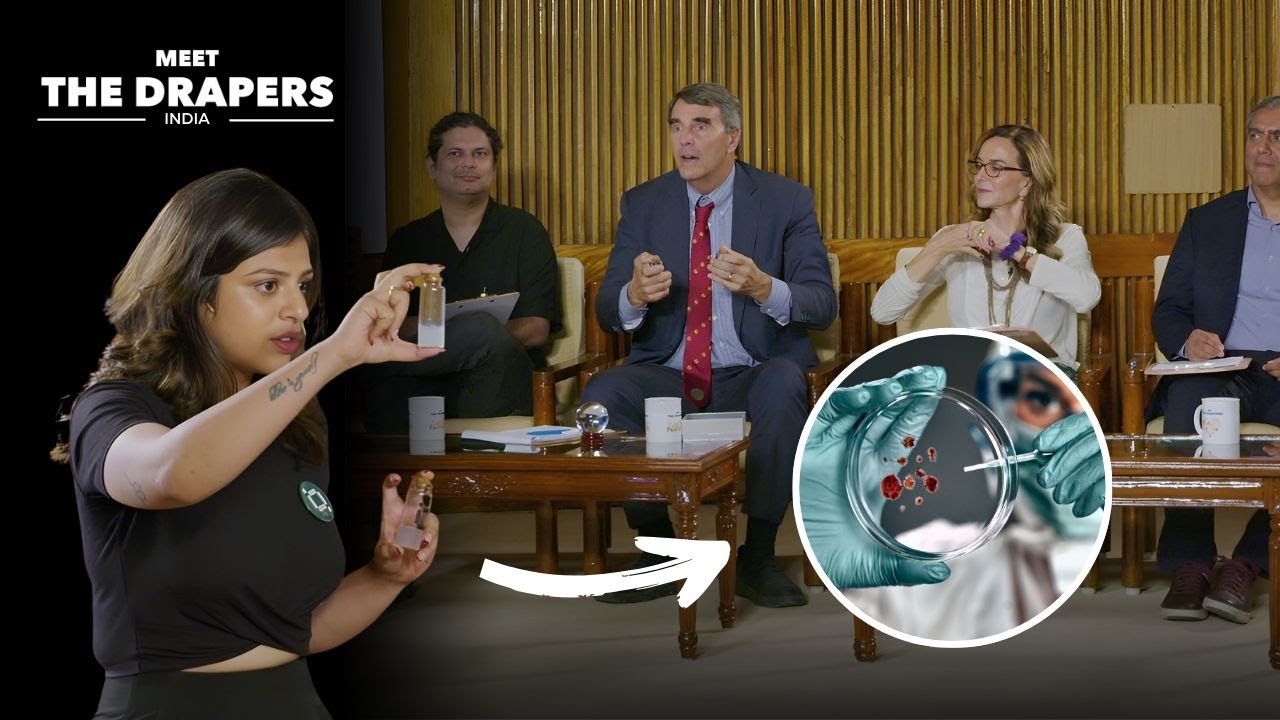
Tim Draper and judges host a live pitch competition at IIM Bangalore where 28 startups compete for $1 million. Bacall Biosciences is developing edible biopolymers to replace microplastics in cosmetics, targeting a $66 billion market ahead of the EU's 2028 microplastic ban. Other standouts include Flow Mobility, which cuts construction costs by 50-60%, and ToyStack, which reduces cloud DevOps costs from $1,000 to $20 monthly.
Chapters
In 1994, my father was the first Silicon Valley venture capitalist in India. He believed in the spirit of this incredible country. 30 years later, my sister Polly and I are on a mission to find India's next unicorn. I'm Tim Draper. I've invested in game-changing companies. Now we're crisscrossing this entire subcontinent, meeting the brightest minds, in the world's most populous country as we search for the country's top entrepreneurs. Thousands applied, but only 28 companies have made the cut for a chance to win an investment of $1 million and a shot at changing the world. It's a journey packed with adventure, innovation, and unforgettable moments. Who will rise to the challenge? Who will be India's next Great entrepreneur. Let the games begin. Welcome everybody. We are going to film the next Meet the Drapers episode at IIM Bangalore, and it is really exciting. We're going to see some amazing entrepreneurs. Bangalore is a hub for entrepreneurship. Let's go in. Let's see how it goes. Just keep challenging what's out there, what's the status quo. And whenever anybody says this can't be done, I have this horrible feeling. How would I? How could I do that? So go out there and just try stuff. You can go, you know, build your business. Thank you very much. That was great fun.
A million-dollar investment.
A million dollars.
A million dollars in investments.
A million-dollar investment is going to quickly help us to show the world that scale-up in India is possible.
With better functionality for sure.
New products and new markets. So it will really accelerate our journey.
We would be able to file our IP, get our regulatory approvals.
More than the million Getting the validation, this is a team of founders that can do something.
It opened doors for us in different ways that we didn't even think about.
Welcome everybody to Meet the Drapers. We're here in Bangalore at IIM, India Institute of Management. India has been just magical for us. I've learned to Meditate. Meditate. The breathing technique, by the way, you guys try that? It's so cool. Here, I'll do it for all of you out there. This is just one of them. I feel better already. With that, we have some amazing guest judges. Polly Draper, my sister, is an actress, director, producer, writer, She's amazing. And on my right, we have Amrit Acharya, co-founder and CEO of Zetwerk. On my far left here, we have Sanjay Nath. He is a co-founder and managing director at Blume Ventures, one of India's leading venture capital firms focused on early stage. So Sanjay, what are you, what are you going to be looking for in an entrepreneur? You got an eye for this.
You know, I think the fundamentals are always the same. It's, you know, team TAM.
Team TAM. So team and total available market.
Yeah. And then what do you have that's so different from, you know, your competition?
All right, let's bring on our first entrepreneur. But before we do, let's see what's going on behind the scenes.
Nobody folds their hands.
Okay.
So both of us are born and raised in Pune.
We met when we We were pursuing our bachelor's in microbiology in Ferguson College. We have been friends, we were in the same group circle. He was the studious one, I was the one who was always kicked out of class, teacher's bloody pet. I entered the class with an undercut, with half my head shaved. Just a very weird spirit for a traditional Indian class. But these guys saw me, adopted me quite quickly. We've been friends ever since. And I did my master's in bioinformatics and applied biotechnology. I got really intrigued by what happens in the genetic component of microbes.
I did my bachelor's and master's both from Ferguson College in microbiology, and after that I pursued my PhD from CSIR-NCL. There I worked in biopolymers, especially polygamma glutamic acid.
Everybody thinks about things that are visible, right? And because we come from the microbiology background, our whole love was to see things that people generally miss, the small little things. So the day I realized that 0.1 to 0.5% of your toothpastes are plastic, every morning you wake up and you brush your teeth and you think about it. I just could not shake that feeling off.
I rang up Pranav because I knew he also wanted to do something in entrepreneurship.
One phone call and we decided, let's do this.
I wanted to do something with microbes that I knew. There was one organism that is Pseudomonas. That organism can literally turn water into ice. Then I was like, what kind of superpower this microorganism has?
How does it do that?
Ice nucleating property.
So within a second?
Within a second, if you shake the bottle, it will completely turn the bottle into ice. So the main problem which I come across was scalability and affordability.
We lucked out with the team. They're all very passionate. The way we deal with conflicts, And we realized that we're very different people, but yet we respect each other's opinions. We still have so many arguments in the lab. His way of designing—
My thinking is different, her thinking is different, but we have to prove each other, yeah, this is right or this is right.
It's very competitive, it's in good spirits, and our tech is better than most because it has come from very different thought processes who fought to prove each other wrong. But when either of us is right, the celebration is just the same. And this is the first time Pranav left his home. I convinced him to come to Bangalore for good. I felt like my brother, right? Like I have to take care of him. I have to make sure that he's comfortable here. No matter what the outcome, this is exactly where I belong, what I'm destined to do. This is University of Agricultural Sciences. This is a place where startups like ours get a chance to display their products to the world. We were born and brought up in Pune, right? But we chose to be in Bangalore just Because there's a really good competitive, healthy competition culture for biotech here. What do we like about it?
I don't like the traffic, that I can say, but bike rides.
Yeah, there's this one place called Nandi Hill. So if you go there in the morning, you'll see that you only see clouds when you look down. I just love it. Bangalore has really good nightlife. You can end up in 15 bars one after the other, and the music will be different, but the energy will be the same. I myself am a cafe person, so I like that there are hundreds of options in every corner where you could just go sit, work. The amount The amount of founder friends that I've made just sitting at a random cafe is amazing.
I guess it was my first stage show.
Yeah, he has stage fright, so it was very difficult for him to come up. I have gotten accustomed to it. I like talking a lot.
Hi, I'm Shruti Gudmutia.
Hello, my name is Pranav Nair. We are the founders of Bacall Biosciences. Bacall stands for Bacterial Alternatives. We are on a mission to replace hidden plastics from cosmetic formulations, home care, oral care, nutraceuticals by using green biopolymers made via fermentation of agro-industrial waste.
When you think about pollution from cosmetic industry, packaging and PET bottles come to mind. But did you know 9 out of 10 top best-selling cosmetic products have microplastics in their formulations? India alone spits 1.8 billion grams of microplastics into the oceans simply by using the toothpaste formulations currently available in the market. So that is an alarmingly high number. Our formulations are edible, so they can go in oral care, home care, nutraceutical, agriculture, and cosmetics. These are platform biopolymers. Use of it is limited by the imagination of the formulator. not by the product.
If I give you 2 minutes to explain plastic, what are you gonna say? That they're malleable, they can become anything, and you wouldn't even know how often you use it in your life.
That's the story about our product. EU, however, has initiated a ban in sale of solid and liquid microplastics starting 2028. Now, this law increases our market opportunity to $66 billion, and our current customers are about 18% of the market size.
Yeah, how big's the total cosmetic industry?
Cosmetic industry in itself It is a giant.
It's a trillion dollars?
Yes.
Are they more expensive to make?
Eventually with scale, we can come to a point where we can sell it at the cost of a carbomer, which is currently the most used plastic ingredient in cosmetics. They're also so biocompatible that they can be applied on open wound and also edible, even in this form.
Show me these.
Yeah.
What, what are these things?
To make cellulose dispersible or soluble, you use halogens, cytotoxic compounds that are also carcinogen, just to get to this level. Ours is completely biodegradable.
Oh, I see, that's the bad one. Yeah, and that's the good one.
But you can't see the difference in the performance. If anything, our product surpasses the performance.
We displayed the products, right, so they could actually feel the chemically made product and the product which we made, right?
It is something that is a perfume carrier.
So there's no smell to it?
No, no.
Wait, theirs has a smell to it.
Yeah, chemical smell, right? You can feel the difference.
Oh, that's a horrible smell. Here, try that.
And that is because they use bleach in making tempo oxidation.
It smells like ether. Here, pass it down and try to avoid getting high smelling the one on the left.
That was not intended. That was not the intention.
What's your background?
History.
Pranav and I met when we were doing microbiology.
Were you dating?
No!
That was hilarious because we've never been asked that before, because if you see our day-to-day dynamics, it's like Okay, very, very, very different people. He was very funny, but okay. I was like, what?
We've known each other for more than a decade.
My mother likes him more than she likes me because he's the quiet one.
I'm the CEO, Chief Enthusiastic Officer, but he's the Tranquil Officer.
We met when we were doing our bachelor's, 2012 to '15.
How much are these now, and how do they compare to the plastic ones?
The plastic ones are carboomers that range from $5 to $25, and when you increase the quality of the product you buy from, it's going to be around $25 to $30. And for PJ, it's going to go as much as $60 to $70.
The government is now mandating that the plastics are out of it. Will they help get the financing of this?
We're currently bootstrapped and half financed by the government money. So yes, they understand that there is a need and the pivoting is going to be quite quick and everybody wants to be a part of it.
Terrific. Shruti.
Thank you.
Pranav. Great to have you on Meet the Drapers.
It feels great. I was kind of nervous, but I guess it went well.
I know. For you guys to give us a platform that helps us explain our products, it was quite great.
Polly, what'd you think?
I think this could be massive. Probably all the high-end products have something like this, but I don't even know if that's true. I think they're great.
The team stands out. There's a lot of passion, energy that comes out. They're going after the right market. Can they go to the L'Oréals and the others and make this a complement versus a threat?
Are they willing to buy something like this, or do they just say, "If the market needs it, we'll make it ourselves"?
Is there like one company can do do it all? You need complementarity, and I think we saw some evidence of that.
Let's see what's going on behind the scenes.
I am born and brought up in a small town in one of the western states of India called Rajasthan. I did my mechanical engineering from there. After MBA, I was working with IBM for a few years. And within 3-4 years, I realized that this is not the life that I want to live. I had a soft spot for startup entrepreneurship because I come from a business family and I've seen relatives doing business all the time. I always aspired to work in the industry, in the core technical industry. A value of technology is only realized when you can have a use case in the industry.
So we started talking to people across different industries I come from central part of India, which is near Nagpur. My family had been always involved in supplying to construction companies, and that entire industry had been very segregated in a way, and the amount of technology infusion was also way too less. My studies in mechanical engineering started getting me into as to how can I help in building things which optimizing the entire process, how things are being done as of now.
My previous company was acquired by Reliance, is a large telecom company in India, and that is where I met Prateek. We shared this, our passion for entrepreneurship. I used to hear from him about the insights that he has seen in construction industry, how miserable the life of construction workers are in India. Can we actually figure out a way where it makes business values very strong for the industry and at the same time it also improves the lives of the people, of the workers who are working in the industry? Flowmobility, we started in 2020. Hardware startups by design are difficult. You need to plan your stuff much better than a software or a SaaS startup. The entire product is completely designed by us without breaking the bank.
And I guess those things have actually helped us start create value on ground for our customer and at the same time for the workers.
I was first in my entire family to even do engineering. There are a lot of aspirations that were attached to me that, okay, this guy will actually go and do some good things. And when I told them that, okay, I'm leaving job and I want to start on my own, there were actually backlash in terms of that, but the initial few years were difficult. So it was a tough decision, but when they saw that I'm completely committed, then I think they started playing along. Then after that, they were very, very supportive.
I wanted to thrive more towards satisfaction when it comes to what I'm working towards rather than just the monetary gains of it. I'm blessed to have amazing set of friends and family, definitely.
With full support is they are really the silent supporters. I think the joy that we see in their eyes when we share about any win, I think that's priceless. A lot of people come to Bangalore to make their career in IT. Bangalore is called IT capital of India. A lot of startups buzzing with energy as well as a lot Spiritual energy. You can see temples around. So this is statue of— it's called Monkey God Hanuman from Ramayana, the god who generally personifies strength. The people here have been able to maintain their connection to the roots, to the heritage. In almost every locality, there is something called a food street. So here in HSR, we have a food street where you go in the evening. On both the roadsides, you have a lot of different varieties of food that is available In this vicinity, we have three different lakes. I like to take a stroll around the lake. That is a very good way for me to unwind. Gives a lot of inspiration that nature has given us so much. We have done a lot of pitches to investors, but those are really in different settings.
Yeah, stage was pretty much new for me as well.
Flow Mobility is building robots for construction industry. As per industry estimates today, if all the running projects have to finish on time. You need 30% more people. There's a big dearth of labor. Even if labor is available, productivity is a challenge. And then the processes followed by construction industries are all outdated. They're still following the same processes what they were doing 15-20 years ago.
Not just that, the number of suicides and incidents happening on ground are seriously alarming.
Help the contractors build better, build faster, build easier by automating these risky, backbreaking, tedious tasks. So our current product is already deployed at large contractors like L&T, Prestige.
We are launching the volume Finishing robots very soon by March.
That is what we intend to do. We have already launched our product. It is being used by large customers in India. Our current customers are getting 50 to 60% savings on cost as of today, and almost half the time it what it takes for them to do the work. So that quickly brings me to the team. I'm one of the founders. I'm doing startup for last ten years. My previous startup was acquired by Reliance in 2018. That's when I met Prateek.
Both of us make money.
He's I think has a very keen business sense, and he can understand a lot of things even before. Before we actually complete explaining to him. They got some multiple on there. I wouldn't say it was an astronomical exit.
No, this is— the answer is no, but—
No, but you should ask them.
Yeah.
But we did create an impact.
They don't all make money. It's okay. Good that you fought the good fight. Sanjay, do you have some questions for these guys?
You're going after a global market. India, India plus. So, you know, how do you update your, uh, the go-to-market plan to a global use case?
For every city, we are in 10 cities right now in India. Every city has a channel partner which takes care of the operations on the ground. And we would follow that same playbook when we go to Middle East and eventually to US, where we have system integrators or channel partners who will be taking care of putting the robot into customers' processes. I think that is the winning recipe.
This doesn't seem like it's too hard to do. Don't you have a lot of competition?
There are a few industry insights which probably got mixed up when we were talking about different markets.
So the competition is way too less, especially if you see in the global market, because of the fact that our major USP comes from the camera-based approach which we take, which gives us the best price-to-performance ratio.
You know, we sell to some of these customers, they— I see some names. It's very hard to sell to these What is the pitch? Is it savings on pricing? Is it safety?
Fortunately, I think when those questions were asked, it gave us capability to talk more about the technology. Our pitch is straightaway simple because it's a monthly rental model. We just go and say, just put the machine on the field for 1 week. After that, if you're satisfied, we'll continue. Otherwise, the nature of automation is that, that if you just show it, we'll say this is a no-brainer, right? Today I'm using a 150 kg wheelbarrow which I have to manually pull in. I have something which is 500 kg payload, motorized. I'm moving the same thing faster with less people.
Besides picking up trash, what's the other thing it does with walls?
Wall finishing. We are asking the customer, do you actually need this?
Right?
And we are getting a very solid validation that wall finishing is something which is a big pain today.
Have any of them bought it and returned it?
Uh, one person out of 16.
Well, terrific. Well, Manish, Prateek, thank you so much. Thank you so much for being on Meet the Drapers.
Oh, it was a great pitch.
I think they were asking very sharp, pinpoint questions. A few things for us to think and go back to.
Sanjay, tell us why you backed them.
We feel that one of the biggest beneficiaries of new tech is actually the old economy. We have examples. The challenge is that there are moving parts, and it's like a service business. I think we think the founders are gritty and hardworking, and they're going after a tough and hard problem.
Yeah, the guy can sell. That's for sure.
Curious on when they make the overseas move and how they have to adapt their business to do that successfully.
Holly, what'd you think?
That's a good point.
I—
but I loved the idea. I thought it was a weird pitch starting with the suicide.
But horrible. Let's bring on our next entrepreneur. But before we do, let's see what's going on behind the scenes. The India Institution. Of management, it is really exciting. Let's go in. You're the director? No, not that. Well, this is nice to be here.
Hi, everybody.
Hi, Karan.
I am the sort of many things already done. I'm the president of the school.
President of university, toughest job on earth. Yeah.
I am Bangalore.
You're familiar with top, you know, the top business schools of the country. We'd like to play as an incubator some convening role in injecting innovation energy there, and that's an important cluster for us.
The river and the farm industry.
We sold this year's this year's land date is about 2.4 crores.
Good gum. It's delicious, by the way.
And whoever I pitch to, every owner understands the pain point.
So if I show this to you, this is how, uh— Is it like, here's the family and here's who owns it?
So like, if you see this particular graph over here, and now this is all in one place in the form of a PDF.
So you can do it much faster than—
Much faster.
This is made out of a car upholstery.
Recycled seat belts.
Thank you. Thank you for.
Oh no, sorry, don't laugh.
I grew up in Bangalore. When I was in high school, Bangalore had not seen any of this development. So houses were like this. People walking on the streets. After my high school, I went to the U.S. I went to the University of Chicago. Spent 13 years in New York. within investment bank Credit Suisse doing mergers and acquisitions advisory. Came back in 2012 back to Bangalore, started a real estate development company. That's how I met Arun, Shrawan, and Mukund.
Mine's very different. I grew up, I would say, in Bangalore but outside Bangalore, in a very rural place. I was doing my PhD in France in machine learning. I quit that in between to come back to India because I had 2 cousins, Shrawan and Mukund, who are other co-founders of ToyStack. We decided let's do a startup together now.
So, you know, I'd say there's 2 aspects of being an entrepreneur. I think one is you get a lot more control over your life. While you have all the risk, a lot of tough decisions, you also have a lot of control over your timings, your time, your life, etc. Until you actually scratch that itch, you don't know how hard it is. I think people thought I was a bit crazy, but I think everybody has their— has to make their own decisions for themselves, right? You can't live somebody else's life.
I think for me it was inevitable. My dad's an He's an aerospace engineer with— he has patents in biotech. Even when we were kids, me, Shavan Mukund, we played games together and we always thought, okay, we should do something together. You know, we got to just build stuff. Like, I don't know a life other than that.
Success is personal. So I looked around my investment banking colleagues, fancy apartments, fancy cars, but they were miserable personally. It looks sexy from the outside, but it's a very selfish existence, I would say. The one thing I didn't like about it is, as you come up and become a managing director, there's only that much food that's on the table, right? There's that many clients, there's that many deals. So there's a— you start seeing a bit of, you know, people cutting you away. And I said, you know, let me try something else. The way Mukund, Shravan, Arun have really built this product, they've actually created something incredible in such a short period of time.
It was always, you know, this really cool tool that allows you to take away the complexity of the cloud. That's the reason we called it We thought it'd be a toy. We never actually thought of this as a replacement for a cloud when we started out. It wasn't such an ambitious goal to begin with at the start. We were just building this for ourselves. It just started to look like we built something of value for these people because instead of going to everybody else, they started coming to ToyStack instead.
The cool thing with all of us is we're very close-knit with our families. Arun just got married. I got married 10 years ago, so I got 2 little kids. My parents are also close by. Everybody brings a completely different skill set to the table. I think that's the very cool part of the 4 of us have really come together.
Yeah. Viewers, usually I'm pretty easy to reach. I mean, there are only 300 million of you. I'm making it a lot easier for you to contact me. I have downloaded I've uploaded my brain into this digital twin, and you can scan this QR code, you can pitch me your idea, you can talk about your business, anything, and I'll answer it 24/7. Enjoy it, it's great. It's a new feature of Meet the Drapers and Draper TV. I think you're gonna have some fun. Meet the Drapers.
We're on Church Street. This is one of the oldest streets in Bangalore. Before Bangalore became like the technology hub, it was more rustic, more quiet. Now you can see a lot more hustle bustle.
Bangalore, I think, was a retirement place maybe even 3 decades ago.
The weather in Bangalore is just phenomenal. It's, it's, it's between 3-4 degrees throughout the year, predictable rainy seasons, but after rain the sun's out. People call it like natural air conditioning. Bangalore is known for its microbreweries.
For me, it's getting a masala dosa and a coffee. I think that's the most cultural thing you can do in Bangalore. The nicest thing in Bangalore is Cubbon Park.
It's almost like Central Park in New York. Cubbon Park is surrounded by all the historical monuments, our government building Vidhana Soudha. Yeah, I would say Cubbon Park is a must-see for people.
Slightly nervous. We never competed with so many startups before.
I think every situation there is some sort of adrenaline, which is nervousness. It was positive nervousness.
So the team has 3 accomplished engineers who've built AI and ML applications at scale. I'm an ex-investment banker from New York complementing their technical expertise. Anybody deploying on AWS needs an expensive DevOps team. It takes days to weeks of configuration and your cloud bill is quite obscene. With Toystack, that entire tooling is automated into a couple of clicks. You connect your application code to our platform, And in minutes you're on the cloud.
So when I go to AWS, the cognitive load is on me. I've got to decide what is the size of the computer I want, what is the storage I want, etc. But the problem is I'm always optimistic. I'm going to think, okay, next month I'm going to get 100,000 users, so I'm going to get the biggest system there is, right? It's going to be very expensive. So what we've done is basically said, okay, cool, just give us your app, we'll figure out a way to scale it up. Tomorrow you have 10,000 users, we'll figure it out. If it needs to come down, we'll do it. The only reason you wouldn't go to Data Samudra tomorrow is because Because there is no API, there is no tooling for that. So what we've done is, A, built the tooling for connecting to these microclouds. Second thing what we've done is we've figured out what is the right technology to scale up and down.
Your main customers are going to be small and medium-sized businesses.
At this point in time, yes.
And you're going to say, hey, it's easier, get on, it'll end up being cheaper.
Cheaper, way cheaper. It'll be way cheaper for them.
Like by half or two-thirds?
There are 3 cost components. One is engineers.
Tim has this ability to focus on a topic and then take you off And if you're caught up and a bit nervous, you tend to— so we were keen to kind of just keep the discussion on track.
Even if you get AWS tomorrow, you need to hire these DevOps engineers who configure AWS for you, right? You eliminate those engineers, A. The second thing you eliminate is the time it takes to go from 0 to 1.
So you're estimating $1,000 per month turning to $20 per month?
Absolutely. We've done this for a customer already. That's the reason I put that here.
What does it cost? What does it cost you to deliver something that's $20 a month?
So we— it'll cost us roughly about $15 for this right now.
Well, that's not a very big margin.
It is not right now.
25%.
If you get that much room between $1,000 a month and $20 a month.
At the end of the day, the hook is the fact that we can make it simple for you, but then pick this, pick that, and then slightly gets expensive, but it'll never go to the range of an AWS.
Would you use them?
I mean, that's what I would like to understand. Like, do your best customers eventually don't need you because they grow big and then they can do it this and that.
No, so we scale to any level.
But when you get bored, what are you gonna do?
We don't get bored.
We have 10 other products that we've come up with based on the same deployment cloud.
This is an ocean. The cloud is an ocean. There's so many interesting things to do. We have so many interesting AI problems within this that we've solved already.
And the last company didn't have that much interest for you?
No, so basically that company was an AI healthcare company. Basically what we did was we developed these AI models.
It's doing phenomenally well, but now it's basically a copy-paste job.
How, how big does this become and how do you all stay like ahead of the tech as well?
We started off with the product-led growth motion, uh, spent very little money on digital ads. We got 9,000 users.
3,000 in a month though. We went viral because somebody just made a video about it.
So that's 9,000 people paying $20 a month?
No, no, this was, this was on the free plan, right?
Oh, free. Yeah.
It's so simple that somebody who knows nothing about technology Right, can use these tools and we're facilitating the deployment to the cloud.
Well, great. This is going to be huge.
Huge.
Very nice to meet you.
Super excited. It was, it was fun.
We expected a lot of tough questions. We got a few, so it was fun.
As a software developer, there's a learning curve involved in the first time.
Right.
But the second time you're leveraging the work you did the first time and—
Oh, so you only have to do it one time. Maybe it's just that one-time cost and after that, it's cheap.
So I think this is going to require a deeper dive into the product and tech.
Holly, what'd you think?
They're basically saying, we'll whittle down the price from what this space is because, I mean, you don't have to buy all that extra.
We'll go up and down with how much you use.
I don't know what I'd use it for, but I would buy it.
Let's see what's going on behind the scenes.
I went to St. Stephen's College in Delhi, where I majored in history and minored in ethics and economics. Grad college, I realized that even though I loved learning about the past, I really wanted to understand how the world works today. That's when I decided that I wanted a degree in geopolitics. Ended up working as an intelligence consultant for an American firm in India, and that's the time that I realized that there is this wide gap between climate change and the technology solutions that we need to bridge that gap, especially in India. That gap is extremely wide. I saw a lot of plastic litter around, and it just made me realize that, you know, we're all English-speaking, educated citizens of the country sitting here and I can still see plastic litter around. I knew at that point in time also that they're toxic. It was very clear to me that the government is not going to be solving this problem. The incumbent industries are not going to be solving the problem. Once I got promoted at my job, I realized that I couldn't lie to my boss or myself. I took my bonus and I left. When it comes to my family, obviously they were not thrilled because I come from very humble beginnings. So I had to work very hard to get into the right colleges, get a good job, all of that. So I was following that good girl path till that time. To me, I knew that something was missing and I knew it just 3 months into the job that I was working. There were a lot of people who told me that this will not work, that this is foolish, that I should stick to, you know, something small. That is something that I've heard a lot. To me, I don't think it ever mattered because as long as I was sticking to science and getting the results in the lab, that's the only thing that I cared about. I've never focused on outcomes. For me, it's, you know, step by step by step. I think what keeps me on every single day when I wake up in the morning and I go to sleep in the night is the fact that I know this is a tough problem to solve and I love tough problems. So in India, we have this story from Mahabharata, which is one of the epics. It has a character called Arjun. Arjun is a sweet character and he's an archer. He's an ace archer. There are many tests that he goes through and every single test test he passes simply because of the fact that he was looking at absolutely nothing else but the target. He was only looking at that, nothing else. Not the tree, not the, not the bow, not his guru. He was just looking at what he had to do. We're right outside Vidhan Sabha where the state legislature stands. You can see it's a nice colonial building. It's one of the nicer parts of Bangalore overall. What I love about being in Bangalore is that it has a thriving ecosystem for building biomanufacturing businesses. Great talent, good labs. To be honest, I haven't had the time to explore. I've just been here for now 18 months. I used to come around this place, especially to Cubbon Park. It's a 100-year-old park to lie down under the big old trees and read books or nap. Bangalore also has great weather. As somebody who comes from Delhi, I really like the fact that it's pleasant throughout the year. But yeah, otherwise there's a lot to do in Bangalore, great places to eat, especially around this area. I was really excited, quite pumped up to go on stage and tell them more about Terra BioWare.
I am a former expert in global intelligence and strategic risk, and I was evaluating the gap between climate risk and technology solutions. One such critical gap that exists is toxic petroplastics. We produce 450 million tons of this material every year. Year, and right now it's present inside all of us, triggering the risk of serious diseases. Plant-based bioplastics are 3 to 5 times more expensive, limiting their adoption. I set out on a mission to make them scalable and affordable. Today, our novel technology transforms carbon emissions into PHAs. In the last 14 months, our microbial technology has also achieved 2 times higher biopolymer output than plants, and we've also taken it from lab to industrial scale. So Terra PHA acts as a biomaterial platform. It's divided into 3 verticals. We convert it into specialty biochemicals that have anti-aging properties for cosmetics as well as nutraceuticals. They mimic the properties of several petroplastic grades that you and I use every day. Now we have understood that if we convert them into specialty biochemicals, we are able to use them for high value, higher margins.
Who's your customer?
Working with L'Oréal right now, as well as Unilever.
So what are you doing with Unilever?
I think he's a great showman. He knows exactly what he's doing. He has command over it. A person who brings so much energy into a room, but at the same time, his head is really focused when he's listening to pitches and asking questions.
Right now, they've taken samples from us, then they're doing their own internal testing and developing formulations.
Both Shrutis and both going after plastics. They have the same first name.
Oh, that's crazy.
That is interesting.
They're based out of the same campus as well.
Familiar with the technology and the polymer that she's working with. The market itself is so large that there's space for everyone.
And you talked about margins. Where do you think the best product-market fit will be?
For TerraVibe, that is where we see the strongest amount of potential. The reason why this market is important to us is because they have anti-aging properties as well as it is a non-glucose source of energy. So this is a new molecule that delivers the same properties but does not use the glucose route. There are few companies only that are producing this, and it's sold for about $1,000 per kg. We're producing it for about $100 to $150 per kg.
You're not a biochemist, but how did you come up with this?
When I saw that gap, I realized that even though I'm excellent at analyzing, predicting risk, I really wanted to solve for it. As an intelligence consultant, you're trained to go through enormous amounts of data, and you have to find that needle in the haystack. So I applied the same skill sets to scientific papers. So I went through all of the biopolymers that exist, what kind of biomanufacturing technologies would really be able to solve for petroplastics in the long run.
How long does it take to develop the whole product from scratch?
What we've seen so far is that they'll take about two to three months. Simultaneously, what you also have to do is you have to convince the business team as well, because R&D usually works separately.
I don't think we got any questions around the confusion. They got it.
Why are you doing this? Why do you care?
After the second COVID wave, I went back home. I was sitting with my loved ones in a public space, and I saw a lot of petroplastics. litter around me. COVID is a virus. We can't see it, but it kills us. I think it's the same with microplastics. And essentially what I realized was that it's a very hard problem to solve. It's complex, and I love complex problems.
Thank you so much for coming, being on Meet the Drapers. Great job.
I'm feeling great. I think the judges were super understanding, even though it is a deep tech startup.
Sanjay, what did you think?
I think one of the key questions here is the commercialization. You may have a great product.
A lot of these large companies have, you know, billions on R&D.
How do you take this to market? How do you convert customers?
Amrit, what did you think?
It's still a concept. And so for me, the key question is how do you shortcut that cycle, which to me seems like years into less than a year?
Yeah, it might have the model of a, like a semiconductor takes a while for the customer to start shipping, but then once they are, you're kind of in there.
Right.
What'd you think, Paul?
I loved her. And I think that of all the companies, the one that cares most about the things that I care about, which is making an impact environmentally. The fact that she said, I looked through every single study, I thought, she's gonna succeed at this no matter what the obstacles are.
We have a very difficult decision to make. We've seen 4 really extraordinary companies. We're gonna all send vibes to the crystal ball. And their crystal ball, as small as it is, it's a big energy source. Bakul is doing pretty much the same one thing as Shruti number 2, but you're focused more on cosmetics. Tell me why you are better than she is.
First of all, there's enough plastic in the world to give us all an opportunity. On a very scientific technical level, the kind of molecules that The kind of molecules that Terra manufactures and the kind of molecules that Vacaut manufactures are completely different. Their use cases are completely different. While she's targeting the— exactly what she explained, what we're targeting is more of things that can mimic what already exists in plastic.
You out in TV land, send your vibes to the crystal ball or go to Draper TV and vote. They could end up getting a million-dollar investment from us. But it's going to be from me.
But what—
but the other venture capitalists are welcome to participate. So will it be Backalt? Will it be Terra Bioware? Will it be Flow Mobility? Will it be ToyStack? I'm starting to get a vibe. You guys getting a vibe? Maybe we need everybody's hands in here. All of you, hands in. Mole Money. I think I've been meditating too long. Oh, we have a conflict! Oh no, ToyStack and Terra BioWare! Congratulations, good job, good job, good job, good job!
I went in thinking it's a 50/50 chance, but then it truly was a 50/50 chance. That didn't matter to us. It was nice that we just won anyway.
Develop some kind of affinity with your fellow co-founders. You guys are trying to accomplish the same thing, so we were happy there was 2.
We really like ToyStack as well. I also wanted them to win because it's a very sweet team. I think my nomination was much more of a surprise. I mean, I was happy.
I think the audience should vote us back just so we can tell our story better, really convey to the people how crucial this problem is and how we're really working hard to solve We can disrupt this category.
Construction has been one of the most overlooked industries. We have all the right ingredients for us to take this business to greater heights. So do vote for us and support us.
See you next time on Meet the Drapers! All right! Good job. We're in Mumbai. The entrepreneurs here are vibrant, exciting, dynamic. There are about 1.5 billion people in the world who are suffering from hearing loss.
It never changed even lasted in 2 decades, and that's made me try to solve the problem myself.
Wait a second, this says a woman-led organization. That's right. Okay, what am I missing?
More from Tim


He Sold His Car to Build This Startup, Then Pitched It for $1M 😳 #Startups #AI

This Startup Moves Your Crypto BEFORE Hackers Can Steal It 😳 #Crypto #Cybersecurity




15 Months Without Refrigeration?! This Startup Thinks It Can Go Global 🥥 #FoodTech #Startups



