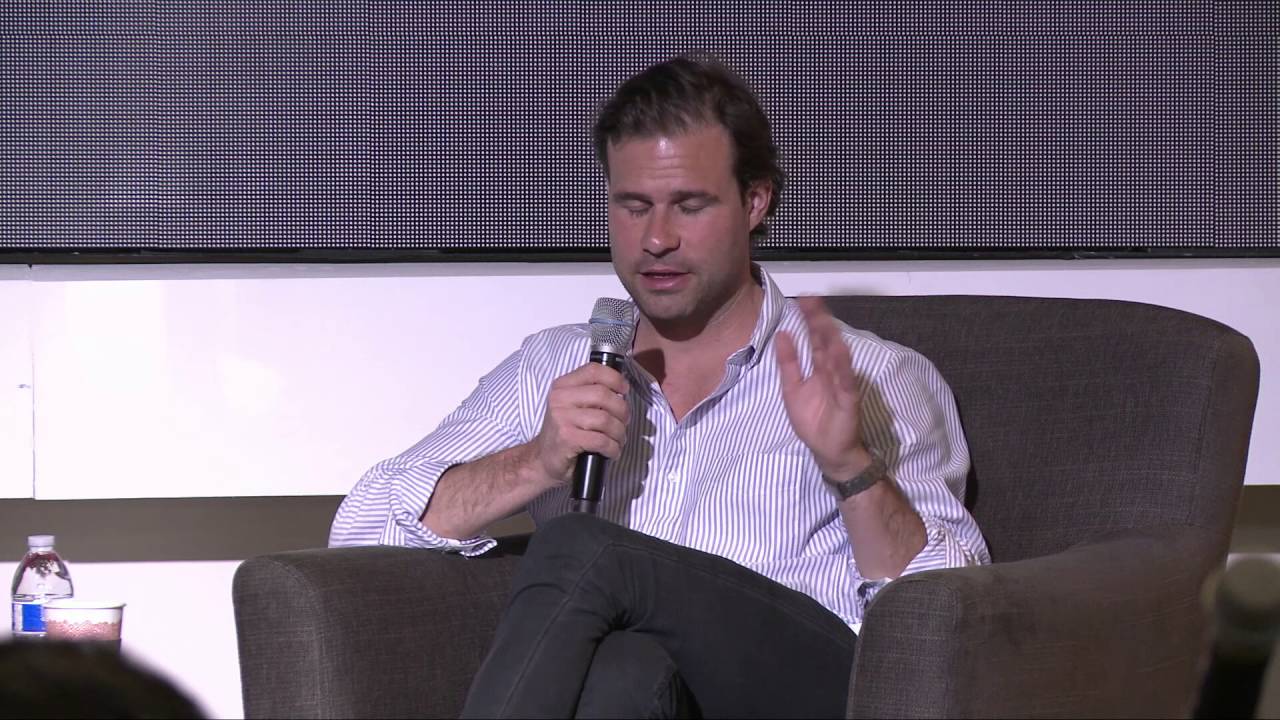
Bastian Lehmann, co-founder of Postmates, talks about shutting down his earlier startup Curated.by, which burned through about $25k, and how he moved into building Postmates. He discusses fundraising challenges at AngelPad and the early operational details of the delivery company.
Chapters
Welcome, Benson Layman. Also, the host, Heather Somerville from Rotas. Heather Somerville. Oh, Somerville, sorry. Yes, please.
Hello, Heather.
Hello, Bastian.
These are very loud. Hi guys, how's it going? All right, thanks for having us. Is this too loud if I speak into this? No, I just hear my own voice. I don't like it much. It's 4 accents mixed in one.
How are you all doing? Great. So my name is Heather Somerville, and I'm a technology reporter for Reuters. I cover many things in the tech space, but venture capital and startups like Postmates are a big part of my beat. So it's fun to be here to talk to Bastian about Postmates. So since the on-demand delivery space is a fairly crowded one with lots of players, you all know Uber, you've probably heard of companies like Sprig and DoorDash and Munchery and on and on we go. Bastian, tell us about Postmates, what you do, how you differentiate yourself from this big crowd, and what makes the company unique.
Right. Okay, that's great. I'm obviously Bastian. Happy to be here. I hope you guys enjoy this. We'll talk a bit and then we'll make it interactive because I, you know, we don't want to preach too much. That's right. So what makes Postmates unique? So let me start with some bragging. It's the largest on-demand delivery company in the United States. There's 25,000 Postmates doing deliveries in 40 markets. It's roughly 200 cities, and we do over a million deliveries each month. So it's, it's, it's, it's the largest footprint of a company that's currently available. What makes Postmates unique? We started with a product that allows you to literally order anything from anywhere. If you imagine the Postmates app, you can open it and You see a couple of featured places, but you can search for almost any place in a city. And for over 50,000 of these places, we have an inventory. There's 1.5 million SKUs in the Postmates platform. And what makes it so unique is that even if we don't have inventory for a place, you can still type in a shopping list. So if we don't have the inventory for a hardware store, you literally can still type in the tools that you need, and the Postmate will walk to that store, will drive there, will cycle there, and He will swipe a debit card that gets loaded with funds for that transaction, and you will receive the goods. In New York, on average, 28 minutes. In San Francisco, something like 43 minutes later.
Great.
So let's go back to the beginning, shall we? And I know a lot of you guys are kind of in the idea stage, got ideas for a company, starting the foundation for those companies. And so before Postmates, you had Curated By. And this was an idea, Bastian, that you had at the original AngelPad, and you got to a point where you had to move on from it. So it'd be really great to know what were the metrics, what were the signs that you had to let that baby go, and how did you manage to do that and then find it in yourself to move on and start a new project?
Okay, I'll tell the story. You interrupt me or you ask more specific questions if I get too waffly. So curated.by was a really stupid thing. We had an idea that there is a world where all of us would love to curate information about specific topics. So, and, and the coolest thing about curated.by was the domain. It was literally curated.by. As I think it's in Belarus, took like 6 months to register. I had to send my passport via fax. I mean, I probably exist 5 times somewhere in Russia at this point. 'Cause you fax everything, like your whole identity, everything, to just get a domain registered. It's weird. So we have the domain and we're like, you know what, the thesis was something like this. Heather knows a lot about journalism and is really smart in specific topics in journalism. And what if we use her as like a proxy and Heather can start a collection of things about specific topics? We call them bundles. So a bundle around the on-demand space, a bundle around— later-stage startups, bundle around VC board members. And she puts all the information that she finds on the web— tweets, pictures, videos— in these bundles, and you can subscribe to them. So you're getting this stream of curated information, blah, blah, blah. So the whole thing was great. We started out with the idea. We had an early write-up on TechCrunch. Robert Scoble, which is one of these media multipliers, however you call him, media mavens— I don't know what he does. It's mostly what he does, right? He's a talking head, and he was using it. So there were around 5,000, 5,000 customers on the platform, which is not bad in, in, in, in like 6 to 8 weeks' time during AngelPad. And, and we all felt really good about it, but I think 2 things happened. We started raising money and we met, we met VCs, and, you know, there was absolutely no traction on the on the funding side. So you're walking into the meetings, you feel like you have the greatest thing in the world, and then the enthusiasm level on the other side is like below zero. And people are too nice to tell you that what you're working on sucks. So they all tell you something great, and they speak code language. Like, VCs never say no. They say things like, it's a little bit too early for us, or, hmm, that's a space we're not as interested in, or, let's stay in touch and let's keep again in 12 months, you know. Or they give you some more specific homework that you should just blankly ignore because it's just them trying to avoid to say no, because regardless of how crazy the idea is that you come up with, there is this 1% chance that you turn this into a gold mine, and then they all wanna be your friends and wanna be known on the record that they supported you from day one. So, that happened, and at the same time, we, like, kept questioning ourselves. The backstory is I wanted to be in the US all my life, since I'm 14. I dropped out of college in Germany, so it wasn't the most easy path for me to get here. And I woke up one day and I realized that, look, you're wasting your time working on something that only you and a few other people think that it's cool. It is probably not really gonna change the world. You're 33. What the fuck are you gonna do to actually leave a mark here?
So stop.
being weird about this and, and work on something that actually matters to you. And that's when we decided to sack the whole thing. I remember having a conversation with Sam, my co-founder, and I told him about an idea that I had back in 2005 when I moved from Munich to London.
How much money had you sunk into Curated by, and was it all your money, or had you raised— successfully raised any money from family and friends?
Oh, we burned it all. I mean, it was just all gone. There was, I think it was $25,000. So clearly then we had no money. So I had to work for another startup. I did their designs. In the AngelPad class, some startups raised a lot of money. That makes you feel real good if you have none.
Sure.
So friends, thankfully enough, friends hired me to do their design. So I did that. So I think we made $20,000 and that was enough to like, keep us afloat until we're working on the, the very first version of Postmates.