One Pitch Away From the Finale | Meet The Drapers Global: Semifinals 2
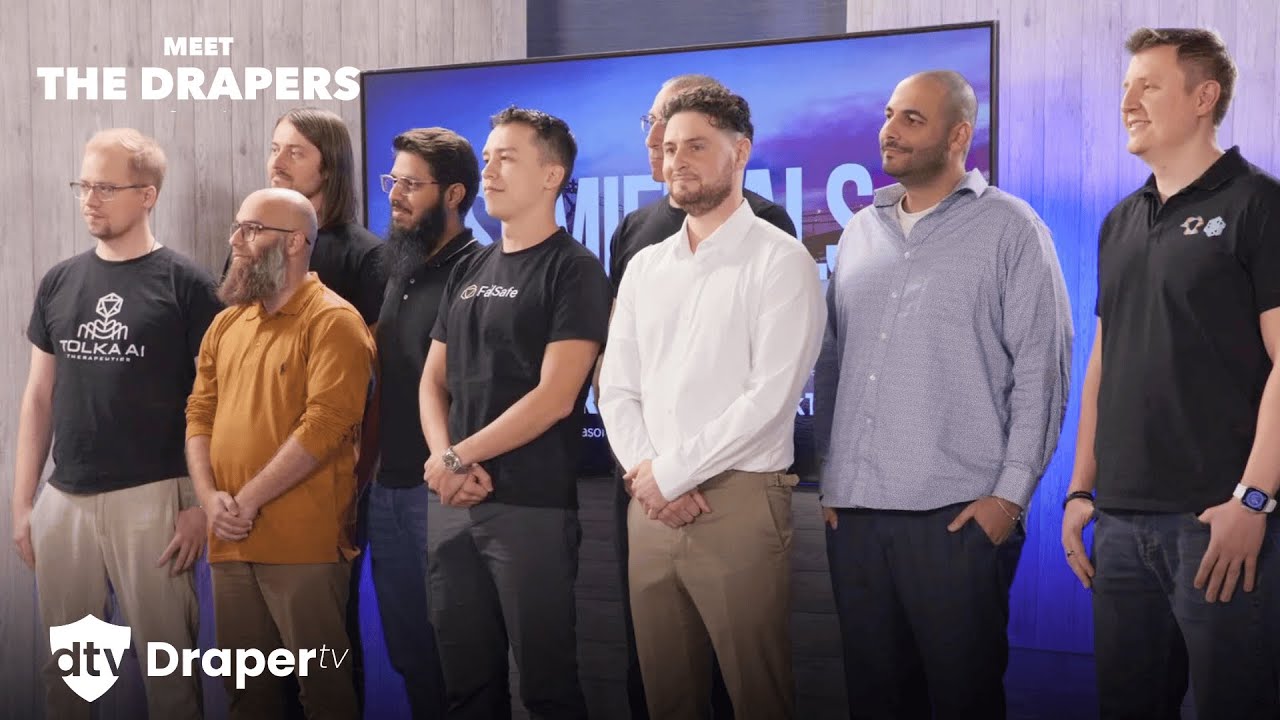
Five startups pitch Tim Draper and judges Bill Draper, Linus Cheung, and Priya Ramachandran in the semifinals. Failsafe has $300k ARR in blockchain cybersecurity, CrossCurve moved $0.5B in DeFi volume, and Tolka AI is tackling antibiotic resistance with phage therapy. Judges pick Failsafe and Reaction Dynamics for the finale.
Chapters
I'm Tim Draper, and I invest in big ideas before they become the next big thing. Entrepreneurs and help them secure a spot in the finale. Who will rise to the challenge and secure the funding to, to turn their dreams into reality? Let's find out together on season 7 of—
The Pitch.
Meet the Drapers!
Welcome everybody back to Meet the Drapers. This is awesome. We have traveled all over the world to bring you the 5 incredible semifinalists you will see today. Today we have these amazing judges. Bill Draper, he is my father, one of the pioneers of venture capital. He ran the Export-Import Bank for the United States. He was the first Silicon Valley venture investor to go to India. Dad, welcome to the show.
Thank you.
Anything in particular you're going to be looking for today?
I think you could go on about me, but originality, energy, those are the two things that I look for typically.
We have Linus Cheung, and Linus has been an operator in high-growth technologies. He's led product teams at iconic companies like LinkedIn. Pinterest, Tesla. He's currently head of product at Magic Eden. Welcome, Linus.
Thanks so much for having me.
You seem to have the Midas touch. Every one of those companies that you joined became a huge monster success.
I was fortunate, and I think you were involved in a couple of them as well.
I should have just been backing you the whole time.
That was the secret, huh?
How about you? What are you thinking about when you look at entrepreneurs?
Yeah, well, I'm looking for grit. You eat a lot of glasses. an entrepreneur. So you're looking for that resilience and the willingness to get through tough times.
Terrific. And on my left, we have the lovely Priya Ramachandran. Priya is the founder and general partner at Foster Ventures. Priya is an operator turned VC, and she focuses on early-stage investments in B2B technology startups. Tell me what you're thinking.
So we look for grit, which is going to be the number one thing. And the most important stuff is how are we going to be driving value for customers?
Terrific. Well, look, let's bring on our first entrepreneur. Before we do, let's see what's going on behind the scenes.
All right, Eric, we're hosting our second crew today, guys that won a pre-selection phase from all around the world. We're super excited to host you in Hero City, in the heart of Silicon Valley.
Our challenge today is going to be a debate. You are going to get 1 minute to give your opening remarks each. And then we'll have 30 seconds each to rebuttal. The prompt and the question is going to be, what is the most important non-technical skill that you need to have as an entrepreneur? All right, think about that. Let's head to the table.
I didn't feel too anxious at that point with the pitch. I think we know it inside out. We felt ready to go straight away.
So our first entrepreneurs are from Failsafe. Give us your pitch.
When I was in the Navy, we were told one thing repeatedly: you do not own what you cannot protect. And the same is true for blockchain today. I don't need to convince you. Every morning you wake up and you see that we're losing the battle to the tune of millions of dollars a day and to the tune of billions of dollars annually. Today, it's companies like Binance, it's WazirX. Tomorrow, it's companies like Microsoft, like PayPal and Mastercard. This is where Failsafe comes in. We've built an entire suite of defense-in-depth and AI-powered cybersecurity tools in one platformized solution that not only detects attacks, but also neutralizes them in real time. Now, what's—
Do you do it in hardware or software?
It's software. We're a full defense-in-depth and end-to-end cybersecurity solution. So if one layer fails, then we know that we have multiple layers to back that up and kick in in an automatic way. Solving the problem in its entirety is so much better for our enterprise customers. And we know that because we're in the trenches with them. We have the most advanced AI-powered vulnerability detection and threat monitoring tools, and we hook that up to real-time response that allows us to actually get in front of an attacker's transaction in milliseconds.
Who needs this? Who would be your first customer that you go after?
We do actually have customers already. So we're currently serving stablecoin issuers. They have huge money The retail user just does not spend on cybersecurity. They expect the platforms that they utilize to make those robust investments. In terms of traction, where it's—
Do they pass the costs on to their customers, or is there some way that you can reach their customers?
This was like any other call, and the questions being asked were definitely along the right lines, and he understood what we were, what we were trying to do. In the same way that McAfee was rolled up into devices and an option then for, as a retail user, to pay more for more advanced cybersecurity. That's how we're working with current enterprises today.
Is this going to be an ongoing battle the way McAfee was? Like the hackers keep coming and you keep protecting and the hackers come and you protect?
You know, we get grilled by everyone all the time— our customers, potential partners, our investors. It just felt like one of those meetings. It's definitely a cat-and-mouse game. Ari and I, we are people that never give up. We invest a lot in our research. We're stress testing them every day. Against sophisticated attacks, we're making sure that we can still get in front of these attacks in real time.
Are you just going to say we're going to protect you against an attack, or are you going to protect them against everything? It's a target-rich environment. So you see things like phishing, social scams, and then you also see really sophisticated attacks by states, essentially. Through our defense-in-depth infra, we're really going after the entire spectrum.
Let me get this straight. Are you an insurance policy for me to sign as a company manager?
So I think any cybersecurity solution says that they'll guarantee or they'll say 100%, they're definitely lying to you. Now, the amazing thing is that we work with insurance providers.
Oh, are you getting insurance companies to pay more so that people will use you?
Exactly. And to forward sell to—
Has that happened yet?
We are in talks with a couple.
Yes.
How are you different from the average insurance agency?
Bill leaned towards, you know, the more traditional business that has definitely been around way longer than blockchain has. So maybe just to highlight a point, we do not specifically insure our customers. We allow them to mitigate risk significantly so they can take that evidence that they're being protected by Failsafe to their insurers, and they can say, we can now pay lower premiums because we have made all these measures to significantly reduce the risk of an attack.
So how are you thinking about handling the complaints and the regulatory needs for different countries?
So we actually work very closely with the Monetary Authority of Singapore. We're headquartered there, and we essentially help to ensure that the companies we serve not only comply with the current standards, but basically allow them to comply to future standards as well.
You said real time, that this protects in real time. So on the blockchain, things can happen in a split second. Your keys are compromised, the wallet is drained immediately. How does your platform actually work in real time?
He wanted to know the specifics, like, because we made some claims. He wanted to know how that actually worked.
It was great to have someone that was ready to get technical on that panel.
We submit a countertransaction with a higher gas fee to be processed just ahead of the attacker.
And move your funds just in time.
Honorin Ari, thank you so much for being on Meet the Drapers. Thank you. Great to have you.
Thank you so much, Tim.
I was not sure if we'd make it a man. It was an adrenaline rush, I have to say.
They're competing with a lot of insurance companies. I like the two of them, and I think they know what they're doing. But I'm a little worried that they're into a very competitive environment.
Yeah, I like the market. First off, it's a huge problem, not only from funds at risk perspective, but this is a huge barrier for blockchain and the crypto industry in general. It's early, but I do like the fact that they have $300,000 in annual recurring revenue. They're onto something here. And so I'm interested.
The partnership is going to be the key stuff, right, with the insurance companies. Instead of looking at the bigger insurance companies as a competitor, If Lloyd's, as they were mentioning, getting into those partnerships is going to be making a huge load of difference.
Let's bring on our next entrepreneur. But before we do, let's see what's going on behind the scenes.
So we'll start with you, Adil. What do you think is one non-technical skill that's extremely important to be a successful entrepreneur?
I think it's undisputed. It's communication. Communication is like Broad word, but actually encompasses everything you do in your life other than technical stuff that you do. So if you're really good at communication, you are effectively supplementing everything else non-technical.
All right, so that was a well communicated argument out of here.
All right, Vlad, what is the most important non-technical skill for entrepreneurs?
Hiring. If you put all your time into hiring, you make sure the next person you hire is. Better than you, always. They will also have that culture, will also hire somebody who's not only better than them but are a cultural fit. So you have the whole company rowing in one direction, focused on one goal, and having the best possible skill you can get. I think the founder's time must be invested mostly into hiring above everything else.
What do you have to say to defend your argument?
You've already said it, communication is important. When you hire people, you have to communicate. I have been running a services company previously, and what I learned was that if you're really good at communication, you can actually hire good people. If you can read the 7-minute signs during an interview, you will know that this guy is suited for me or not. You get to know about the culture of the person. You can map your culture onto that person if you are good at communication.
So I agree that communication is a really important skill, but I think it's not enough. You guys all have seen Elon Musk, right? Probably he's not the top communicator on the planet, right? But I imagine in the beginning of the company, he invested time into hiring people who are really good, built that core team, then the team creates the culture of the company. I believe the hiring is the main focus of the founder.
Excellent, thank you guys.
Eric?
Yeah, I mean, these are 2 very, very powerful arguments. I might be biased as a communication coach, but I feel that the argument for communication was better.
Final answer?
Final answer.
All right, Kazzy, Adil, congratulations.
Thank you very much.
Good job, guys.
This is our fourth venture together.
So wait, what happened to the other three? How's that gonna work? Both of you are gonna go full time on this one.
We weren't expecting to qualify for the semis.
There was a lack of. confidence, to be honest. We didn't know what other teams were coming in. We had no experience, you know, with VC pitching.
Qazi, give us your pitch.
I would like your attention because I believe that at the end of it, you are all going to be on board. 80% of Pakistanis face legal trouble, but only 20% of them get the help they need because this takes 15 years in courts and there are 2.1 million cases in backlog, including one of mine. We are in a business litigation and the lawyer said it will take 2 months or 4 months tops. It has been 2 years and the case is still there. It's a global situation, and that's where Quasi was born. Quasi is an LLM-based end-to-end case management platform. You can generate legal documents, you can perform legal analysis, you can do even precedence referencing and generate draft judgments. We are trying to accelerate justice and increase court credibility and accessibility globally.
Do you think that people will just use Quasi instead of Going to court.
That is exactly the idea.
So you think people will do that though? That's a change of attitude, and usually they're mad at each other.
Yes.
What makes them say, "Okay, we'll go to quasi"?
Yeah, it was full of interruptions, like Tim does it. But this time I think we were more prepared for this. Two reasons: first of all, you don't have to sit in a long line where you don't get any resolution, and your grandchildren are coming for resolution.
Your grandchildren coming.
Exactly, exactly. I have had similar dispute for land record in my. Hometown. And impartiality. So you are not worried that this judge is in a bad mood or for any bias— gender, race— is going to be biased against me.
And there is a third one as well. Before going into the litigation, when you are in the heat of the moment, you can evaluate the costs. That do I even stand a chance or not?
You brought up bias. I was going to ask, because bias in LLMs, large language learning models, is a well-documented problem. What are you doing to mitigate errors and bias in your models, and who has the legal expertise that's advising your team about how to navigate this?
So we are starting off with Pakistani market. So we have the law firms and some legal experts on board who are advising us on this. Right now, our model is based on Meta's LLaMA, an open-source model. So we are extensively using the guardrails provided by Meta and some of our own features that we call Negron features.
What's the special sauce for how you train data, what proprietary data to make this really, really unique and not just something anybody can replicate?
So we are building on top of the model and not exactly using the same model. We are already engaged with the government of Pakistan. We are trying to secure funding from EU and State Department for B2G model. Similarly, a couple of law firms that we are already working in for B2B and B2C case are very much in.
When we are looking at Consumers in small villages who go through these land disputes that you spoke about.
Yeah.
They might not be even actually computer savvy. How are you thinking about the user adoption?
Bringing a very interesting perspective, like from a developing country background.
She seemed interested, I think, but can't say much. Right now we are training the LLM on English, but we plan to train it on local languages as well. For example, we are already in talks with a company for Urdu adoption. We might not be able to solve their ultimate problems at the get-go, but it will be good information to start with.
Would you just tell me a little bit about your own background?
So I'm the CEO. I have a bachelor's in electrical engineering and I have a computer science degree with a specialization in machine learning from Georgia Tech. In this new company, I'm taking the role of CEO and generally sales and public representation. Dhanyal is taking the helm of technical development as CTO.
I have an electrical engineering background as well. So we studied together in the university and we were together in our venture with German automotive industry.
So the general plan is that I will go full-time onto this. Daniel is going to take the helm of our current services company because that's what's funding us. And then both these entities are going to have an arm's-length contract where some of the essential resources will be brought into Qazi.ai, but the rest of them will be available on the contractual terms.
So Daniel, you won't be building It's a valid concern.
I think we should have just communicated our side in a better way. At the moment, it's necessary to run the other part because we don't have any funding sources.
I think we were not able to, you know, punch this point through. That's what, you know, turned him off, I guess.
We will provide services to Kazi.ai if required for the development because development in our part of the world But you won't, you won't be building the product?
So essentially he will be building the product because the team will be with him and we will both be 50% shareholders in both companies. It's not just about like who takes the final shot on the company, but we are going to maintain 50% shareholding in both companies.
Okay, thank you two for coming and being on Meet the Drapers yet again.
Thank you so much.
Great, good to see you.
Well done.
In general, we were more confident today.
We have a good chance now.
I am not too enthusiastic about them. They didn't really give a good description of what their mission is. I just wasn't taken by them.
They are targeting on 3 different customer profiles. B2B, B2C, B2G.
Do you think maybe it's different in Pakistan?
Legal stuff is way different. Looking at all the 3 things itself is like a very difficult go-to-market approach.
They're serial entrepreneurs. Clearly they like each other to work together for the 4th time, but automotive, genetics, now the legal industry— not sure I'm taken by the passion and the expertise that is going to be necessary for them to really make a dent in this, in this market. I asked about differentiation and what's proprietary about their technology. Frankly, I didn't get a satisfying answer there.
I think the mission is really important. I think they've just got to be all in. They have to drop or sell the other business. They've got a team. I don't think they have a true entrepreneur with a vision. Anyway, with that, let's bring on our next entrepreneur. But before we do, Let's see what's going on behind the scenes.
All right, second round, heavy hitters. Things are heating up a little bit, so you guys know the drill.
One of the foundational skills for any entrepreneur to have is networking. In building the right network, you will get easier access to finance, easier access to the best talent to build the team, sales leads, inbound, outbound.
It's crucial to have a large network to improve your sales, improve your fundraising success, and just propel your So in my opinion, the most important non-technical skill to have is the ability to navigate through complexity and uncertainty. When you're running a company, you will go through problems and you'll go through problems that you haven't solved and you have to find a solution because everybody's counting on it. And you also have to be able to know what is important and what is a priority while being in a position where you can lose your company, you can lose your team, you can lose your livelihood, the livelihood of your employees.
Yeah.
All right, so we got the pilot and the networker. Raj, do you have anything to say to defend your argument?
Yeah, I think like the skill of navigating the complexity is quite important. With a proper network, you're not alone. So you have mentors, coaches, you have other entrepreneurs that went through the same course. So if you do have an enormous network with a proper support system in place, you always will be able to Easier go through the storm.
My background in engineering, you learn, and as an entrepreneur, I had to learn the importance of having a good network through effort and pain and a lot of things. But I believe the importance of navigating through that complexity and uncertainty. At the end of the day, you're owner of that ship. You have to make a decision. You can have the best network. They cannot push you to decide to make the right decision. You may have great mentors telling you to do the right thing, but if you decide to go the other way, And screw it up. At the end of the day, you're the one. You're the one that has to be accountable.
All right.
So we're going to come to decision here. Building a big company is a very tough and complex thing to do. Nobody's going to do it for you. So I would give this one to Bashar. Right?
Okay.
Congrats.
Thanks, Tom. Yeah.
Good job.
Thank you.
Why start the business?
What we are building.
I'm not asking you that. I'm asking you why.
Why?
Why do you care? What's going on?
I was super nervous just like moments before. There are so many thoughts in your head, but once you are there, I mean, I actually felt super comfortable.
Cross curve. Give us your pitch.
Hi everyone, I'm Faraj and I'm a co-founder of CrossCurve by AVA, a company that revolutionizes decentralized finance. And we're here to solve 3 actually main problems of decentralized finance, which is fragmented liquidity, it's insecure cross-chain communication, and it's poor user experience. The market is huge. We're planning to build the most efficient cross-chain DEX. and we can capture very big market shares. You guys all know the success of Coinbase. We can have the same opportunity for you to invest in the next Coinbase.
So what's the real beauty here? Why start the business? There's a lot of stuff going on here.
Absolutely.
And you're fitting in somewhere and trying to make it— some little piece of it a little bit better.
I'm super passionate about the industry. I'm super passionate about my project. Really want to succeed with all my heart.
But you got hit over the head and you said, we got to do this.
Why?
What we are building, we're utilizing the most novel technology and we're backed by the pioneers of that technology, Curve Finance.
By using their I'm not asking you that. I'm asking you why.
Why?
Why do you care? What's going on?
Maybe I kind of misunderstood the message from the judges, what actually they wanted to hear from me, and I was too focused on the technical aspects of what I'm building. Absolutely.
And why was this a big problem you had to solve?
If I would get a second chance, I would do something different. In our opinion, decentralized finance creates a lot of potential for innovation in the finance space, and we believe that the future of finance will have a lot of elements from DeFi going into it. So in my opinion, it will make the world better. So that's what I'm striving for. We are aggregating the liquidity from 8 chains and create 5 to 8 times more efficient operations. 5 to 8 times cheaper transactions for ordinary users. The traction-wise, we already have—
Forgive me, but how far along are you?
We are already quite far. We already did half a billion dollars in volume over the last 6 months. The protocol is ready. It's fully operational. We're continuously innovating to make it more efficient.
Now you've got $500 million in volume. Do you charge on that volume? How do you make money?
Yes, we charge about 0.04%. So we're charging per each transaction.
So you've had $20,000 in revenue so far?
Correct. Yes, per month. Any project can list their token on our exchange and traders from every chain can buy the token with any asset that they want. It's just a one-click solution.
How do you do that?
Why are you the magician that gets There are always people that are not within the crypto industry. You can straightaway sense that they're not actually getting where are we going with all this. We have a decentralized app that works from any device, mobile or laptop. As long as you have internet, you're connected to the exchange and you can use it. So, how does it work?
If there's consolidation around Bitcoin, which is starting to happen, will people trade this stuff less? Where do you think this is going 5 or 10 years from now?
In our opinion, there will always be Layer 2s, even on Bitcoin, serving different purposes. As a technology provider, we will be actually serving not only the EVM ecosystems, but also Terrific, Wolf.
Thanks so much for being on Meet the Drapers. Great to see you. Good to see you again.
Good. Thanks a lot.
Went relatively smooth, I would say.
I actually like the trend of CrossCurve, that there's going to be more assets coming on-chain, and the fragmentation and the proliferation of blockchain ecosystems is not slowing down. There's a lot of competition, and I wasn't quite convinced about the differentiation. In this game, it's about growth. And so they're going to have to race and really, really get to billions and billions in monthly volume in order to be relevant in this space.
The margins will get thinner and thinner and thinner as time goes on.
It's a race to the bottom. He and his team have a huge problem in trying to reach the market. I was not wildly impressed by him.
It's also important for us to look at the users' data. How many users are coming back? How many of these people are actually just coming in for like a one-time transaction? What is the capability of this company to be like doing billions of dollars?
Okay, let's bring on our next entrepreneur. But before we do, let's see what's going on back there.
All right, we're on a roll. You know the drill by now.
I'll tell you what the foundational I agree with you, crisis management. But to get there, you need to be able to have the courage. You need to have the courage to do the right thing. You're not running away from the burning fire, you're running towards that cat in the tree. You need to have the courage to be able to do the right thing. Courage is foundational to everything that we do. We run into that fire and we just have an unreasonable faith that we know that we're going to be okay. But it's the courage to do the right thing.
Courage and faith is important, and very often You gotta do the right thing even if you're scared. But courage without judgment is worthless. If you're doing the wrong thing for your team and for your company, you will end up failing. And this is why I believe the ability to still manage and navigate that complexity and that uncertainty is important. You need to have courage to do it for sure, but you also have to have the ability to make the right decision, to have the judgment that comes with it.
You need to turn the tide right now. At the end of the day, you You need to be able to exercise courage in order to make that judgment, because making that judgment often needs to be the right one, not the easy one.
Right.
Yes, perhaps courage is more of a personality trait than a skill, but it can be trained. You need to exercise good judgment, but you need to be able to have the courage to back it up and do the right thing.
I don't know, they're both very unique qualities, and I think important skills. What did you say? What do you think the argument battle, who kind of took the leadership there?
Yeah, I feel we're— there's an argument there as well.
Have some courage to make a decision on this one.
Let me bring it out. And that's exactly it. I think some of that might be innate with courage. So drawing that out and being able to get out of your comfort zone and build up that courage is definitely something that's important to you. But yeah, I think having that ability in there there as making the decisions in leadership, uh, would, would be my choice.
Bashar again it is.
Congratulations.
I was fairly relaxed, especially compared to last time in Miami. You know, we've pitched this so many times at this point, we had some practice.
Johan Wikström and Volod Tolka, AI Therapeutics. Go ahead and give us your pitch.
We are Tolka AI Therapeutics, and we are solving antibiotic resistance.
Antibiotic resistance is on track to kill more people than cancer and cost over $1 trillion per year by the year 2050. At the same time, we don't see new antibiotics hit the market at all. We need something completely different. We need phage therapy. Phages are viruses that infect kill and replicate in specific strains of bacteria. They have to be personalized to each and every patient. We are building an automated platform to use software and AI to automate that entire process and make a personalized phage therapy in 30 days or less. We have already treated our first patient, which, by the way, is myself. I have had Mycobacterium abscessus for the past 17 years. And as you can see, my insurance company spent over $300,000 It wasn't until we added the TOLGA phage therapy that we actually saw a meaningful drop in our target strain. And as soon as we stopped treating with the phages, you can see that it rebounded, which proves that it was actually the phages that caused the drop.
So other people aren't looking at phages?
There are companies that try to apply phages to kill bacteria. The problem is that they treat them exactly like old antibiotics. They try to find one phage to rule them all. And make just one copy of that and give it to everybody, and it has the exact same problems.
You did it for your own body, but the infection popped back up. Isn't that the same thing that happens with antibiotics?
So that tells us that for this particular pathogen, this is likely going to need to be a very long-term treatment, just like with the antibiotics. And obviously, from a patient perspective, you want it to be as short as possible. From a commercial perspective, you want it to be as long as possible. You know, this is what Big Pharma really likes.
How can I get this particular treatment? How is it going to be like reaching the normal people?
Well—
It's going to be pretty difficult, right?
Does she have to do a blood test or something and then send it to you and then you send a drug or what happens?
Your physician would decide that you would be a good candidate for this and they would send a sample For pulmonary infections, the lung infections, we're looking at a sputum sample where you cough and spit in a cup. They would send that to us, we would isolate the target pathogen, and then we would isolate the phages to kill that target pathogen specifically for you.
So what is the process?
Is that it?
You spit into a cup, send it to TOLKA AI?
There's about a, you know, 15, 20 steps in between us receiving the sample and the drug being ready for use. That is why it's taken on average 6 months in academia and cost a tremendous amount of money.
What about your partner? He hasn't said anything about it.
I think that was great. He kind of put me on the spot when he said that I didn't say almost anything. It was a bit of a last-minute decision to have me present together with Johan, so yeah.
Have you given him the injection? He has said no thanks.
So he's doing our bioinformatics, our automation, and software engineering, and also regulatory.
How do you do the regulatory perspective with respect to clinical trials and approvals, you know?
I think that is completely fair. You know, regulatory pathway is such an important part of biotech. It would be strange if people were not concerned about it.
So we already got approval to treat Johan with the FDA, and these early conversations will help us pave the way to future clinical trial approvals in the next few years. But before that, we'll treat 5 to 10 more patients under the same expanded access program.
You said a few years. Walk me through the exact timeline that you're expecting, and how does this funding help you? It sounds like there might be risk in that timeline. It can be very long. You might need more capital.
It is a long timeline.
What are we talking about, 10 years, 20 years?
Many investors, they have a different time horizon. Biotech really is— you wait a very long time, and then if you succeed, you get a massive payday. 10 years is the average for an antibiotic. We are going to target patients that basically don't have a lot of other options. So we are going to ask for expedited— essentially every way to expedite the process we can. But we're still looking at 4 or 5 years at the very least from now.
Do either of you have an MD?
So that would be Bob. Bob is the MD. Bob has a tremendous amount of experience because he was at Adaptive Phage Therapeutics in the past. They've really pioneered a lot of these phage technologies.
So there's a high reliance on Bob, and I'm sure he's phenomenal in terms of providing that medical expertise, but also the regulatory expertise. But that's one person.
Well, we also have Volod on our side and consultants. How did you hear about Well, obviously I've had the problem myself for 17 years. My wife is a physician. 2.5, 3 years ago, we read all the papers that had recently come out. This was the most promising technology. People were not making progress on commercializing it quickly enough. So somebody really needs to bring down the cost, increase the speed, and actually get proper FDA approval.
Terrific. Well, thank you so much, Johan and Volod. Nice to see you.
Yeah, you too.
Thank you very much.
It was hard to read some of them during the pitch.
We actually got through the entire pitch without them interrupting, so I think it was relatively captivating.
What did everybody think of Tolka AI?
I think they're working. It's a wonderful thing if they're successful, and I guess I'm not sure I didn't think that they would be, but it's really exciting.
I mean, he's got a high motivation to make it happen. Yeah, he certainly does. He's the first user.
He's the first customer.
The FDA does allow you to inject yourself. They don't allow you to inject anyone else. So many great entrepreneurs do this.
I think it's inspiring. It's eating your own dog food at its finest. I think they're being optimistic about the regulatory approval. We like optimism. in entrepreneurs, but as an investor, you've got to exercise realism and caution.
Yeah, 4 to 5 years out still seems like a lot.
A lot.
Even if it's—
A lot of risk, yeah.
And that's optimistic for them. So as an investor, that's tough. With that, let's move on to our final entrepreneur. But before we do, let's see what's going on behind the scenes.
On the right corner, Bashar with being able to make rough and good decisions. And on the left, we have Adil with communication. So I would love to hear why you think communication Leadership and navigating all different situations is definitely important.
How do you do it? How do you get to know it's a difficult situation? It's all about communication. When you start a company, you're not a leader, you're an individual, and you want someone to join you. How do you convince him to join me in this venture, whether it's an engineer or a co-founder? You communicate your way into it.
It's a great point, and communication is something that I had to learn myself personally. So I believe having that ability to make the right decision, having the right judgment, implies you're able to communicate. And even if you have a hard time communicating, at the end of the day, it's deciding where the ship has to go. It's knowing what is more important, how to allocate your resources accordingly. And it has to be done with right communication, that's for sure. But that can be improved. I think it's, it's a skill that can be learned.
So you have picked up a big word. What you are actually communicating is that leaders are made through communication. Always on the stage, you have that co-founder which is good at communicating. He's the one who is throwing the VN at everyone. Elon Musk, great communicator, bold ideas. He communicates and then he makes them through. Steve Jobs, Mark Zuckerberg, name all these founders, and the common theme you will find in all of them is communication.
Elon is not the best communicator, but Elon knows when to take a risk, knows how to push, put everything on the line to save SpaceX and to save Tesla. And if he decided to pull away in one of these companies, we wouldn't be driving electric cars, we wouldn't be watching amazing rocket stunts. So it is really the ability to have the right judgment, have the judgment call, and make the right decision.
They're both very important, and this is going to be one of the hardest decisions we have today.
It's coming down to the wire. It's, uh, no win by knockout. We gotta look into the points. The winner is Bashar.
All right, great job.
Amazing day. Really excited to go back to the main stage.
I think they're pretty warmed up now to make their pitch now that they've argued a bunch of different sides. So yeah, good luck to everyone.
Go get it.
How are you competing? Where is your edge?
We've proven that they work here on Earth.
You still haven't proven that these things work in space.
To be very candid, we build rocket engines. We're used to dealing with stress, anxiety, high-stakes moments. So for us, it was another day at the office.
I think as soon as we kind of stepped onto that stage and the lights were shining on our face, we really turned on and we matched the level of energy of the, of the Satellites, GPS, and global data networks all rely on the same fundamental infrastructure. Space isn't just for astronauts. It is the invisible backbone of modern society and our daily lives. We are delivering the world's most critical infrastructures and satellite technologies for governments, for agencies, and for commercial operators alike. Our launch and delivery vehicle systems can be deployed both from Earth or from space with long-term loitering capabilities Ready to deploy a host of technologies developed for the US and our allies, ushering in a new era of critical infrastructure and war deterrence.
A result of a radical novel technology, patented rocket propulsion, as well as a unique know-how in additive manufacturing. And we signed very recently our very first government contract with the US Department of Defense.
SpaceX is a launch and delivery How are you competing? Where, where is your edge?
Tim made investments with SpaceX. He made investments with a few other space companies. So he is fairly familiar with that industry. So we wouldn't be surprised if he decided to, you know, dig deeper.
When you pitch the US government, what are you selling?
Sure. We'll start with SpaceX.
Of course, we see SpaceX as peers. All these constellations that are being launched into space, A SpaceX rocket will launch 20, 30, 40 satellites at a time. We will launch a single satellite to pinpoint accuracy with rapid launch and rapid delivery.
There's already a company out there doing this.
Firehawk and a few others.
And we bet.
Yes.
We're at least getting the questions that we would expect from someone that understands how to run a company but may not be necessarily an expert in the field.
This is solid rocket fuel and you can, you can choose, right?
You are correct, yes. The fuel is indeed a solid, as you stated. The oxidizer is a liquid, but we leverage combustion. So you'll always have that combustion going on throughout the whole burn. What really makes it so interesting, the simplicity reduced the cost by about an order of magnitude. So we're able to offer customers a launch that is about a third of the cost of what you would pay to reach orbit with other technologies.
Supposing you have all the money you need tomorrow, what are you each going to do besides—
Well, so I'll just— we're looking for $1 million from you folks today to go towards $5 million that we're currently raising to demonstrate the world's first hybrid rocket to fire in the vacuum of space. In particular, if you don't mind, Bill, we're very well aware of your contribution and your commitment to the United Nations Development Program. We'd like to thank you for Okay.
He's sucking up. Why is that connected to the hybrid and the vacuum?
Sure. Tim kind of dialed in and maybe put a little bit of pressure.
Tim must have heard a million pitches in his life. Bill must have heard a million pitches in his life. They want to really go deep to it.
So we've tested our engines over 300 times.
We've tested our We've motors over 1,000 times.
proven that they work here on Earth. The next step with one— with your $1 million—
I see. You still haven't proven that these things work in space.
You are correct.
Were you here to see Cree Edwards just before this meeting?
Yeah, we spoke earlier. We spoke to him earlier.
Yeah.
If suddenly our world is different and everything is energy—
Yeah.
Does that change the way you might look at propulsion in space?
Rocket propulsion is the purest form of energy conversion. You're converting those chemicals, propellants, into thermal energy, then you're converting that into kinetic energy. We don't see it changing, we don't believe it will change. There's a lot of things Einstein can be wrong, but the second law and first law for thermodynamics have been proven right for 300 years.
I'll add that the difference between what everyone else is doing and what we're doing, we've done away with toxic and hazardous chemicals. We use a stable It's a condensed and recycled plastic, and so it's non-reactive. It's very safe for service members, for troops, and for anyone working in the space sector.
You don't need oxygen for this thing to work?
We do need an oxidizer. In our case, our oxidizer, unlike pretty much every company, is storable at room temperature, and that enhances our stockpilability.
Would SpaceX use your technology to move vehicles in space once they're up there?
That's a very astute comment. The contract that we talked about with the U.S. Department of Defense is leveraging Starship's capabilities to mobilize our rockets into space. So that's exactly what we're doing.
It's really impressive that you've got a contract with the Department of Defense. I know there's sensitive information here, but I'd imagine that these sales cycles, these discussions are very, very long. I'm also concerned about the capital intensity of this business.
Walk me through how you think—
Yeah. What I will add actually is that the U.S. Department of Defense is currently on an expedited Timeline. So the Pentagon has placed a huge, a huge emphasis on this growing superiority in Russia and China. At the moment, we're actually benefiting from an expedited process.
And you are correct, a sale process that takes a little bit of time. We have been talking to customers since the inception of the company.
Good, Jesse. Great to see you again. Appreciate it, Bakar. Nice to meet you.
Thanks, guys.
Smiling faces, open eyes, listening. I mean, credit to Jesse. He ran that presentation.
I'll admit I was a little bit worried going last. You really have to beat every other company that's come up.
So what did you think of Reaction Dynamics?
I shared my concerns that it's capital intensive and, hey, these contracts with government agencies, they'll take a long time. Of course, they're sharing a really bullish story that within a couple months they'll know, but it's really up in the air. I'm not sure what $1 million is going to do to this. For this, but it sounds like it's a really, really important test. We might have sat in front of the next Elon Musk. Who knows? That's pretty inspirational to think about.
It's great what they're building. They love it. The CEO knows, and he's an expert in propulsion engine. And the company was also launched like you know six years ago or something like that. That is the time that's needed.
I think you're right. That's the best of the group.
Let's bring out the entrepreneurs and let's. Let's put them on the hot seat. There are 5 of you. 2 of you are going to move forward to the finale. All will depend on what the crystal ball tells us.
All of you are wonderful entrepreneurs and will be successful.
And let's see what the crystal ball Ooh, I like that. Oh, Linus has a thing. It's a little like look at his eyes to the west. I'm feeling it. It's reaction dynamics and failsafe. Congratulations.
We're very happy that we got to the final.
There was actually a moment of fear where we thought maybe Tim might go against the grain.
We were very.
pleased to hear our name alongside Failsafe.
Honestly, I had no idea if we would make it out of this round. It was very humbling.
We were out here to fulfill that mission, and I'm glad to say mission accomplished.
We would be able to change the world, and I will do everything in my capacity to do that. Please vote for me, and then I will be in the finals to show the judges my passion and Obviously I'm biased, but, you know, I expected to win because I think our startup is the best.
We will just keep going. It's an important problem, and that's why we should be voted back.
So why should viewers vote us back? Because we are trying to change the fundamental problem in the justice system. We are trying to make it more accessible. It's a global thing, and we can really, really revolutionize the justice system. Come on, if you have guys making rockets, it's really hard to compete, right?
See you next time on Meet the Drapers!
More from Tim


He Sold His Car to Build This Startup, Then Pitched It for $1M 😳 #Startups #AI

This Startup Moves Your Crypto BEFORE Hackers Can Steal It 😳 #Crypto #Cybersecurity




15 Months Without Refrigeration?! This Startup Thinks It Can Go Global 🥥 #FoodTech #Startups



