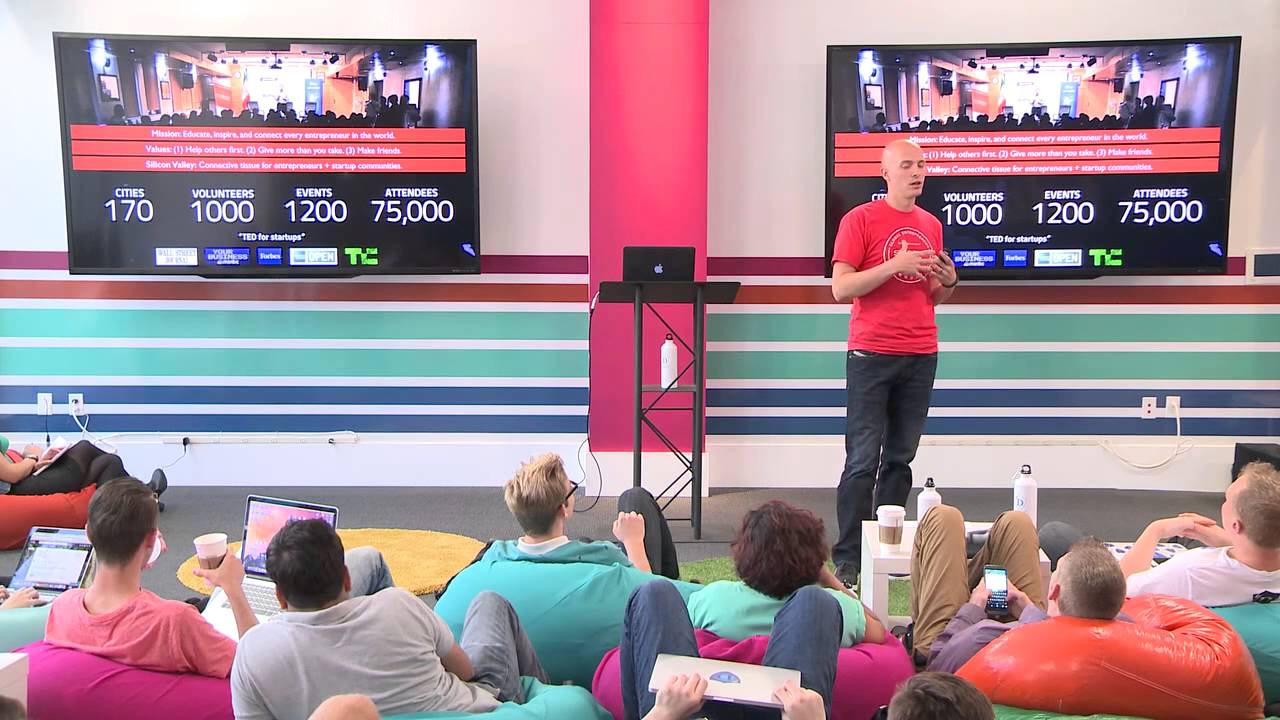
Derek Andersen quit his job at EA after his first child was born, failed to sell a product, and eventually founded Startup Grind. The organization now reaches 173,000 entrepreneurs across 170+ chapters with one core principle: give more than you take. Andersen credits authentic values and asking "How can I help you?" for building a community where chapter directors from Tel Aviv, Tehran, and Ramallah work together.
Chapters
Startup Grind is very simple. Our mission is to help every entrepreneur in the world, and there's a number of ways we try to help entrepreneurs. We do that through educating them through events. We do that through trying to help them build good networks to get CTOs, to get co-founders, to get COOs, to get marketing people, whoever. And we primarily do that through events. This is the first Startup Grind event, 5 years ago in my office in Mountain View. And it really was nothing. Like, it was not— this was not a startup. My career started at EA, and I was in product marketing, and I worked on games like Burnout and Madden and Mirror's Edge, and if anybody's played any of that, we got— we must have gamers in here. Oh, yeah. And I quit my job in 2009, 6 weeks after my wife had our first child, And that's a great time to quit your job, right? Right after your wife has a baby, that makes you— that really endears you to your spouse. And I just— I had this idea and I decided I'm going to do it. And I tried to sell this product and I tried to get people to buy it and everything I did for 6 months and I literally couldn't get one customer. And I'm not the best salesperson in the world, but I'm not the worst. And so this was good market feedback. No one is— in spite of all your efforts, no one will buy your product. Like, maybe you shouldn't be selling that product. It's kind of— it's pretty easy to figure that out, right? So then what happened was a friend of mine came to me and he said— this guy I knew from college— and he said, hey, I don't know about that startup you're doing, but like I have this startup that we're just getting going and I need somebody to run all the marketing for us. And I'm like, I'm focused, I can't do anything, I can't have anything to do with that, I have to do what I'm doing. He's like, well, could you do 20 hours a week? And I wasn't making any money, so it was like, and I've got this baby and I've got this, my wife. And so I'm like, okay, well, how much could you pay me? And he goes, I don't know, $80 an hour? And I was like that, that reaction, that was my reaction. I remember right where I was, right at the phone call I had, I looked at the phone and I was like, I couldn't do it for less than $85. Because that's what you do. You always negotiate, right? So of course, I could do it for way less than $85. So I spent 20 hours a week, and that made enough money for me to then do everything else I needed to do. And then I got other marketing deals and other contracts. So I kind of like— it wasn't what I planned to do, but it's what the market wanted me to do, right? So that's the first thing that I learned very early in my entrepreneurial career is that it's not about me. It's never about you as the founder. You see these people in magazines, you see them on blogs or whatever. The great companies, it's not about the founder, it's about the product. And this is what you're learning here. This is what— you already know this, but this is something that I didn't know and I had to learn. And so a few months after that, a friend and I, the guy in the red shirt, Spencer, we decided, hey, why don't we start just getting our friends together brainstorming in our office? And so this is the first event. There's 9 people. There's pizza. You can see the reflection in the windows. There's almost no one behind me taking the picture. But this is what it was. And this is, in my experience, this is how most great products or great movements start. They start as nothing. They start as us solving our own problems. Today we're 173,000 entrepreneurs in 70 countries. We have 170+ chapters around the world. And we're all kind of united in some very, very simple things. We have 1,000 volunteers. Again, we were the first volunteers, so the value proposition for us, what made it work for us, it turns out it made it— that was interesting to other people. This is where we are. We're all around the world. And the thing about Startup Grind that is maybe different or that has helped us grow or that is that has attracted us is our values. And our values are super simple. It's about giving more than you take. It's about helping others first. And it's about making friends. It's not about how many LinkedIn connections you get. It's not about how many business cards you get. It's about how many people do I meet at Startup Grind that I sit next to and I say, how can I help this dude tonight? What is he doing? What is he working on? How can I be helpful to him? And what— Our philosophy is that as you help people, that you end up helping yourself. It's super simple. And this is like a great principle. You should take this approach everywhere you go. Whenever I meet someone, as long as they're not rude, one of the first questions I ask is, how can I help you? It doesn't mean I can, but if we can just get to that quickly, then maybe I can. If I can help you, that's probably why you're coming up and talking to me is like you think there's something I can do to help you. Maybe there is, maybe there isn't, but tell me what that is and I'll do everything I can to do that. Or if it's not me, then I start to think about you over the next week or two and then like there's somebody else I can connect you with who actually can solve your problem for you. And so these, you should all, you know, you're very early stage I assume, right? How many people in here have revenue on their product? 2. Okay, let's give it up for this guy. Yes! Well done. Should you spend a tremendous amount of time on figuring out what your values are, what your culture is going to be, all that stuff? Not necessarily. These things are who you are. So be the person you want to be and these things will kind of come out. But what I have found is over time, once you get a little bit of traction, once you get a little energy, These things do become incredibly important. If you go to our website, this is actually the most important thing that we have on our website is our values. And we get 120 people a month that apply to be chapter directors. And I can tell you the vast majority of them apply because they see this and they say, this is either who I am or this is who I want to be. And so I want to get on your train. And like— If we had really negative values or like, you'll see this as you start thinking about this, like think about companies that you're not impressed with. Maybe they make a lot of money, but you're just like, you're not impressed with their brand, you're not impressed with what they've built, and you'll see that their values are not aligned with what values of companies and brands you like. Like I love Virgin, I like the United Nations brand, I like, of course, everybody likes Apple's brand, but you think about what are their values, right? And that's attracted the type of products that they build, that's attracted the type of people that work at their company. So this personifies the friendship at Startup Grind. Who's the tiger? This is— who is the tiger? That's the person sitting next to you. So it could be whoever is sitting next to you. This is the picture I'm most proud of with Startup Grind. 4 random people, right? But the person on the left and on the right are our directors in Tel Aviv, and the 2 people in the middle are our directors in Tehran and in Palestine, in Ramallah. In no other scenario in the world does this picture make any sense except for Startup Grind. It doesn't make sense even at the UN. When someone from one of these countries starts to speak, the others walk out. But at Startup Grind, we're hugging, we're friends. That's amazing. We're trying to help each other.